Google Keyword Planner reports Google's search demand, not Amazon's, and the two consistently diverge because Amazon shoppers arrive already looking to buy. There's no Amazon-run equivalent tool, but a third-party one built on Amazon's own on-platform search data does the same job for the platform where the product is actually sold.
Key Takeaways
- Amazon doesn't publish its own version of Google Keyword Planner. A third-party tool has to pull Amazon-specific search data instead.
- Google Keyword Planner numbers reflect Google's audience, not Amazon shoppers, and the two can diverge sharply for the same term.
- The Amazon equivalent needs real on-platform search volume plus a competition score, since Amazon doesn't publish keyword difficulty either.
- Amazon SEO Ranking's Search volume and Keyword ideas tools together cover what Google Keyword Planner does for Google Ads: volume, related terms, and a competitiveness signal.
- Marketplace coverage differs by tool: the Search volume tool covers 16, while the Keyword ideas tool's related-term expansion covers 4 (US, Egypt, Saudi Arabia, UAE).
Amazon Keyword Planner at a Glance
| Google Keyword Planner Does | Amazon Equivalent |
|---|---|
| Monthly search volume per keyword | Search volume: real Amazon on-platform monthly search volume |
| Related keyword suggestions | Keyword ideas: expands a seed into related Amazon search terms |
| Competition rating | A computed competition score, from top-ranking listings' reviews and badges |
| Historical trend data | Saved lists: monthly volume-history snapshot per keyword |
Why Google Keyword Planner Numbers Don't Transfer to Amazon
Google Keyword Planner measures how often a term is searched on Google, across every kind of intent from research to comparison to a direct purchase decision. Amazon search skips most of that: a shopper typing into Amazon's search bar has largely already decided to buy something in that category. The same phrase can carry very different volume on each platform, and neither number substitutes for the other. A seller relying on Google Keyword Planner data for an Amazon listing is optimizing for the wrong platform's audience.
What an Amazon-Specific Keyword Planner Needs to Show
The useful parts of Google Keyword Planner aren't unique to Google, they're just built on Google's data. An Amazon equivalent needs the same shape of information sourced from Amazon instead: real monthly search volume per term, related keyword expansion from a seed, and some signal for how competitive a term actually is to rank for, since Amazon doesn't publish a keyword-difficulty number any more than it publishes raw search volume.
How the Search Volume Tool Fills the Volume Role
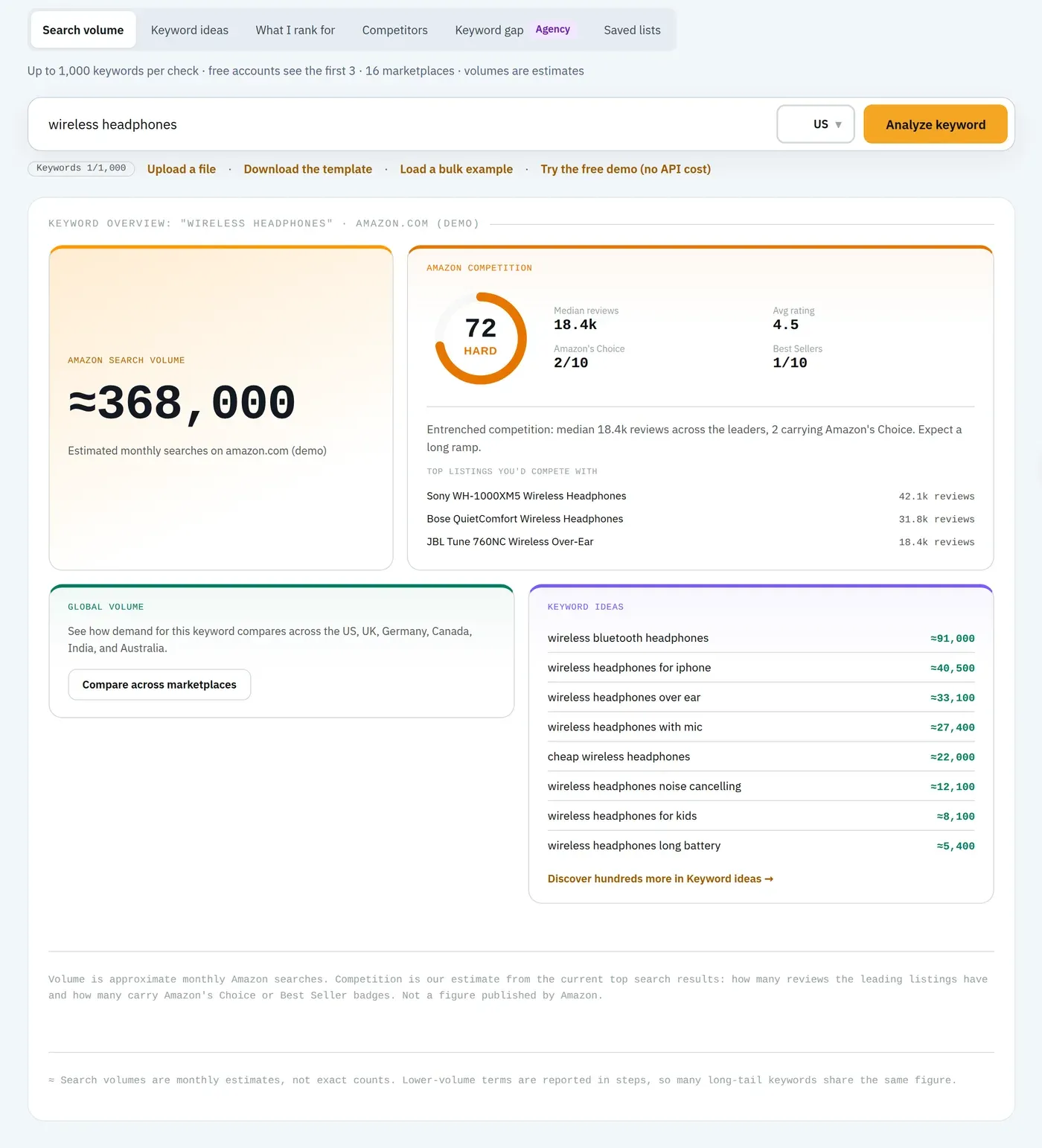
The Search volume tool returns real Amazon on-platform monthly search volume for one keyword or a batch, the direct equivalent of Google Keyword Planner's core function. It also returns a competition score computed from the top-ranking listings' review counts and Amazon's Choice or Best Seller badge density, since Amazon doesn't publish that number the way Google Ads' auction data implies competitiveness. How that competition score gets calculated is worth understanding before treating a high-volume term as automatically worth targeting.
How the Keyword Ideas Tool Fills the Suggestion Role
Google Keyword Planner's related-keyword suggestions are one of its most-used features for expanding a short list into a full campaign. The Keyword ideas tool does the equivalent job for Amazon: one seed term in, a list of related Amazon search phrases out, checked against real demand rather than guessed variations.
What It Costs to Use an Amazon Keyword Planner
| Plan | Keyword checks/mo | Price |
|---|---|---|
| Free | Not included | $0/mo |
| Pro | 2,000 | $79/mo |
| Agency | 10,000 | $189/mo |
| Enterprise | Custom | Custom |
Everything You Need to Know About an Amazon Keyword Planner
| Question | Short Answer |
|---|---|
| Does Amazon have its own Keyword Planner? | No, Amazon doesn't publish a Keyword Planner equivalent itself |
| Will Google Keyword Planner numbers work for Amazon? | No, they reflect Google's search demand, not Amazon's |
| What replaces the competition rating? | A computed competition score, from reviews and badge density on top-ranking listings |
| Which marketplaces are covered? | 16 for real search volume (Search volume); 4 for related-term expansion (Keyword ideas): US, Egypt, Saudi Arabia, UAE |
FAQ
Is there a keyword planner for Amazon like Google's?
Amazon doesn't publish its own version of Google Keyword Planner, but a third-party tool built on real Amazon on-platform search data can do the equivalent job: Amazon SEO Ranking's Search volume tool returns real monthly Amazon search volume and a computed competition score, while the Keyword ideas tool handles related-keyword expansion, together covering what Google Keyword Planner does for Google Ads.
I'm used to Google Keyword Planner for my website, but the numbers don't match what people search on Amazon. What's the Amazon equivalent, and how different is the data likely to be?
Google Keyword Planner reports Google's search demand, which reflects a mix of research and buying intent, while Amazon search skips most of that since a shopper typing into Amazon has largely already decided to buy in that category. The two numbers frequently diverge, sometimes sharply, for the same term. The Amazon equivalent is a tool that pulls Amazon's own on-platform search volume directly, such as the Search volume tool, rather than a Google Keyword Planner export relabeled for Amazon sellers.
Why doesn't Amazon publish its own keyword planner?
Amazon hasn't published a public keyword-research tool with search volume the way Google Ads does for Google search, despite running its own massive search engine internally. That gap is exactly why third-party tools built on Amazon-specific search data exist, pulling from Amazon's on-platform search behavior rather than Amazon's own unpublished data.
Can I just use Google Keyword Planner and adjust the numbers myself?
Not reliably. The gap between Google and Amazon search demand isn't a fixed ratio that applies evenly across categories or terms, since it depends on how much of a given search reflects research intent versus buying intent on each platform. There's no consistent adjustment factor to apply, which is why a directly Amazon-sourced number is more reliable than an adjusted Google one.
Does an Amazon keyword planner show competition like Google Ads does?
Not in the same form, since Google Ads' competition rating comes from auction data that doesn't exist on Amazon. The Amazon equivalent is a computed competition score based on visible signals instead, specifically how many reviews the top-ranking listings for a term carry and how often Amazon's Choice or Best Seller badges appear among them.
Does the Amazon keyword planner cover every Amazon marketplace?
Coverage differs by tool. The Search volume tool pulls real search volume across 16 marketplaces, while the Keyword ideas tool's related-term expansion, along with "What I rank for" and Keyword gap, currently covers 4: US, Egypt, Saudi Arabia, and UAE. That's narrower than the separate Listing Audit product, which covers 20 marketplaces, so a seller focused primarily outside those 4 should check which specific tool they need coverage for before relying on the numbers.
Is the Amazon keyword planner free to use?
The Keyword Research suite, including the Search volume and Keyword ideas tools, is open on the Free plan with no card required. Free accounts see the first 3 results of each search, up to 30 keyword lookups a month; full results need a Pro or Agency plan. Pro includes 2,000 keyword checks a month with a 7-day trial before any charge.
What should I check first when moving from Google Ads keyword research to Amazon?
Start by re-checking your existing keyword list against real Amazon search volume rather than assuming the Google Keyword Planner numbers carry over, since the two platforms' demand can diverge significantly for the same terms. A term that looked strong on Google Ads can turn out to have thin Amazon demand, and a term Google Keyword Planner rated as low-value can be genuinely high-volume on Amazon.
Try the Amazon Equivalent of Keyword Planner. Real Amazon search volume, related-term expansion, and a competition score, the same job Google Keyword Planner does for Google Ads, built for Amazon instead. No card required to start.
Check Amazon Keywords Free