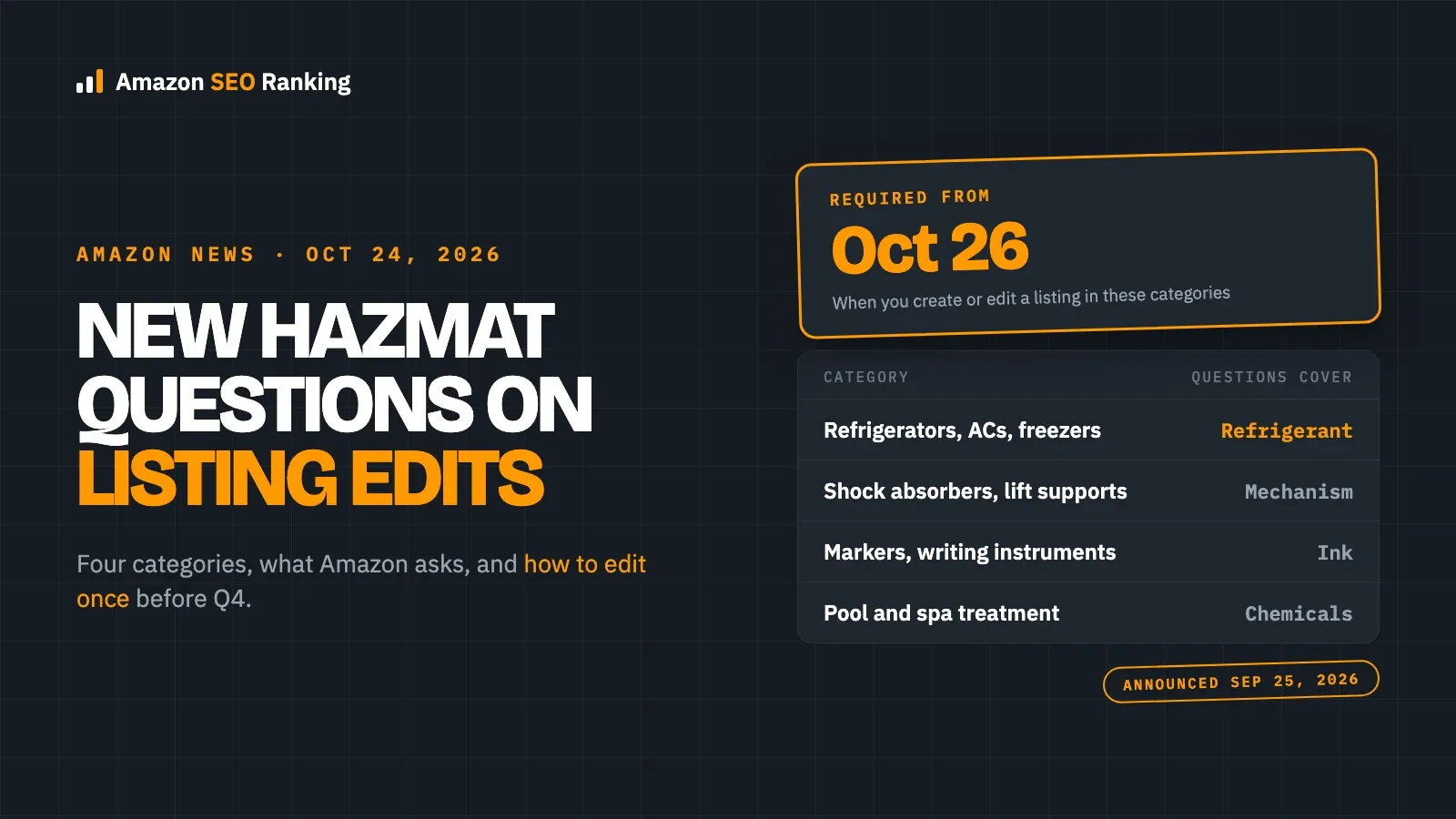
From October 26, 2026, Amazon requires answers to new dangerous goods questions when you create a listing or edit an existing one in four categories: refrigerators and air conditioners, shock absorbers and suspension lift supports, markers and writing instruments, and pool and spa water treatment products. Amazon announced the change in Seller Central News on September 25 (login required).
Existing listings don't need any action before the deadline. The questions appear the next time you open one of these listings to change it, and that's the catch in late October: any title, bullet or image fix you planned for Q4 in these categories now comes with a compliance step attached. Our Q4 listing checklist recommends a listing freeze from October 31, so the window to make those edits is about a week.
This article covers what Amazon asks in each category, the conflicting date in Amazon's own notice, and how to make your Q4 listing edits once instead of twice. It's for sellers and agencies with products in the four affected categories who still have listing changes to make before Black Friday on November 27, 2026.
Key Takeaways (TL;DR)
- From October 26, 2026, creating or editing a listing in four categories requires answers to new dangerous goods questions.
- The categories are refrigerators, air conditioners, freezers and similar products; shock absorbers and suspension lift supports; markers and writing instruments; and pool and spa water treatment products.
- Existing listings need no action until you next create or edit them, so a listing you don't touch isn't affected on October 26.
- Amazon's notice also mentions August 31, 2026 for existing listings, which conflicts with the October 26 date; treat October 26 as the working deadline and ask Seller Support if your account shows something different.
- Any Q4 copy fix in these categories now triggers the questions, so gather the technical details first and make every listing change in one edit.
Amazon's Dangerous Goods Listing Questions: at a Glance
The questions are about the product's physical properties, not its marketing copy. Each category gets questions on one property.
| Category | What the questions cover | When they appear |
|---|---|---|
| Refrigerators, air conditioners, freezers and similar products | Refrigerant gas properties | Next create or edit, from October 26 |
| Shock absorbers and suspension lift supports | The shock-absorbing mechanism | Next create or edit, from October 26 |
| Markers and writing instruments | Ink properties | Next create or edit, from October 26 |
| Pool and spa water treatment products | Chemical composition and packaging | Next create or edit, from October 26 |
What Amazon Announced
Amazon's notice, titled "New compliance questions for dangerous goods listings apply October 26", was posted in Seller Central News on September 25, 2026. The Seller Central page needs a login, but the full text is reproduced in a Sellers Ask Sellers forum thread from the next day.
Amazon gives three reasons for the questions: to identify dangerous goods, to enable more ship methods, and to reduce unnecessary disposal costs and fees. In practice, the answers help Amazon decide how a product can be stored and shipped, so accurate answers matter for fulfillment as much as for compliance.
The notice points sellers to Amazon's help page on dangerous goods (hazmat) required information and documentation to see which questions they may be asked. It doesn't say what happens to a listing edit if the questions are left unanswered, and it doesn't classify any product as hazardous. As EcomCrew notes, the questions are a data requirement: two products that look alike can differ in formulation, mechanism or packaging, so one answer shouldn't be copied across a whole brand.
Amazon's notice gives two dates. The headline and opening say October 26, 2026, while a later sentence says existing listings need no action before August 31, 2026, a date that has already passed. Both the policy tracker at Autopilot and EcomCrew treat October 26 as the effective date.
What It Means for Your Listings
Nothing changes on a listing you leave alone. The change bites when you edit, and late October is when most sellers do: rewriting titles that still run over the 75-character limit, filling Item Highlights, tightening bullets before the holiday traffic. Our guide to keywords for Amazon listings covers those field limits.
For a product in one of the four categories, each of those edits now opens the dangerous goods questions too. If the person editing the copy doesn't have the refrigerant, ink or chemical details to hand, the edit stalls, or gets submitted with a guessed answer. A wrong answer about a product's properties is a compliance problem, not a copy problem, and it can affect how the product ships.
The practical consequence is about timing. Several small edits spread over a week mean answering the questions, or at least reviewing them, several times. One planned edit per listing, with the technical facts ready, means doing it once.
What to Do Now: 5 Steps
- List every ASIN you sell in the four categories, with the exact factory model behind each one.
- Collect the facts Amazon asks about before anyone opens Edit Listing: refrigerant type and properties, the shock-absorbing mechanism, ink properties, or the safety data sheet and packaging details for pool and spa chemicals.
- Decide every copy change for each listing before you edit, so the title, Item Highlights, bullets and backend search terms go in one submission. A 12-criteria audit of the live listing shows which fields lose points.
- Make the edit before October 31, answer the dangerous goods questions from your product records, and keep a note of what you submitted.
- After the edit, open the live product page and confirm the new copy is showing and the listing is still active.
What We Don't Know Yet
- Whether Amazon will enforce the August 31 date it also printed for existing listings. Watch your Seller Central notifications and Account Health for any message about these categories.
- What happens to an edit submitted without answers. The notice doesn't say, so have the answers ready rather than finding out on a live listing.
- Whether more categories will follow. The notice names four; Amazon's wording, "select categories", leaves room for more.
Everything You Need to Know About Amazon's Dangerous Goods Listing Questions
| Topic | Summary |
|---|---|
| What changed | New required dangerous goods questions when creating or editing a listing |
| Effective date | October 26, 2026 (announced September 25, 2026) |
| Categories | Refrigerators, ACs and freezers; shock absorbers and lift supports; markers and writing instruments; pool and spa water treatment |
| Existing listings | No action until the next create or edit |
| Open question | The notice also mentions August 31, 2026 for existing listings |
| Amazon's stated reason | Identify dangerous goods, enable more ship methods, reduce disposal costs and fees |
| What to do | Gather product facts first, then make all Q4 copy changes in one edit before the October 31 freeze |
Get Your Q4 Listing Edits Right the First Time, Free
Amazon SEO Ranking doesn't answer dangerous goods questions or classify products; those answers come from your product records. What it does is make the one edit you now want to make count. The audit scores a live listing against a published 12-criteria rubric and lists every fix in order of the points it's worth, so you know the full set of changes before you open Edit Listing. The AI Copy Rewriter writes the title, Item Highlights, bullets and backend terms with the 75-character title, 200-character bullet and 249-byte backend limits enforced in code, and you can score the rewrite as a draft before pasting it into Seller Central.
It's built for sellers with a handful of listings to fix before the freeze, and for agencies who need the same check across a client catalog: a bulk run audits and rewrites up to 100 ASINs on Pro and 500 on Agency, on any of 20 Amazon storefronts.
The free plan includes 3 audits a month with no card required, enough to plan the edit on your top listings in the affected categories this week. For a catalog, Pro costs $79 a month and starts with a 7-day free trial.
FAQ
What are Amazon's new dangerous goods listing questions?
Amazon's new dangerous goods listing questions are required compliance questions that appear when you create or edit a listing in four categories, from October 26, 2026. They ask about refrigerant gas properties for refrigerators, air conditioners and freezers, the shock-absorbing mechanism for shock absorbers and lift supports, ink properties for markers and writing instruments, and chemical composition and packaging for pool and spa treatment products. Amazon says the answers help it identify dangerous goods and enable more ship methods.
When do the Amazon dangerous goods questions start?
The Amazon dangerous goods questions start on October 26, 2026, according to the Seller Central News notice posted on September 25, 2026. From that date, they appear whenever you create a new listing or edit an existing one in the four affected categories. The same notice also mentions August 31, 2026 for existing listings, which conflicts with the headline date, so check with Seller Support if your account shows the questions earlier.
Do I need to update my existing Amazon listings before October 26?
No, you don't need to update existing listings before October 26, 2026. Amazon says the questions appear the next time you create or edit a listing in the affected categories. A listing you leave unchanged isn't affected on that date. If you plan to edit the listing for Q4, gather the product facts the questions ask about first, so you can answer them in the same edit.
Which Amazon categories need dangerous goods answers?
Four groups of products need dangerous goods answers from October 26, 2026: refrigerators, air conditioners, freezers and similar products; shock absorbers and suspension lift supports; markers and writing instruments; and pool and spa water treatment products. Amazon describes them as select categories, which leaves room for more to be added later, so watch Seller Central News for any extension.
Does answering the dangerous goods questions mean my product is hazmat?
No, answering the dangerous goods questions doesn't mean your product is classified as hazmat. The questions collect information about the product's properties, and Amazon uses the answers to decide how it can be stored and shipped. Products that look alike can differ in formulation, mechanism or packaging, so answer from each product's own records, such as its safety data sheet or specifications, rather than copying one answer across a brand.
Do the dangerous goods questions affect Amazon SEO or ranking?
The dangerous goods questions don't change how Amazon ranks a listing, but they change how you edit one. In the four affected categories, every title, bullet or backend search term change now opens the compliance questions as well. The practical effect is to plan all your copy changes first and submit them in one edit, ideally before a Q4 listing freeze at the end of October.
Can a tool answer Amazon's dangerous goods questions for me?
No, a listing tool can't answer Amazon's dangerous goods questions for you, because the answers depend on your product's physical properties and documentation, such as its refrigerant type, ink or chemical formulation. A listing audit tool helps with the other half of the edit: deciding which copy changes to make, so you only open the listing once. Amazon SEO Ranking's free plan includes 3 audits a month with no card.
Plan every change for a listing in one audit before you edit it on October 26. Three free audits a month, no card required.
Run free audit