Auditing & Workflows
Amazon Q4 Listing Checklist: 21 Checks Before Black Friday 2026
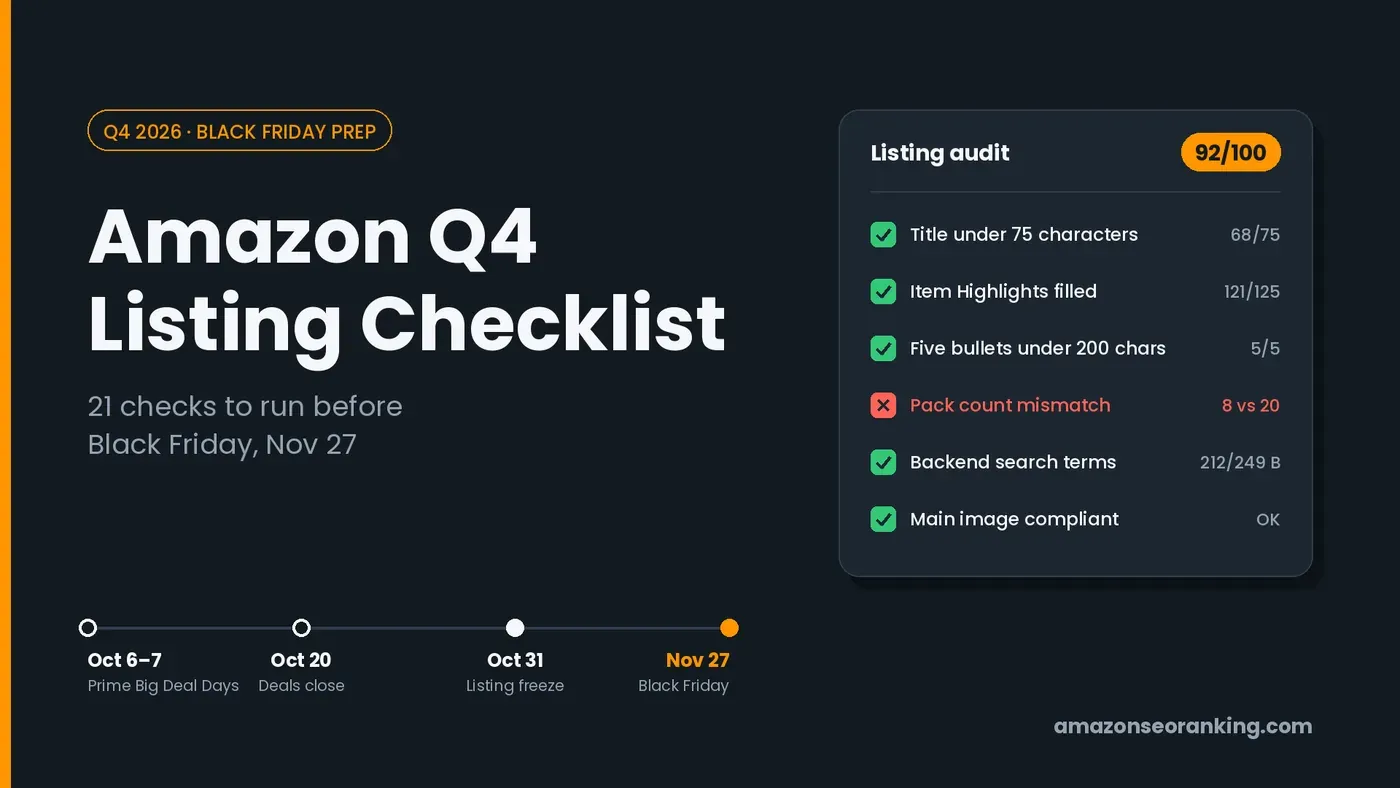
This Amazon Q4 listing checklist covers the 21 things to check on a product page before Black Friday on November 27, 2026 and Cyber Monday on November 30. Title length, bullet points, backend terms, images, stock and price. It's written for sellers and agencies who already have inventory on the way and want the listing itself ready before traffic peaks.
Most Q4 prep guides spend their words on inventory and PPC. Both matter, and every date you need is in the table below. This year there's a listing-specific reason to start with the product page: since July 27, 2026, titles in every category except media must be 75 characters or fewer, spaces included, and Amazon's AI rewrites titles that break the rule. Black Friday 2026 is the first peak season under it.
Key Takeaways (TL;DR)
- The working deadline is October 20, not November 27. Black Friday and Cyber Monday deal submissions close October 20, and FBA stock has to be checked in by October 21 or 28 depending on your shipment option.
- Audit now, fix in early October, and stop making structural listing edits by the end of October. Changes made in November can sit in review during the busiest week of the year.
- Check your title first. Anything over 75 characters is a candidate for Amazon's own AI rewrite, and if you're not brand-registered you don't get a review window. Writing your own 60–75-character version now keeps the choice with you.
- Numbers must match across the page. A title that says 8 packets and a bullet that says 20 is a "not as described" return waiting to happen and holiday returns come back through January.
- Keep "Black Friday", "sale" and "best" out of backend search terms. Amazon's search-terms guidance excludes temporary and subjective words, and they waste bytes in a 249-byte field.
- Check every marketplace you sell on separately. Prime Big Deal Days runs in 22 countries this year, and the dates can differ by country.
Table of Contents
- Amazon Q4 Listing Checklist: at a Glance
- Amazon Q4 2026 Dates That Set Your Listing Deadlines
- Why Listing Errors Cost More in Q4
- How to Prepare for Amazon Q4: Audit, Fix, Freeze
- The Amazon Q4 Listing Checklist: 21 Checks by Section
- Amazon Seller Tips for Q4 Most Prep Guides Skip
- Common Q4 Listing Mistakes and How to Fix Them
- What to Do If a Listing Breaks During Black Friday Week
- Everything You Need to Know About the Amazon Q4 Listing Checklist
- Get Your Listings Checked Before the Freeze
- FAQs About the Amazon Q4 Listing Checklist
Amazon Q4 Listing Checklist: at a Glance
Checks 1–15 follow the same seven categories Amazon SEO Ranking scores in its published 12-criteria audit. Checks 16–21 add the Q4-specific work around stock, deals and the freeze.
| Section | Checks | What to confirm | Finish by |
|---|---|---|---|
| Title & Item Highlights | 1–3 | Title ≤75 characters, main keyword early, Item Highlights filled, no unapproved AI rewrite | October 5 |
| Bullets & description | 4–6 | Five bullets under 200 characters, gift-buyer answers, pack counts consistent everywhere | October 12 |
| Backend & keywords | 7–10 | Under 249 bytes, no temporary terms, seasonal terms backed by real volume, correct category | October 12 |
| Images & A+ Content | 11–13 | Full gallery, compliant main image, A+ submitted early | October 12 |
| Reviews & AI-readiness | 14–15 | Negative reviews answered, copy answers the questions Rufus gets asked | October 19 |
| Stock, price & deals | 16–19 | Inventory checked in, FBM backup, reference price valid, deals submitted | October 20–28 |
| Compliance & marketplaces | 20–21 | No restricted claims, every storefront audited, baseline score saved before freeze | October 31 |
Amazon Q4 2026 Dates That Set Your Listing Deadlines
Amazon confirmed the fall event on September 15: Prime Big Deal Days runs October 6–7, 2026. For Black Friday, inventory has to arrive by October 14 for AWD, October 21 for FBA with minimal shipment splits, or October 28 for FBA with Amazon-optimized splits. Stock that lands after your date isn't guaranteed the Prime badge during the event.
Fees change mid-October too. Holiday peak fulfillment fees apply from October 15, 2026 to January 14, 2027, at roughly $0.32 per unit above non-peak rates.
| Date | What happens | What it means for the listing |
|---|---|---|
| Now – October 5 | Last clean week before Prime Big Deal Days | Run the audit; fix titles first |
| October 6–7 | Prime Big Deal Days | Watch which listings convert – they're your templates |
| October 14 | AWD arrival deadline for BFCM | Stock drives the Prime badge and Buy Box |
| October 15 | Peak fulfillment fees start | Re-check your price floor |
| October 20 | BFCM deal submissions close | Listings with deals need copy finished by now |
| October 21 / 28 | FBA arrival deadlines (minimal / optimized splits) | Out-of-stock listings lose rank fast |
| October 31 | Our recommended listing freeze | No title rewrites, variation or category changes after this |
| November 1 | Extended holiday returns start (based on 2025) | Every listing error now has a long return tail |
| November 27 / 30 | Black Friday / Cyber Monday | Monitor, don't edit |
| January 14 / 31 | Peak fees end / extended returns end (2025 pattern) | Review return reasons against listing copy |
The October 31 freeze is our recommendation, not an Amazon rule. Amazon hasn't published its 2026 holiday return window yet; the November 1–January 31 dates follow its 2025 policy.
Why Listing Errors Cost More in Q4
The traffic is concentrated. In the US, shoppers spent $44.2 billion online during Cyber Week 2025, including a record $11.8 billion on Black Friday and $14.25 billion on Cyber Monday, according to Adobe Analytics. A listing that ranks badly that week loses the most valuable five days of the year, and there's no second attempt until next November.
More of that traffic now arrives through AI assistants. Adobe reported AI-referred traffic to US retail sites up 805% on Black Friday 2025 and 670% on Cyber Monday. On Amazon, that means Rufus reading your title, bullets and spec table to decide whether your product answers a question like "gift for a runner under $50."
Errors also stay with you longer. In the 2025 season, most items bought between November 1 and December 31 could be returned until January 31, 2026. A size, count or compatibility claim that doesn't match the product turns into returns that keep arriving for a month after the peak.
And the title rule is new. Titles over 75 characters get edited by Amazon's AI gradually and without further notice. Brand-registered sellers get 14 days to approve, change or reject the edit; sellers without Brand Registry get no review window at all. If you haven't looked at your live titles since July, check whether they're still yours.
How to Prepare for Amazon Q4: Audit, Fix, Freeze
If you're working out how to prepare for Amazon Q4 with four weeks left, split the time into four blocks.
Week 1 (now – October 5): Audit. Score every listing you plan to promote, on every marketplace you sell on. Sort by revenue so the top 20% of ASINs get fixed first. On a catalog, a bulk run does this in one pass – up to 100 ASINs per run on Pro, 500 on Agency.
Weeks 2–3 (October 6–19): Fix. Rewrite titles, Item Highlights and bullets; submit image and A+ changes early because approval slows as Q4 fills up. Use Prime Big Deal Days as a live test – a listing that converts well on October 6–7 is the model for the ones that didn't.
Week 4 (October 20–31): Lock. Deals are submitted, stock is checked in, and every change you plan to make is live and indexed. Record each listing's score as a baseline.
November 1 onward: Monitor. Only fix what breaks. One agency that runs Q4 for managed accounts notes that image, A+ and variation edits that clear in hours in September can sit for days during peak, which is why structural changes wait until January.
The Amazon Q4 Listing Checklist: 21 Checks by Section
Each check lists what to look for and how to confirm it. Where Amazon SEO Ranking runs the check, the note says which plan it's on.
Title and Item Highlights (Checks 1–3)
1. The title is 75 characters or fewer, with the main keyword near the front. Count spaces. Aim for 60–75 characters so you use the space you have: brand, product type, then the one attribute shoppers filter on (size, count, material). The primary keyword should appear in the first five or six words, because on mobile that's what shows. Amazon SEO Ranking enforces the 75-character limit in code on every audit (all plans).
2. The live title is the one you wrote. Open the product page on each marketplace and compare it with the title in Seller Central. If Amazon has suggested or applied an AI rewrite, decide now whether to accept it. Brand owners have a 14-day window; missing it in October means an unreviewed title on Black Friday.
The alternative to Amazon's version is your own compliant one. Amazon SEO Ranking's AI Copy Rewriter writes a 60–75-character title built on the listing's spec table and your brand fact sheet, with your chosen keyword placed early, and flags any health claim, unsupported claim or pack-count mismatch before you see it (all plans).
3. Item Highlights are filled. Item Highlights give you another 125 characters that are searchable and shown next to the title in results and on the product page. This is where the details you cut from the title go – material, use case, who it's for. In Q4, it's a good place for gift context that would have crowded the title.
Bullet Points and Description (Checks 4–6)
4. Five bullets, each under 200 characters, with sentence-case headers. ALL CAPS bullet headers break Amazon's style guidelines and read as shouting on mobile. Five bullets under 200 characters each is the structure Amazon's current guidance supports, and the audit checks both limits in code.
5. The bullets answer a gift buyer's questions. In Q4, a large share of buyers are shopping for someone else. They want to know who the product suits, what's in the box, what size it runs and whether it works with what the recipient already owns. If the answer isn't on the page, they ask Rufus or go to the next listing.
6. Counts, sizes and claims match everywhere on the page. Compare the title, Item Highlights, bullets, description and spec table. "8 Packets" in the title, "20 packets" in bullet three and "8.0 Count" in the spec table is a common pattern after several rounds of edits. With an extended return window, a mismatch like that is a January problem as well as a November one. Amazon SEO Ranking's consistency check flags exactly this on every audit – pack counts, unit counts and unsupported product or health claims – on the free plan, with no AI call.
Backend Search Terms and Keywords (Checks 7–10)
7. Backend search terms are under 249 bytes and don't repeat visible words. Bytes, not characters – accented and non-Latin characters take more than one byte each, which matters on amazon.de, amazon.co.jp and the Arabic-language storefronts. Words already in the title or bullets are indexed; repeating them wastes space. Use the backend search terms checker to count bytes (all plans).
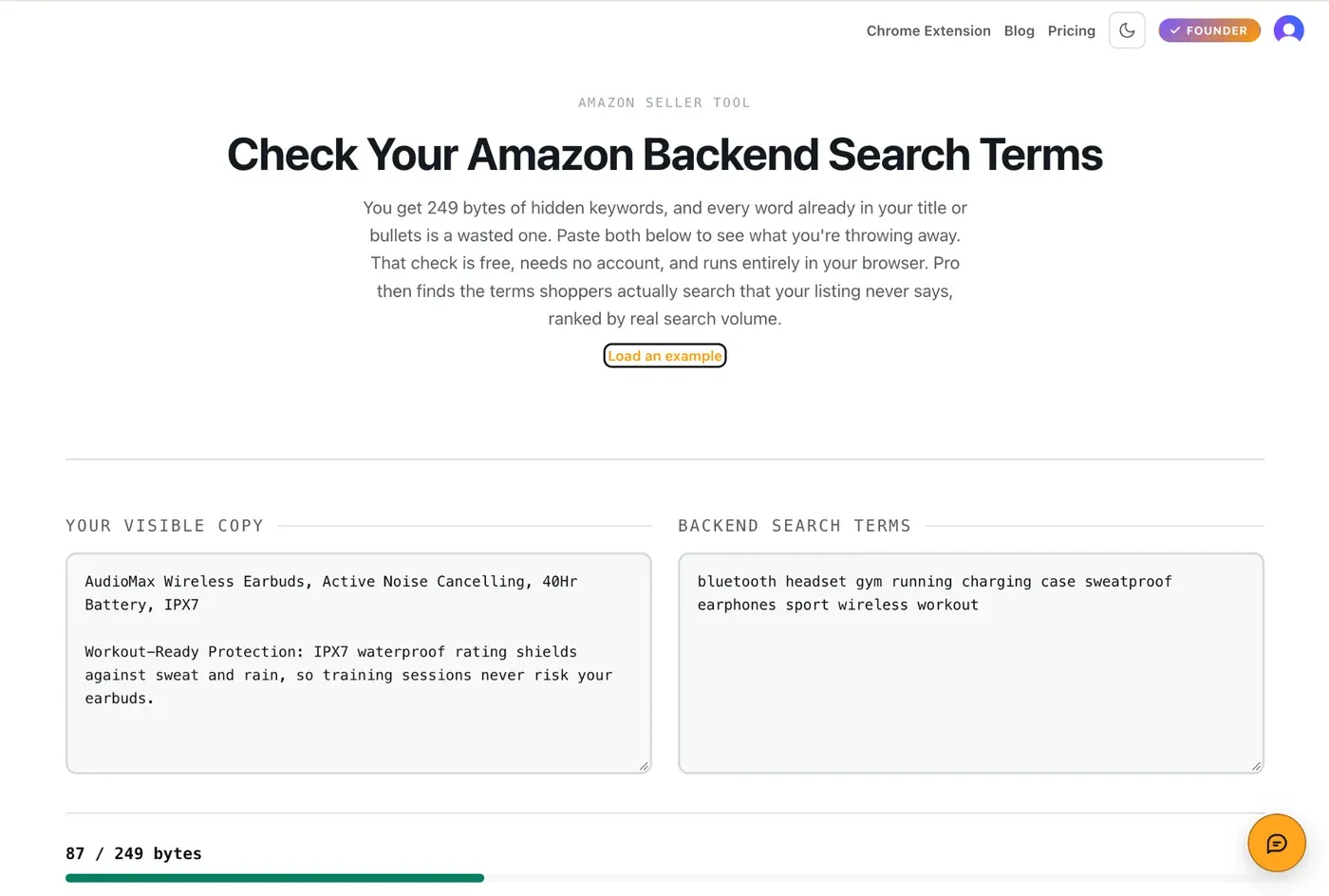
8. No temporary or subjective terms in the backend. Amazon's search-terms guidance excludes temporary statements ("new", "on sale", "available now") and subjective claims ("best", "amazing"). Some Q4 guides suggest adding "Black Friday deals" to backend keywords. It uses up bytes on words Amazon tells sellers to leave out, and the deal badge already signals the offer.
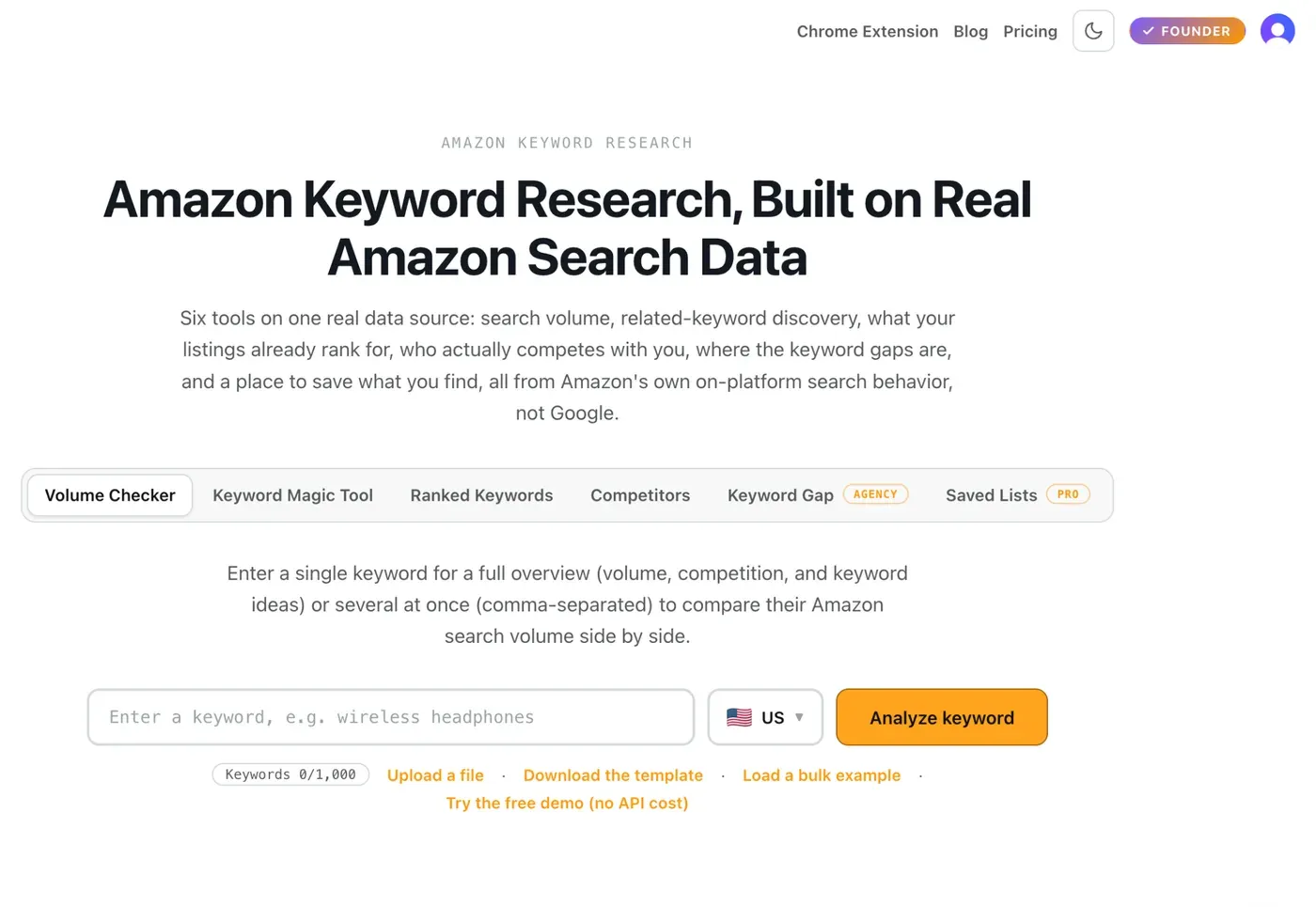
9. Seasonal keywords are backed by real search volume. "Gift for dad", "stocking stuffer" and "Christmas gift for her" are reasonable guesses – check the volume in each marketplace before adding them. A seasonal phrase with no Amazon search volume in your storefront takes space from a term people type. The Volume Checker gives estimated Amazon search volume across 16 marketplaces (Pro and Agency). More on method in our guide to Amazon keyword research tools.
10. The category and browse node are correct. A product in the wrong browse node can miss category filters and deal placements. Fix it in early October; category changes are one of the edits to avoid once peak starts. Category placement is one of the 12 scored audit criteria.
Images and A+ Content (Checks 11–13)
11. Every gallery slot is used, including scale and lifestyle shots. Shoppers can't hold the product. A scale image (in a hand, next to a common object) prevents "smaller than expected" returns. Seasonal lifestyle images work well in secondary slots through Q4.
12. The main image is compliant. Pure white background, the product filling most of the frame, no text, badges or "Black Friday" graphics. Main-image violations can suppress a listing, and a suppressed listing in late November is the most expensive kind. The AI Vision Image Audit reviews the actual gallery for main-image compliance and missing scale or lifestyle shots (Pro and Agency).
13. A+ Content is updated and submitted early. If you plan a gift-focused A+ module or a comparison chart, submit it in the first half of October so it's approved and live before the freeze. The A+ Content generator drafts modules on every plan.
Reviews and AI-Readiness (Checks 14–15)
14. Recent negative reviews are answered, and their causes are fixed in the copy. Read the last 30 days of one- and two-star reviews. If three people say it runs small, that belongs in the size bullet before Black Friday brings 10 times the traffic to the page. Reply to Reviews drafts the responses on every plan.
15. The copy answers the questions shoppers ask Rufus. Rufus pulls from your title, bullets, description and spec table. State use cases, recipients and key specs in plain words ("fits wrists 6–8 inches", "for runners and hikers") so the product can match a gift-style question. AI-readiness for Rufus is two of the 12 audit criteria.
Stock, Price and Deals (Checks 16–19)
These four are Seller Central and inventory work. Amazon SEO Ranking doesn't manage stock, pricing or deals; the audit only reads Prime eligibility from the live listing.
16. Inventory is checked in by your route's deadline. October 14 (AWD), October 21 (FBA, minimal splits) or October 28 (FBA, optimized splits). "Arrive by" means received, and receiving slows through October.
17. Top ASINs have a backup FBM offer. An FBM offer on your best-selling ASINs keeps sales going if FBA stock runs out – you lose the Prime badge but keep revenue and reviews coming in.
18. The reference price is valid and a price floor is set. A strike-through price only shows if your reference price has been active long enough, so the pricing calendar needs planning well before BFCM – and raising prices right before a deal works against you. Set the lowest price you'll accept after fees, ad cost and the October 15 peak fee.
19. Deals are submitted before October 20. After that, the Black Friday Week and Cyber Monday deal windows are closed for the year.
Compliance and Marketplaces (Checks 20–21)
20. No restricted claims on the page. Health and medical claims ("detox", "weight loss"), guarantees, contact details and promotional language can get a listing suppressed. Check the title, bullets, description and A+ – and any copy an AI tool wrote for you. The consistency check flags health and unsupported claims on every plan; the Compliance Risk Scanner adds guarantees, review manipulation, contact info and banned formatting (Pro and Agency).
21. Every storefront is audited separately, and a baseline score is saved before the freeze. A listing optimized for amazon.com isn't automatically right for amazon.de or amazon.co.uk – translation, title length in bytes and local keywords all differ. The audit covers 20 Amazon storefronts. Record each listing's score on October 31, so January's review shows what the Q4 changes did. Score history is kept for 1 listing on Free and every listing on Pro and Agency.
Amazon Seller Tips for Q4 Most Prep Guides Skip
The five competitor guides we reviewed cover inventory dates and PPC budgets well. These q4 Amazon tips cover the listing-side gaps.
Score the new copy before it goes live
You get roughly one clean edit window before the freeze. If you rewrite a title in October and it underperforms, there's no time to test a second version. Amazon SEO Ranking's draft audit scores copy that isn't live yet against the listing's real images, rating and Prime status, and shows the before and after next to the last live score. Each draft audit uses one audit credit.
Treat AI-written copy as a draft that needs checking
Generative tools – including Amazon's own title suggestions – can invent claims or drop the attribute your shoppers filter on. Before publishing any AI rewrite, confirm that the pack count matches the spec table, that there's no health or "organic"-type claim the product can't back up, and that the title is still under 75 characters. General-purpose writers in the big seller suites don't tie their output to a specific rule failure, which is the gap we cover in Amazon SEO Ranking vs Helium 10.
Use Prime Big Deal Days as your test run
October 6–7 is a smaller version of the traffic you'll see in November. Compare conversion across your listings during the event. The one that converts best is usually the template for the rest – same image order, same bullet structure, same Item Highlights pattern. For agencies, "Compare your listings" puts every tracked listing's latest audit side by side by category and marks which one to use as the template.
Plan the listing for January as well as November
The extended return window means Q4 listing accuracy shows up in January's return reasons. When returns arrive, sort them by reason and match "not as described" or "didn't fit" against the specific bullet or image that set the expectation. That's the first fix for next year's checklist.
Agencies: send the client proof before the freeze
Clients want to see that their catalog is ready before peak. On the Agency plan, a bulk run covers up to 500 ASINs, and white-label PDF reports include the methodology behind each score – about $0.38 per listing on monthly billing, against the $50+ per listing agencies typically bill for manual work.
Common Q4 Listing Mistakes and How to Fix Them
| Mistake | What it costs | Fix |
|---|---|---|
| Editing titles in November | Re-indexing delay or review hold during peak week | Finish title changes by October 31 |
| Leaving a title over 75 characters | Amazon's AI may rewrite it; no review window without Brand Registry | Rewrite to 60–75 characters now |
| "Black Friday" or "sale" in backend terms | Wasted bytes on excluded words | Replace with volume-backed product terms |
| Pack count differs between title and bullets | "Not as described" returns into January | Match every number to the spec table |
| Seasonal images in the main slot | Main-image policy violation, possible suppression | Keep seasonal images in secondary slots |
| Auditing only your home marketplace | Unfixed listings on the storefronts you don't check | Audit each marketplace separately |
| Missing the October 20 deal cutoff | No Black Friday deal badge | Submit deals by October 19 |
What to Do If a Listing Breaks During Black Friday Week
Score-change email alerts (5 listings on Pro, 25 on Agency) tell you when a tracked listing's audit score moves during the freeze, so you're not checking every page by hand.
| Problem | First move | Then |
|---|---|---|
| Listing suppressed | Check Inventory → Manage All Inventory → Inactive for the reason | Fix only the flagged field; don't make other edits at the same time |
| Title changed without you | Compare live title with Seller Central; check for AI recommendations | Restore your approved title if it's compliant and under 75 characters |
| Buy Box lost | Check who holds it and at what price | Match if above your price floor; report unauthorized sellers through Brand Registry |
| FBA stock runs out | Switch the top ASIN to your FBM backup offer | Lower bids on that ASIN until stock is back |
Everything You Need to Know About the Amazon Q4 Listing Checklist
| Topic | Summary |
|---|---|
| What it is | 21 checks on titles, bullets, backend terms, images, reviews, stock, price and compliance, run before Black Friday |
| Key 2026 dates | Prime Big Deal Days Oct 6–7; deals close Oct 20; FBA arrivals Oct 21/28; Black Friday Nov 27; Cyber Monday Nov 30 |
| New this year | 75-character title limit and the 125-character Item Highlights field, live since July 27, 2026 |
| Recommended timeline | Audit by Oct 5, fix by Oct 19, freeze by Oct 31, monitor from Nov 1 |
| Most common error | Structural listing edits during peak weeks |
| Hidden cost | Listing inaccuracies returned through the extended holiday window |
| Multi-marketplace rule | Each storefront needs its own check – event dates, byte limits and keywords differ |
| Tools needed | Seller Central for stock, pricing and deals (checks 16–19); a listing audit such as Amazon SEO Ranking for checks 1–15, 20 and 21 |
Get Your Listings Checked Before the Freeze
Amazon SEO Ranking scores a live listing against a published 12-criteria rubric – every criterion and pass rule is public, so you can see exactly why a listing lost points. Its AI rewrites are checked in code before you see them: 75-character titles, bullets under 200 characters and backend terms under 249 bytes are enforced, and health claims, unsupported claims and pack-count mismatches are flagged. The draft audit scores new copy against the live listing before you paste it into Seller Central – the check that matters most when you only have one edit window before the freeze.
It's built for sellers updating listings ahead of Q4 who don't want a 20-tool suite to do it, and for agencies who need to run the same checks across a client catalog on any of 20 Amazon storefronts.
The free plan includes three audits a month with no card required – enough to audit your top listing, score a rewrite as a draft, and check one more ASIN before Prime Big Deal Days on October 6. For a full catalog, the Pro plan ($79/month) starts with a 7-day free trial, which covers a bulk run of up to 100 ASINs before the October 20 deal cutoff.
FAQ
What should I check on my Amazon listings before Black Friday?
Before Black Friday, check your Amazon listings for a title of 75 characters or fewer, filled Item Highlights, five bullets under 200 characters, backend search terms under 249 bytes, and pack counts that match across the page. Confirm that the main image has a pure white background with no text, and that every gallery slot is used. Check that inventory is received by October 21 or 28 and that deals are submitted by October 20. Finish these checks by the end of October so no structural edits are pending during Black Friday week on November 27, 2026.
When should I stop editing Amazon listings before Black Friday?
You should stop editing Amazon listings structurally by October 31, four weeks before Black Friday on November 27, 2026. Structural edits include title rewrites, variation changes and category changes, which can trigger re-indexing or review holds. Image and A+ changes can take days to clear once peak season starts. After November 1, only fix issues that break the listing, such as a suppression or an unapproved title change.
What is the Amazon FBA inventory deadline for Black Friday 2026?
The Amazon FBA inventory deadline for Black Friday 2026 is October 21 for shipments using minimal splits and October 28 for Amazon-optimized splits. AWD shipments must arrive by October 14. Stock that arrives after your deadline isn't guaranteed the Prime badge during Black Friday Week and Cyber Monday. "Arrive" means received and checked in, and check-in times lengthen through October.
Should I add Black Friday keywords to my Amazon backend search terms?
You should not add "Black Friday" or similar deal words to your Amazon backend search terms. Amazon's search-terms guidance excludes temporary statements such as "on sale" and "new", and subjective words such as "best". The backend field is capped at 249 bytes, so those words take space from product terms shoppers search for. Seasonal product phrases like "gift for dad" are a better use of the space when they show real search volume in your marketplace.
When does Amazon Q4 start for sellers?
Amazon Q4 for sellers starts in early October, with Prime Big Deal Days on October 6–7, 2026, and runs through the end of December. Peak fulfillment fees apply from October 15, 2026 to January 14, 2027. The busiest stretch is Black Friday on November 27 through Cyber Monday on November 30. Holiday returns extend the season into late January, based on Amazon's 2025 return window.
How do I prepare for Amazon Q4?
To prepare for Amazon Q4, work backward from the October 20 deal cutoff and the October 21–28 FBA arrival deadlines. Audit your listings by early October, fix titles, bullets, backend terms and images by mid-October, and freeze structural edits by October 31. Ship inventory with a 10–20% safety buffer and set up an FBM backup on your top ASINs. Submit Black Friday and Cyber Monday deals by October 19 to leave a day of margin before the cutoff.
What happens if Amazon rewrites my product title during Q4?
If Amazon rewrites your product title during Q4, the new title goes live on the listing, and you only get a say if you're brand-registered. Brand owners have 14 days to approve, change or reject Amazon's AI-generated title and Item Highlights. Sellers without Brand Registry get no review window. Titles still over 75 characters are the ones at risk, so replacing them with your own 60–75-character version before October 31 keeps the choice with you.
Can't I ask ChatGPT to rewrite my listings for Q4 instead?
You can ask ChatGPT to rewrite your listings for Q4, but it doesn't see your live listing, your spec table or Amazon search volume, and it can miscount characters against a 75-character title limit and a 249-byte backend field. General AI tools also add claims the product can't support, like "organic" or a wrong pack count. Amazon SEO Ranking grounds each rewrite in the listing's spec table and your brand fact sheet, then checks it in code for length limits, pack-count consistency and restricted claims. If you already work in Claude, the Amazon SEO Ranking connector (Pro and Agency) lets Claude run those same checks and pull live audit and keyword data. Either way, no rewrite should go live on a peak-season listing without that check.
Score your top listing against 12 published criteria before the October 20 deal cutoff. Three free audits a month, no card required.
FREE AUDITMore from the blog