Listing Optimization
Backend Search Terms: What to Include and What to Avoid
Backend search terms are 249 bytes, hidden from shoppers, indexed by Amazon but genuinely invisible to any tool outside a seller's own account, including this site's main ASIN audit, which excludes backend terms from automatic scoring for exactly that reason. What goes in the field matters, and so does knowing that no one can check it for you from outside.
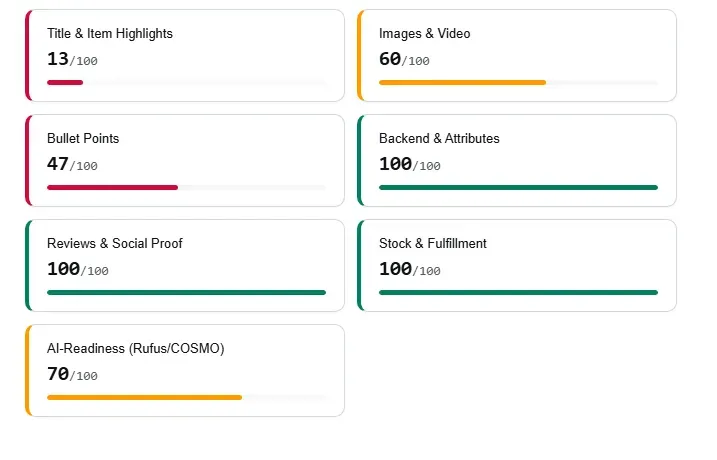
For where backend terms fit alongside the rest of a listing, see the listing-optimization guide.
What belongs in the field
- Synonyms for terms already in the visible listing: a word shoppers use that your title or bullets don't.
- Common misspellings of your product type or brand.
- Translated terms, if you sell into a marketplace with meaningful multilingual search behaviour.
- Use-cases and audiences your visible copy never states outright, like "gift for" or "for camping."
What wastes it
Repeating a word already in your title or bullets spends bytes on nothing. Amazon indexes a term once no matter how many fields it appears in. Commas between terms are also a quiet waste: Amazon's own guidance is to separate terms with single spaces, since a comma can be parsed as part of the term itself.
Competitor brand names never belong in backend terms. It's a direct policy violation, and being hidden from shoppers doesn't make it hidden from Amazon's enforcement. It's one of the more common ways a listing picks up a policy strike for something no customer ever saw.
Why an ASIN audit can't check this automatically
Backend search terms don't appear on the public listing page and aren't returned by any scrape of Amazon's storefront. They only exist inside the seller's own Seller Central account. That's a genuine limit on what any external tool can observe, not a gap in effort. It's also exactly why a dedicated Backend Terms Checker exists as a separate tool: a seller pastes their own current backend terms in directly, since nothing else can retrieve them.
FAQ
Can competitor brand names go in Amazon backend search terms?
No. Using a competitor's brand name anywhere in a listing, including hidden backend fields, violates Amazon's policies and risks the listing being suppressed or the account receiving a policy strike. Backend terms being invisible to shoppers doesn't make them invisible to Amazon's enforcement.
Why doesn't an ASIN audit check backend search terms automatically?
Because they're genuinely invisible from outside the seller's own account, not on the public listing page, not returned by any scrape. That's a real gap in what any external tool, including this site's main audit, can observe, which is exactly why a separate tool exists that a seller pastes their own backend terms into directly.
Do backend search terms need to be separated by commas?
No. Amazon's own guidance is to separate terms with single spaces, not commas, since commas can be parsed as part of the term itself and quietly waste bytes.
How do I check my Amazon backend search terms?
Paste your current backend search terms into the Backend Terms Checker, which reads them directly since they don't appear anywhere else on the public listing or in any outside scrape. It returns your remaining byte count against the 249-byte limit and flags any word that's already indexed elsewhere in your title or bullets, so duplicated terms are visible instead of guessed at.
Is there a way to check exactly which of my backend keywords are duplicates and how many bytes I've got left?
Yes, the Backend Terms Checker compares your pasted backend terms against your current title and bullets, flags any word already indexed there as a duplicate, and shows your remaining byte count against the 249-byte limit. That turns "I think I'm wasting bytes" into a specific, checkable list rather than a guess.
The main audit can't see your backend terms, but it scores everything else. Paste any ASIN for the rest of the picture.
Audit a listing freeMore from the blog