Listing Optimization
How to Use A+ Content to Improve Comprehension and Conversion
A+ Content replaces the plain-text description for Brand Registry-enrolled sellers, and while it isn't a direct ranking factor the way title relevance is, it drives conversion rate and AI-readiness, both of which are. This site's own audit checks three specific elements, and grades all three as self-reported rather than auto-detected, because A+ Content isn't something a scrape can reliably confirm from outside.
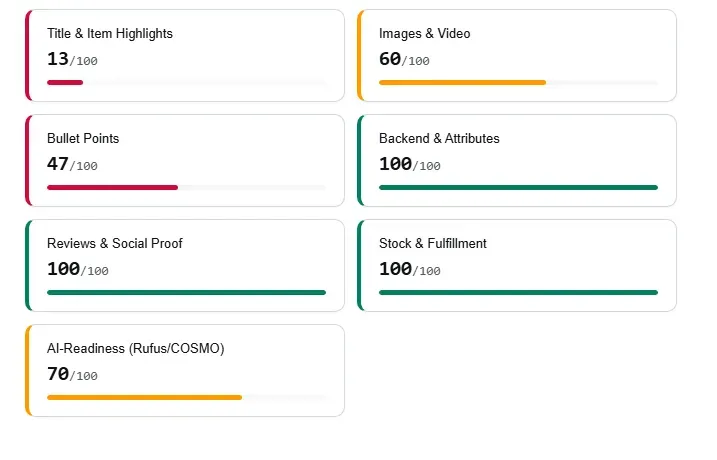
For where A+ Content fits alongside the rest of a listing, see the listing-optimization guide.
What it requires
Enrollment in Amazon Brand Registry, which itself requires a registered trademark. Third-party sellers without Brand Registry are limited to the plain-text description field and don't have access to A+ modules at all.
The three elements that get scored
- A+ Content live at all: the most basic check, modules published versus the listing still running on a plain description.
- A comparison table and FAQ module. These are the formats AI shopping layers cite most directly, since they're already structured as a direct answer to a likely question.
- A Brand Story module. Lower weight than the other two, but it's what drives cross-sell across a brand's other products and builds the trust a single-listing description can't.
Standard vs. Premium A+
Standard A+ covers comparison charts, image-text modules, and FAQs. Premium A+ adds interactive elements like video and larger hero modules, and is generally gated behind sales history or invitation rather than available to every enrolled brand immediately. It's worth checking eligibility in Seller Central rather than assuming it's available from day one of Brand Registry.
Why comparison and FAQ modules specifically
A comparison table is already a direct answer to "which of these is right for me," exactly the shape of question a conversational AI assistant gets asked. An FAQ module is the same idea applied to specific objections. Both formats do the work of anticipating a question and answering it structurally, which plain paragraph text does far less cleanly. More on why that structure matters in How Rufus and COSMO Are Changing Amazon SEO.
FAQ
Do I need Brand Registry to use A+ Content?
Yes. A+ Content is only available to sellers enrolled in Amazon Brand Registry, which requires a registered trademark. Third-party sellers without Brand Registry are limited to the plain-text description field.
Does A+ Content directly affect ranking?
Not as a direct ranking input the way title relevance does, but it lifts conversion rate, which is a ranking input, and its structured modules are exactly the format AI shopping layers like Rufus can cite directly. The effect on rank is real, just routed through conversion and AI-readiness rather than counted on its own.
What's the difference between A+ Content and Premium A+ Content?
Standard A+ Content covers comparison charts, image-text modules, and FAQs. Premium A+ adds interactive elements like video and larger hero modules, and is generally gated behind higher sales history or invitation rather than being available to every Brand Registry account immediately.
The audit checks whether A+ Content is live and what it covers. Paste any ASIN to see where a Brand Registry-enrolled listing stands.
Audit a listing freeMore from the blog