Amazon SEO & Algorithm
Does Conversion Rate Affect Amazon Ranking? Here's How Much
Conversion rate, the share of sessions that end in a purchase, is widely considered the single strongest input to Amazon's ranking stage. This site's own scoring rubric labels it, in plain terms, "the #1 A10 factor." It's also one you can never read from outside your own account, which is exactly why it gets misunderstood.
For where conversion rate fits among every other ranking factor, see Amazon SEO in 2026.
What conversion rate actually measures
On Amazon it's Unit Session Percentage: units ordered divided by sessions, visible in Seller Central's Business Reports. It's not a page-view metric. A session counts a shopper's whole visit, so someone who views a listing three times before buying counts once, not three.
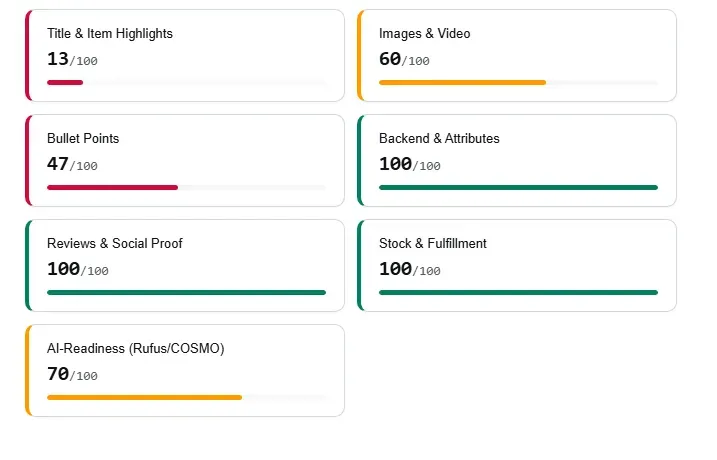
No third-party tool can read your actual conversion rate, including an SEO audit. It's account-level data Amazon only shows the seller. Anything scoring your listing is grading the inputs that drive conversion, such as images, price, reviews, and title clarity, not the resulting number itself.
Why it outweighs almost everything else
Amazon is optimizing for a sale, not for the most relevant-looking page. A shopping engine's whole incentive is to show what's most likely to convert. A listing with excellent keyword coverage but a conversion rate below category average is, from Amazon's perspective, evidence that it's the wrong result even for shoppers who found it. That's a stronger negative signal than most sellers assume, which is part of why fixing indexing without fixing conversion still caps how far a listing climbs.
What actually moves it
- The main image, usually the single biggest lever, since it's the first thing a shopper evaluates before ever opening the listing.
- Price relative to visible competitors: not the lowest price in the category, but a price that looks reasonable next to what's shown alongside it in search results.
- Star rating and recent review volume: social proof shoppers check before committing, especially above roughly the 4.3 threshold this site's own audit treats as a pass bar.
- A title that states what the product actually is. A shopper who has to guess whether a listing matches their search bounces before converting, regardless of how well it ranked to get there.
Reviews and rating do enough of this work on their own that they're covered in full in Do Amazon Reviews Affect Ranking?
What doesn't reliably move it
Discounting and coupons shift price-sensitive traffic but don't durably raise the rate at full price. The moment the discount ends, conversion typically reverts, so it's a traffic tactic more than a content fix. Fake urgency banners and manufactured scarcity claims aren't just unreliable; they're the kind of listing manipulation Amazon actively polices. Treat them as a compliance risk, not a growth lever.
Checking where you actually stand
Seller Central's Business Reports show Unit Session Percentage per listing, and the category-level benchmark sits alongside it. That comparison matters more than the raw number, since a 9% rate is strong in one category and weak in another. Track it after any content change; because it's a lagging signal, expect a delay of days, not hours, before a title or image change shows up in the rate.
FAQ
What's a good Amazon conversion rate?
It varies enormously by category, so there's no single target. A $12 phone case and a $400 espresso machine convert at very different rates. What matters is your rate relative to your own category average, which Seller Central's Business Reports shows alongside your Unit Session Percentage.
Does Amazon show me my exact conversion rate?
Yes, as Unit Session Percentage in Seller Central's Business Reports: units ordered divided by sessions. It's not shown anywhere on the public listing page, which is also why no third-party tool, including an SEO audit, can read it directly.
Can I improve conversion rate without more traffic?
That's the only way to improve it in isolation. Conversion rate is a ratio, so raising it means converting more of the sessions you already get, not attracting more sessions. Better images, a clearer title, and stronger reviews all work on the existing traffic you have.
The audit can't read your conversion rate, but it scores every visible input that drives it: image count, title clarity, and rating, and flags what's failing.
Audit a listing freeMore from the blog