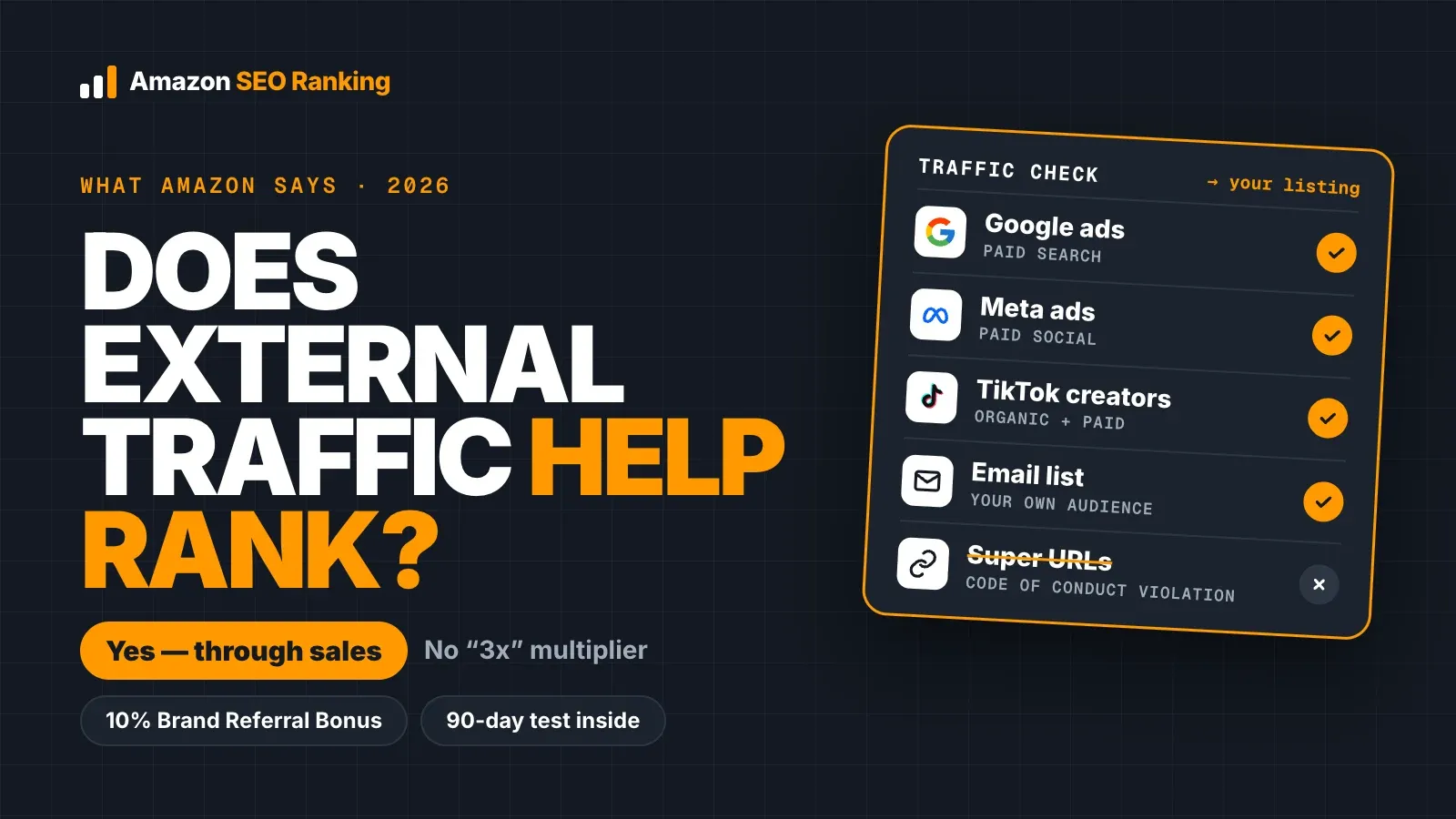
Yes, external traffic can help Amazon ranking, but only through what those visitors do on your listing: view the page, add to cart and buy. Amazon's own Attribution guide lists increasing glance views of product pages, which can help support organic rankings among the reasons to send non-Amazon traffic. It doesn't say how much weight an outside sale carries, and it has never published the "3x" multiplier many seller guides repeat.
Two things decide whether sending traffic pays off. The listing has to convert the visitors you send, and the traffic has to arrive the way Amazon allows. Links built to fake a keyword search, such as super URLs and two-step URLs, break the Seller Code of Conduct.
This guide is for brand owners and agencies thinking about Google, Meta, TikTok, email or creator campaigns that point to Amazon. It covers what Amazon has actually said, what Amazon Attribution and the Brand Referral Bonus do, one 90-day test with real numbers, and what to check on the listing before you spend anything.
Key Takeaways (TL;DR)
- External traffic helps rank through detail page views and sales. A click that leaves without buying adds little.
- Amazon's one direct statement: glance views from non-Amazon channels can help support organic rankings. No Amazon source gives a multiplier.
- An Amazon Attribution link opens your detail page or Store, so the visit arrives with no search keyword attached.
- Super URLs, two-step URLs, funnels, treasure hunts and search-find-buy are named Code of Conduct violations.
- The Brand Referral Bonus credits brands an average of 10% of qualifying sales from tagged external traffic, in the US store only.
- In one public 90-day test, external sales were 4.9% of the listings' revenue and the owner couldn't say how much of the rank gain they caused.
- Fix the listing first. Traffic you pay for converts on the same title, images, price and reviews as everyone else's.
Does External Traffic Help Amazon Ranking: at a Glance
The table sorts common external traffic sources by what Amazon has said about them. "Ranking effect" means the route by which each one can move rank, not a promise that it will.
| Traffic source or tactic | What Amazon says | Ranking effect | Brand Referral Bonus | Risk |
|---|---|---|---|---|
| Paid search or social ads to your detail page | Measurable with Amazon Attribution | Through views and sales it brings | Yes, with an Attribution tag (US) | Spend that doesn't convert |
| Organic social posts and creator content | Attribution measures paid and organic channels | Through views and sales | Yes, if tagged | Low |
| Email to your own list | Listed as a measurable channel | Through views and sales | Yes, if tagged | Low |
| Same discount promoted on and off Amazon | Welcomed by Amazon | Through sales | Yes, if tagged | Low |
| Off-Amazon rebate not offered on Amazon | Code of Conduct violation | Treated as manipulation | Not relevant | Account action |
| Super URLs, two-step URLs, search-find-buy | Code of Conduct violation | Treated as manipulation | Not relevant | Account action |
| Sponsored Products and other Amazon ads | Named by Amazon as a way to rise in results | Through sales on the keyword | No, Amazon ads don't qualify | Spend that doesn't convert |
What Amazon Says About External Traffic and Ranking
Most guides answer this question with confidence and no source. Amazon has addressed it directly in one sentence, so this section separates what Amazon published from what sellers assume.
The one Amazon line that links outside traffic to rank
Amazon Ads' guide to Amazon Attribution lists the jobs non-Amazon channels can do for a brand. One of them is raising glance views of product pages, which the guide says can help support organic rankings and add to the audiences you can reach with display ads.
That's the closest Amazon comes to answering the question. Note the wording: "can help support", tied to page views. It doesn't say outside traffic ranks you on its own, and it doesn't say an outside sale counts for more than a sale from Amazon search.
What Amazon names as ranking inputs
Amazon's seller guide to Amazon SEO describes Best Sellers Rank as a measure of real-time sales within a category, and names keyword research, titles, descriptions, bullets, backend search terms, images and price as the levers sellers control. It also says listing quality and account health can contribute to search rankings, and that Sponsored Products can help offers rise through results.
External traffic connects to that list in one place: sales. A buyer who arrives from a TikTok video and buys adds to the product's sales the same way a buyer from Amazon search does. Our guide to how to rank for keywords on Amazon covers the other inputs in order, starting with indexing.
The "3x weight" claim has no Amazon source
Search this topic and you'll find claims that external sales carry two or three times the ranking weight of sales from Amazon search, often credited to "A10". Amazon hasn't published an algorithm called A10, and none of the pages making the claim link to an Amazon document that states a multiplier.
The idea isn't absurd. Amazon pays a bonus for tagged external sales, so it clearly wants them. Paying for a sale and weighting it higher in search are different things, though, and only the first is documented.
When Does External Traffic Help Amazon Ranking?
Amazon ranks a listing in two stages: first it decides whether the product matches a search, then it orders the matches by how shoppers respond. External traffic can't help with the first stage at all. It can only add to the second, and only when visitors buy.
Traffic that converts and traffic that bounces
A visitor from outside Amazon lands on the same detail page as everyone else. If the title is cut off, the main image breaks the rules or the price sits above page one, that visitor leaves too.
This is why external campaigns tend to work best on listings that already sell. The traffic adds to a page that converts. Sent to a weak page, it adds views with few orders behind them, and most of the ad spend goes to clicks that never become orders.
Why an external click carries no keyword
Amazon Attribution tags send shoppers to a product detail page or a Store page, which are the two destinations the setup accepts. The shopper never types a search, so the visit has no search phrase attached to it.
That matters because Amazon ranks per keyword. A sale from the search "dog water bottle" is a sale on that phrase. A sale from a creator's link is a sale with no phrase, and Amazon hasn't said how, or whether, it credits that sale to any particular search. This gap is exactly what super URLs and two-step URLs were built to fill, and why Amazon banned them.
Where the effect shows up instead
Two effects are documented. Sales from external traffic count toward the product's sales history, which Best Sellers Rank reflects. And Attribution reports a brand halo: purchases of your other products by shoppers who clicked an ad for one of them, within 14 days of the click.
Amazon Ads also reports that advertisers who adjusted their non-Amazon media using Attribution insights saw an average 18% increase in new-to-brand sales, based on an internal study of 93 advertisers between November 2020 and April 2021. That's a sales figure, not a ranking one.
External Traffic Tactics Amazon Prohibits
The line Amazon drew is about faking a search, not about sending traffic. In a Seller Forums announcement, an Amazon moderator wrote that it violates the Seller Code of Conduct to manipulate search rank through two-step URLs, super URLs, funnels, treasure hunts and search-find-buy, and that a service by any name meant to artificially boost search ranking is a violation.
The same post covers off-Amazon incentives. Amazon welcomes sellers advertising the same price and discounts outside Amazon that they offer in the store. A rebate or discount offered only off Amazon, for a product sold without it on Amazon, is a violation, because it can inflate search ranking and create artificial conversion behavior.
| Tactic | How it works | Status |
|---|---|---|
| Super URL | A detail page link with search parameters copied in, so the click looks like it came from a search | Named violation |
| Two-step URL | A link to a search results page for a chosen keyword, then the shopper clicks through | Named violation |
| Search-find-buy | Shoppers are told to search a keyword, find the product and buy | Named violation |
| Off-Amazon rebate | A refund or discount paid outside Amazon on a full-price Amazon order | Violation |
| Same discount on and off Amazon | A deal or coupon live in the store, promoted outside it | Welcomed |
| Tagged ads, posts and emails to the detail page | An Attribution link from any channel | Allowed and measured |
The post also reminds sellers that they're responsible for what third-party services do on their behalf. Buying a "ranking launch" from an agency doesn't move the risk to the agency.
Amazon Attribution and the Brand Referral Bonus
These two programs are how Amazon wants brands to send traffic: tagged, measured and paid back in part. Neither one is a ranking tool. Attribution measures, and the bonus refunds part of your fees.
What Amazon Attribution measures
Amazon Attribution is free. Amazon describes it as a measurement tool for paid and organic non-Amazon channels: search, social, display, video, email and third-party affiliate marketing. Per Amazon Ads, it's available in the US, Canada, the UK, Germany, France, Italy and Spain to sellers enrolled in Brand Registry with brand representative status, vendors and agencies.
Each ad group gets its own tag, which you paste into the destination URL of an ad, post or email. Reports show clicks, detail page views, add to carts, purchases, units, sales, new-to-brand purchases and brand halo. Amazon uses a 14-day, last-touch window, so a purchase counts if it happens within 14 days of the most recent tagged click.
Two limits are worth knowing before you set it up. Only products that are in stock and have photos and prices can be measured. And Amazon says to expect a 10-20% gap between Attribution clicks and the publisher's own click count.
What the Brand Referral Bonus pays
The Amazon Brand Referral Bonus credits brands an average of 10% of qualifying sales from non-Amazon marketing measured with Attribution tags. It's open to sellers in Amazon's US store on a Professional plan with a brand enrolled in Brand Registry, and it doesn't apply to Amazon's own ads.
The bonus is a credit against future referral fees. Amazon's example: a $100 backpack with a 14% referral fee might earn a 7% credit, which offsets the fee on a later sale and raises net profit on that sale from $86 to $93. Rates vary by category; Amazon lists clothing at 11%, and furniture at 10% up to $200 of the sale price and 7% above it.
The bonus also covers purchases of your other brand products within 14 days of the click, and Amazon credits it after a two-month wait to allow for returns.
| Program | What it does | Who can use it | Ranking role |
|---|---|---|---|
| Amazon Attribution | Measures clicks, views, carts and sales from non-Amazon channels | Brand Registry sellers, vendors, agencies in 7 marketplaces | None directly; shows which traffic sells |
| Brand Referral Bonus | Credits an average of 10% of tagged external sales against referral fees | US Professional sellers with Brand Registry | None; lowers the cost of external sales |
What One 90-Day External Traffic Test Showed
Public tests with real numbers are rare. EcomCrew founder Dave Bryant published one in July 2024: about $5,335 on Facebook and Google ads over 90 days, aimed at two ASINs whose rankings had been falling for a year.
He sent the ad traffic to his own Shopify site first, with "Buy on Amazon" buttons that used Attribution links. About half of buyers chose Amazon.
| Measure | Result |
|---|---|
| Ad spend, 90 days | ≈$5,335 (Facebook retargeting, Facebook lookalike, Google Performance Max) |
| Amazon add-to-carts from Attribution links | 122 |
| Amazon purchases from Attribution links | 22, worth $3,440.64 |
| Brand Referral Bonus earned | $338.26 |
| External sales as a share of the two ASINs' revenue | ≈4.9% of $69,594 |
| Average organic position, start to end | 13.21 to 10.96 |
Rankings improved. The author was careful about why: competitors' prices, PPC changes and other factors moved during the same 90 days, and he wrote that it was impossible to say how much the outside traffic contributed. He also judged the ads unprofitable on their own numbers.
Two things in the data are worth taking from it. The bonus came to roughly 10% of the attributed Amazon sales, in line with Amazon's stated average. And a few dozen sales on listings doing about $23,000 a month were a small share of the signal Amazon already had, which makes a large ranking jump unlikely from that volume alone.
Worked Example: Checking a Listing Before Sending Traffic
Take a fictional listing, Trailpup Dog Water Bottle, whose brand plans a creator video and a Google search campaign in the US. Before any money goes out, the listing gets the same checks a shopper's first visit would.
Step 1: Confirm the listing ranks for the phrases shoppers search
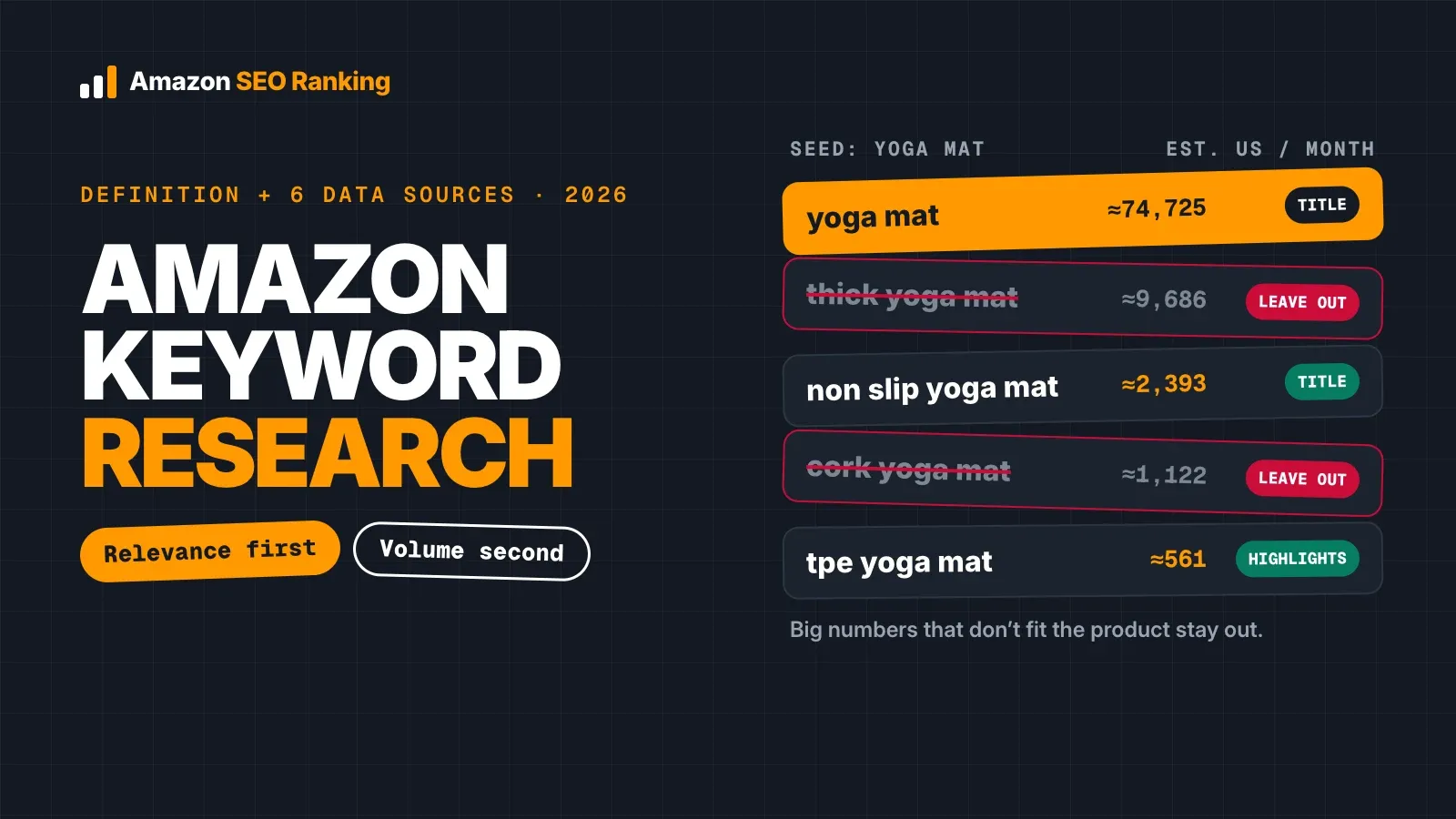
External buyers who come back later will search, not click your link again. The title and fields need to cover the phrases with demand. Estimated monthly US Amazon searches, from Amazon SEO Ranking's keyword tools on 27 October 2026:
| Search phrase | Est. monthly US searches | Covered by |
|---|---|---|
| dog water bottle | ≈1,870 | Title |
| dog water bottle portable | ≈374 | Title |
| dog travel water bottle | ≈261 | Title |
| dog water bottle for walking | ≈149 | Title |
| portable dog water dispenser | ≈74 | Item Highlights |
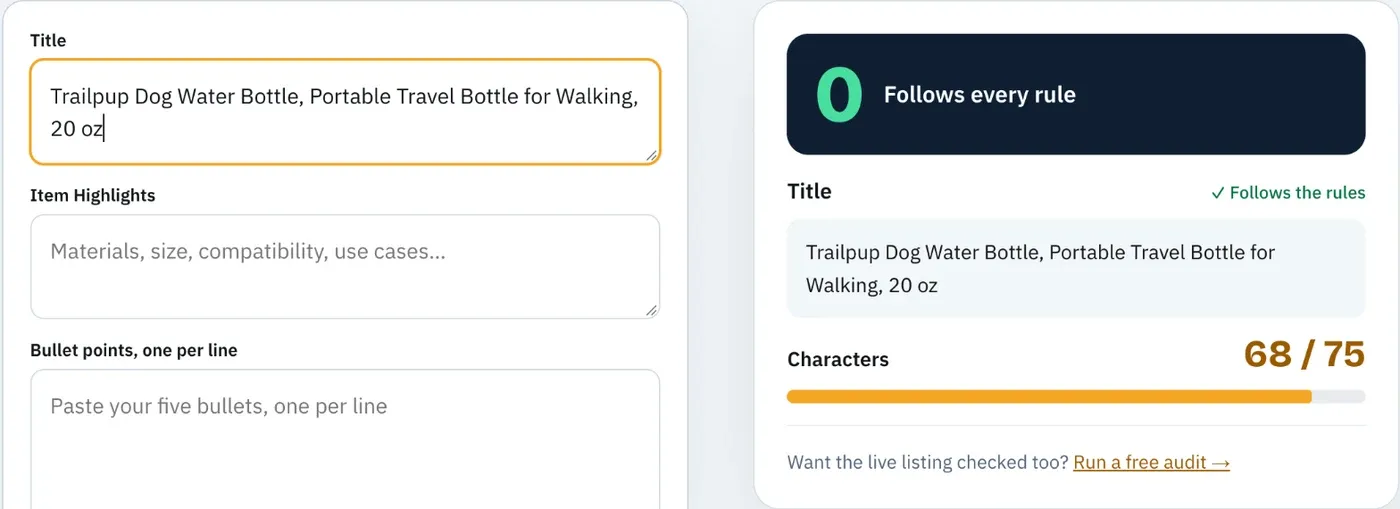
The title, *Trailpup Dog Water Bottle, Portable Travel Bottle for Walking, 20 oz*, is 68 of 75 characters and passed our listing copy check, including the AI compliance scan on Pro. Over 75 characters, Amazon may rewrite it; the free Amazon character limit checker shows where each field gets cut.
Step 2: Audit the page visitors will land on
A visitor from the creator video judges the same things an Amazon shopper does. Amazon SEO Ranking's audit scores the live listing against 12 published criteria, and several of them are the ones that decide whether paid clicks turn into orders: Title & Item Highlights, Images & Video (gallery count), Reviews & Social Proof (star rating) and Stock & Fulfillment (Prime eligibility). Every audit also flags, for free, pack counts that disagree across fields and claims the spec table can't back up, which are the details that turn new buyers into returns.
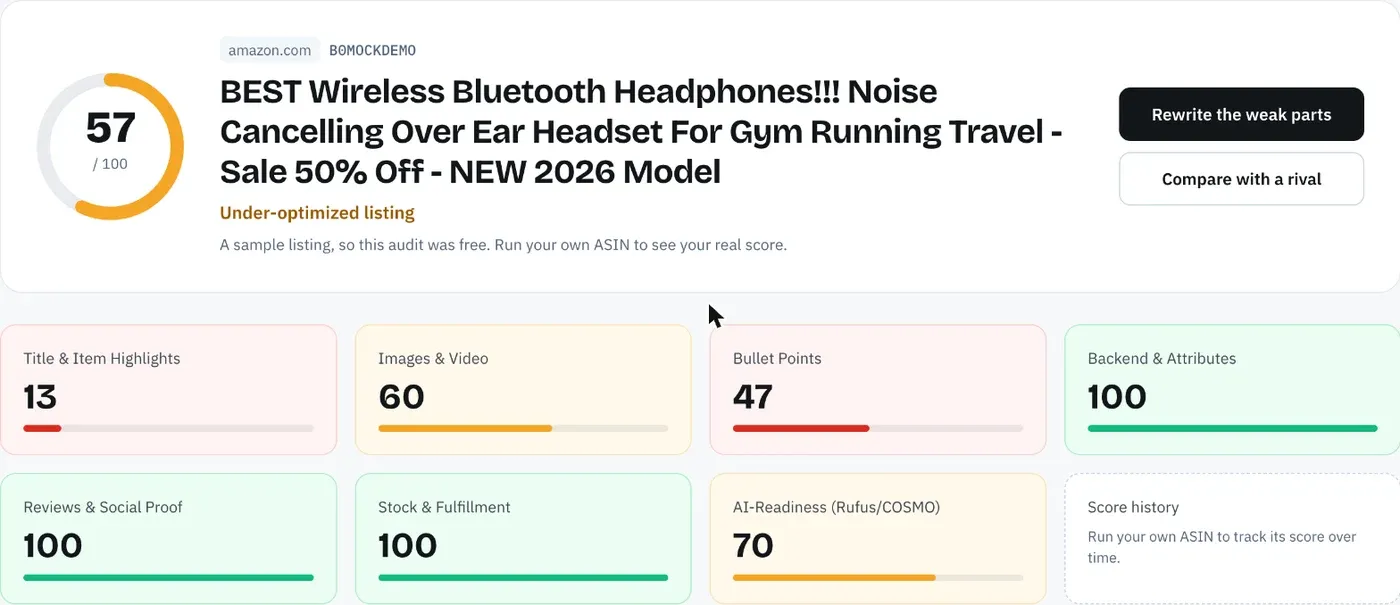
The audit doesn't check price, so compare that by hand against page one for "dog water bottle", and confirm you have stock to cover a spike. If the score shows a weak category, fix it before launch: rewrite the copy, then score the new version as a draft audit against the live listing's images, rating and Prime status before it goes live. Our list of Amazon listing SEO mistakes covers the 13 that cost the most.
Look at the backend field too. Shoppers from the campaign may come back and search for "pet canteen" or "puppy hiking bottle", and those synonyms belong in the hidden field; our guide to Amazon backend search terms covers the byte limit and the five checks.
Step 3: Tag each source separately
In Amazon Attribution, create one campaign for the bottle, then one ad group for the creator video and one for Google search. Each gets its own tag pointing to the detail page. After 14 days, compare purchases per click between the two ad groups, and check brand halo for buyers who picked up the brand's other products.
Step 4: Record rank before and after
Before launch, record the listing's position for each phrase in the table. In the US, Amazon SEO Ranking's What I rank for (Pro) lists every keyword an ASIN ranks for with its position, so the baseline is one lookup, and the same lookup each week shows what moved. The US is also the only store where the Brand Referral Bonus applies, so it's where most tagged campaigns run.
Change nothing else on the listing during the campaign if you can, since the EcomCrew test shows how hard it is to separate one cause from another afterward. On Pro, score alerts watch up to 5 listings, so if the audit score drops mid-campaign (a lost Prime badge, a falling rating) you hear about it by email. If a phrase drops out of the results entirely, search your ASIN plus the phrase to check it's still indexed.
If you're an agency running this for a client
The same four steps work across a catalog. Bulk Optimization runs the audit and rewrite on up to 500 ASINs per run on the Agency plan, so you can find the listings worth promoting before the client spends on ads. The Agency ranking visibility view shows, for every tracked ASIN, how many keywords rank at #1, #2 to 3, #4 to 10 and #11 to 100, which gives you a before-and-after for the campaign report.
White-label PDF reports let you hand the client the audit under your own brand, including the methodology section, so the pre-launch fixes are documented alongside the Attribution results.
How to Drive External Traffic to Amazon Without Wasting It
If you decide to drive external traffic to Amazon, the order below keeps money from going to a page that can't convert it.
- Audit and fix the listing. Run a free audit on the ASIN and fix its weakest categories, then check price and stock by hand.
- Enroll. Brand Registry, then Amazon Attribution, then the Brand Referral Bonus if you sell in the US store.
- Tag every link. One ad group per channel or creative, pointing to the detail page or your Store.
- Match the offer. Any discount you promote outside Amazon should be live in the store at the same price.
- Read the data at 14 days. Keep the channels with purchases, cut the ones with only clicks.
- Watch rank by phrase. Log positions weekly alongside any listing edits.
Without Brand Registry, steps 2 and 3 aren't available to you: Attribution and the bonus both require it for sellers. Step 1 still applies, in every storefront you sell in. The audit covers 23 Amazon storefronts, and a listing that converts helps with any traffic, from Amazon search or anywhere else.
Amazon external traffic works best as a sales channel with a fee rebate, and any lift in rank comes from those sales. Plan the budget on the sales, and treat ranking as a possible side effect.
Everything You Need to Know About External Traffic and Amazon Ranking
| Topic | What to know | Rule or number |
|---|---|---|
| Does it help rank | Through views and sales on the listing | Amazon: glance views "can help support organic rankings" |
| Multiplier | No Amazon source gives one | Treat "2x" or "3x" claims as unverified |
| Keyword credit | Attribution links land on the detail page or Store | No search phrase attached |
| Prohibited | Fake searches and off-Amazon-only incentives | Super URLs, two-step URLs, funnels, treasure hunts, search-find-buy |
| Allowed | Tagged ads, posts, emails, same-price promotions | Any channel |
| Amazon Attribution | Free measurement of non-Amazon traffic | US, CA, UK, DE, FR, IT, ES; 14-day last-touch |
| Measurable products | Must be in stock with photos and prices | Expect 10-20% click discrepancy |
| Brand Referral Bonus | Credit against referral fees | Average 10%, US, Professional plan, Brand Registry |
| Bonus timing | Credited after returns window | About two months |
| Amazon ads | Don't earn the bonus | Sponsored Products still help rank through sales |
| Public test | 90 days, ≈$5,335 spend | 22 Amazon sales, rank 13.21 to 10.96, cause unclear |
| Before spending | Audit the page visitors land on | 12 criteria, plus price and stock by hand |
| Measuring rank | Record positions before and during | Per phrase, weekly, in each marketplace |
Make Sure the Page Converts Before You Pay for Traffic
Amazon SEO Ranking doesn't run or track off-Amazon campaigns; Amazon Attribution does that job. What it checks is the page your traffic lands on. The audit scores a live listing against 12 published criteria, including Images & Video, Reviews & Social Proof and Stock & Fulfillment, so you can see which fix is worth the most points before the first paid click. The AI rewrites target the exact criterion your listing fails and are checked in code for Amazon's limits, pack counts and unsupported claims, and you can score new copy as a draft before it goes live.
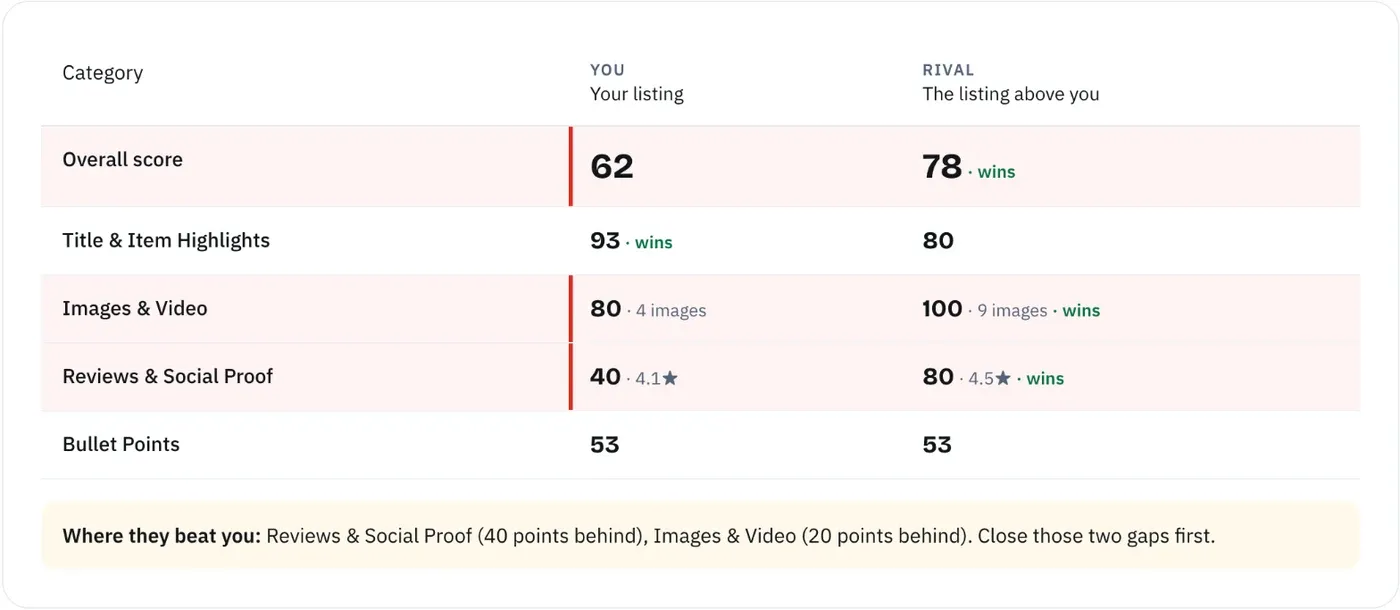
It's built for brand owners and agencies with live listings that should sell and rank better, especially brands selling one product across several of the 23 Amazon storefronts the audit covers. If you're sending traffic to a page that competes with a stronger listing, the Amazon competitor analysis tool audits yours and up to two rivals side by side. Search volume for the phrases your campaign should support comes from the Amazon keyword research tool.
The free plan includes 3 full audits a month with no credit card required. Pro costs $79 a month with a 7-day free trial and adds full keyword research including What I rank for, unlimited score history and email alerts on 5 listings, so a drop during a campaign shows up without a manual check. Run a free Amazon listing audit on the ASIN you plan to promote, or compare plans and pricing if a whole catalog is getting outside traffic.
FAQ
Does external traffic help Amazon ranking?
External traffic helps Amazon ranking when it turns into detail page views and sales on your listing, since sales history is one of the inputs Amazon names. Amazon's Attribution guide says glance views from non-Amazon channels can help support organic rankings. Amazon hasn't published how much weight an outside sale carries, and no Amazon document supports the common "3x" claim. Traffic that leaves without buying adds views with no sales behind them.
Does social media help Amazon ranking?
Social media helps Amazon ranking only through the visits and purchases it sends to your listing. Amazon Attribution measures both paid social ads and organic posts, so you can tag each post and see which ones lead to sales. In the US store, tagged social sales also earn the Brand Referral Bonus, averaging 10% of qualifying sales. Posts that send clicks but no orders show up in Attribution as clicks with no purchases.
What is the Amazon Brand Referral Bonus?
The Amazon Brand Referral Bonus is a credit averaging 10% of qualifying sales that Amazon gives brands for sales driven by non-Amazon marketing and measured with Amazon Attribution tags. It's available to sellers in Amazon's US store on a Professional plan with a brand in Brand Registry. The credit offsets future referral fees and arrives after about two months. Sales from Amazon's own ads, such as Sponsored Products, don't qualify.
Do Amazon Attribution links help ranking?
Amazon Attribution links don't add ranking weight by themselves, because they're a measurement tool. A tag adds URL parameters that let Amazon connect later activity to the click, and the link opens the detail page or Store. Any ranking effect comes from the sales the tagged traffic brings. What the tag gives you is proof of which channels produce those sales.
Are super URLs and two-step URLs against Amazon's rules?
Super URLs and two-step URLs are against Amazon's rules. An Amazon moderator's Seller Forums announcement named two-step URLs, super URLs, funnels, treasure hunts and search-find-buy as Seller Code of Conduct violations. The same post said any service meant to artificially boost search ranking is a violation by any name. Sellers are also responsible for what third-party services do for them.
How do I drive external traffic to my Amazon listing?
You drive external traffic to your Amazon listing by tagging each ad, post or email with an Amazon Attribution link that points to the detail page or your Store. Enroll in Brand Registry first, since Attribution requires it for sellers. Use a separate tag for each channel or creative so the 14-day reports show which ones lead to purchases. If you sell in the US store, enroll in the Brand Referral Bonus to get an average 10% back on qualifying sales.
Is it worth sending Google Ads traffic to Amazon?
Sending Google Ads traffic to Amazon is worth it when the attributed sales pay for the clicks, since the ranking effect alone is unproven. In EcomCrew's public 90-day test, about $5,335 in Facebook and Google ads produced 22 Amazon purchases worth $3,440.64 and $338.26 in Brand Referral Bonus. Average rank for the two ASINs moved from 13.21 to 10.96, but the author couldn't separate the ads from other changes. Judge the campaign on attributed sales first.
Should I send external traffic before my listing is optimized?
You shouldn't send external traffic before your listing is optimized, because outside visitors convert on the same title, images, price and reviews as Amazon shoppers. Amazon Attribution only measures products that are in stock with photos and prices. Check the title against the 75-character limit, the main image and your price against page one first. Amazon SEO Ranking's free plan includes 3 full audits a month with no card, which covers the ASIN you plan to promote.
Audit the page your traffic will land on before you pay for the first click: 12 published criteria, 3 free audits a month and no credit card required.
Run free audit