Amazon SEO & Algorithm
How Price, Buy Box, and Stock Affect Amazon Ranking
Price, Buy Box, and stock are three distinct mechanisms that get treated as one because they interact. A price that's high enough to lose the Buy Box behaves, for ranking purposes, almost exactly like a stockout. Separated out, each has its own fix.
For where these sit among every other ranking factor, see Amazon SEO in 2026.
Price feeds Buy Box eligibility, not rank directly
There's no ranking bonus for being the cheapest option in a category. What price actually controls is whether an offer is competitive enough to win the Buy Box, and in most categories, only the Buy Box winner is even eligible to appear in search and category browse results. Losing it isn't a minor visibility hit; it can remove a listing from discovery almost entirely, independent of how well the content itself is written.
What losing the Buy Box actually looks like
With multiple sellers on one listing, Amazon rotates or fixes the Buy Box based on price, fulfilment method and seller performance. A seller can be technically "in stock and selling" while their specific offer never surfaces as the default buyable one. Checking Buy Box percentage in Seller Central is the only reliable way to catch this; it doesn't show up as an error anywhere on the listing itself.
Stockouts don't reset cleanly
Going out of stock removes a listing from results for as long as it lasts, which is the obvious part. The less obvious part: the ranking history built before the stockout doesn't fully carry over on restock. A listing coming back from an extended stockout often re-ranks closer to where a brand-new listing starts than to where it left off, because the behavioural signals that supported its old rank went stale while it was unavailable.
Fulfilment speed is weighted more than sellers expect
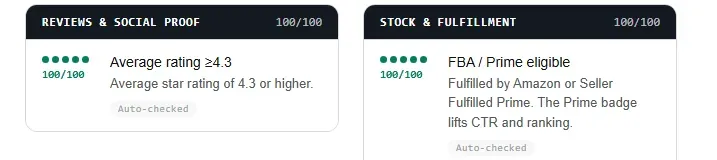
FBA or Seller Fulfilled Prime eligibility is one of the more heavily weighted factors in this site's own scoring rubric, on par with review rating, and higher than most content-level factors like backend terms. The Prime badge does two jobs: it's a trust signal that measurably lifts conversion, and Amazon weighs fulfilment speed directly in ranking, which is why FBA and merchant-fulfilled versions of a near-identical listing routinely rank differently.
What to actually monitor
- Buy Box percentage, in Seller Central, not visible from the public listing page.
- Inventory Performance Index and days of stock remaining, the earliest warning of an approaching stockout, well before the listing actually goes unavailable.
- Price relative to the Buy Box-winning offer, if you're not the only seller on the listing.
None of this is something an SEO audit tool can see; it lives entirely in Seller Central, not on the public listing. Treat it as a separate, ongoing check alongside content-level optimization, not a replacement for it.
All three get harder to hold steady under a traffic surge. The Q4 Listing Checklist covers what to check before Black Friday and holiday volume hits, specifically because a lost Buy Box or a stockout costs more when there's more traffic behind it.
FAQ
What happens if I lose the Buy Box?
In most categories, only the Buy Box winner is eligible to appear in search and category browse results at all. Losing it doesn't just hurt one offer among several; it can remove the listing from discovery almost entirely, regardless of how strong the rest of the content is.
Does going out of stock hurt my ranking permanently?
Not permanently, but it doesn't reset cleanly either. A stockout removes you from results while it lasts, and the ranking history built before it doesn't fully carry over. A listing coming back from an extended stockout often re-ranks closer to a new listing than to where it left off.
Is FBA required to rank well on Amazon?
No, but it helps. Seller Fulfilled Prime gets the same Prime badge and much of the same ranking weight as FBA. What actually matters is Prime eligibility and fulfilment speed, not the specific program used to get there.
The content half is what the audit can check: paste any ASIN and see how the title, images and reviews are scoring alongside everything covered here.
Audit a listing freeMore from the blog