Amazon SEO & Algorithm
How Rufus and COSMO Are Changing Amazon SEO
Rufus is the conversational shopping assistant a customer talks to; COSMO is the underlying model that connects products, attributes and intent into a knowledge graph both Rufus and Amazon's broader AI systems draw on. Neither replaces classic keyword-based search. They sit alongside it, and they read listings differently enough that a listing can rank normally while still being a poor source for an AI assistant to quote.
For where AI-readiness sits among every other ranking factor, see Amazon SEO in 2026; for the mechanics of classic retrieval and ranking these systems sit alongside, see How Amazon Actually Ranks Listings.
What each one actually does
Rufus answers a shopper's question in natural language, such as "which of these is best for a small kitchen," by reading and synthesising listing content rather than matching a query against indexed keywords. COSMO is the layer underneath: it builds a knowledge graph connecting products, attributes, and use cases, and it's what lets an AI system understand that a listing missing its material or dimensions field has an actual gap in what it knows about that product, not just a blank form field.
Why complete data matters more than it used to
A blank attribute field used to just mean a shopper couldn't filter by it. In a knowledge-graph model, an empty field is a severed connection. The product simply isn't linked to that attribute at all, which means it can't surface for a question built around it. Backend attributes and structured A+ Content modules aren't just nice-to-haves anymore; they're the data an AI system actually has to work with.
Writing copy an AI assistant can use
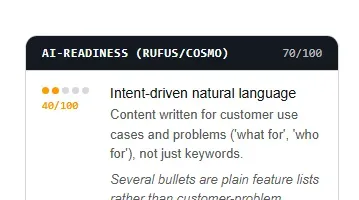
Keyword-dense fragments are hard to quote from. Plain, complete factual sentences are easy to quote and easy to match against a real question:
20oz insulated, fits standard cup holders, keeps drinks cold 24hrs
That reads fine to a keyword matcher and gives an AI assistant almost nothing clean to quote. Rewritten as a sentence, it becomes both:
Holds 20 ounces and fits standard car cup holders. Insulation keeps drinks cold for up to 24 hours.
Same keywords, same information, but now it's a sentence a model can lift directly into an answer instead of having to guess at the relationship between fragments.
Where this shows up across a listing
- Bullets and description, rewritten as complete sentences rather than keyword strings.
- Backend attribute fields, filled in completely rather than left blank where they're not customer-visible.
- A+ Content modules, especially comparison charts and FAQs, which are exactly the structured format these systems can cite directly.
FAQ
What is COSMO in Amazon SEO?
COSMO is Amazon's foundational shopping model. It builds a knowledge graph connecting products, attributes and customer intent, and it's what tools like Rufus draw on to answer a shopper's question rather than just match keywords. Incomplete attribute fields on a listing leave gaps in that graph.
Is Rufus the same as Amazon's search algorithm?
No. Classic search retrieval and ranking still run on keyword matching and behavioural signals. Rufus sits alongside it as a conversational layer that reads and summarises listings to answer natural-language questions. A listing can rank normally in search and still be a poor source for Rufus to quote, or vice versa.
How do I write listing copy an AI assistant can actually use?
Plain, complete factual sentences: who the product is for, what it's made of, when to use it. A model can quote "holds 20oz and fits standard cup holders" directly; it can't cleanly extract the same facts from a fragment like "20oz cup holder fit insulated."
AI-readiness is scored as one of the audit's 12 criteria. Paste any ASIN and see whether the copy reads as fragments or as sentences a model could quote.
Audit a listing freeMore from the blog