Amazon SEO & Algorithm
How Amazon Actually Ranks Listings, And What You Control
Amazon ranks a listing on two things: how well it matches what someone typed, and how well it converts once shown. Your content decides the first. Your sales history decides the second. Almost every ranking problem a seller has is one of those two, and they need completely different fixes.
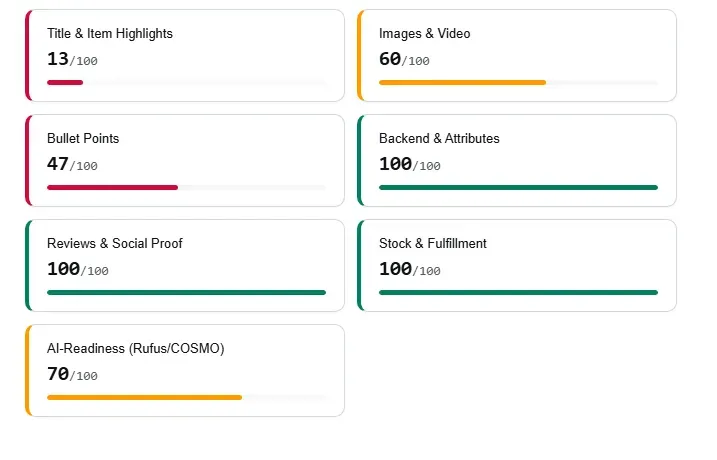
That distinction matters more than any tactic, because it tells you whether your problem is fixable by editing text this afternoon or not.
This piece stays focused on that mechanism. For the full factor-by-factor picture, reviews, price, Buy Box, stock, external traffic and Amazon's AI layers, see the complete Amazon SEO guide for 2026.
What does Amazon's ranking algorithm actually do?
It answers a shopper's query with the products most likely to sell. Amazon is a shopping engine, not a library. It isn't ranking the most informative page, it's ranking the one most likely to end in a purchase.
That runs in two stages. First a retrieval stage decides which products are even eligible for a query: this is pure text matching against your indexed content. Then a ranking stage orders the eligible set using behavioural signals, including click-through, conversion rate, sales velocity, reviews, price competitiveness, and fulfilment speed.
If your listing isn't indexed for a phrase, no amount of sales history will make it rank for that phrase. You can't be ordered into a set you were never retrieved into.
Why isn't my listing showing up in search at all?
Nine times out of ten it's the retrieval stage, and the cause is one of these:
- The phrase isn't in your indexed content. Amazon can only match words it has. If "noise cancelling" appears nowhere in your title, bullets, description or backend terms, you are not in that result set.
- Your title was suppressed or rewritten. Titles over the character limit, or containing banned promotional terms, can be silently altered. The rewrite is the dangerous case, since nothing tells you it happened.
- You're out of stock or not Prime-eligible. Availability gates visibility, and the Prime badge is a strong ranking and conversion signal in its own right.
- The listing is too new. With no behavioural history, there's nothing for the ranking stage to work with yet.
Check retrieval first. It is the cheapest thing to fix and the most common cause.
Does Amazon rank by keywords or by sales?
Both, but not at the same step, and that's the part most advice gets wrong. Keywords decide whether you appear. Sales performance decides where you appear.
The practical consequence: stuffing more keywords into a listing that already ranks won't move it up, and improving conversion won't rescue a listing that isn't indexed for the term. Diagnose which half is broken before you spend a week on the wrong one.
There's also a feedback loop worth understanding. Better content raises click-through and conversion, which feeds the performance signals, which improves rank. Content is the only input you control directly; everything else is downstream of it.
Does keyword repetition help?
No. Amazon indexes a word once. Repeating it in your title, then again in bullets, then again in backend terms buys nothing, and heavy repetition is a known trigger for automatic rewrites.
This is why the 249-byte backend field is so often wasted. Sellers fill it with the words already in their title. Those are already indexed. The field exists for demand that has nowhere else to go: synonyms, common misspellings, translated terms, and use-cases the visible copy never states. The Backend Terms Checker exists to show you exactly which of your bytes are doing nothing.
What is Rufus, and does it change how I write a listing?
Rufus and COSMO are Amazon's AI shopping layers. Instead of matching a keyword, they answer a question, such as "which of these is best for a small kitchen," by reading listings and summarising them.
This changes what good copy looks like. Keyword-dense fragments are hard for a model to quote. Plain factual sentences that state who the product is for, when to use it, and what it's made of are easy to quote. A listing that reads like a specification sheet ranks fine in classic search and gets ignored by an AI summary.
You don't need to choose. A listing written in clear, factual sentences containing your keywords satisfies both, which is why AI-readiness is one of the twelve criteria the audit scores.
Which ranking factors can I actually control?
Sort every factor into two buckets and only work the first one:
- Written today: title format and length, bullet structure, description, backend search terms, image count and type, A+ content. All of it is editable in Seller Central this afternoon.
- Earned over time: conversion rate, sales velocity, review count and rating, return rate. These respond to changes in bucket one, but only after traffic flows through.
Sellers waste enormous effort on bucket two directly, chasing reviews, cutting price, while a fixable content problem quietly caps how much traffic ever arrives. Fix what you control, then let the performance signals catch up.
What should I fix first?
In this order, because it's roughly the order of impact per hour spent:
- The title. It carries the most ranking weight and is the most common compliance failure. Brand + Product + one differentiating attribute, inside the character limit, no promotional terms.
- Images. Below about seven images you are losing conversion, which feeds straight back into rank.
- Bullets. Five benefit-led bullets, sentence-case headers, no ALL CAPS, a rule now actively enforced.
- Backend terms. Fill the 249 bytes with words that appear nowhere else in the listing.
- AI-readiness. Rewrite at least a few lines as plain factual sentences a model can quote.
None of this requires guessing. Every item above is checkable against a fixed rule, which is exactly what an audit is for.
FAQ
How do I rank higher for a keyword on Amazon?
Ranking higher for a keyword on Amazon means working on two different things depending on where you're stuck. If your listing isn't showing up in search results at all for the term, that's a retrieval problem: the phrase needs to actually appear in your indexed content (title, bullets, description, or backend terms). If you're showing up but low in the results, that's a ranking problem, driven by conversion rate, sales velocity, reviews, and price competitiveness. Fixing the wrong one wastes effort, so diagnosing which stage is broken comes first.
I'm indexed for my main keyword but stuck on page three. What actually moves a listing up Amazon's rankings?
Being indexed but stuck on page three means the retrieval stage is working and the ranking stage is where the problem lives. That stage runs on behavioral signals: click-through rate, conversion rate, sales velocity, reviews, price competitiveness, and fulfillment speed, not the copy itself. The copy's job was already done getting you indexed; from here, the fastest lever is usually conversion rate, since it feeds directly into the ranking signals Amazon actually weighs.
Does adding more keywords to my listing help me rank higher?
Only if those keywords aren't already indexed somewhere in the listing. Amazon indexes a word once regardless of how many fields repeat it, so adding a keyword that's already in your title, bullets, or backend terms changes nothing. Adding a genuinely new term you're not yet indexed for can help you get retrieved for that additional search, which is a different effect than ranking higher for a term you already show up for.
What's the difference between being indexed and ranking well on Amazon?
Being indexed means your listing is eligible to appear at all for a given search term, decided by whether that phrase exists in your title, bullets, description, or backend terms. Ranking well means where you show up within that eligible set, decided by behavioral signals like conversion rate and sales velocity. A listing can be indexed for a term and still rank on page three; that's a ranking problem, not an indexing one.
Does Rufus or COSMO change how Amazon ranks listings?
Rufus and COSMO summarize listings to answer a shopper's question rather than matching keywords directly, which changes what counts as good copy: plain factual sentences a model can quote, rather than keyword-dense fragments. It doesn't replace classic search ranking; a listing needs to satisfy both, which is why AI-readiness is scored as one of the 12 audit criteria alongside the traditional ranking factors.
How long does it take to see a ranking change after fixing my listing?
Content fixes like a rewritten title or bullets can affect retrieval quickly, often within days, once Amazon reindexes the updated content. Ranking changes take longer, since they depend on behavioral signals like conversion rate and sales velocity accumulating after the fix, not the fix itself. A seller checking rank the day after a content change is usually checking too early to see the ranking-stage effect.
I've already optimized my title and bullets. Why hasn't my rank improved?
If retrieval is already working, meaning the listing shows up for the term at all, further title and bullet changes won't move rank further, since that's now a ranking-stage problem driven by conversion rate, sales velocity, and reviews rather than content. Checking which stage is actually stuck, rather than continuing to edit content that already indexes correctly, is what usually gets missed.
Can I rank for a keyword I haven't put in my title?
Not for that specific exact term, no. Retrieval requires the phrase to exist somewhere in your indexed content: title, bullets, description, or backend search terms. A keyword that appears nowhere in the listing isn't eligible to be retrieved for that search, regardless of how strong your sales or reviews are.
Paste any ASIN and see which of the 12 ranking criteria it fails, with AI-written replacement copy for anything that breaks a rule. Free, no card needed.
Audit a listing freeMore from the blog