To check Amazon keyword search volume, you need a source built on Amazon's own search data: Brand Analytics if your brand is registered, or an Amazon keyword search volume tool for any phrase you want to size. A Google figure measures a different audience.
This guide covers the four places sellers get the number, what the figure means, and how to turn it into a title, bullets and backend terms you can score before they go live.
Key Takeaways (TL;DR)
- Amazon keyword search volume is the estimated number of times shoppers type a phrase into Amazon's search bar in a month, on one marketplace.
- Amazon publishes real query counts only inside Brand Analytics, for Brand Registry sellers on a Professional account.
- Third-party figures are modelled estimates. Read them as approximate (≈) and compare terms against each other.
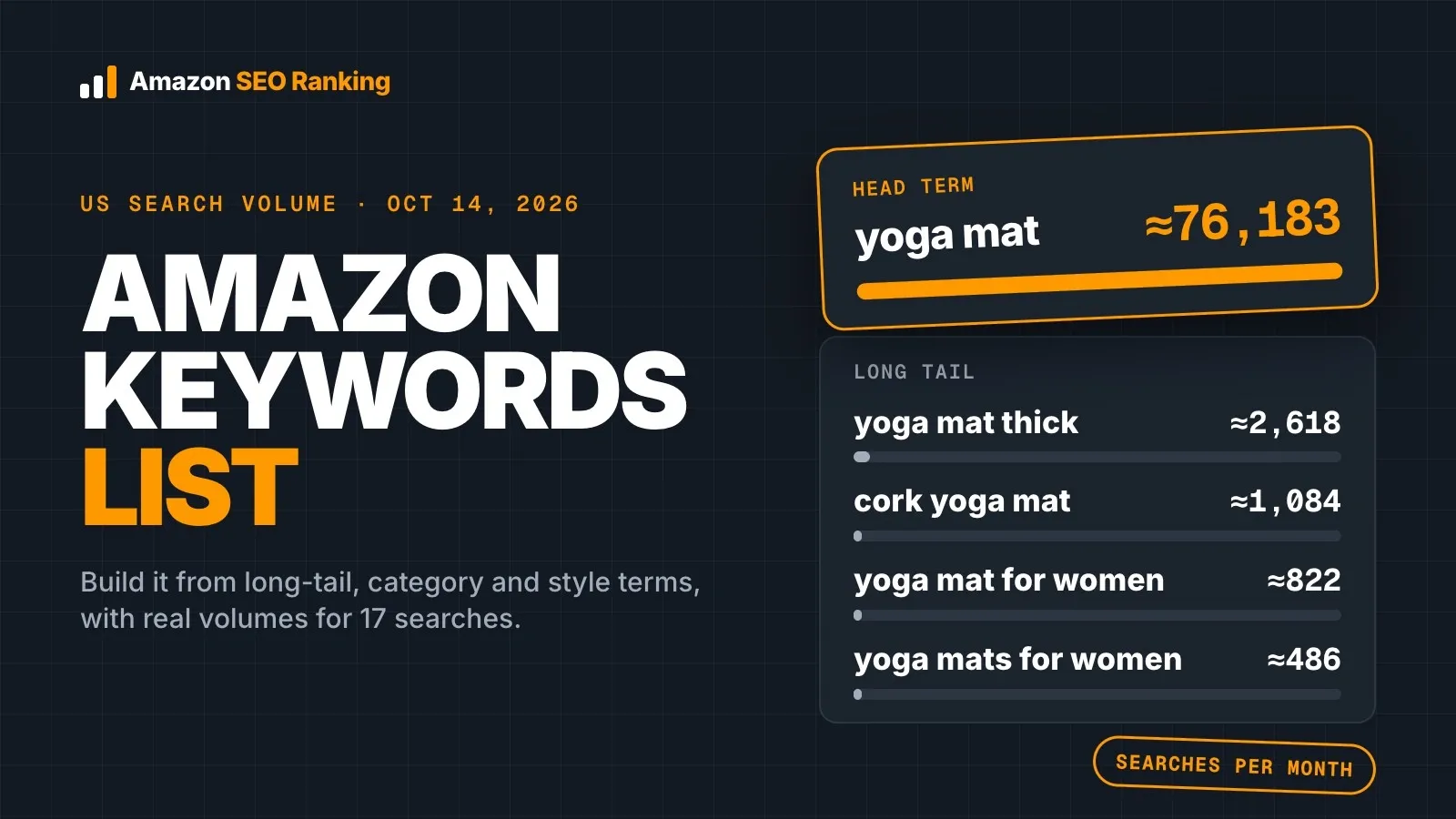
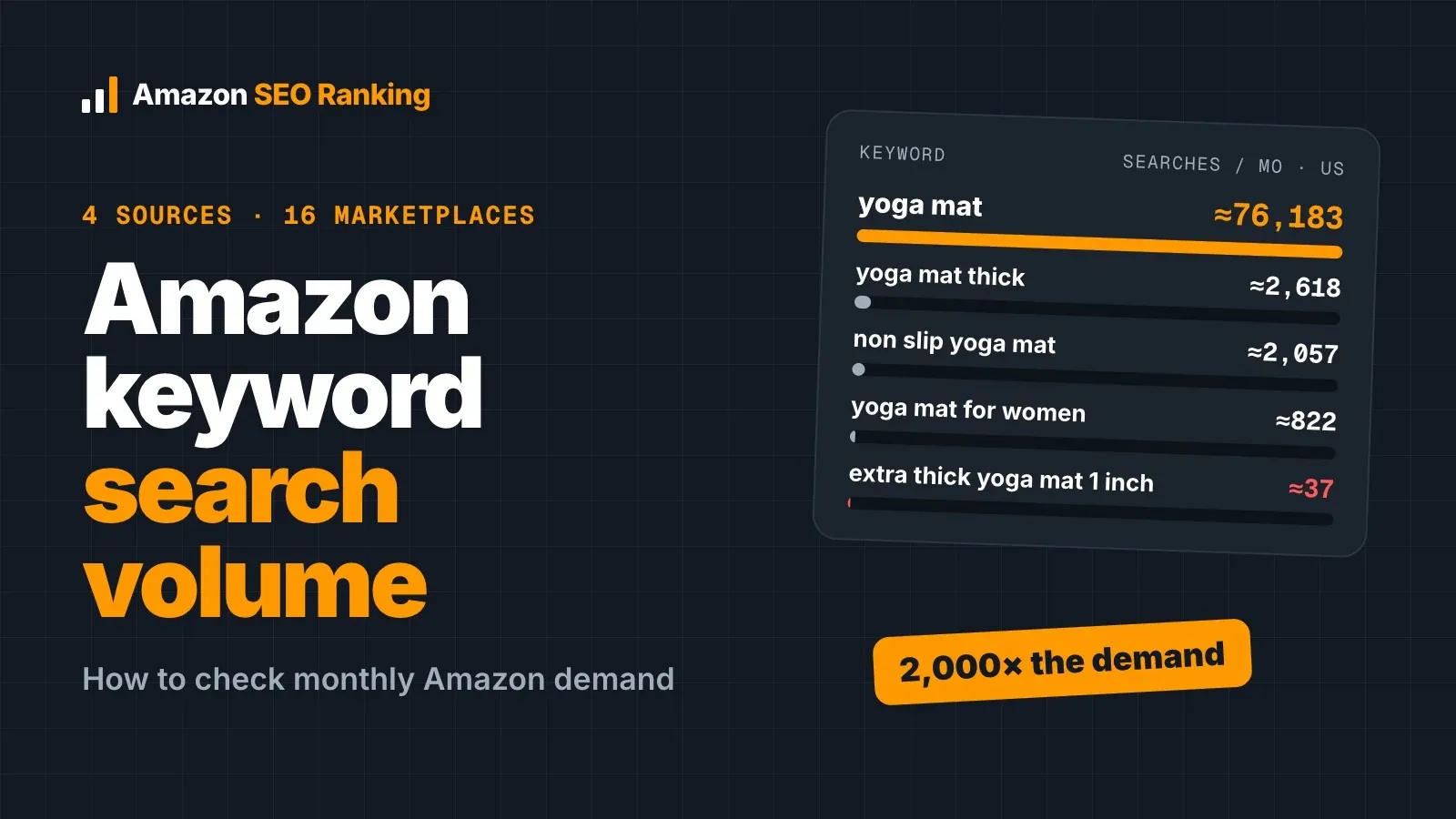
- In our own US check, "yoga mat" returned about 76,000 searches a month; "extra thick yoga mat 1 inch" returned 37.
- Pair volume with a competition signal before a term goes in your title.
- Volume pays off once it's placed in copy. Amazon SEO Ranking feeds your chosen keywords into the AI Copy Rewriter's coverage check, and you can score the new copy as a draft before it goes live.
- The Search volume tool covers 16 marketplaces at 1 lookup per keyword, with 2,000 lookups a month on Pro ($79/mo, 7-day trial). It also runs inside Claude through our connector.
Amazon Keyword Search Volume: at a Glance
| Question | Answer |
|---|---|
| What it measures | Estimated monthly searches for an exact phrase on one Amazon marketplace |
| Official source | Brand Analytics, Search Query Performance dashboard (Brand Registry only) |
| Third-party source | Modelled estimates from Amazon search data, shown as ≈ |
| Typical spread | Related phrases can range from tens to tens of thousands a month (37 to ≈76,000 in our yoga mat check) |
| What to use it for | Choosing the title keyword, bullet keywords and backend search terms |
| What to pair it with | A competition score and the month-to-month trend |
| Marketplaces in our Search volume tool | 16 |
| Cost in Amazon SEO Ranking | 1 keyword lookup per keyword; Pro includes 2,000 a month |
The rest of this guide expands each row.
If you only need the number for one phrase today, skip to Method 4. If you're deciding what goes into a listing, the worked example and the reading section matter more than the raw figure.
What Amazon Search Volume Measures
Amazon search volume is a count of how often shoppers enter a specific phrase into the search bar on one Amazon storefront over a set period, usually a month. It's tied to the exact phrase and the marketplace. "Yoga mat" on amazon.com and "Yogamatte" on amazon.de are two separate numbers.
Outside Brand Analytics, the search volume Amazon records isn't published. Tools model it from Amazon search data, which is why our Search volume tool shows volumes with "≈" and reports lower volumes in steps, so several long-tail phrases can share one figure.
That has a practical consequence. A gap of 2,618 versus 2,057 searches tells you less than a gap of 2,000 versus 37. Use the number to rank candidate phrases against each other, and treat small gaps as a tie.
Amazon Search Keyword Volume vs Google Search Volume
Shoppers start product searches on Amazon more often than anywhere else. In a May 2022 survey charted by eMarketer, 61% of US consumers said they begin their product search on Amazon, ahead of search engines like Google. Those searches come from people already shopping inside a category.
Google Keyword Planner counts searches across the open web, where the same words mix research, review and comparison intent. There's no fixed ratio for converting one figure into the other, because the gap changes by category. Our guide to the Amazon keyword planner question covers where the two sources disagree.
For a listing, the Amazon figure is the one to plan around. It's the demand your title and bullets compete for.
How to Check Amazon Search Volume: 4 Methods
There are four places to get Amazon keyword data. They differ in who can open them and how much of the search universe they show.
| Method | Who can use it | What you get | Main limit |
|---|---|---|---|
| Brand Analytics | Professional account + Brand Representative on a Brand Registry brand | First-party query volume, impressions, clicks, cart adds, purchases | Only queries tied to your brand |
| Amazon Ads search term report | Sellers running Sponsored Products | Queries that triggered your ads, with impressions and clicks | Only queries your ads served on |
| Amazon autocomplete | Anyone | Phrases shoppers type, in suggested order | No numbers |
| Amazon keyword search volume tool | Subscribers | Estimated monthly volume for any phrase | Modelled estimate |
Most sellers combine two of these. Autocomplete or Brand Analytics builds the list, and a volume tool sizes every phrase on it, including the ones you don't rank for yet.
Method 1: Brand Analytics Search Query Performance
Brand Analytics is Amazon's own reporting inside Seller Central. According to Amazon, access needs a Professional selling account and the Brand Representative role on a brand enrolled in Brand Registry. You open it from Brands, then Brand Analytics.
The Search Query Performance dashboard lists the queries customers use to find your brand, with query volume, impressions, clicks, cart adds and purchases. That's first-party Amazon keyword search data. Its limit is scope: it reports on queries where your brand already appears, so it can't size a keyword you haven't reached. The separate Top Search Terms dashboard lists what customers search for, with the top three products, categories and brands for each term.
Method 2: Your Amazon Ads search term report
If you run Sponsored Products, the search term report shows the queries that triggered your ads, with impressions and clicks. High impressions on a query point to real demand.
The report only covers queries your ads were eligible for. A term outside your targeting never appears, so use it as evidence that a query converts for you and size the wider market elsewhere.
Method 3: Amazon autocomplete
Type a seed term into Amazon's search bar and the suggestions show phrases shoppers enter on that marketplace. It's free and takes seconds.
Autocomplete gives you no counts. It's a list builder, and the list still needs sizing with Method 1 or Method 4. Our post on Amazon long-tail keywords shows how to grow that list from one seed.
Method 4: An Amazon keyword search volume tool
A third-party Amazon keyword volume tool estimates monthly volume for any phrase, whether or not you sell in the category yet. Each Amazon keyword tool search volume figure is a model, so two tools can return different numbers for the same term. Pick one and compare terms inside it.
In Amazon SEO Ranking, the Search volume tool works in four steps:
- Pick the marketplace (16 available, from the US to Australia).
- Paste one keyword or a batch.
- Read each estimated monthly volume next to its competition score. The score is computed from the review counts of the top-ranking listings and how often Amazon's Choice or Best Seller badges appear among them.
- Save the terms you'll use to a saved list, which records a monthly volume snapshot.
Each keyword costs 1 lookup. Pro includes 2,000 a month and Agency 10,000. If you need new ideas rather than sizing a list you already have, the Keyword ideas tool in our Amazon keyword research tool suite expands a seed into up to about 300 ideas graded by relevance, at 10 lookups per search (US, Egypt, Saudi Arabia and UAE).
If you work in Claude, you can skip the browser. On Pro and Agency, the Amazon SEO Ranking connector gives Claude the same keyword volume lookup, so you can paste a shortlist into a chat and get Amazon volumes back, on the same quota as the website.
Agencies sizing keywords across client catalogs get 10,000 lookups a month on the Agency plan, plus Keyword gap to compare up to 20 ASINs and a project workbook that collects every table into one linked .xlsx.
What to Look for in an Amazon Keyword Volume Tool
Every tool on the market returns a number. The useful differences are in what the number comes with and what you can do with it next.
Four questions separate a tool you'll keep using from one you'll export from once:
- Does it label estimates as estimates? A tool that shows "2,618" as an exact count invites you to over-read small gaps. Our Search volume tool marks every figure with ≈ and reports low volumes in steps.
- Is there a competition signal next to the volume, so a head term buried under heavily reviewed listings doesn't look like the obvious pick?
- Does the volume reach your copy? In Amazon SEO Ranking, the keywords you pick become the target and secondary keywords in the AI Copy Rewriter, which shows where each one landed.
- Can you check the finished copy before it's live? A draft audit scores the new title and bullets against the listing's real images, rating and Prime status, using 1 audit.
The last two matter most for a seller about to update a listing. A volume table sitting in a spreadsheet hasn't changed anything yet.
A Worked Example: Five Yoga Mat Keywords
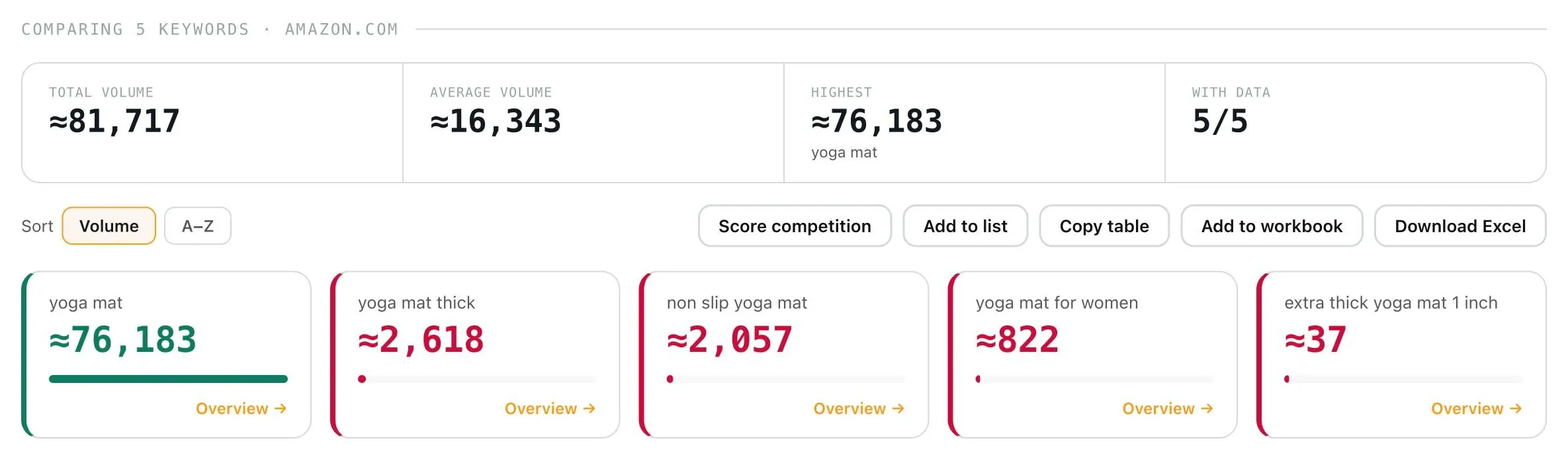
We ran five related phrases through our Amazon keyword volume checker on amazon.com. The head term carries more than 2,000 times the demand of the longest phrase.
| Keyword | Est. monthly US searches |
|---|---|
| yoga mat | ≈76,183 |
| yoga mat thick | ≈2,618 |
| non slip yoga mat | ≈2,057 |
| yoga mat for women | ≈822 |
| extra thick yoga mat 1 inch | ≈37 |
"Yoga mat" is the title keyword by volume, and also the term every large brand in the category targets. "Yoga mat thick" and "non slip yoga mat" sit close enough to count as a tie, so pick whichever describes your product and place it in the title or first bullet. "Extra thick yoga mat 1 inch" at 37 a month fits in backend search terms, where it uses no visible space.
The useful output here is the order. A seller writing from instinct might lead with "for women" because it sounds targeted, and give up about three times the demand of "yoga mat thick." Run an Amazon keyword volume search for each phrasing you're considering before you commit a title to one.
How to Read the Numbers Before You Write
A volume figure on its own doesn't tell you which term to use. Three checks turn it into a decision.
Each one below takes a minute once the numbers are in front of you.
What counts as a good search volume
There's no universal threshold. A good number is high relative to the other phrases that accurately describe your product, in your category, on your marketplace. 822 searches a month is small next to "yoga mat" and large for a niche replacement part.
High Amazon search volume keywords also attract the most heavily reviewed listings. That's why the Search volume tool shows a competition score beside each volume. A newer listing with few reviews often gets more from a mid-volume term with thin competition than from the head term.
Reading Amazon keyword search trends over time
A single check is a snapshot. Amazon keyword volume moves with seasons and trends, and a term that peaks in November can look small in July.
Saved lists keep a monthly snapshot for every saved keyword, sortable by change, so you can see whether a term is rising before you rebuild a listing around it. For seasonal products, recheck volume before working through your Amazon Q4 listing checklist.
Checking volume per marketplace
Volume doesn't carry over between storefronts. A term with strong demand on amazon.com can be weak on amazon.co.uk, and translated phrases on amazon.de need their own check. A seller who only checks their home marketplace is guessing everywhere else they list.
Our Search volume tool covers the US, Canada, Mexico, UK, Germany, France, Italy, Spain, Netherlands, Austria, UAE, Saudi Arabia, Egypt, India, Singapore and Australia. The deeper tools (Keyword ideas, "What I rank for", Competitors and Keyword gap) currently cover the US, Egypt, Saudi Arabia and UAE.
The listing audit goes further, to 20 Amazon storefronts. Once you've sized keywords for a marketplace, you can audit the same ASIN there, and the score and the fixes it asks for often differ from your home store.
From Search Volume to a Listing That Uses It
Volume data pays off once it's in the copy. A title has room for one main keyword near the start plus a couple of attributes; our audit enforces a 75-character title, and the Amazon title character limit guide covers the current rules.
A simple placement order:
- The highest-volume term that describes the product goes early in the title.
- The next two or three belong in Item Highlights and the first bullets.
- Relevant low-volume phrases go into backend search terms, inside the 249-byte limit and without repeating visible words. See our guide to Amazon backend search terms for the formatting rules.
The AI Copy Rewriter takes a target keyword plus secondary keywords and shows a coverage check of where each one landed. Every rewrite is checked in code for length limits, pack-count mismatches and unsupported claims, and you can score the new copy as a draft audit before it goes live.
To see which terms a listing already ranks for before you change it, run a reverse ASIN lookup with "What I rank for". Each lookup uses 1 audit and covers the US, Egypt, Saudi Arabia and UAE.
Everything You Need to Know About Amazon Keyword Search Volume
| Topic | Summary |
|---|---|
| Definition | Estimated monthly searches for an exact phrase on one Amazon marketplace |
| Official data | Brand Analytics Search Query Performance; Professional account and Brand Registry required; only queries tied to your brand |
| Free methods | Autocomplete (no counts) and the Ads search term report (only your ads' queries) |
| Third-party data | Modelled estimates shown as ≈; compare terms inside one tool |
| Amazon vs Google | Different intent; no fixed conversion ratio between the two |
| Choosing a tool | Estimates labelled as estimates, a competition score, volume that reaches your copy, and a way to score the copy before it's live |
| Good volume | Judged against your other candidate phrases, alongside a competition score |
| Trends | Recheck monthly; Saved lists snapshot each keyword |
| Marketplaces | 16 for volume in Amazon SEO Ranking; 4 for the advanced keyword tools; 20 for the listing audit |
| Placement | Main term early in the title, next terms in Item Highlights and bullets, long tail in backend terms (249 bytes) |
| Cost in Amazon SEO Ranking | 1 lookup per keyword; Pro $79/mo for 2,000; Agency $189/mo for 10,000; also available inside Claude on both plans |
Use this table as a checklist before a listing update.
If a row raises a question, the matching section above has the detail, and the FAQs below cover the questions sellers ask most.
Check Your Amazon Keywords Before You Rewrite
Amazon SEO Ranking gives you Amazon search volume from Amazon's own search data across 16 marketplaces, and connects it to the copy. The same keywords feed the AI Copy Rewriter's coverage check, every rewrite is checked for health claims, unsupported claims and pack-count mismatches before you paste it, and a draft audit scores the result before it goes live. The audit behind it is published in full: 12 criteria, each with its pass rule.
It's built for sellers and agencies whose job is making existing listings rank better, including listings sold on more than one Amazon storefront and teams that do their listing work in Claude. Pro costs $79 a month, compared with $99 for Helium 10's Platinum plan in our Amazon SEO Ranking vs Helium 10 comparison. It doesn't cover product research or PPC.
Open the Amazon keyword volume checker and start a 7-day Pro trial, with no charge until it converts and a 14-day money-back guarantee on any charge. Not ready to commit? Run a free Amazon listing audit first, with no credit card and 3 audits a month.
FAQ
How can I check the monthly search volume for a keyword on Amazon?
To check the monthly search volume for a keyword on Amazon, use Brand Analytics Search Query Performance if your brand is enrolled in Brand Registry, or an Amazon keyword search volume tool for any phrase. Brand Analytics reports first-party query volume, but only for queries where your brand already appears. Amazon SEO Ranking's Search volume tool returns estimated monthly volume for one keyword or a batch across 16 marketplaces, with a competition score beside each. Each keyword costs 1 lookup, and Pro includes 2,000 a month for $79, on the website or inside Claude.
Does Amazon show keyword search volume?
Amazon shows keyword search volume only inside Brand Analytics, which requires a Professional selling account and the Brand Representative role on a brand enrolled in Brand Registry. Its Search Query Performance dashboard lists query volume, impressions, clicks, cart adds and purchases for the queries customers use to find your brand. The search bar and autocomplete show no counts. For every other term, sellers rely on third-party estimates.
Can I check Amazon keywords search volume in bulk?
Yes, you can check Amazon keywords search volume in bulk by pasting a list into a volume tool instead of checking terms one at a time. Amazon SEO Ranking's Search volume tool accepts a single keyword or a batch and returns an estimated monthly volume and competition score for each. Each keyword uses 1 lookup, so a 50-keyword shortlist uses 50 of Pro's 2,000 monthly lookups. Results copy as a table into Google Sheets or Excel, or can be added to a linked project workbook.
Why do Amazon keyword tools show different search volumes?
Amazon keyword tools show different search volumes because Amazon doesn't publish counts, so each tool models its own estimate. Differences in data sources, refresh timing and rounding produce different figures for the same phrase. Amazon SEO Ranking shows volumes with "≈" and reports lower volumes in steps, so several long-tail phrases can share one figure. Compare terms inside one tool and avoid mixing numbers from two.
What is a good search volume for an Amazon keyword?
A good search volume for an Amazon keyword is one that ranks high among the phrases that accurately describe your product, in your category and marketplace. In our October 2026 US check, "yoga mat" returned ≈76,000 monthly searches and "yoga mat for women" ≈822, and both are usable in a yoga mat listing. Read volume alongside competition, because a term whose top listings carry large review counts is harder to win than a mid-volume term with thinner competition. Put the highest-volume relevant term in the title and smaller ones in bullets and backend terms.
Is Amazon search volume monthly or daily?
Amazon search volume is usually reported as a monthly figure. Amazon SEO Ranking's Search volume tool returns estimated monthly searches, and Saved lists record a snapshot each month so you can track change. Brand Analytics Search Query Performance reports query volume for the period you select. Monthly figures smooth out daily swings, so seasonal terms are best rechecked in the months before their peak.
How accurate is Amazon keyword search volume data?
Amazon keyword search volume data from third-party tools is an estimate, accurate enough to rank phrases against each other but not to forecast exact traffic. Only Brand Analytics reports first-party counts, and only for queries your brand appears in. Small gaps, such as 2,618 versus 2,057 monthly searches, should be read as a tie, while large gaps, such as ≈76,000 versus 37, are reliable signals. Check that the top listings for a term show real sales activity before you commit your title to it.
Why pay for Amazon search volume when Google Keyword Planner is free?
Paying for Amazon search volume makes sense because Google Keyword Planner measures Google searches, which carry a different intent mix from searches typed into Amazon. In a May 2022 survey charted by eMarketer, 61% of US consumers said they start their product search on Amazon, so the demand your listing competes for is recorded there. There's no fixed ratio for converting a Google figure into an Amazon one, since the gap varies by category. Amazon SEO Ranking's Pro plan includes 2,000 Amazon keyword lookups for $79 a month, with a 7-day free trial before any charge.