Listing Optimization
Amazon's 75-Character Title Limit: What Actually Changed
If your titles were written before this year, a good number of them are now non-compliant, and the listings that suffer most are usually the ones that were working hardest. The long, keyword-dense title that used to be an advantage is the exact shape the new rule targets.
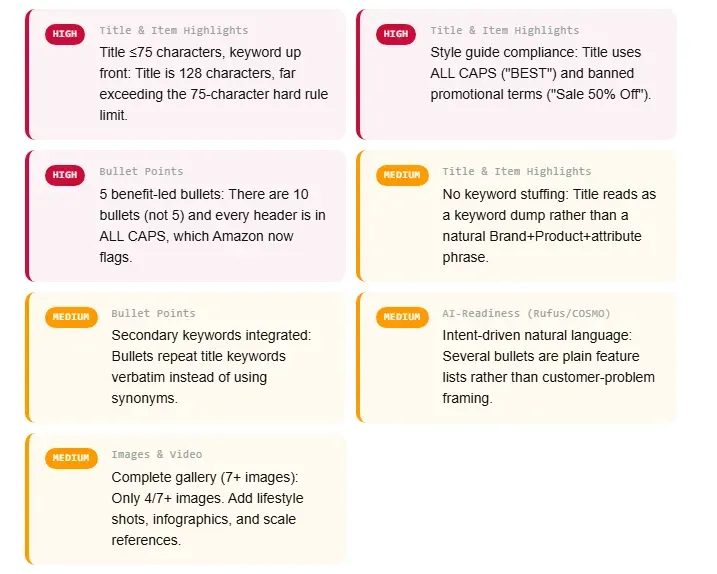
This piece covers the title in isolation. For where it fits alongside bullets, images and backend terms, see the complete listing-optimization guide.
The rule in one line
Titles are capped at 75 characters including spaces across nearly every category, with media categories excluded. That is roughly half of the 150 to 200 characters most sellers built their titles around.
Amazon may suppress or silently rewrite a title that breaks the limit. A rewritten title is the worse outcome: you keep the traffic loss without seeing an error.
What else is being enforced
Length is the visible change, but the style rules that always existed are now actually checked:
- No promotional terms, like
best,cheap,sale,free shipping,guarantee,#1. - No decorative characters, like
~ ! * $ ? _ { } #, emoji, and the ™ / ® symbols. - No ALL CAPS, in the title or in bullet headers.
- No keyword stuffing. Repeating a term is a trigger for an automatic rewrite.
Where the keywords go instead
This is the part sellers get wrong. Cutting a title to 75 characters does not mean losing the keywords. It means moving them somewhere Amazon still indexes:
- Item Highlights, the newer indexable field, is where materials, use cases and secondary attributes belong.
- Backend search terms hold synonyms, common misspellings and translated terms: 249 bytes that shoppers never see.
- Bullet points carry the benefit-led detail that used to be crammed into the title.
A word already in your title is already indexed. Repeating it in the backend field spends bytes on nothing, which is what the Backend Terms Checker is for.
Rewriting a title that's too long
The format that survives the rule is Brand + Product + one differentiating attribute. Everything else moves.
Best Cheap Wireless Bluetooth Earbuds!!! Noise Cancelling Headphones For Gym Sports Waterproof IPX7 40Hrs Battery NEW 2026
That title breaks four rules at once: over the limit, promotional terms, decorative characters, and a repeated keyword. The compliant version keeps the ranking terms and drops the noise:
AudioMax Wireless Earbuds, Active Noise Cancelling, 40Hr Battery, IPX7
Same product, same search relevance, 70 characters. The waterproof rating and battery life stay because they are differentiating attributes; the superlatives go because they were never indexed anyway.
Checking your own catalogue
Character count is the easy part; a spreadsheet will find it. The harder failures are the style ones, because nothing tells you they happened. A listing that was quietly rewritten looks fine in Seller Central.
Run any ASIN through the audit and see which of the 12 criteria it fails, with a compliant rewrite for anything that breaks a rule.
Audit a listing freeMore from the blog