Listing Optimization
Amazon Listing Optimization: The Complete Guide to Title, Bullets, Images and Keywords
Five parts of a listing decide whether it ranks and sells: title, bullet points, images, description or A+ Content, and backend search terms. Fix them in that order, because the title carries the most ranking weight and is the field with the strictest rules, and the rest compound from there.
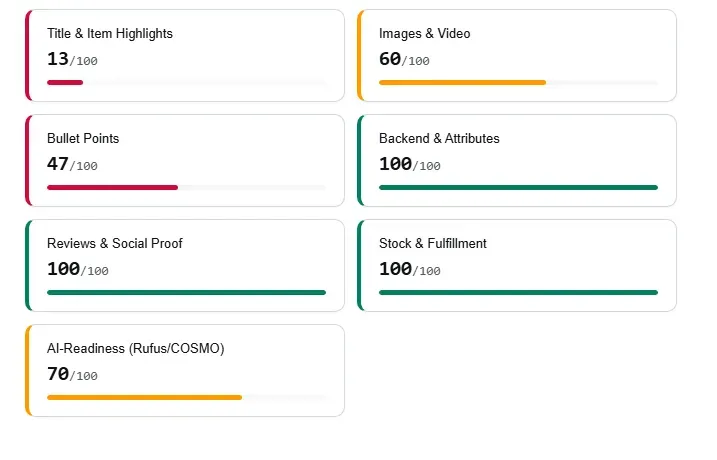
This guide stays at listing level: what to write, and in what order. For how these elements feed into Amazon's ranking algorithm itself, see Amazon SEO in 2026; for the exact character limit and formatting rules a title has to pass, see Amazon's 75-Character Title Limit.
The five things worth optimizing, in order
Not every element carries equal weight, and fixing them out of order wastes effort. A beautifully written description won't rescue a title that's over the limit or missing your main keyword. Work through these five in sequence:
Title
Brand, product type, and one differentiating attribute, inside the 75-character limit, no promotional language, no decorative characters. It carries some of the heaviest scoring weight of the five, and it's the field most listings get wrong, because it's also the field with the strictest formatting rules. See the full title-limit breakdown for exactly what's enforced and how to rewrite one that's now too long.
Bullet points
Five bullets, sentence case, no ALL CAPS: a rule Amazon now actively enforces rather than just recommends. Lead each one with the benefit, not the feature. "Keeps drinks cold for 24 hours" outranks "Double-wall vacuum insulation" as an opening clause, because it answers the shopper's actual question before the spec does. If you'd rather not rewrite five bullets by hand for every listing, the AI Copy Rewriter generates compliant, benefit-led options from your current copy. How to Write Bullet Points That Rank and Convert covers the full structure.
Images
Below about seven images, you're losing conversion, and conversion is a ranking input, so this isn't a cosmetic issue. The main image needs a pure white background with no props or text overlays; the rest of the set should mix lifestyle shots, a scale reference, and an infographic stating the specs a shopper would otherwise have to read for. A stronger image set is one of the fastest conversion improvements available, because it doesn't wait on new reviews or sales history to take effect. The Impact of Images on CTR and Sales covers the exact requirements.
Description and A+ Content
If your brand is enrolled in Brand Registry, A+ Content replaces the plain-text description and does more work: comparison charts, use-case modules, and brand story sections that plain text can't match for comprehension. It isn't a direct ranking factor the way title and bullets are, but it lifts conversion, and it's increasingly what AI shopping layers like Rufus read to summarise a product, which makes plain, factual module copy worth as much as persuasive copy now. How to Use A+ Content covers the three scored elements.
Backend search terms
249 bytes, hidden from shoppers, meant for the words that have nowhere else to go: synonyms, common misspellings, translated terms, and use-cases your visible copy never states outright. A word already in your title or bullets is already indexed; repeating it here spends bytes on nothing. The Backend Terms Checker shows exactly which of your current bytes are dead weight, and Backend Search Terms: What to Include and What to Avoid covers why no external audit can check this field automatically.
Common on-page mistakes
- Repeating a keyword across title, bullets and backend terms. It's indexed once no matter how many times you write it.
- ALL CAPS bullet headers, which Amazon now flags and can rewrite without warning.
- Leaving A+ Content unused despite being Brand Registry-enrolled, a wasted conversion lever, not just a missed nice-to-have.
- Backend terms that just restate the visible title, spending 249 bytes on nothing.
- Fewer than seven images in a category where the top competitors run nine or ten.
Common On-Page SEO Mistakes on Amazon Listings covers these in full, plus two more that don't show up on a casual read-through.
A listing-optimization checklist
- Rewrite the title to Brand + Product + one differentiator, inside 75 characters.
- Rewrite bullets as five benefit-led, sentence-case lines.
- Count your images. Add lifestyle and infographic shots to reach at least seven.
- Enable or refresh A+ Content if your brand is eligible and it's currently blank or outdated.
- Clear the backend field of any word that already appears in the visible listing, then fill the freed bytes with real synonyms.
This checklist is what to fix. For the process of finding out what needs fixing in the first place, including how to grade a listing you don't have edit access to, see how to audit an Amazon listing for SEO.
FAQ
How long should Amazon bullet points be?
There's no hard character cap the way there is for titles, but the practical limit is what fits above the fold before a shopper has to expand the listing: roughly 200 to 250 characters per bullet works well in practice. Longer than that and the benefit gets buried; shorter and you're leaving room to state the actual use case unused.
How many images does an Amazon listing need?
Enough to answer a shopper's obvious questions without them reading a word: what it looks like from multiple angles, its scale next to something familiar, and how it's used. In practice that's rarely fewer than seven, and competitive categories often run nine or ten. Below that range, conversion measurably drops.
What's the difference between backend search terms and Item Highlights?
Backend search terms are 249 bytes, hidden from shoppers, indexed but never displayed, which makes them the right place for synonyms and misspellings. Item Highlights is a visible, indexed field shoppers actually read, meant for real attributes and use cases that don't fit in the title. Put searchable-but-invisible terms in the backend field and visible selling points in Item Highlights; putting the same content in both wastes one of them.
Does A+ Content improve ranking, or just conversion?
Primarily conversion. Amazon hasn't confirmed it as a direct ranking input the way title relevance is. But conversion rate is itself one of the strongest ranking inputs, so the effect on rank is real, just indirect. It's also increasingly what AI shopping layers read to summarise a product, which makes it worth more than a conversion-only lever now.
What's the single most common on-page SEO mistake on Amazon?
Repeating keywords across every field instead of spreading them. Amazon indexes a word once no matter where it appears, so a title, bullets and backend field that all repeat the same three phrases are wasting most of the space available to cover additional search terms. The fix is coverage, not repetition.
Paste any ASIN and see which of these five elements your listing is actually failing, scored against all 12 ranking criteria with AI-written fixes for anything that breaks a rule.
Audit a listing freeMore from the blog