Auditing & Workflows
How to Audit an Amazon Listing for SEO: A Step-by-Step Guide
An audit is a diagnosis, not a fix. It means checking a listing against a fixed set of criteria to find out what's actually costing it rank, before you touch anything. This guide walks the process itself: what a real audit covers, how to run one by hand, when a competitor's listing is worth auditing too, and how to turn it into a routine instead of a one-off.
For what each factor actually does for rank, see Amazon SEO in 2026; for how to fix what an audit finds, see the listing-optimization guide. This one stays on the process: what to check, in what order, and how often.
What counts as an audit
An audit is a listing checked against a fixed set of criteria, not a read-through for a general impression. "This title looks fine" isn't an audit result; "this title is 84 characters against a 75-character limit" is. That distinction matters because it's what makes an audit repeatable: two people checking the same listing against the same criteria should land on the same findings, which is what lets you compare listings, track a score over time, or hand the checklist to someone else on the team.
The six categories a real audit checks
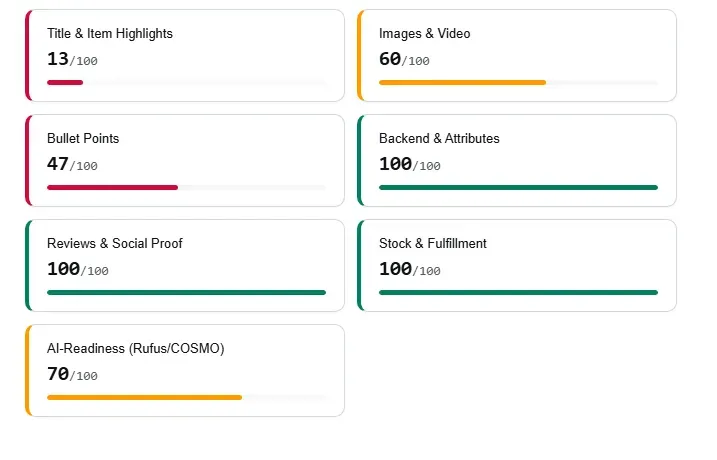
This site's own audit scores a listing against 12 criteria grouped into six categories. Run by hand, it's the same six checks:
Title & Item Highlights
Under 75 characters, Brand + Product + one differentiator, no promotional language. Item Highlights filled in with whatever didn't fit in the title.
Bullet Points
Five bullets, benefit-led, sentence case. Specs and likely objections covered, not just features restated.
Images & Video
Pure white background on the main image, at least seven images total, a product video if you have one.
Reviews & Social Proof
Rating trending up or flat, review count competitive for the category, no backlog of unanswered questions.
Stock & Fulfillment
No stockouts in the recent history, Prime-eligible via FBA or Seller Fulfilled Prime.
AI-Readiness
Plain, factual sentences an AI assistant could quote directly, not just a wall of keyword fragments.
Auditing a competitor's ASIN
Everything above except backend search terms and internal metrics like conversion rate is visible on any public listing page, which means you can run the same six checks on a competitor's ASIN. It's most useful when a specific competitor consistently outranks you on a keyword you're indexed for too. Grading their listing against the same criteria usually shows exactly which category is winning it for them. The Competitor Comparison tool runs this side by side automatically, category by category, against your own listing. How to Compare Your Listing to Competitors covers the method in full.
Manual vs. automated audits
Manual makes sense for a single listing you already know well, or for the judgment calls worth a second look by eye. It doesn't scale: 20 to 40 minutes per listing means a 200-SKU catalog is a multi-day project, and the subjective criteria, does the copy read naturally, would an AI assistant quote it, are exactly where two people checking the same listing disagree most.
Automated audits trade that judgment for consistency and speed: the same 12 criteria, scored the same way, in about 20 seconds instead of 30 minutes. For a catalog beyond a handful of listings, that difference is what makes auditing a monthly habit instead of something that only happens when rank drops. Bulk Optimization runs the same audit across an entire catalog at once. Manual vs. Automated Analysis covers when each approach actually makes sense.
Turning an audit into a monthly routine
A single audit tells you where a listing stands today. A routine tells you whether it's improving. Re-audit every listing monthly, and immediately after any Amazon policy change. The 75-character title limit landed with limited warning, and listings that weren't re-checked stayed non-compliant for weeks before anyone noticed the rank drop. Every Listing You've Audited, in One Place tracks the score over time automatically, so a routine re-audit becomes a one-click comparison instead of starting from scratch. How to Build a Monthly Optimization Routine lays out a concrete cadence.
One exception to a flat monthly cadence: Q4. The Q4 Listing Checklist covers what to front-load before Black Friday and holiday traffic hits, since surge traffic exposes a weak listing faster than steady traffic does.
A repeatable audit checklist
- Count the title's characters and check it against Brand + Product + one differentiator.
- Read all five bullets: benefit first, feature second, no ALL CAPS.
- Count the images and confirm the main image has a pure white background.
- Check the rating trend over the last 90 days and scan for unanswered questions.
- Confirm there's been no stockout in the recent history and the Prime badge is showing.
- Reread one paragraph of the description as if you were an AI assistant trying to quote it.
For the exhaustive version of this list, every one of the 12 criteria, not just six, see the complete audit checklist.
FAQ
How long does an Amazon listing SEO audit take?
A manual pass through all six categories, title, bullets, images, reviews, stock, and AI-readiness, takes most sellers 20 to 40 minutes per listing, longer the first time and faster once you know what you're looking for. An automated audit against the same criteria takes about 20 seconds.
What tools do I need to audit a listing?
None, technically. Every criterion is visible on the live listing page or in Seller Central. In practice you need a character counter for the title, a way to see your current backend search terms, and enough judgment to grade the subjective calls, like whether the copy reads naturally or an AI assistant could quote it. An automated audit replaces all of that with one paste.
How often should I audit my Amazon listings?
Monthly at minimum, and immediately after any Amazon policy change. The 75-character title limit and stricter bullet formatting rules both landed with limited warning, and listings that weren't re-checked stayed non-compliant for weeks. For a catalog of any size, monthly is also often enough to catch reviews or stock drifting before they cost meaningful rank.
Can I audit a competitor's listing?
Yes. Everything in an audit except backend search terms and internal metrics like conversion rate is visible on any public listing page. You can grade a competitor's title, bullets, images and reviews the same way you'd grade your own, which is useful for figuring out why they outrank you on a shared keyword.
What's the difference between an audit and optimization?
An audit is the diagnosis: checking a listing against a fixed set of criteria and finding out what's failing. Optimization is the fix: rewriting the title, restructuring bullets, adding images. Skipping straight to optimization without auditing first usually means fixing whatever's most visible rather than whatever's actually costing the most rank.
Skip the manual pass: paste any ASIN and get the same 12-criteria audit in about 20 seconds, with AI-written fixes for anything that fails.
Audit a listing freeMore from the blog