Auditing & Workflows
How to Build a Monthly Amazon Listing Optimization Routine
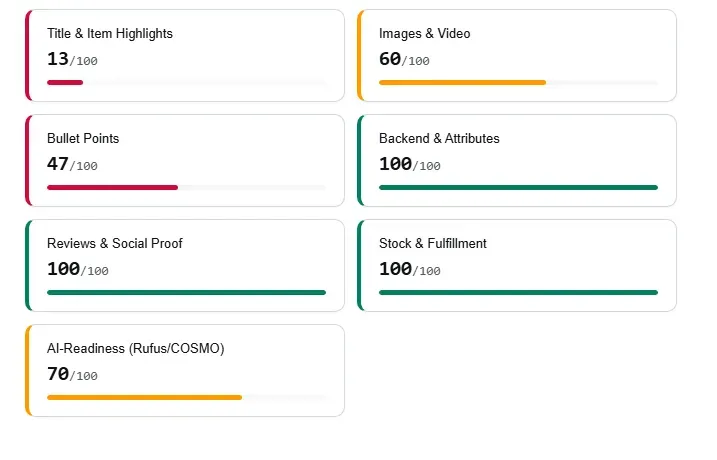
Re-audit every listing monthly, fix by weight rather than by whatever's easiest, and re-check immediately after any Amazon policy change instead of waiting for the next scheduled pass. A routine is what turns a score into a trend instead of a single snapshot.
For what to check each pass, see the full 12-criteria checklist.
Why monthly, not quarterly
Reviews drift, stock lapses happen, and Amazon's own rules change without much warning. The 75-character title limit landed with limited notice, and listings that weren't re-checked stayed non-compliant for weeks before anyone noticed the rank drop. A listing that passed last month can genuinely fail this month without anyone having touched it, which is what a monthly cadence is built to catch.
A concrete monthly structure
- Full re-audit, every listing. Not just the ones with known problems; a passing listing can quietly start failing.
- Fix by weight, not by ease. Title and image failures move the score more than a backend-term tweak; fix the heaviest failures first even if they take longer.
- Check Buy Box and stock status. Operational, not content, but a lost Buy Box or a stockout undoes content work instantly.
- Re-verify compliance after any Amazon policy update. Don't wait for the next scheduled pass if a rule changed mid-month.
Prioritizing fixes across a catalog
When multiple listings fail multiple criteria at once, fix the highest-weighted category across every listing before moving to the next category, not one listing perfected while the rest sit untouched. Across a catalog, that usually means every listing's images and title before any listing's A+ Content or backend terms.
Tracking whether it's actually working
A single audit score is a snapshot; what matters is the trend. Every Listing You've Audited, in One Place keeps the score history automatically, so a monthly re-audit becomes a one-click comparison against last month instead of a fresh read with nothing to compare it to.
FAQ
How long does a monthly Amazon audit routine take?
For a catalog under 20 listings, a few hours a month covers a full re-audit plus fixing whatever the highest-weighted failures turn out to be. Most of that time goes to fixes, not the audit itself, especially once it's automated.
Should I re-audit every listing every month, or just the ones with problems?
Every listing, briefly. A listing that passed last month can fail this month without anyone touching it, since reviews drift, stock lapses, and Amazon's own rules change. A full sweep catches that; only checking known problem listings misses it.
What's the first thing to check after an Amazon policy change?
Title compliance, specifically length and style rules. They're the most frequently updated and the most visibly enforced, and a title that goes non-compliant can be silently rewritten without any notification, which makes it the easiest thing to miss without an explicit re-check.
Start the routine this month. Paste any ASIN, and every re-audit after the first one shows up as a trend, not just a score.
Audit a listing freeMore from the blog