Auditing & Workflows
Amazon SEO Tools: Manual vs. Automated Analysis
Manual audits don't scale: 20 to 40 minutes per listing turns into days across a real catalog. Automated audits scale but can't see everything; some criteria simply aren't visible to an outside scrape. The honest setup for most sellers is a hybrid: automated for what's checkable, self-reported for what isn't.
For the full manual process this compares against, see how to audit an Amazon listing for SEO.
What manual actually costs
20 to 40 minutes per listing, longer the first time through and faster with practice. That's fine for a single listing worth close attention, a flagship SKU before a launch, say. Past roughly 10 to 15 listings, the math flips: a full catalog audit becomes a multi-day project, which is exactly when it stops happening regularly and starts happening only after rank already dropped.
What automated tools are actually good at
Anything deterministic: character counts, image counts, structural checks, whether a keyword is repeated across fields. These don't vary by who's running the check and don't degrade with fatigue across a hundred listings the way a manual pass does.
Where automation alone falls short
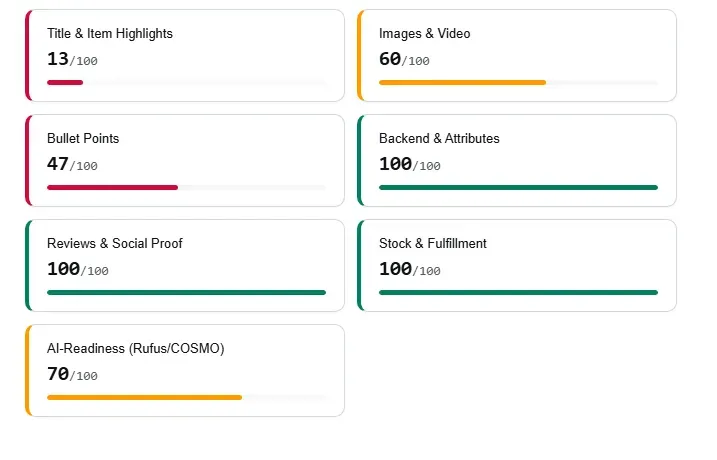
Two places specifically. First, subjective judgment: does the copy read naturally, would an AI assistant actually quote it. That's why better tools use AI grading for these criteria rather than pretending they're a simple pass/fail. Second, data that's genuinely invisible from outside: backend search terms, A+ Content presence, whether a product video exists. This site's own scoring engine splits its 12 criteria almost evenly across auto-detected, AI-graded, and self-reported for exactly this reason. No single method covers everything a real audit needs.
A practical split
- Automated, run monthly across the whole catalog, for the deterministic and AI-graded criteria that don't need a human in the loop.
- Manual, run once per listing, for the handful of self-reported items (A+ Content status, video presence) an automated scrape can't confirm.
- Manual, run selectively, for a hero listing where the extra 20 minutes of close human review is worth it beyond what any tool checks.
Bulk Optimization runs the automated half across an entire catalog at once, which is what makes monthly audits realistic past a handful of SKUs.
FAQ
Are automated Amazon SEO audits actually accurate?
For the criteria they check, yes. Character counts, image counts, and structural rules are deterministic and don't vary by who's checking. Where accuracy genuinely depends on the tool is the subjective calls, like whether copy reads naturally, which is why the better tools use AI grading for those specifically rather than pretending everything is a simple yes/no.
Can an automated tool replace a human audit entirely?
Not entirely. Some criteria, like whether A+ Content is live or a product video exists, aren't reliably visible to an automated scrape and have to be self-reported. A hybrid approach, automated for what's checkable, self-reported for what isn't, covers more ground than either alone.
At what catalog size does automation become worth it?
Past roughly 10 to 15 listings, the math flips. A manual audit at 20 to 40 minutes each turns into multiple full days, while an automated pass takes the same few minutes regardless of catalog size. Below that, manual is often fast enough not to bother automating.
See the hybrid approach in action. Paste any ASIN and get the same auto, AI-graded, and self-reportable breakdown this guide describes.
Audit a listing freeMore from the blog