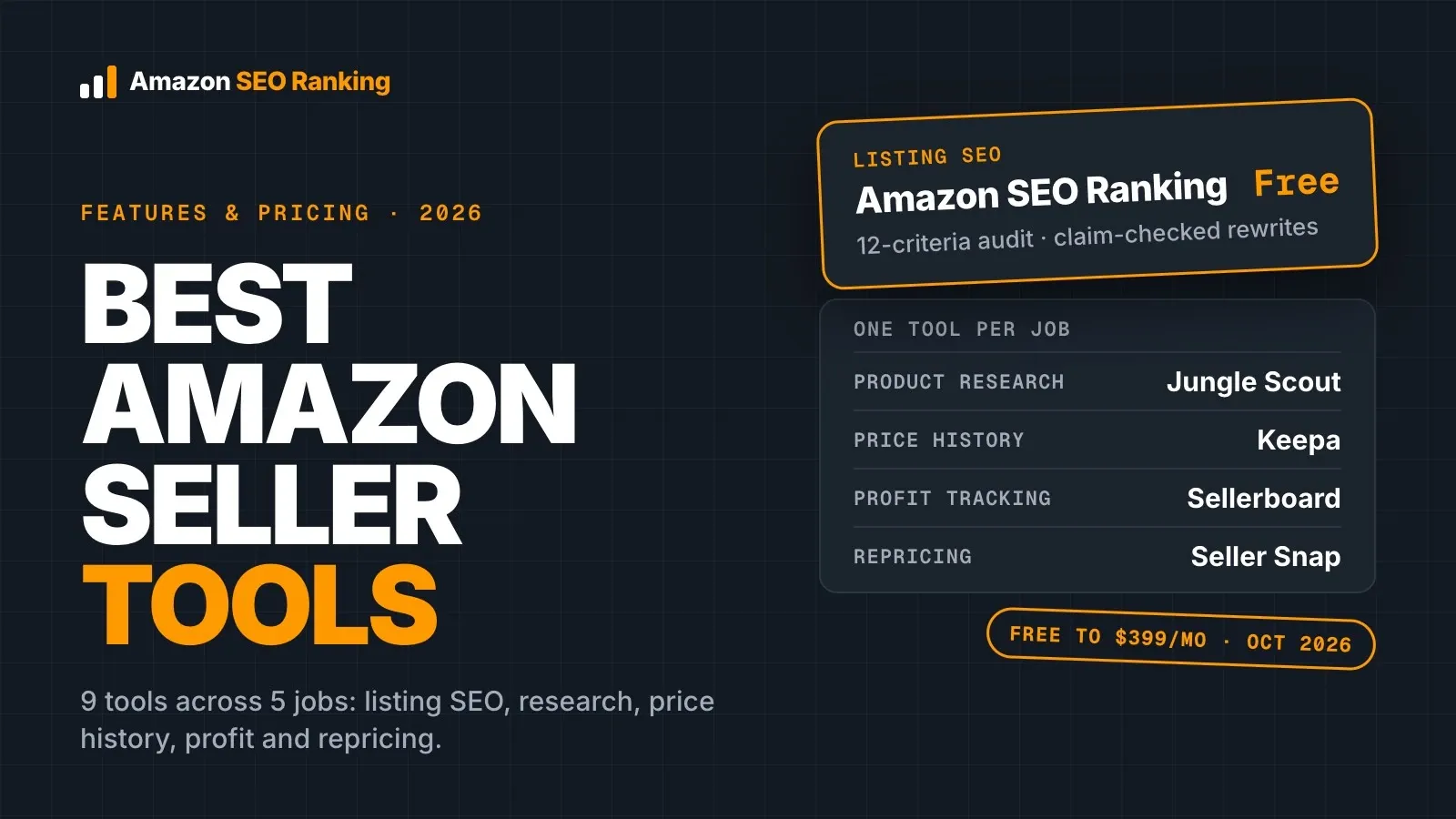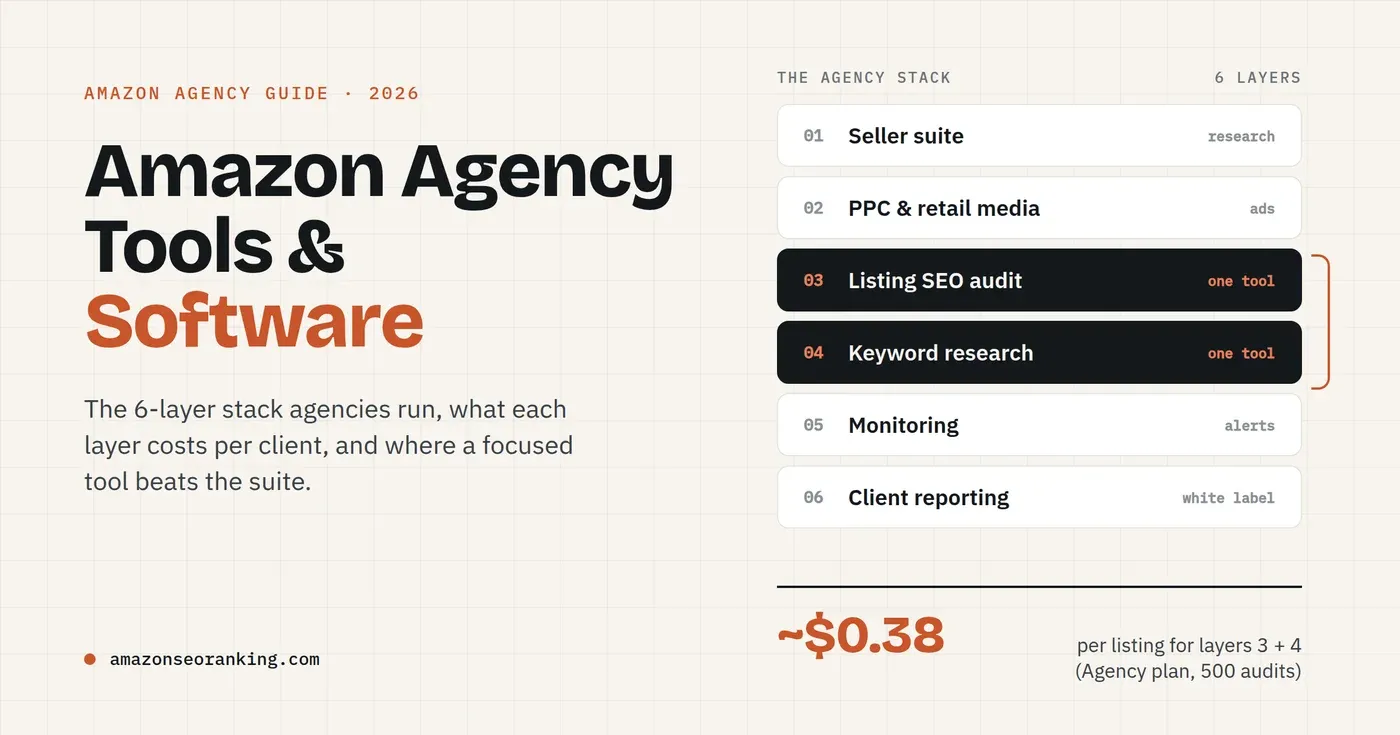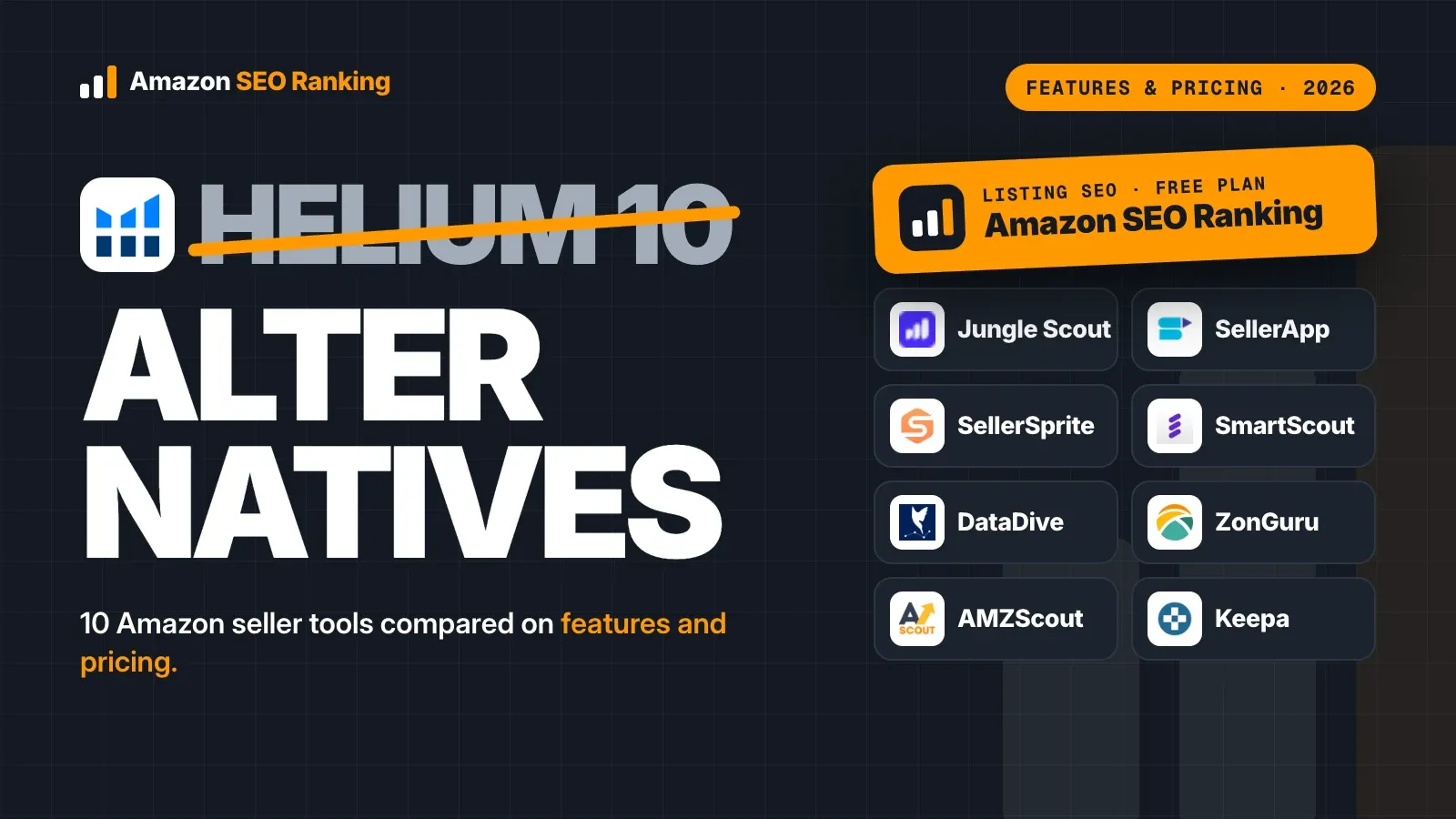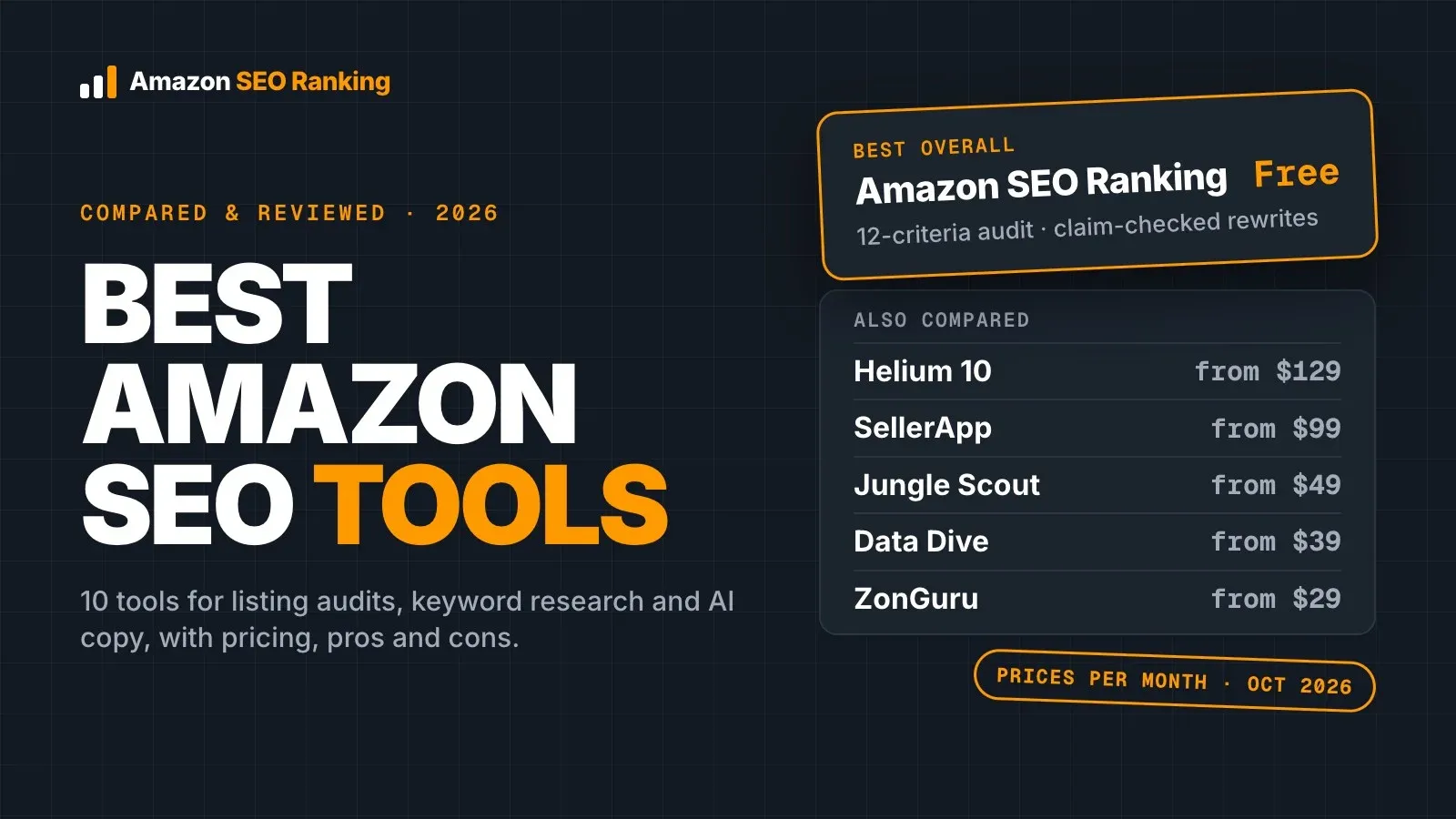
The best Amazon SEO tools in 2026 depend on one question: do you need to find what to sell, or make a listing you already have rank better? For the second job, Amazon SEO Ranking is the best overall pick. It scores a live listing against 12 published criteria, then rewrites whatever fails in copy you can paste into Seller Central.
The large suites (Helium 10, Jungle Scout, SellerApp) cover more ground, including product research and PPC. Most sellers use two or three of their tools and pay for twenty. For an independent comparison of five of these tools with their October 2026 prices, see The Revenue Thesis's guide to the best Amazon SEO tools.
Key Takeaways (TL;DR)
- The best overall Amazon SEO tool: Amazon SEO Ranking. Unlike Helium 10, Jungle Scout, SellerApp, AMZScout and ZonGuru, it publishes its full scoring rubric, and its AI rewrites are checked in code for false claims and pack-count errors before you see them.
- Why you need one: Amazon decides rank from your title, bullets, backend terms and listing data, and it suppresses copy that breaks its rules. A tool shows which of those inputs is costing you visibility, using real Amazon search volume instead of guesses.
- Who it's for: private-label sellers, agencies running client catalogs, brands selling across several Amazon storefronts, and teams writing listings with AI assistants like Claude.
- How to choose: decide whether your gap is product research or listing quality, check that the tool covers your marketplaces, and ask whether it explains its score or only shows a number.
- Price range: Amazon SEO Ranking has a free plan (3 full audits a month, no card), Pro at $79/month and Agency at $249/month. Across the market, paid plans run from $29/month (ZonGuru's entry plan) to $490/month for Data Dive Enterprise. Amazon Brand Analytics is free if you're in Brand Registry.
Top Amazon SEO Tools in 2026 at a Glance
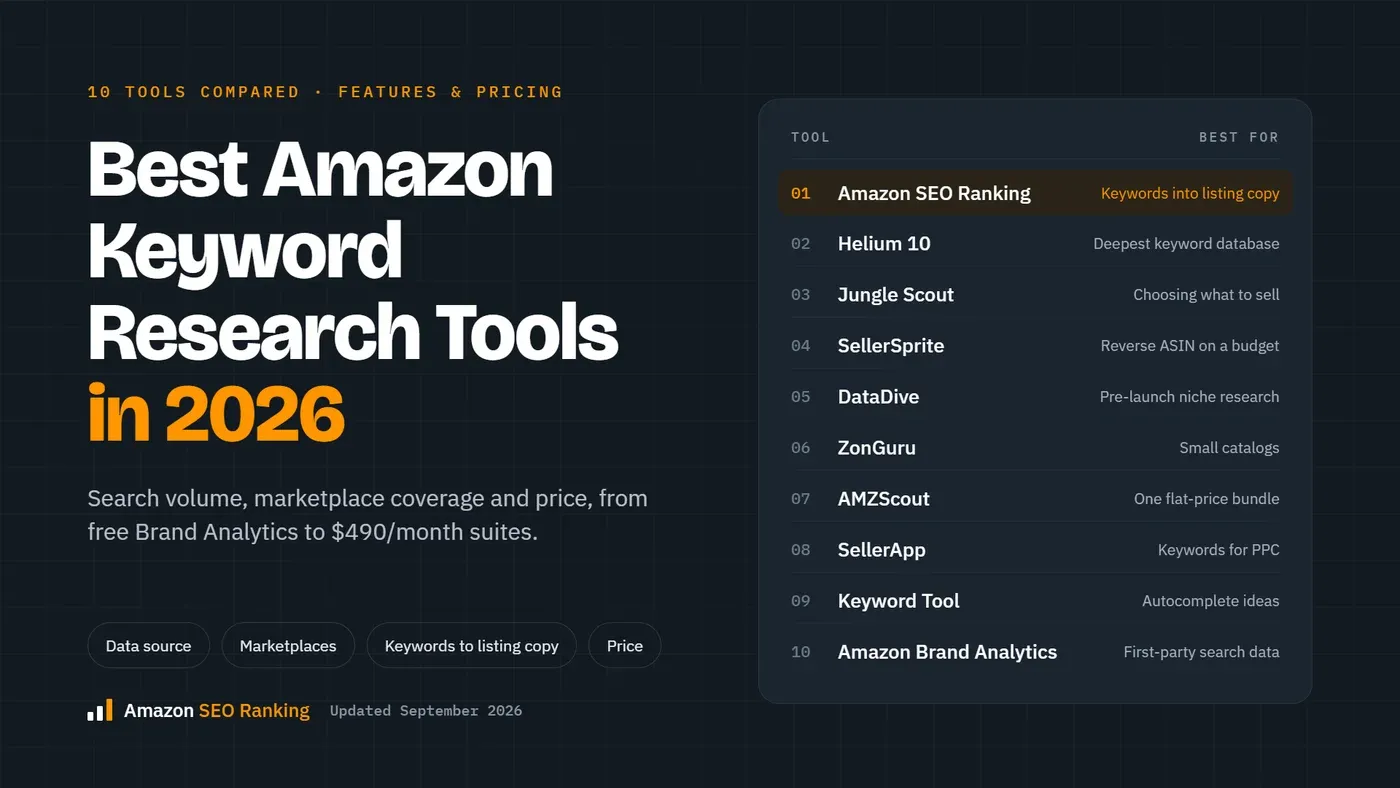
Ten tools made this list. Four are full seller suites, three are keyword and research specialists, two focus on listing quality, and one is Amazon's own free dashboard for brand owners.
| Company | Best For | Key Strengths | Pricing (monthly billing) |
|---|---|---|---|
| Amazon SEO Ranking | Making existing listings rank better | Published 12-criteria audit, claim-checked AI rewrites, draft audits, Claude connector, 23 storefronts | Free (3 audits/mo, no card). Pro $79, Agency $249 |
| Helium 10 | Sellers who want research, listing and PPC in one suite | 20+ tools, deep reverse-ASIN keyword data, wide marketplace coverage | Limited free plan. Platinum $129, Diamond $359 |
| SellerApp | Sellers pairing listing work with PPC automation | Listing Quality Index, public API, white-label reports, managed services | Freemium. Pro $99, Smart $250 |
| Jungle Scout | Deciding what to sell before you list | Product database, supplier search, category benchmarks | No free plan. $49 (research-only) to $149 |
| ZonGuru | Small catalogs that want operations tools too | Keyword placement score, review requests, inventory tracking | 7-day trial. From $29, rising to $249 by SKU count |
| Data Dive | Niche-level keyword research for private label | Master keyword lists per niche, rank tracking via Rank Radar | $39 / $149 / $490 |
| SmartScout | Brand, seller and category intelligence | Brand and seller databases, Traffic Graph, AI listing scorecard | $49 / $119 / $299 ($29 / $99 / $239 billed yearly) |
| AMZScout | Budget product research and sourcing | Product database, product tracker, lifetime-license option | No free plan. From $59.99, or $1,599.99 lifetime |
| MerchantWords | Keyword discovery and seasonality data | Large Amazon search-term database, trend history | $35 / $79 / $149 / $749 |
| Amazon Brand Analytics | Brand-registered sellers on a zero budget | First-party search query and click-share data from Amazon | Free with Amazon Brand Registry |
Prices were checked against each vendor's pricing page or published plan data in October 2026. Annual billing lowers most of them.
What Are Amazon SEO Tools?
Amazon SEO tools are software that help a product listing show up higher in Amazon's search results. They do it in one of four ways: finding the search terms shoppers type, tracking where an ASIN ranks for each term, grading the listing copy and data, or writing new copy.
Most products in this category started on the research side. Helium 10, Jungle Scout and AMZScout grew out of product discovery ("what should I sell?") and added keyword and listing features later. A smaller group, including Amazon SEO Ranking and parts of SellerApp and ZonGuru, starts from the listing itself and asks why it isn't ranking.
The distinction matters more in 2026 than it did three years ago. Amazon's search now reads listings with AI models (COSMO for relevance, Rufus for shopper questions), so the full text of your title, bullets and attributes carries weight that a list of keywords alone doesn't capture.
Why Do You Need Amazon SEO Software?
You need Amazon SEO software because the inputs that decide your rank are hard to check by hand, and some of them are invisible from the product page. The backend search terms field holds 249 bytes that no shopper or outside audit can see. Titles over the category limit, ALL CAPS bullet headers and promotional phrases get listings suppressed or quietly demoted.
AI shopping has raised the stakes. On Amazon's Q3 2025 earnings call, CEO Andy Jassy said 250 million shoppers had used Rufus that year, with monthly users up 140% and customers who used it 60% more likely to complete a purchase. Rufus answers from your listing text, so a vague bullet or a missing spec now costs you in two places: search rank and the assistant's answer.
The third reason is consistency. A seller with 40 ASINs across three storefronts cannot cross-check every title length, pack count and claim by hand each time copy changes. A good Amazon SEO tool does that check in seconds and tells you which line to fix.
Who Needs an Amazon SEO Tool?
Private-Label Sellers With a Small Catalog
If you sell five to fifty of your own products, your main question is why a specific listing sits on page three. You need a clear read on what's weak and copy you can paste the same day, without hiring a copywriter.
Budget matters at this stage. A free plan that runs real audits on your own ASINs lets you test a tool's judgment before you pay for it.
Amazon Agencies Managing Client Catalogs
Agencies need throughput and proof. Running hundreds of ASINs in one batch, exporting branded reports and showing a client exactly why a score moved are daily tasks.
A published scoring method helps here. When the client asks "why 62?", you can point to the criteria that failed instead of defending a black-box number.
Sellers Expanding to New Amazon Marketplaces
A listing optimized for amazon.com is not automatically optimized for amazon.de or amazon.co.jp. Character limits, search language and category rules differ by storefront.
These sellers need a tool that audits each marketplace's live listing separately and writes copy in that storefront's own language.
Brands Launching or Relaunching a Product
Before a listing goes live, there is no rank data to analyze. The useful question is whether the draft copy will score well once it's published.
Tools that score draft copy against the live listing's images and reviews save a round of publish, wait and fix.
Teams Writing Listings With AI Assistants
More sellers now draft listings in ChatGPT or Claude. The weak spot is that a general assistant can't see the live listing or real Amazon search volume, and it miscounts characters.
These teams need Amazon data and rule checks that their assistant can call directly, so the copy it produces is checked against Amazon's limits before anyone pastes it.
Best Amazon SEO Tools: In-Depth Review & Comparison
The tools below fall into three groups: listing-quality tools that grade and fix what's live, full seller suites that cover research through PPC, and keyword specialists. Each entry covers what the product does, who it fits, its pricing and where it stops.
We built the first entry. The rest are based on each vendor's published plans and features as of October 2026, and every review names the jobs where that tool is the better pick.
1. Amazon SEO Ranking
Overview
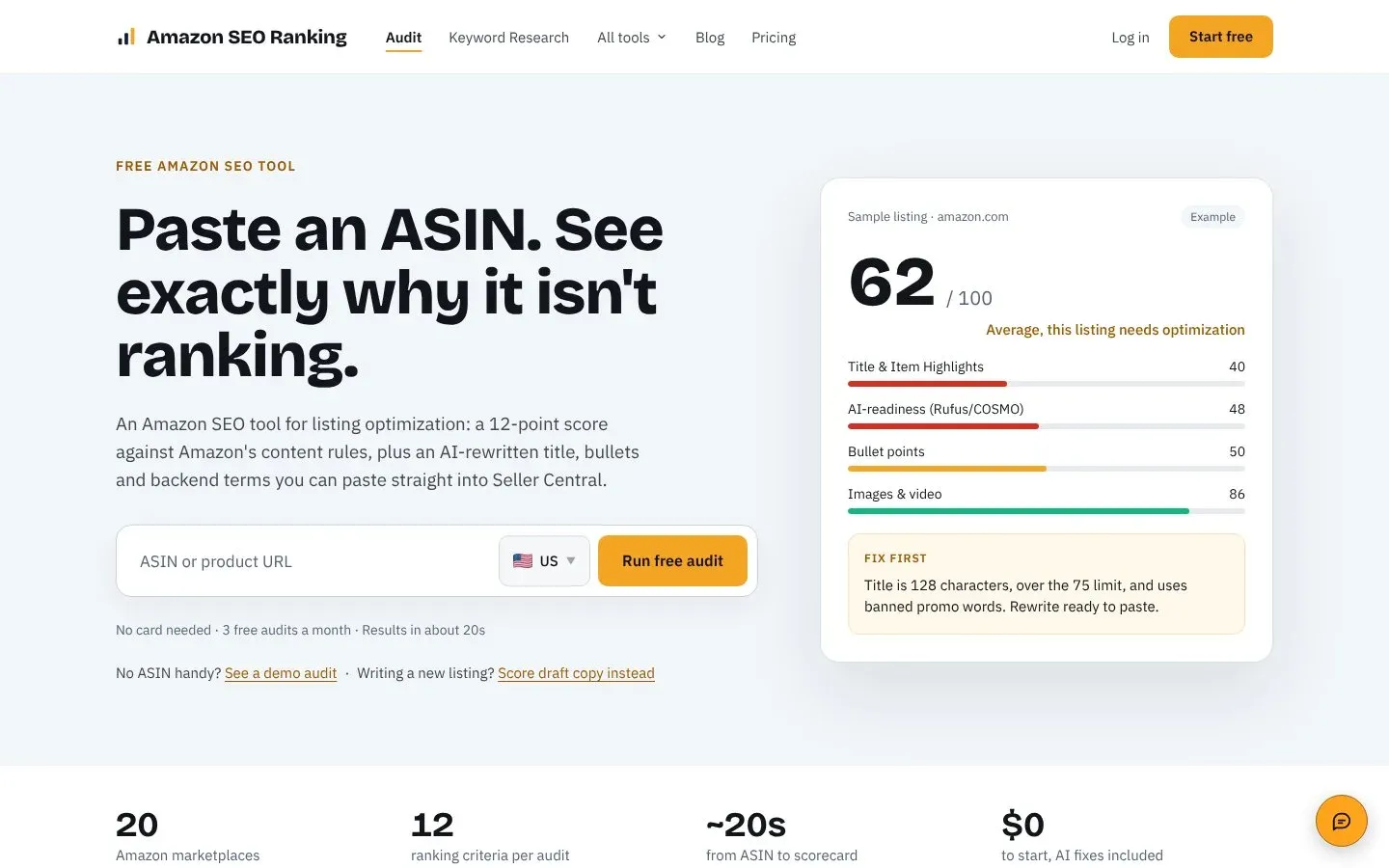
Amazon SEO Ranking audits a live Amazon listing against a published 12-criteria rubric, then uses AI to rewrite whatever fails: title, Item Highlights, bullets, description and backend search terms. Paste an ASIN and you get a 0 to 100 score in about 20 seconds, with each criterion explained and ranked by what to fix first.
The rewrites are grounded in the listing's own spec table and your brand fact sheet. Before you see them, code checks every line for health claims, unsupported claims ("protein" on a fruit product), pack-count mismatches and Amazon's hard limits. It covers 23 Amazon storefronts and writes copy in 12 languages.
Ideal For
- Private-label sellers who want to know why one listing underperforms
- Agencies auditing and rewriting client catalogs of up to 500 ASINs per batch
- Sellers listing the same product on several Amazon marketplaces
- Teams that run listing work through Claude
Why Do We Stand Out?
The scoring method is public. All 12 criteria and their pass rules are published, and each counts equally, so an agency can show a client exactly why a listing scored 62. Helium 10, Jungle Scout, SellerApp, AMZScout and ZonGuru return a score, if any, without publishing how it's calculated.
The AI copy is checked before you paste it. A real example: a listing whose title says "8 Packets", whose bullet says "20 packets" and whose spec table says "8.0 Count" gets flagged on the audit, before shoppers notice and send it back as "not as described". You can also score a rewrite as a draft, against the live listing's images and reviews, before it goes live.
It also works inside Claude. Pro and Agency include a Claude connector with six tools (audit, copy check, keyword volume, related keywords, keyword gap on Agency, audit history), so an AI-assisted team gets real Amazon data instead of the model's own guesses.
Scores stay consistent. Every audit pulls the live listing at run time, an unchanged listing keeps its last score, and when Amazon's data can't confirm Prime eligibility, that criterion is marked "Not verified" and left out of the score instead of counted as a fail.
Pros
- Published, equally weighted 12-criteria rubric
- AI rewrites checked in code for false claims, pack counts and character limits, and scoreable as a draft before publishing
- Real Amazon search volume on 16 marketplaces, shown as estimates, with relevance-filtered keyword ideas
- The free plan runs 3 complete audits a month on your own ASINs, no card, and every plan includes Competitor Comparison and a self-serve A+ Content generator
- Flat pricing whatever your catalog size
Cons
- No product research or sourcing tools, so it won't tell you what to sell
- No PPC management
- Advanced keyword tools (Keyword ideas, What I rank for, Competitors, Keyword gap) cover 4 marketplaces: US, Egypt, Saudi Arabia and UAE
Pricing
Free: 3 audits a month with AI rewrites, all 23 storefronts. Pro: $79/month or $799/year, with 100 audits, 2,000 keyword lookups, bulk runs of 100 ASINs and the Claude connector. Agency: $249/month or $2,490/year, with 500 audits, white-label PDF reports and API access. Monthly plans start with a 7-day free trial, and Enterprise pricing is custom.
Final Verdict
If your job is making listings you already have rank better, Amazon SEO Ranking is the best Amazon SEO tool on this list. It's the only one that shows its scoring method, checks its own AI copy before you see it, and lets you score a draft before publishing.
If you need to find products to sell or manage PPC, pair it with a research tool or pick one of the suites below.
2. Helium 10
Overview
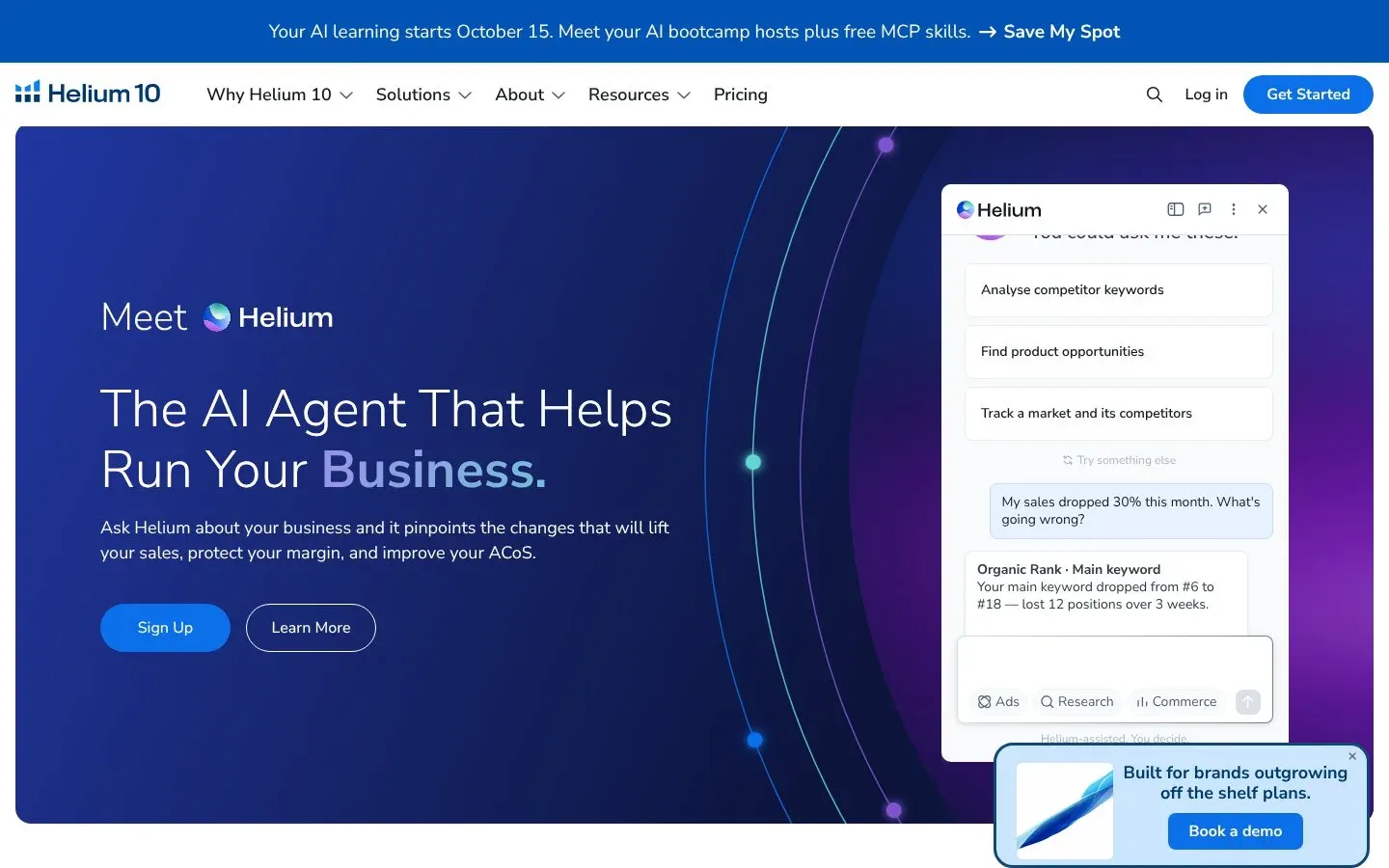
Helium 10 is a suite of 20+ tools covering product research (Black Box, Xray), keyword research (Cerebro, Magnet), listing work (Listing Analyzer, Scribbles), PPC (Helium 10 Ads) and operations such as inventory forecasting and refund recovery.
It is the default choice for many established sellers because it puts the whole Amazon workflow in one account. Most users touch two or three of the tools.
Ideal For
- Established sellers who want research, listing, PPC and operations in one subscription
- Teams doing heavy reverse-ASIN keyword research
- Sellers working in marketplaces beyond the US and Middle East
Why Do They Stand Out?
Cerebro's reverse-ASIN data is one of the strongest keyword sources in the category, and Helium 10's keyword tools reach more marketplaces than most competitors. For a seller who wants one login for research, listing and ads, it's one of the smartest choices.
It also offers a free plan, though it opens only a few tools with limited use.
Pros
- Broadest feature set on this list
- Deep reverse-ASIN and keyword data
- Built-in PPC management
- Wide marketplace coverage for keyword tools
Cons
- Listing Analyzer doesn't publish how it scores a listing
- AI copy is general-purpose, not tied to a specific failed rule
- $129/month is the entry paid tier, and most sellers pay for tools they don't use
- The free plan is too limited to test the listing tools on your own ASINs
Pricing
A limited free plan, then Platinum at $129/month ($99/month billed annually) and Diamond at $359/month ($279/month billed annually). Amazon SEO Ranking is 31% to 39% cheaper month to month at the comparable tiers. Our Amazon SEO Ranking vs Helium 10 comparison goes tool by tool.
Final Verdict
Helium 10 fits sellers who use research, keyword, listing and PPC tools every week and want them under one bill. For a seller whose main problem is a listing that won't rank, most of the subscription goes unused.
3. SellerApp
Overview
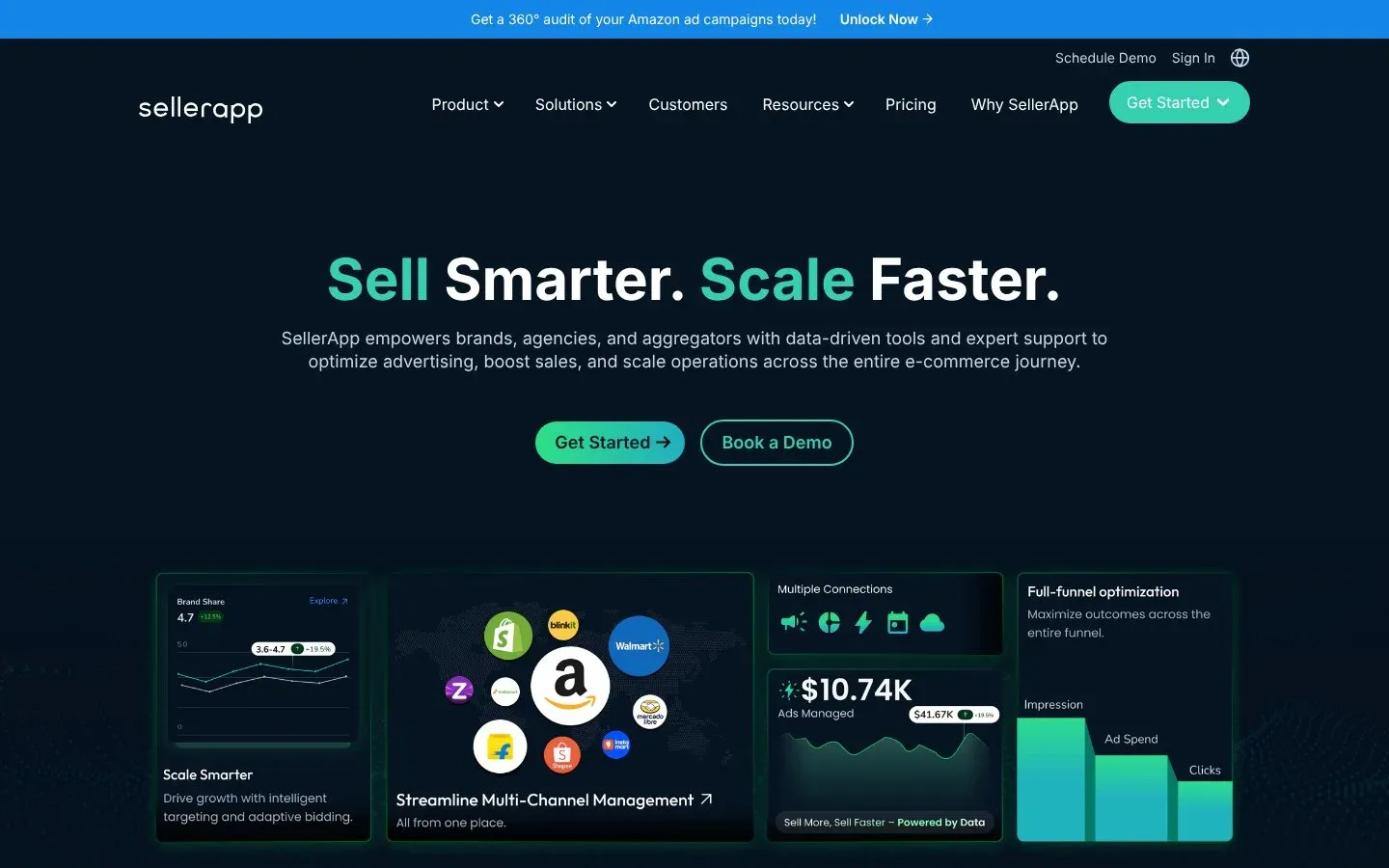
SellerApp combines listing optimization, keyword research and PPC automation, with managed services for brands that want the work done for them. Its Listing Quality Index gives a structured score for each listing.
It's the closest like-for-like competitor to Amazon SEO Ranking, with a public API and white-label reporting for agencies.
Ideal For
- Sellers who want SEO and PPC in one workflow
- Agencies that need an API and white-label reports
- Brands open to managed, done-for-you optimization
Why Do They Stand Out?
SellerApp is one of the strongest choices for sellers who treat organic rank and advertising as one job. Its PPC automation and managed services go further than listing-only tools.
The Listing Quality Index is a real, structured score, and keyword research covers 18+ marketplaces.
Pros
- Structured Listing Quality Index
- PPC automation alongside SEO
- Public API and white-label reporting
- Freemium tier
Cons
- The Listing Quality Index weighting isn't published
- A+ Content is offered through managed service (Amazon SEO Ranking's A+ generator is self-serve on every plan)
- Its advertised 50% discount applies only to the first 3 months
Pricing
Freemium, then Pro at $99/month and Smart at $250/month. Amazon SEO Ranking is 20% cheaper at Pro and level at the top tier ($249 against $250) (full SellerApp comparison).
Final Verdict
SellerApp is a good fit for brands that want organic and PPC in one place, or want an agency-style service on top. Sellers who only need listing audits and copy will pay for PPC features they won't use.
4. Jungle Scout
Overview
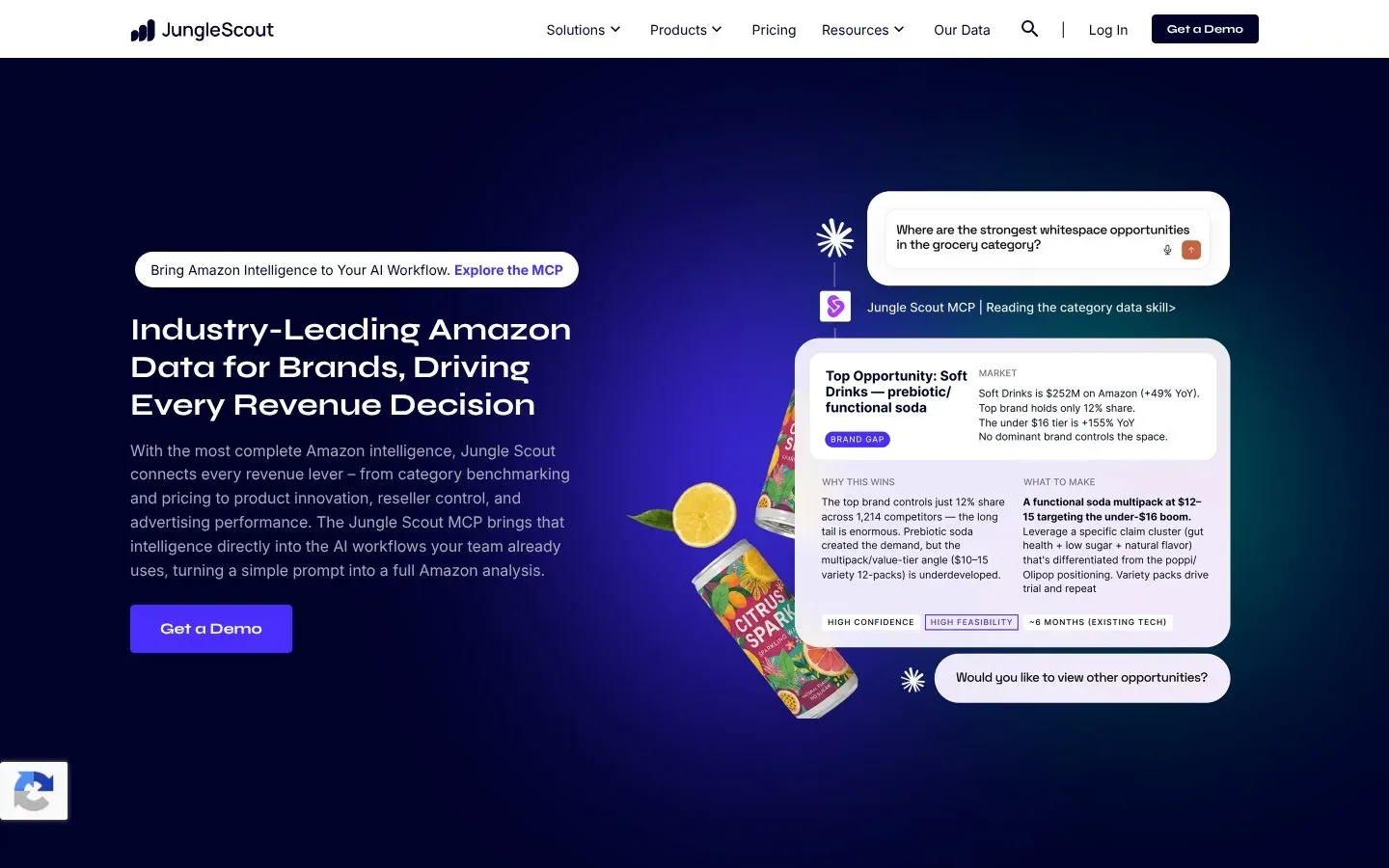
Jungle Scout is built around the decision that comes before a listing: what to sell. Its Product Database, browser extension, supplier database and category benchmarks help sellers size a niche and find manufacturers.
Listing features exist (AI Assist refines copy), but they don't grade a live listing against a fixed standard.
Ideal For
- New sellers choosing their first product
- Brands researching new categories
- Sellers who want supplier sourcing in the same account
Why Do They Stand Out?
For product research, Jungle Scout is one of the strongest names in the category. Its sales estimates and supplier database answer the "should I launch this?" question better than listing-focused tools.
The top Cobalt tier reaches up to 19 marketplaces for keyword data.
Pros
- Product and supplier research in one tool
- Category and Buy Box benchmarking
- Wide keyword marketplace coverage on Cobalt
Cons
- No free plan
- The $49/month Starter tier is research-only
- No published listing-scoring method
Pricing
No free plan. Plans run from $49/month (Starter, research-only) to $149/month (Brand Owner + Competitive Intelligence). Its annual Growth Accelerator rate is $588/year. See the Jungle Scout comparison for the plan-by-plan breakdown.
Final Verdict
Pick Jungle Scout when the question is what to sell. Once the product is live and the question becomes why it isn't ranking, a listing audit tool does that job at a lower price.
5. ZonGuru
Overview
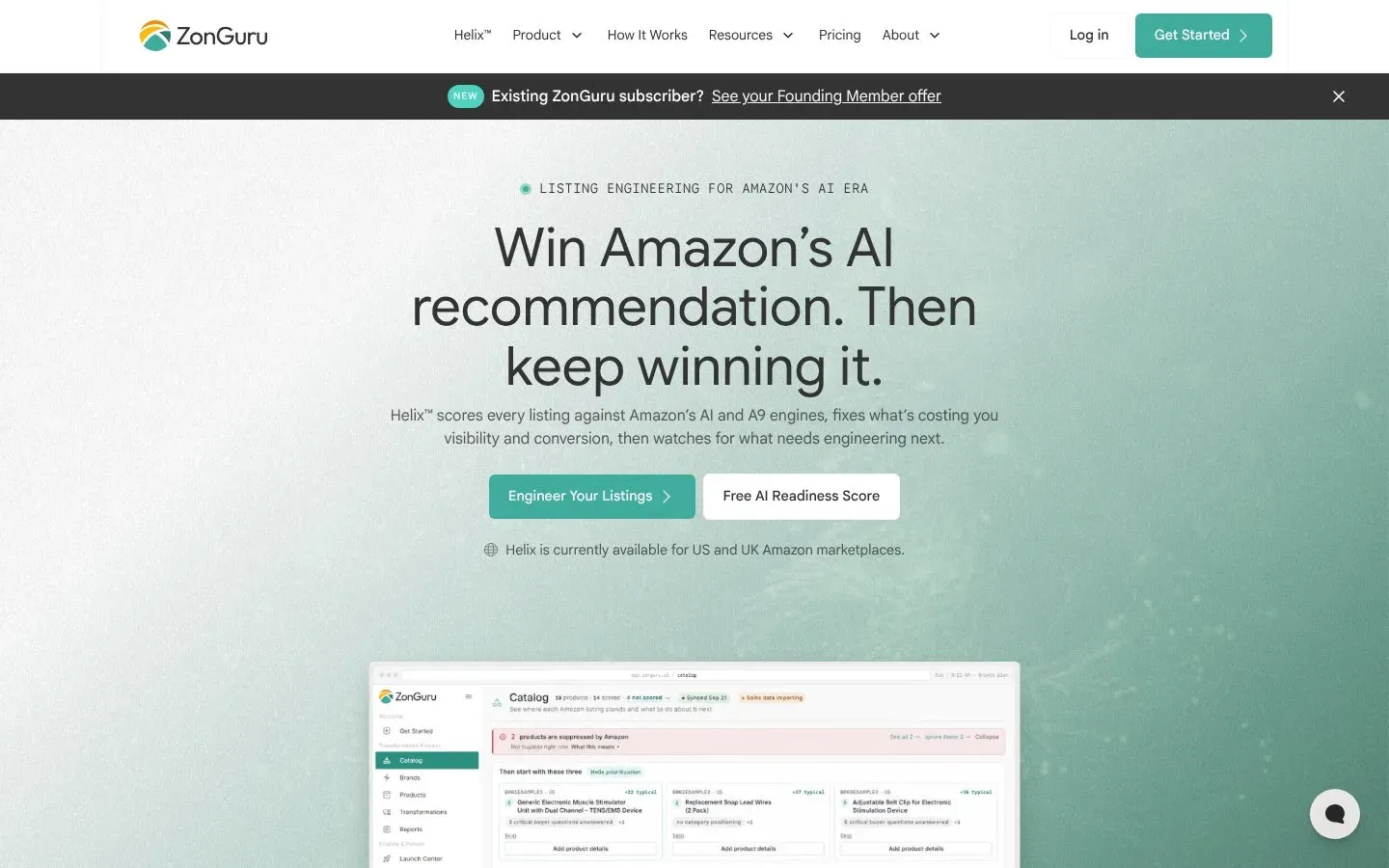
ZonGuru mixes listing optimization with small-catalog operations: order management, automated review requests, email sequences and inventory tracking. Its Listing Optimizer scores how well a listing places its target keywords.
Pricing scales with the number of active SKUs, which suits sellers with a handful of products.
Ideal For
- Sellers with fewer than 100 SKUs
- Owners who want review requests and inventory alerts next to listing work
- Sellers focused on keyword placement in titles and bullets
Why Do They Stand Out?
Few listing tools also run review-request automation and inventory tracking. For a solo seller who wants one subscription for listing keywords and day-to-day operations, ZonGuru is one of the more practical choices.
At very low SKU counts its entry price is below most suites.
Pros
- Operations tools (orders, reviews, inventory) alongside listing work
- Keyword-gap checks against competitors
- Low entry price for small catalogs
Cons
- The Listing Optimizer score covers keyword placement, not images, reviews or stock; AI-readiness scoring sits in ZonGuru's separate Helix product (US and UK only)
- The scoring formula isn't published
- Price climbs with SKU count, reaching $249/month at 101 to 1,000 SKUs
- No free plan (a 7-day trial instead)
Pricing
Plans start at $29/month and scale with active SKUs to $249/month. Read the ZonGuru comparison for how SKU-based pricing plays out at different catalog sizes.
Final Verdict
ZonGuru suits small sellers who want keyword placement checks plus review and inventory tools in one place. As the catalog grows past 100 SKUs, the price grows with it, and the score still says nothing about images, reviews or AI-readiness.
6. Data Dive
Overview
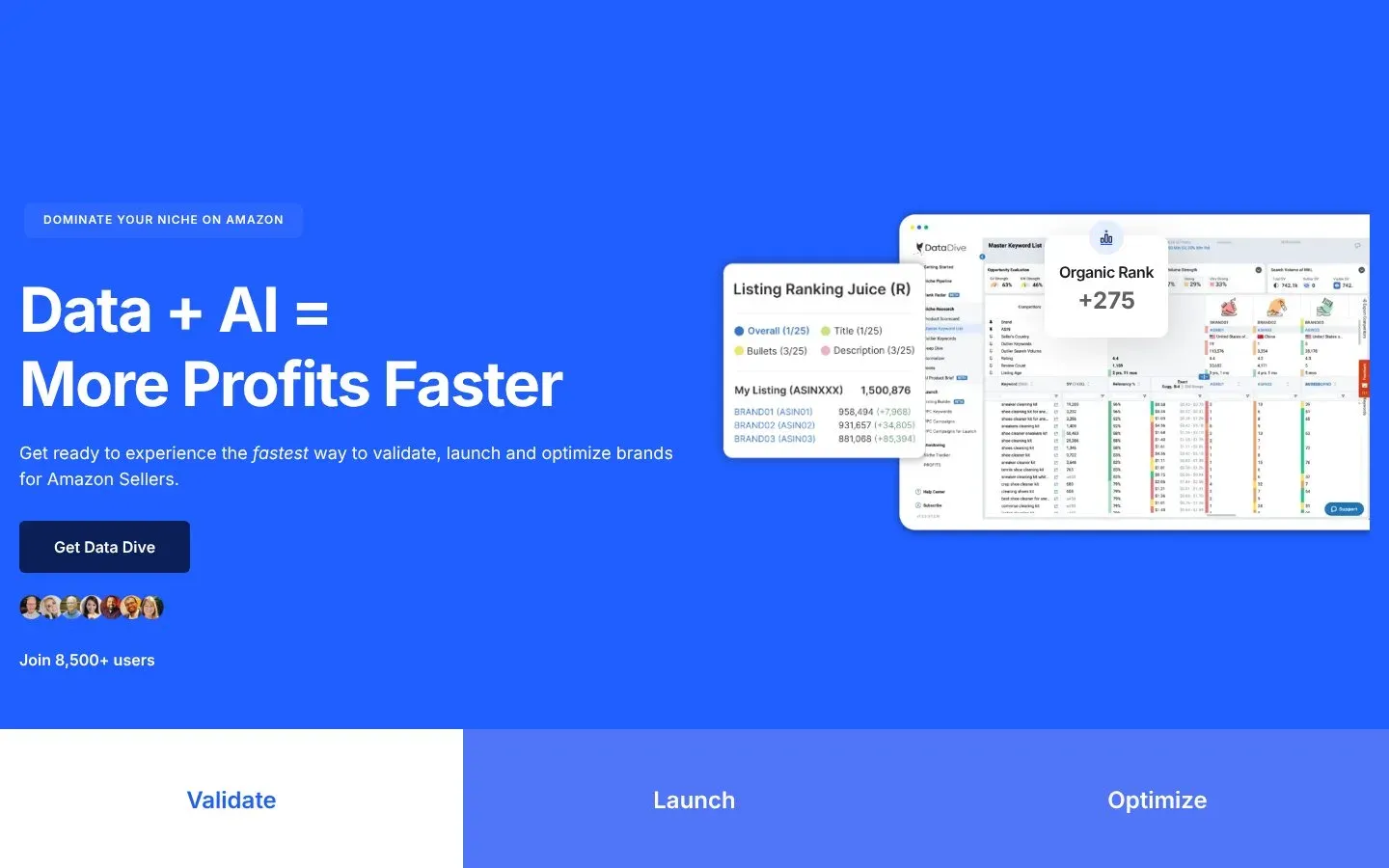
Data Dive is a keyword and niche research tool for private-label sellers, run mostly through its Chrome extension. It builds a master keyword list for a niche from the top competing ASINs, then tracks your rank for those terms with Rank Radar.
It has a loyal following among sellers who build listings keyword by keyword from competitor data.
Ideal For
- Private-label sellers building a listing from a niche's top competitors
- Sellers who want rank tracking tied to a curated keyword list
- Teams of up to 10 on the Standard plan
Why Do They Stand Out?
Data Dive's niche-level keyword lists are one of the strongest ways to see which terms the top 10 to 20 competitors share. Paired with Rank Radar, you can watch whether a listing change moved rank on those exact terms.
Plan limits are clear: Starter includes 100 Dive ASINs and 25 tracked keywords a month, and Standard raises that to 1,000 and 1,000.
Pros
- Niche-level master keyword lists
- Rank tracking on the terms that matter to that niche
- Clear, published usage limits per plan
Cons
- No free plan
- Workflow depends on the Chrome extension
- Starter's 25 tracked keywords run out fast
- Focused on keywords, not on grading the rest of the listing
Pricing
Starter $39/month, Standard $149/month and Enterprise $490/month, with a discount for annual billing (plan limits per Front Desk Review).
Final Verdict
Data Dive is a strong pick for sellers who build listings from a niche's keyword data and want to track those terms. It won't check claims, pack counts, images or compliance, so most users pair it with a listing audit.
7. SmartScout
Overview
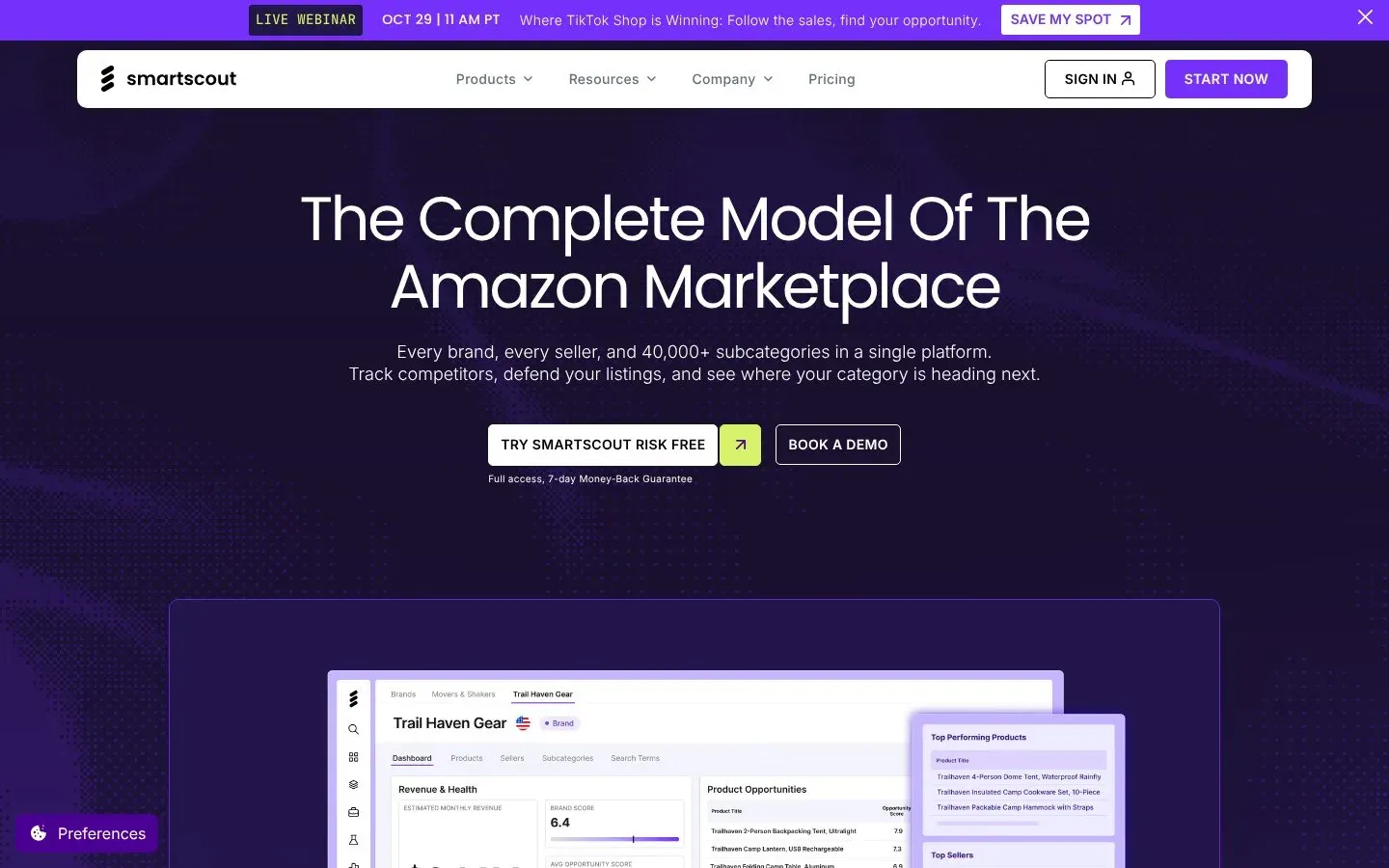
SmartScout is a market intelligence tool built on databases of Amazon brands, sellers, products and subcategories. Wholesale buyers, online arbitrage sellers and agencies use it to map who sells what and how traffic flows between products.
It has added AI features in 2026: an AI Scorecard that grades a listing for COSMO, an AI Listing Architect and an MCP server for connecting its data to AI tools.
Ideal For
- Wholesale and online arbitrage sellers sourcing brands
- Agencies prospecting for brand clients
- Brands tracking competitors' traffic and share of voice
Why Do They Stand Out?
Its brand and seller databases (500,000+ brands and 2,000,000+ sellers) and the Traffic Graph are one of the smartest ways to see a category's structure from the outside.
Search Terms Explorer and Rank Maker add keyword research, with unlimited keyword tracking from the Essentials plan up.
Pros
- Brand, seller and subcategory databases
- Traffic Graph shows how shoppers move between products
- MCP access to its data on Business and Enterprise
Cons
- AI Scorecard audits are capped: 1 a month on Basic, 10 on Essentials, 25 on Business
- One user per plan, with each extra seat at $49/month
- No free trial (a 7-day money-back guarantee instead)
Pricing
Basic $49/month, Essentials $119/month and Business $299/month, or $29, $99 and $239 a month billed yearly. Enterprise is custom.
Final Verdict
SmartScout fits wholesale sellers and agencies who need to see brands, sellers and categories at scale. For auditing and rewriting your own listings, its audit caps make it a supporting tool rather than the main one.
8. AMZScout
Overview
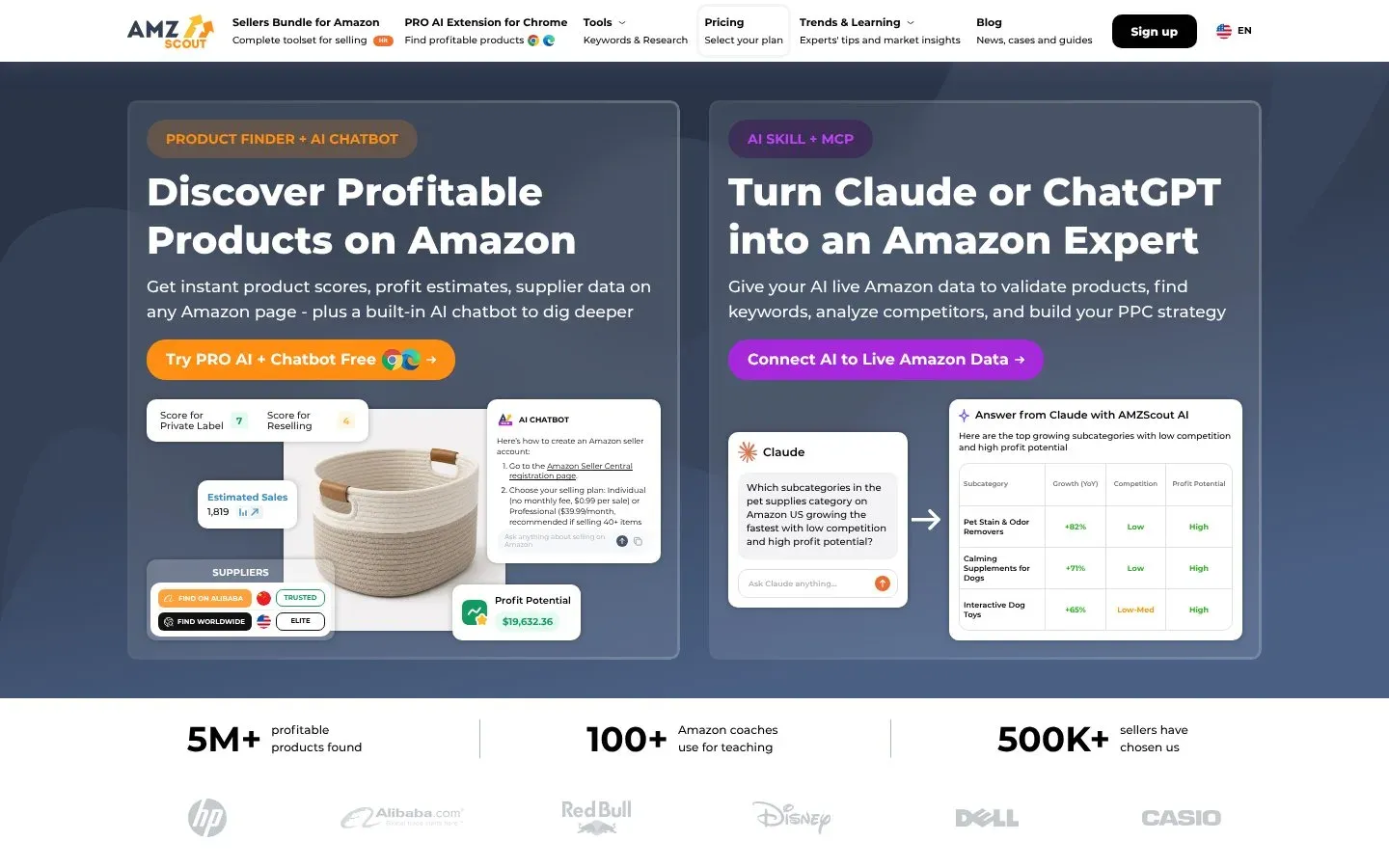
AMZScout is a product research and sourcing toolkit: Product Database, Product Tracker, a sales estimator and Alibaba-connected supplier search. Its AI Listing Builder generates copy, but it doesn't grade a live listing.
It's one of the few tools in the category sold as a one-time lifetime license.
Ideal For
- Beginners looking for their first product
- Budget-conscious sellers who prefer an upfront purchase
- Sellers sourcing from Alibaba
Why Do They Stand Out?
On an annual or lifetime plan, AMZScout is one of the cheapest ways to get a working product-research toolkit. Its Alibaba connection shortens the step from idea to supplier.
Pros
- Low effective price on annual (about $33 to $50 a month) or lifetime plans
- Supplier sourcing built in
- Simple interface for new sellers
Cons
- No listing-scoring rubric
- No free plan (a 10-day money-back guarantee, paid upfront)
- Keyword depth is behind the larger suites
Pricing
From $59.99/month, about $33 to $50 a month on annual plans, or $1,599.99 for a lifetime license. The AMZScout comparison covers which plan fits which seller.
Final Verdict
AMZScout is a good budget pick for finding a product. Once you're selling, it has no way to tell you why a live listing underperforms.
9. MerchantWords
Overview
MerchantWords is a keyword database built from Amazon shopper searches, with search history that shows seasonal patterns. It doesn't do product research or listing audits, only keyword discovery and volume.
Ideal For
- Copywriters and agencies building keyword lists
- Sellers planning around seasonal demand
- Teams that already have a listing tool and need more keyword ideas
Why Do They Stand Out?
MerchantWords is one of the longest-running Amazon keyword databases, and its trend history helps plan listing updates before a seasonal peak.
Its Silver plan is one of the lowest entry prices on this list.
Pros
- Large search-term database
- Seasonality and trend history
- Low entry price
Cons
- Keywords only, no audit or copywriting
- No product research or competitor tracking
- Enterprise at $749/month is a big jump from Platinum
Pricing
Silver $35/month, Gold $79/month, Platinum $149/month and Enterprise $749/month.
Final Verdict
MerchantWords is useful as a second keyword source next to a listing tool. On its own, it gives you terms to target and nothing about how your listing uses them.
10. Amazon Brand Analytics
Overview
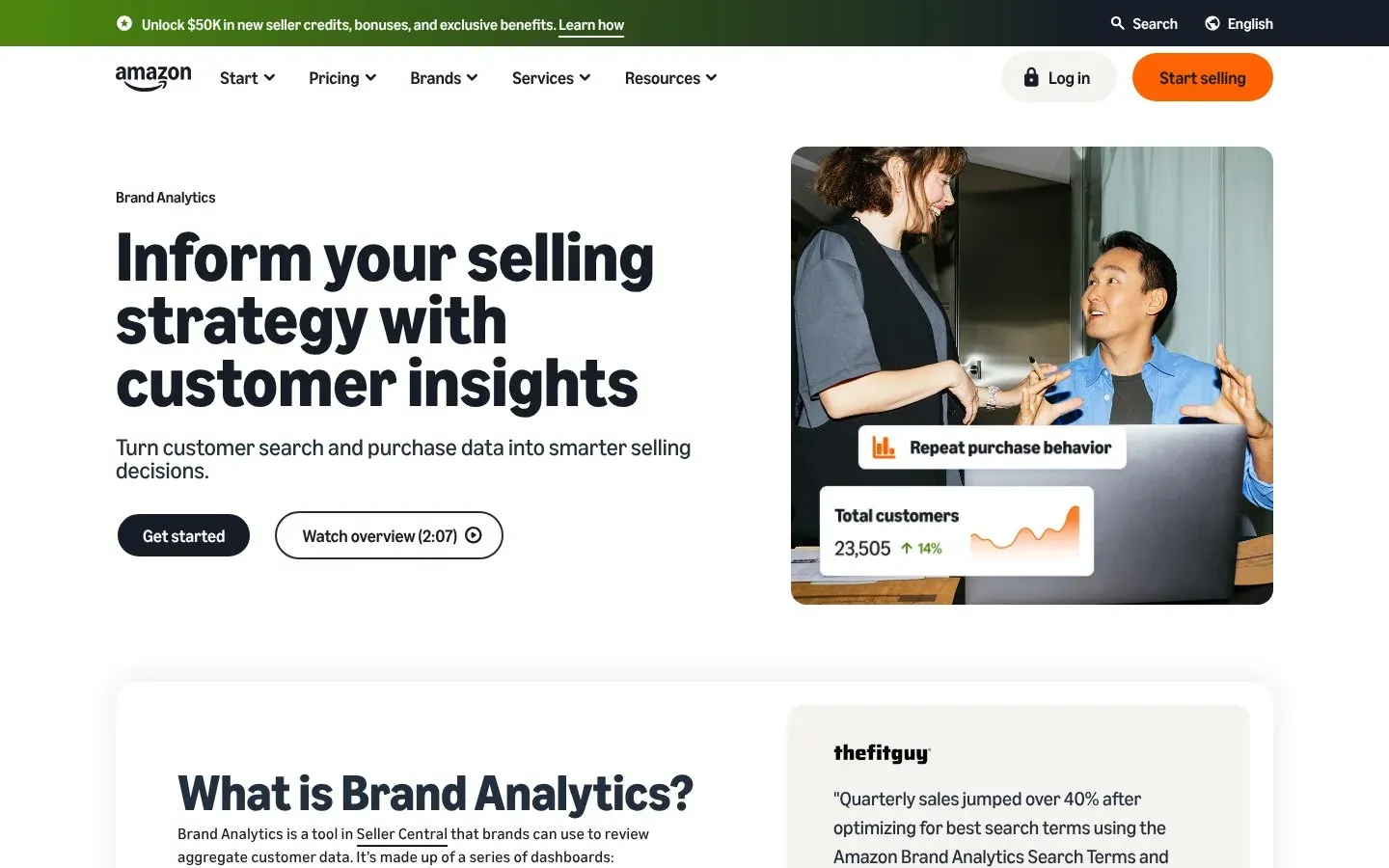
Amazon Brand Analytics is Amazon's own dashboard inside Seller Central, open to brand owners enrolled in Amazon Brand Registry. Its Search Query Performance and Top Search Terms reports show real Amazon search and click data for your brand.
No third-party tool has this first-party data, but it only covers your own brand and the reports take work to read.
Ideal For
- Brand-registered sellers on a tight budget
- Brands that want to check third-party keyword estimates against Amazon's data
- Teams comfortable working in exported reports
Why Do They Stand Out?
It's the only source of Amazon's own query, impression and click-share data for your ASINs. For a brand owner, that makes it a reliable free check on which terms bring shoppers to a listing.
Pros
- Free with Brand Registry
- First-party Amazon search and click data
- Shows click and purchase share for top search terms
Cons
- Only available to brand owners in Brand Registry
- No listing audit, copy suggestions or rank tracking
- Reports are raw and need manual analysis
Pricing
Free for sellers enrolled in Amazon Brand Registry.
Final Verdict
Every brand-registered seller should use Brand Analytics. It tells you which searches matter, and a listing tool tells you whether your copy is set up to win them.
How to Choose the Best Amazon SEO Tool (What to Consider)
Start with the job, then check the details. The seven checks below are in the order most sellers should run them, and each one can be tested in a free plan or trial.
1. Decide Whether Your Gap Is Research or Listing Quality
If you don't know what to sell yet, you need a research tool: Jungle Scout, AMZScout or SmartScout. If you have live products that sit on page three, you need a tool that grades and fixes listings.
Many sellers buy a suite for the second problem and pay for the first. Write down the last three things you wanted a tool to answer. If all three were about existing listings, a suite's research features will go unused.
2. Check That It Audits Each Storefront Separately
A listing that scores well on amazon.com can fail on amazon.de or amazon.co.jp. Title limits, search language and category rules change by storefront, and the same ASIN often carries different copy in each one.
Ask whether the tool pulls the live listing from the storefront you pick and scores it there. Amazon SEO Ranking audits 23 storefronts this way and writes rewrites in 12 languages. For keyword coverage by marketplace, our guide to choosing an Amazon keyword research tool compares the options.
3. Ask How the Score Is Calculated
A listing score you can't explain is hard to act on and hard to bill a client for. Ask each vendor which criteria the score uses, how each is weighted and what counts as a pass.
If the answer is "proprietary", you're trusting the number. A published rubric lets you see which line cost you points and check whether the fix worked.
4. Test the AI Copy for Claims and Counts
AI copywriting is now in most Amazon SEO software, and the failure mode is consistent: invented claims, wrong pack counts and titles over the limit. Run the same ASIN through each tool's AI writer and read the output line by line.
Look for three things: whether it uses the listing's spec table, whether it flags health or product claims the listing can't back up, and whether the backend terms fit under 249 bytes. Our free backend search terms checker shows how the byte limit is counted.
5. Run It on Your Own ASIN Before Paying
Demo listings are chosen to look good. Your own listing, with its real weaknesses, is the only fair test.
Amazon SEO Ranking's free plan runs 3 full audits a month on your ASINs with no card. Helium 10's free plan opens a few tools; SellerApp has a freemium tier; Jungle Scout, AMZScout, ZonGuru, SmartScout and Data Dive require payment or a card-backed trial.
6. Price It Against Your Catalog Size
Pricing models differ more than headline prices. ZonGuru scales with SKU count, SmartScout charges $49 a month per extra seat, and Data Dive caps ASINs and tracked keywords per plan.
Work out what you'd pay at your catalog size a year from now. A flat plan with 500 audits a month costs about $0.50 per listing on Amazon SEO Ranking's Agency plan, against the $50+ per listing agencies typically bill for manual optimization.
7. Check How It Fits Your Workflow
Think about where the output goes. Agencies need white-label reports and an API. Teams writing in Claude need the tool's data and checks inside their assistant, so ask which plan unlocks that. Amazon SEO Ranking includes its Claude connector from Pro at $79/month, with sign-in instead of an API key, while SmartScout puts MCP access on Business ($299/month) and Enterprise.
Small details add up. Amazon SEO Ranking puts a Copy table button on every table (it pastes straight into Google Sheets) and collects tables into one linked workbook, so keyword lists and ASIN data stop living in five separate files.
Everything You Need to Know About Amazon SEO Tools
| Category | Key Considerations |
|---|---|
| Top 3 Amazon SEO tools | Amazon SEO Ranking for auditing and fixing live listings, Helium 10 for an all-in-one suite with PPC, Jungle Scout for product research |
| Who it's for | Private-label sellers, Amazon agencies, multi-marketplace sellers, brands preparing a launch, teams writing listings with AI |
| Use cases | Listing audits, AI copy rewrites, keyword research, rank tracking, draft scoring, competitor comparison, bulk catalog optimization |
| How to choose | Match the tool to your gap (research or listing), check per-feature marketplace coverage, ask how the score works, test the AI copy on your own ASIN |
| Mistakes to avoid | Paying for a 20-tool suite to use two tools, trusting a score with no published method, pasting AI copy without checking claims and pack counts, assuming a US-optimized listing works on every storefront |
| Pricing starts | Free (Amazon SEO Ranking, Amazon Brand Analytics with Brand Registry). Paid plans from $29/month (ZonGuru entry plan) |
Audit Your First Listing Free with Amazon SEO Ranking
If your products are live and not ranking, start with the listing. Amazon SEO Ranking scores it against 12 published criteria in about 20 seconds, marks what to fix first, and hands you a rewrite that has already been checked for false claims, pack-count mismatches and Amazon's character limits.
The free plan includes 3 full audits a month across all 23 storefronts. No card required, and nothing changes on Amazon until you paste the new copy yourself. When your catalog outgrows that, Pro adds 100 audits, bulk runs and the Claude connector for $79 a month, with a 7-day free trial. Amazon SEO Ranking launched as the #1 Product on IndieHunt.
Run a Free Audit on Your ASIN or Compare Pro and Agency Plans
FAQ
What is the best Amazon SEO tool in 2026?
The best Amazon SEO tool in 2026 for improving listings you already sell is Amazon SEO Ranking, because it publishes its 12-criteria scoring rubric and checks its AI rewrites for false claims and pack-count errors before you see them. It covers 23 Amazon storefronts and has a free plan with 3 full audits a month. Helium 10 is the stronger pick if you want research, listing and PPC tools in one $129/month suite. Jungle Scout is the better fit if your main question is what product to sell.
What should I consider when choosing the right Amazon SEO tool for me?
When choosing the right Amazon SEO tool, consider five things: whether your gap is product research or listing quality, marketplace coverage per feature, whether the score's method is published, how safe the AI copy is, and price at your catalog size. Check coverage feature by feature, since a tool may audit 23 storefronts but run advanced keyword tools on only 4. Test each tool's AI writer on your own ASIN and look for invented claims, wrong pack counts and backend terms over 249 bytes. Compare pricing models too, because SKU-based or per-seat pricing changes the real cost as you grow.
How does Amazon SEO Ranking differ from similar alternatives?
Amazon SEO Ranking differs from similar alternatives by publishing its full scoring method and checking AI copy in code before it reaches you. Helium 10, Jungle Scout, SellerApp, AMZScout and ZonGuru don't publish how their listing scores are calculated. It also scores draft copy before it goes live, and Pro and Agency plans include a Claude connector with six tools. It is 31% to 39% cheaper than Helium 10 month to month at comparable tiers, but it doesn't offer product research, sourcing or PPC management.
How do I get started with Amazon SEO Ranking?
Getting started with Amazon SEO Ranking takes one step: paste an ASIN or Amazon product URL, pick the marketplace and run the audit. Results arrive in about 20 seconds with a 0 to 100 score, each criterion explained and a rewrite ready to copy. A free account gives you 3 audits a month with no card, and a demo audit works without signing up. Monthly plans start with a 7-day free trial.
How easy is it to switch to Amazon SEO Ranking?
Switching to Amazon SEO Ranking is easy because there is nothing to migrate: every audit pulls the live listing from Amazon at run time. Agencies can upload a CSV or Excel file of up to 500 ASINs per bulk run, each with its own marketplace and target keywords. Many sellers keep their research tool for product discovery and use Amazon SEO Ranking for listing audits and copy. The Pro plan is $79/month, below Helium 10 Platinum at $129/month.
Can't I just use ChatGPT or Claude to optimize my Amazon listing?
You can use ChatGPT or Claude to optimize an Amazon listing, but a general assistant can't see your live listing, its spec table or Amazon search volume, and it often miscounts characters. That leads to copy with invented claims or a title over Amazon's limit. Amazon SEO Ranking grounds rewrites in the listing's own facts and checks every line against Amazon's hard limits. On Pro and Agency plans, its Claude connector gives Claude those same checks and real keyword data inside the chat.
Are there free Amazon SEO tools?
Yes, there are free Amazon SEO tools, and two on this list cost nothing to start. Amazon Brand Analytics is free for brand owners enrolled in Amazon Brand Registry and shows Amazon's own search query and click data. Amazon SEO Ranking's free plan runs 3 full listing audits a month with AI rewrites, plus a keyword preview, with no card. Helium 10 offers a limited free plan, and SellerApp has a freemium tier.