The best Amazon keyword research tool depends on what you do with the keywords once you have them. If you research products before you source them, you want the biggest keyword database you can afford. If you already sell and need a listing to rank, you want volume data that lands in your title, bullets and backend terms without a spreadsheet in between.
This comparison covers ten tools, including Amazon’s own free reports, so you can pick the best keyword tool Amazon sellers in your position can actually use. Prices reflect vendor pricing pages and independent reviews checked between September 14 and September 26, 2026.
Key Takeaways (TL;DR)
- The Best Overall Amazon Keyword Research Tool: Amazon SEO Ranking, for sellers and agencies whose goal is getting an existing listing to rank. Search volume covers 16 Amazon marketplaces, and the keywords you pick go straight into an AI rewrite that’s checked for Amazon’s length limits, pack-count errors and unsupported claims.
- Why Do You Need It: In a 2024 Jungle Scout survey, 56% of US online shoppers started their product searches on Amazon. A keyword tool shows which words those shoppers type, and roughly how often.
- Who It’s For: Private-label sellers writing or rewriting listings, agencies managing client catalogs, and brands selling in more than one Amazon marketplace. Brand-registered sellers also get Amazon’s own Brand Analytics reports for free.
- How to Choose the Right One: Check where the volume data comes from and which marketplaces it covers. Then check whether the keywords reach your listing as copy that’s safe to paste, and whether you can score that copy before it goes live.
- Expected Price: Amazon SEO Ranking has a free plan (3 audits a month with AI rewrites), Pro at $79/month with the keyword tools and 2,000 keyword lookups, and Agency at $249/month with 10,000. Keyword research starts on Pro, which comes with a 7-day free trial. Across the market, prices run from free (Amazon Brand Analytics, Helium 10’s capped free plan) to $359/month for Helium 10 Diamond on monthly billing, with DataDive’s top plan reaching $490/month.
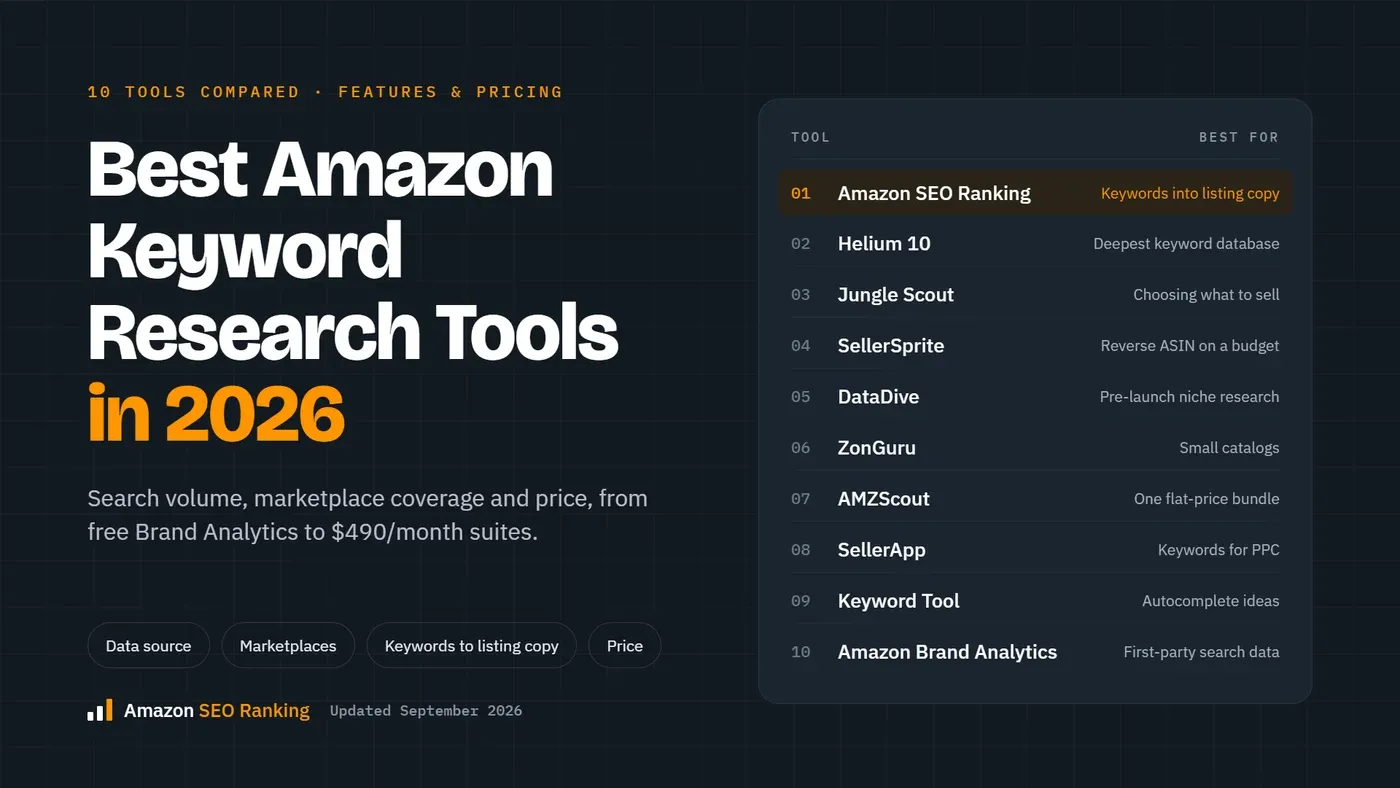
Top Amazon Keyword Research Tools in 2026 at a Glance
| Company | Best For | Key Features | Pricing |
|---|---|---|---|
| Amazon SEO Ranking | Sellers and agencies turning keywords into listing fixes | Search volume (16 marketplaces), Keyword ideas, What I rank for, Keyword gap (Agency), AI rewrite with keyword coverage and claim checks | Free plan (audits and rewrites); Pro $79/mo; Agency $249/mo |
| Helium 10 | Sellers who want the deepest keyword database plus a full seller suite | Cerebro reverse ASIN, Magnet keyword discovery, Keyword Tracker, Listing Builder | Free plan with daily caps; Platinum $129/mo; Diamond $359/mo |
| Jungle Scout | New sellers choosing what to sell | Keyword Scout, Product Database, Opportunity Finder, rank tracking | Starter $49/mo; Growth Accelerator $79/mo; Brand Owner + CI $149/mo |
| SellerSprite | Budget-conscious sellers who want reverse ASIN and ad data | Keyword Mining, Reverse ASIN, ABA Opportunity Finder, keyword conversion rate | Free plan; paid from $390/yr (Basic); Standard $79/mo |
| DataDive | Private-label brands validating a niche before launch | Master Keyword List, Roots clustering, Rank Radar, AI Listing Builder | Starter $39/mo; Standard $149/mo; up to $490/mo |
| ZonGuru | Small catalogs that also want customer and review automation | Keywords on Fire, Listing Optimizer, daily Keyword Tracker | Researcher $49/mo; Seller from $79/mo (scales by SKU) |
| AMZScout | Product hunters who prefer one flat bundle | Keyword Search, Reverse ASIN Lookup, Keyword Tracker, PRO AI Extension | $59.99/mo; $399.99/yr; $1,599.99 lifetime |
| SellerApp | Sellers who run PPC through the same tool | Keyword research, Listing Quality Index, PPC automation, managed services | Freemium; Pro $99/mo; Smart $149/mo for 3 months, then $250/mo |
| Keyword Tool | Marketers researching Amazon alongside Google and YouTube | Amazon autocomplete keyword ideas across many platforms | Free (no volume); Pro Basic $89/mo; Pro Business $199/mo |
| Amazon Brand Analytics | Brand-registered sellers who want Amazon’s first-party search data | Search Query Performance, Top Search Terms, Search Catalog Performance | Free with Brand Registry and a $39.99/mo Professional selling plan |
What Are Amazon Keyword Research Tools?
An Amazon keyword research tool estimates what shoppers type into Amazon’s search bar and how often. You enter a seed term or a competitor’s ASIN, and the tool returns related search terms with an estimated monthly volume and some measure of competition.
Amazon’s search engine matches a shopper’s query to listings by the words in them. Amazon’s own seller guidance tells sellers to put the main keyword in the title, work secondary terms into bullets and the description, and use backend search terms for relevant words that don’t fit anywhere visible, without repeating what’s already on the page.
The tools differ most in where their numbers come from:
- Amazon autocomplete. Free and current, but it gives you suggestions with no volume attached. Keyword Tool’s free version works this way.
- Modelled estimates. Most suites combine several signals (autocomplete, ad data, panel or clickstream data, sales estimates) into a monthly volume. Helium 10, Jungle Scout, SellerSprite, DataDive and ZonGuru sit here, each with its own model.
- Amazon’s first-party data. Brand Analytics reports show real query, click and purchase data, but only for brand-registered sellers, and the Top Search Terms report ranks terms by search frequency rather than giving an absolute monthly count.
No third-party tool gets exact search counts from Amazon. Every volume you see outside Brand Analytics is an estimate. That’s why Amazon SEO Ranking marks its volumes with “≈”, and why experienced agencies cross-check two sources before locking in a master keyword list. For a step-by-step walkthrough, see this guide on how to do Amazon keyword research.
Why Do You Need an Amazon Keyword Research Tool?
Amazon is where a large share of product searches begin. Jungle Scout’s 2024 consumer survey of 1,000 US online shoppers found 56% started product searches on Amazon, against 42% on search engines like Google.
A listing that doesn’t contain the words those shoppers use won’t be matched to their searches. The tool replaces guesses with estimates you can compare.
Here is what changes when you work from data:
- You pick the title phrase by demand. Two phrasings that sound identical to you can differ several-fold in search volume, and you find out before the title goes live rather than after a month of flat sales.
- Category jargon a manufacturer uses often has little shopper volume behind it, so you stop writing for terms nobody searches.
- You fill the backend field properly. Amazon’s backend search terms field holds 249 bytes, and nobody outside your account can see it. A keyword list tells you which leftover synonyms, spellings and use cases deserve those bytes.
- Reverse ASIN tools list the terms a rival listing already ranks for – a faster route to gaps than brainstorming.
Amazon warns against keyword stuffing, so more keywords isn’t the goal. Its seller blog suggests a focused mix of roughly 10 to 20 relevant terms across a listing. The research tells you which 10 to 20.
There’s a newer risk too. More sellers now hand their keyword list to an AI tool and ask it to write the listing. A general AI model doesn’t see the listing’s spec table, so it can add claims the product doesn’t support (“detox” on a fruit snack) or contradict the pack size (“20 packets” in a bullet on an 8-count box). Those errors lead to suppressed listings and “not as described” returns. The keyword step and the writing step now need to be checked together.
Who Needs Amazon Keyword Research Tools?
1. Solo and Small-Catalog Sellers
You write your own listings and don’t have an agency or copywriter. You need to know which phrase leads the title and whether your bullets cover the terms shoppers use. Price matters, so a tool that caps lookups sensibly and lets you test on your own product before paying is worth more than a 30-tool suite you’ll half use.
2. Agencies Managing Client Listings
You run keyword research across many brands and categories, then defend the choices to clients. Bulk throughput, exports that paste into a client report, and gap analysis across several competitor ASINs at once matter more than product-sourcing tools. So does a listing score with a published method: a client will question a number you can’t explain. White-label reporting and an API save hours per client each month.
3. Sellers in More Than One Amazon Marketplace
The same product is searched differently on amazon.de, amazon.co.uk and amazon.ae. A term with strong US volume may barely register elsewhere, and local phrasing rarely matches a translated US title. You need volume data for each marketplace you sell in, which narrows the field quickly.
4. Sellers Launching or Relaunching a Listing
A brand-new listing ranks for nothing yet, so reverse-ASIN tools have nothing to report on it. You need to see which listings you’ll compete with for your main search phrase, choose target keywords by volume, and write copy around them. Then you want to know how that copy scores before it’s live in Seller Central, rather than finding out from a month of weak sales.
5. Teams Working Through an AI Assistant
More sellers now draft listings with Claude, ChatGPT or Gemini. A general assistant has no live Amazon search data, so it guesses at volumes and often miscounts characters. Teams working this way need keyword data and listing checks the assistant can call directly through a connector, instead of pasting numbers back and forth.
Best Amazon Keyword Research Tool: In-Depth Review & Comparison
Prices below are list prices for new customers, checked between September 14 and September 26, 2026. Vendors change plans often, so confirm on each pricing page before you buy.
1. Amazon SEO Ranking
Overview
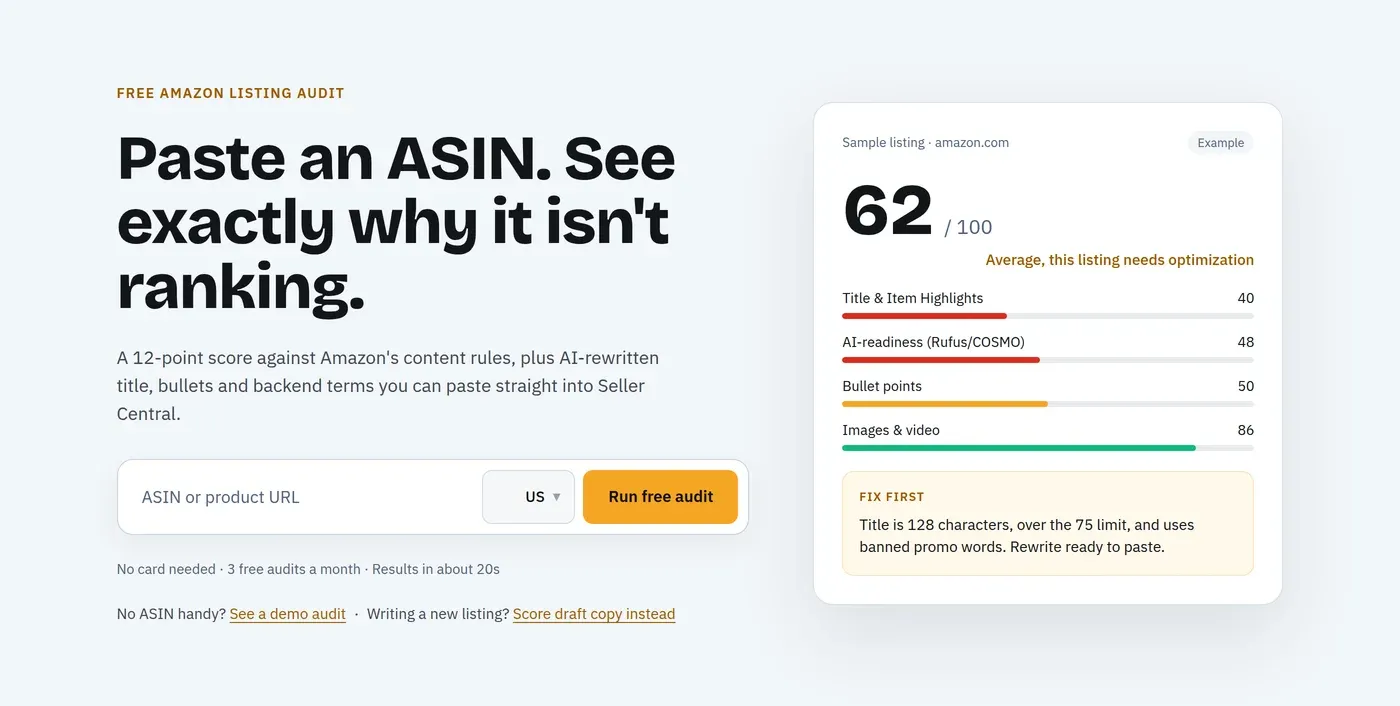
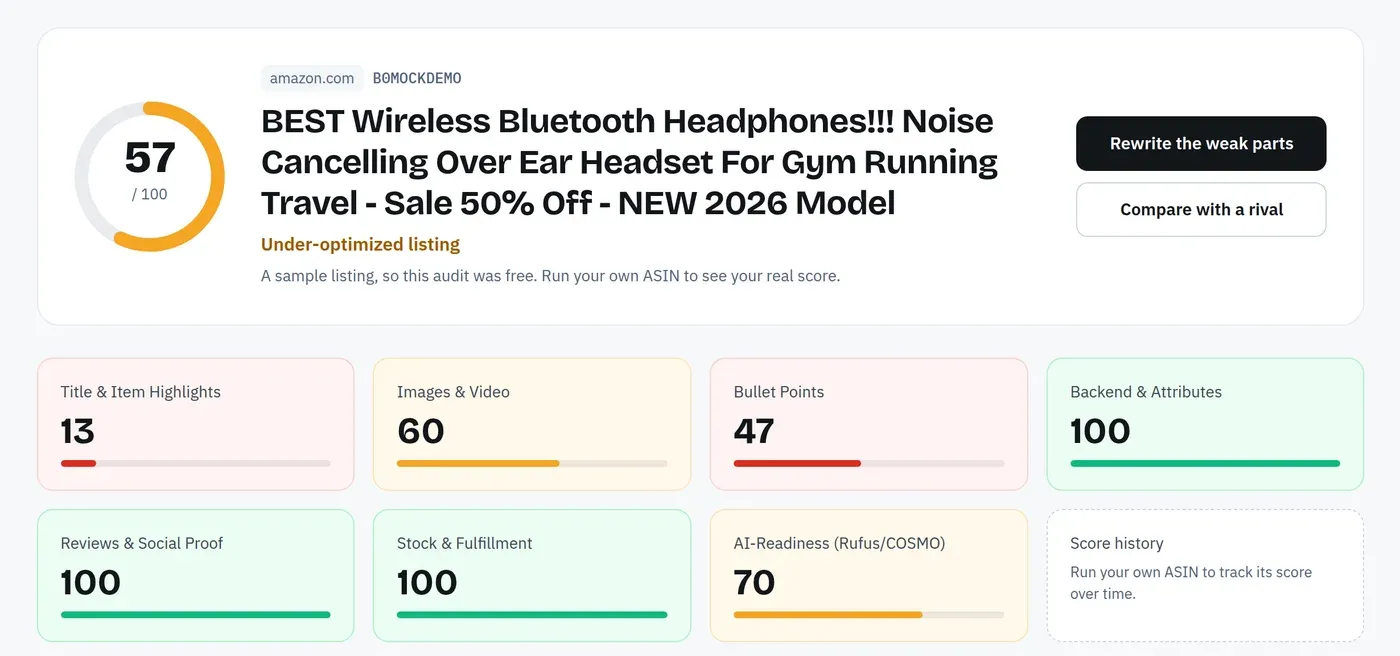
Amazon SEO Ranking is a listing SEO tool built around one job: getting an existing Amazon listing to rank better. Keyword research is one half of it. The other half is a live listing audit against a published 12-criteria rubric, followed by an AI rewrite of the title, Item Highlights, bullets, description and backend search terms.
The keyword suite has six tools, using Amazon on-platform search data with volumes shown as estimates. What sets it apart from the research-first suites is what happens after you find a keyword. You set it as the target or secondary keyword for the rewrite, and the tool shows where each one landed in the new copy.
It’s built for solo sellers, agencies and multi-marketplace sellers who already know what they sell. It doesn’t do product research, sourcing or PPC.
Ideal For
- Sellers updating or launching a listing who want the copy built around real search volume
- Agencies that need bulk runs, keyword gap analysis across client competitors and white-label reports
- Sellers checking demand across several marketplaces, including the UAE, Saudi Arabia and Egypt
- Teams that draft listings inside Claude and want live Amazon keyword data there
Top Features
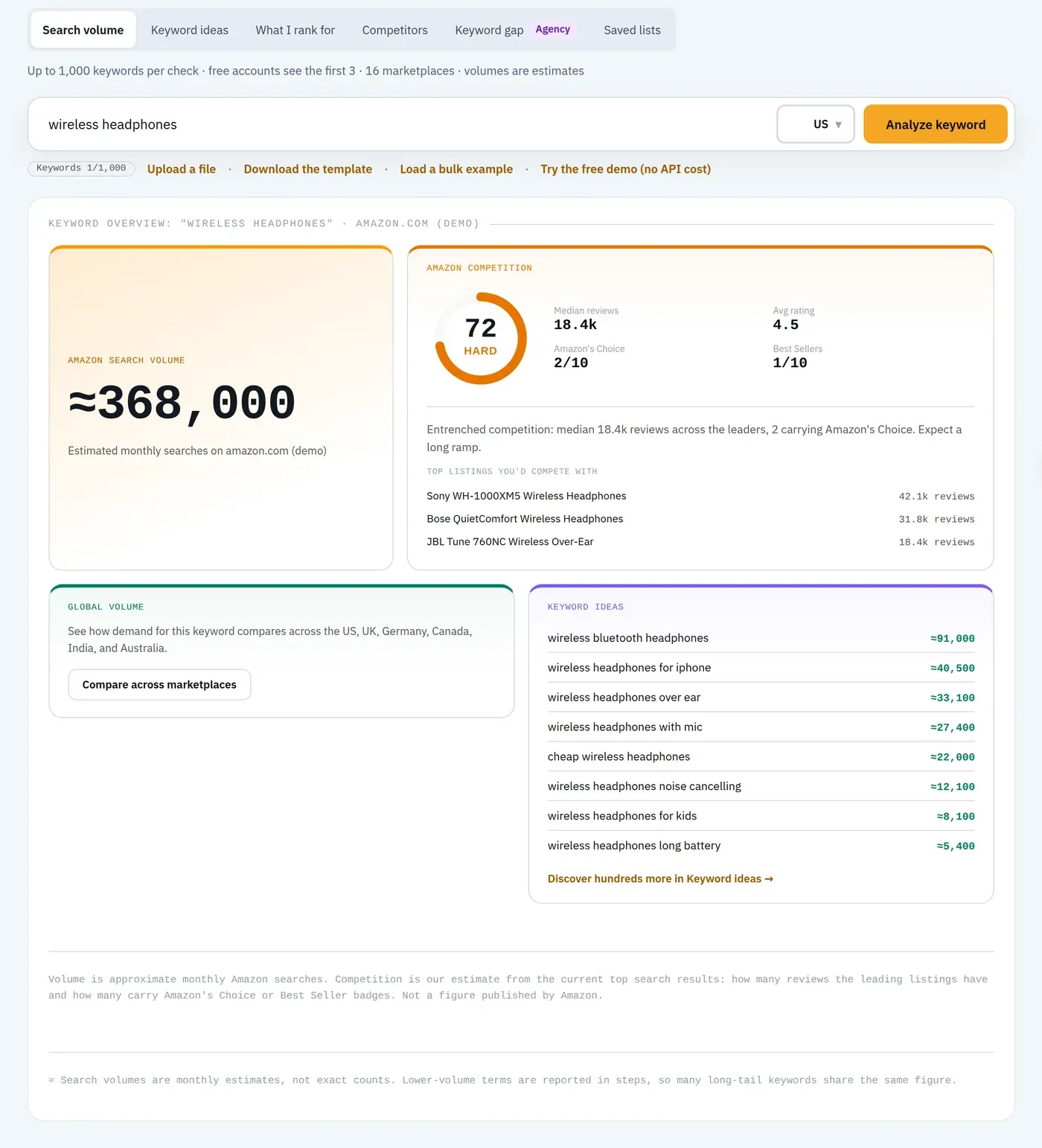
- The Search volume tool returns estimated monthly volume for one keyword or a batch, plus a competition score built from the review counts of top-ranking listings and how many carry Amazon’s Choice or Best Seller badges. It covers 16 marketplaces.
- The Keyword ideas tool expands a seed term into up to about 300 related keywords, graded as Close match, Related or All, so off-topic ideas drop out before they reach your list.
- "What I rank for", Competitors and Keyword gap show what any ASIN already ranks for, which listings compete for the same searches, and the terms rivals rank for that you don’t. For a brand-new listing that ranks for nothing yet, Competitors falls back to the top organic results for a phrase from the title. Keyword gap is on the Agency plan and compares up to 20 ASINs, filtered to your gaps or your wins.
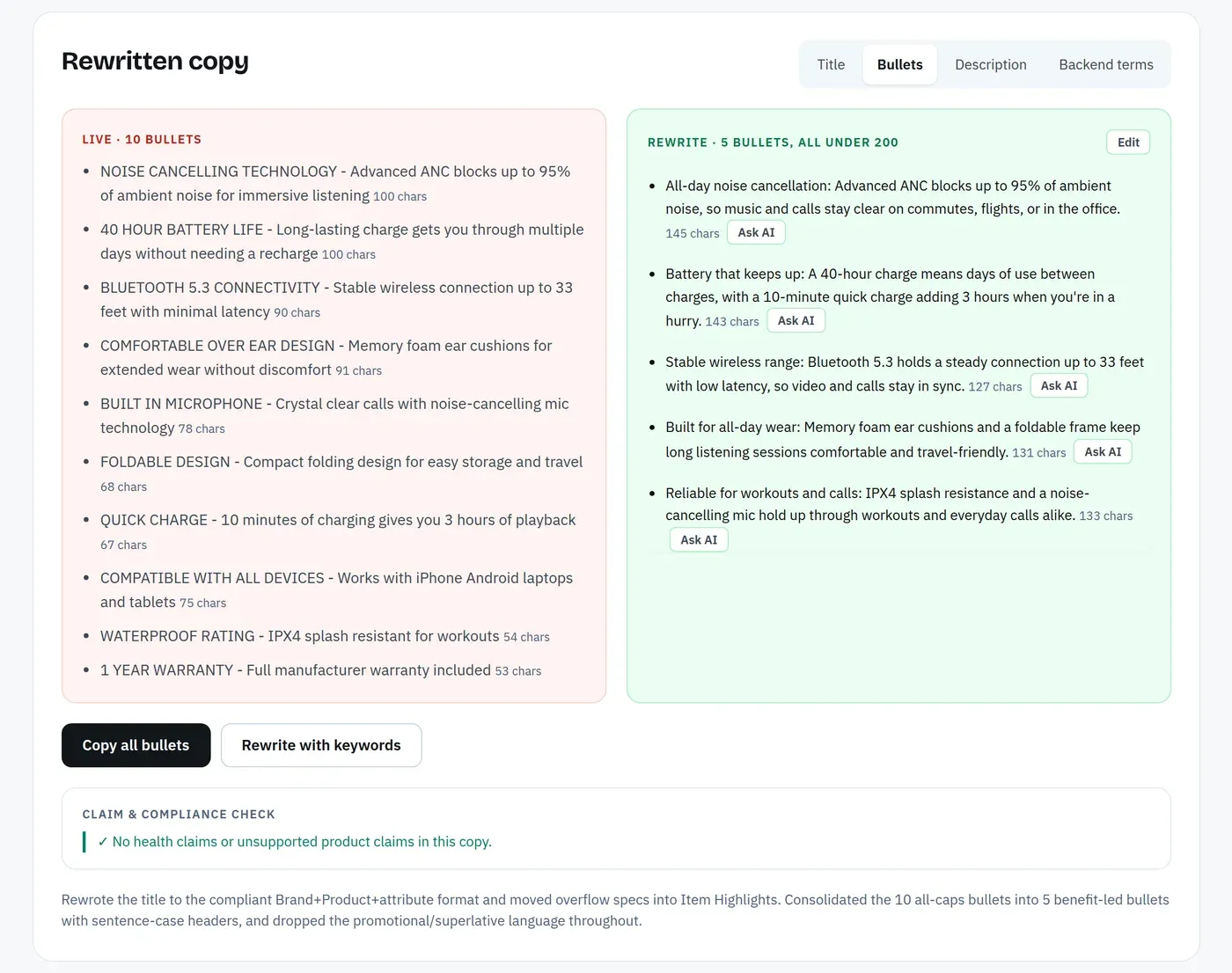
- Keywords into copy: pick a target keyword and secondary keywords, and the AI rewrite places the main term early in the title and works the rest into Item Highlights, bullets and description, with a coverage check. Backend terms stay under 249 bytes and never repeat visible words.
- Saved lists keep monthly volume snapshots. Every table has Copy table (pastes straight into Google Sheets or Excel), and a project workbook collects tables into one linked .xlsx.
- Claude connector (Pro and Agency) – keyword volume, related keywords, listing audits and copy checks callable from inside Claude, plus keyword gap on Agency.
Why It Stands Out
Most keyword tools stop at the list. Amazon SEO Ranking connects the list to a scored audit of your live listing and a rewrite that uses those keywords, so you can see whether the new copy fixes what the audit flagged. The 12 criteria and their pass rules are published, and each counts equally, which makes the score something an agency can explain to a client.
Every rewrite is grounded in the listing’s own spec table and checked in code for Amazon’s length limits, pack-count contradictions and unsupported health or product claims. Generic AI copy tends to invent those, and they turn into suppressed listings or “not as described” returns. You can then score the rewritten copy as a draft and compare it with the listing’s current score before anything changes in Seller Central.
Pricing is flat and doesn’t scale with SKU count. On monthly billing, Pro at $79 costs 39% less than Helium 10 Platinum ($129), and Agency at $249 costs 31% less than Helium 10 Diamond ($359).
Pros
- Keyword research, listing audit and AI rewrite in one workflow, with a coverage check that shows where each keyword ended up
- AI copy checked for claims, pack counts and Amazon’s limits, and scoreable as a draft before it goes live
- Search volume for 16 marketplaces, including Egypt, Saudi Arabia and the UAE, which many suites cover thinly
- Relevance grading on keyword ideas and “≈” marking on estimates make the data easier to trust
- Flat pricing, a 7-day trial on monthly plans and a 14-day money-back guarantee on every charge
Cons
- Keyword tools start on Pro. The free plan covers audits and rewrites, so the 7-day Pro trial is the way to test the keyword tools.
- The advanced tools (Keyword ideas, "What I rank for", Competitors, Keyword gap) cover four marketplaces: US, Egypt, Saudi Arabia and UAE. For deep reverse-ASIN work in Europe or Japan, Helium 10 or SellerSprite covers more.
- No daily keyword rank tracker, product research or PPC management.
Pricing
- Free: $0. Three audits a month with AI rewrites, A+ Content and review-reply tools. No keyword research.
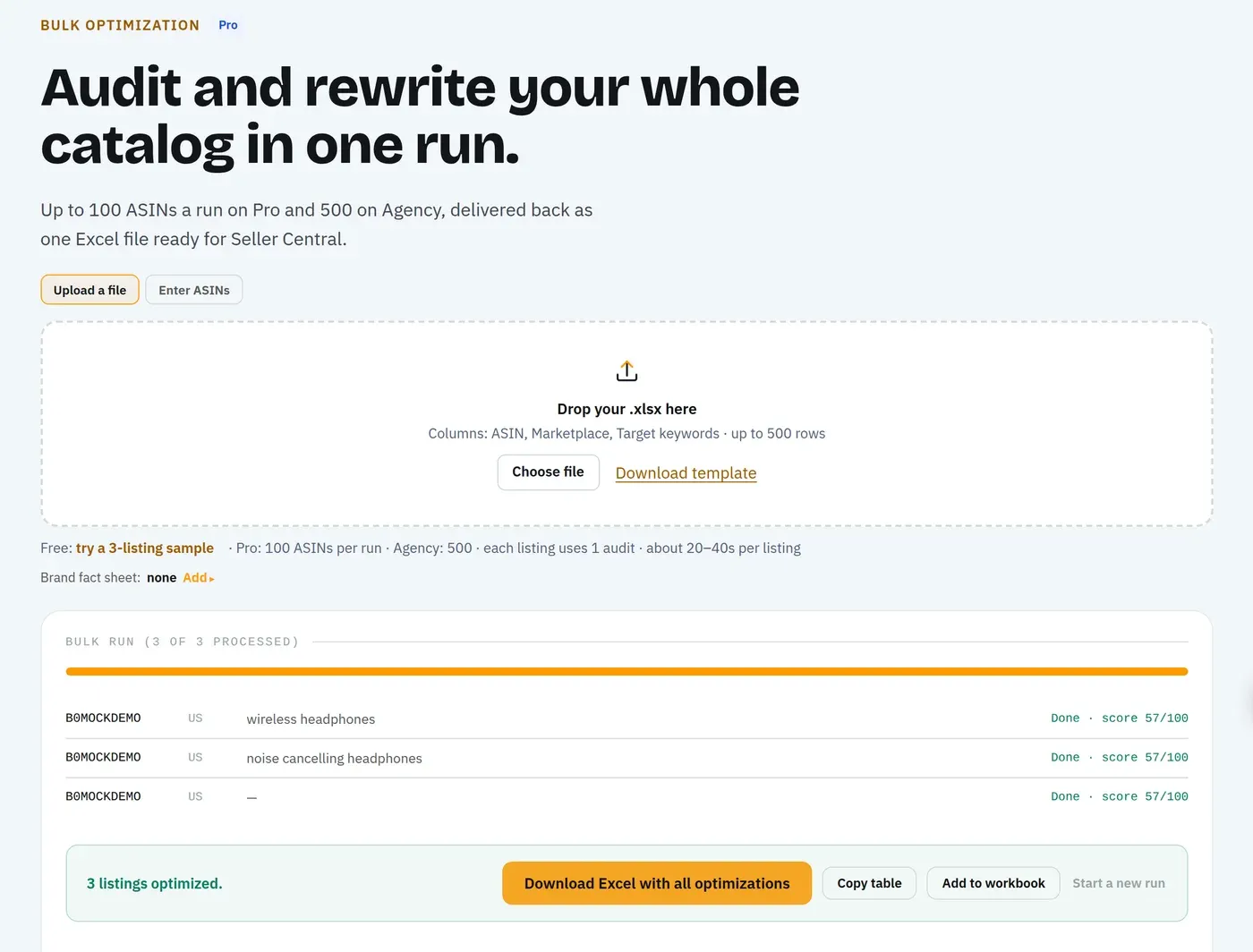
- Pro: $79/month or $799/year. 100 audits and 2,000 keyword lookups a month, Search volume, Keyword ideas, What I rank for, Competitors, Bulk up to 100 ASINs, Claude connector.
- Agency: $249/month or $2,490/year. 500 audits and 10,000 keyword lookups, Keyword gap, Bulk up to 500 ASINs, white-label PDF reports, API access.
- Enterprise: custom limits, SSO and a dedicated account manager.
Quota works in two currencies. The Search volume tool uses one keyword lookup per keyword, and each Keyword ideas search uses 10. "What I rank for" and Competitors lookups each use one audit, and Keyword gap uses one audit per ASIN compared. The full breakdown is on the Amazon SEO Ranking pricing page.
Final Verdict
Amazon SEO Ranking is the pick if your keyword research exists to improve a listing you already sell or are about to launch. It’s the shortest path from “which terms matter” to checked copy you can paste into Seller Central, and it covers Middle East marketplaces most suites treat as an afterthought. If you mainly research products before sourcing, or need reverse-ASIN depth across Europe and Japan, one of the suites below fits better.
2. Helium 10
Overview
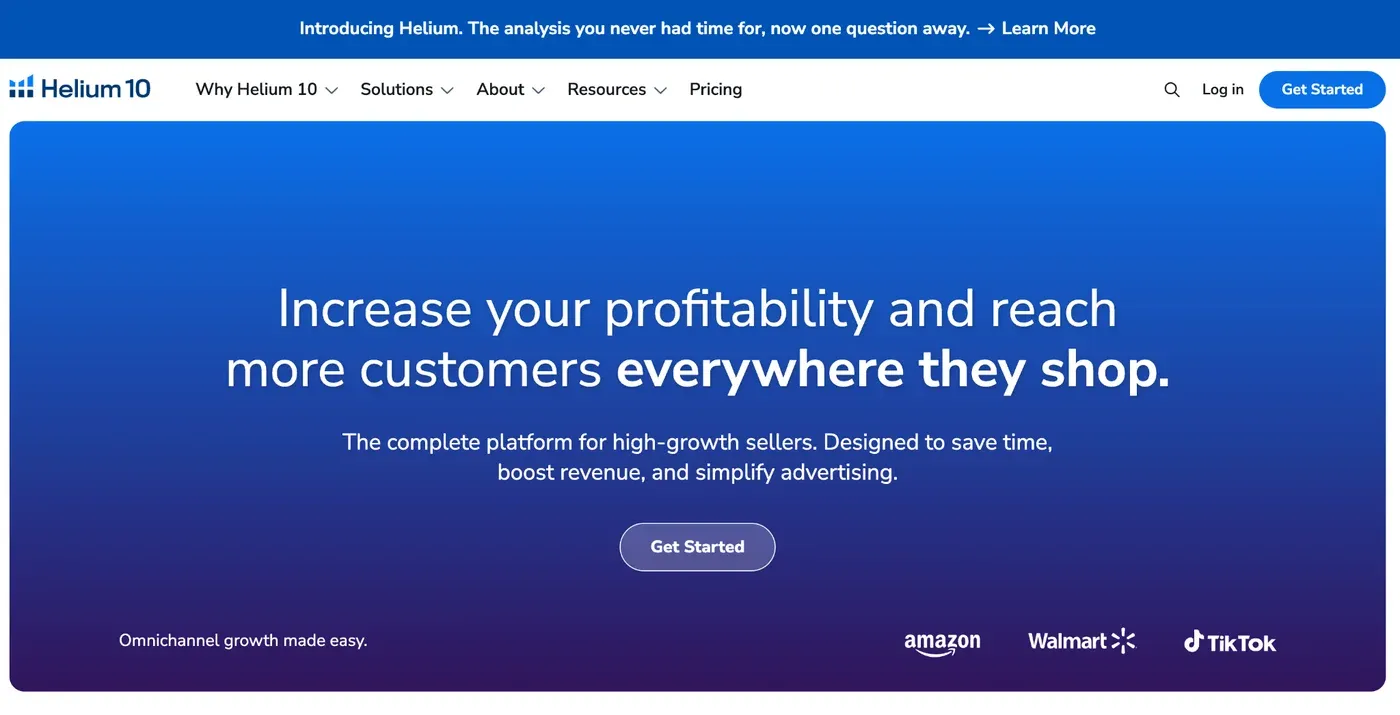
Helium 10 is the largest Amazon seller suite, covering product research, keyword research, listing building, PPC and operations for Amazon, Walmart and TikTok Shop. Its keyword tools are the reason many sellers subscribe. Cerebro shows the keywords any ASIN ranks for, and Magnet expands a seed keyword into related terms; several 2026 reviews report the two now share one interface.
It’s aimed at established sellers who want one subscription for most of their workflow and will pay for it.
Ideal For
- Established sellers doing heavy keyword and competitor research every week
- Sellers who also want PPC, profit analytics and inventory tools under one login
- Sellers across Amazon, Walmart and TikTok Shop
Top Features
- Cerebro (reverse ASIN) lists the organic and sponsored keywords competitors rank for, with search volume and historical trends
- Magnet expands seed terms, including misspellings and long-tail variants
- Keyword Tracker monitors your rank for tracked keywords over time
- Listing Builder and Scribbles draft listings and track which keywords you’ve used
Why They Stand Out
Helium 10’s keyword database is one of the deepest available, and Cerebro remains a benchmark for reverse-ASIN research. G2 reviewers consistently name Cerebro and Magnet as the tools they’d keep if they dropped everything else. For sellers whose main job is research across many markets, it’s one of the strongest choices.
Pros
- Deep keyword database with historical volume trends
- Reverse-ASIN research across many Amazon marketplaces
- Free plan with a few daily Cerebro and Magnet searches, no card required
- Covers most of a seller’s workflow beyond keywords
Cons
- The entry paid plan is $129/month on monthly billing, after the 2026 price changes retired the cheaper Starter plan
- Platinum caps Cerebro and Magnet usage, so large-catalog research can push you to Diamond
- Its Listing Analyzer returns a score without publishing how it’s calculated
- The breadth means a learning curve, and many sellers pay for tools they rarely open
Pricing
- Free: limited daily Cerebro and Magnet searches
- Platinum: $129/month, or $99/month billed annually
- Diamond: $359/month, or $279/month billed annually
- Enterprise: custom
Final Verdict
Helium 10 is the pick for sellers whose keyword research is a daily, multi-market habit and who’ll use the rest of the suite. For a seller with a handful of listings who mainly needs to fix titles and bullets, the $129 entry price buys a lot of unused tooling. The Amazon SEO Ranking vs Helium 10 comparison goes through the trade-offs category by category.
3. Jungle Scout
Overview
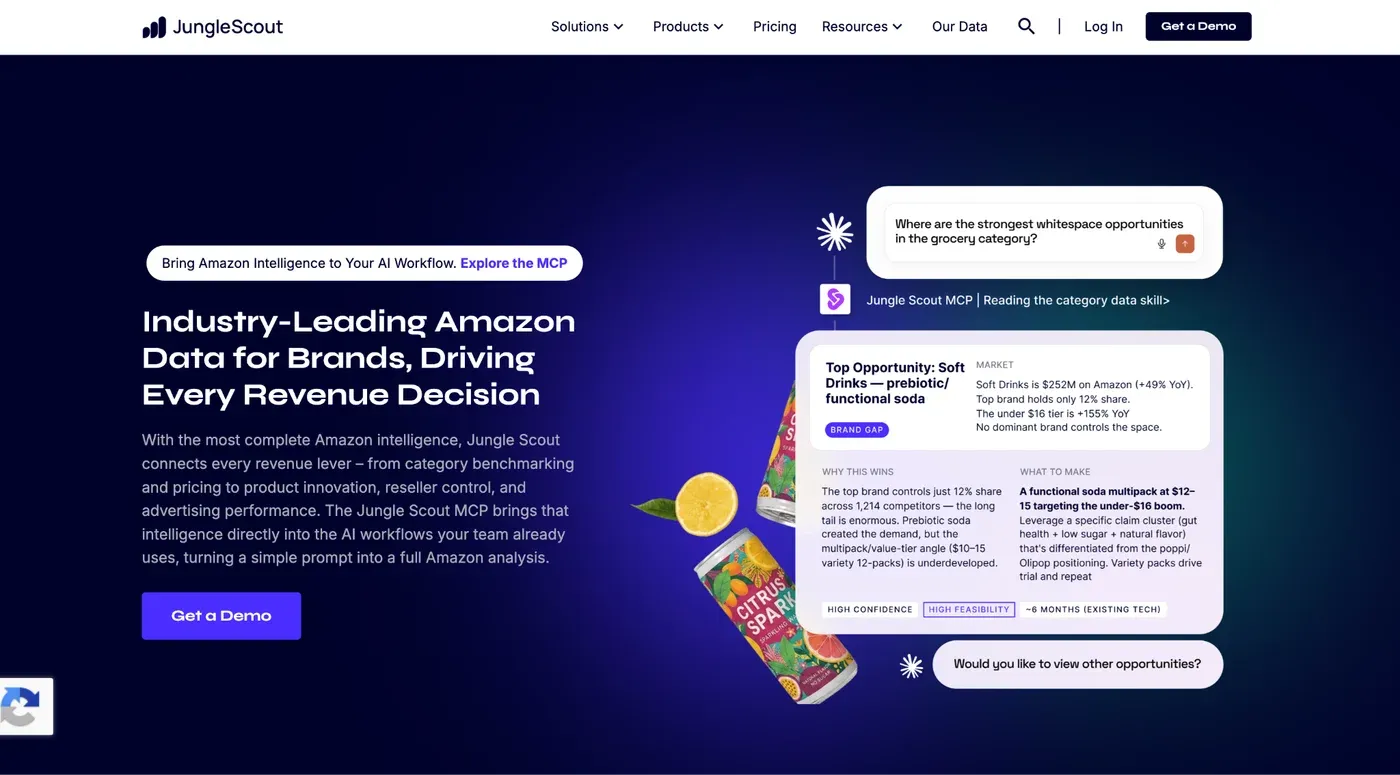
Jungle Scout started as a product research tool and still leads with it. Its Catalyst plans cover product and keyword research, supplier discovery and listing tools, while Cobalt serves enterprise brands. Keyword Scout shows search volume, trends and competitor keywords, and Amazon’s own seller blog names it among the third-party keyword tools worth trying.
Ideal For
- New sellers deciding what to sell
- Sellers who want a supplier database alongside keyword data
- Brands that want competitive intelligence on a category
Top Features
- Keyword Scout returns volume, historical trends and competitor keywords
- Product Database and Opportunity Finder surface niches with demand and weak competition
- Rank Tracker (Growth Accelerator and up) follows keyword positions
- A Supplier Database helps with sourcing
Why They Stand Out
Jungle Scout pairs keyword data with product-selection data better than most, so you can judge demand and competition in one place before committing to inventory. For new sellers, it’s one of the smartest starting points.
Pros
- Keyword and product research in one subscription
- Cleaner interface than most full suites
- Up to two years of keyword history on higher plans
- 7-day money-back guarantee
Cons
- Starter limits Keyword Scout to about 50 searches a month and disables data export
- No free trial, and the money-back guarantee has to be requested
- No published listing-scoring method
- Extra seats cost $459/year each
Pricing
- Starter: $49/month, or $29/month billed annually
- Growth Accelerator: $79/month, or $49/month billed annually
- Brand Owner + CI: $149/month, or about $129/month billed annually
- Cobalt: custom enterprise pricing
Final Verdict
Jungle Scout suits sellers at the “what should I sell?” stage. Once you’re selling and the work shifts to ranking specific listings, its Starter limits bite quickly, and its listing tools are thinner than its research tools. See Amazon SEO Ranking vs Jungle Scout for a side-by-side.
4. SellerSprite
Overview
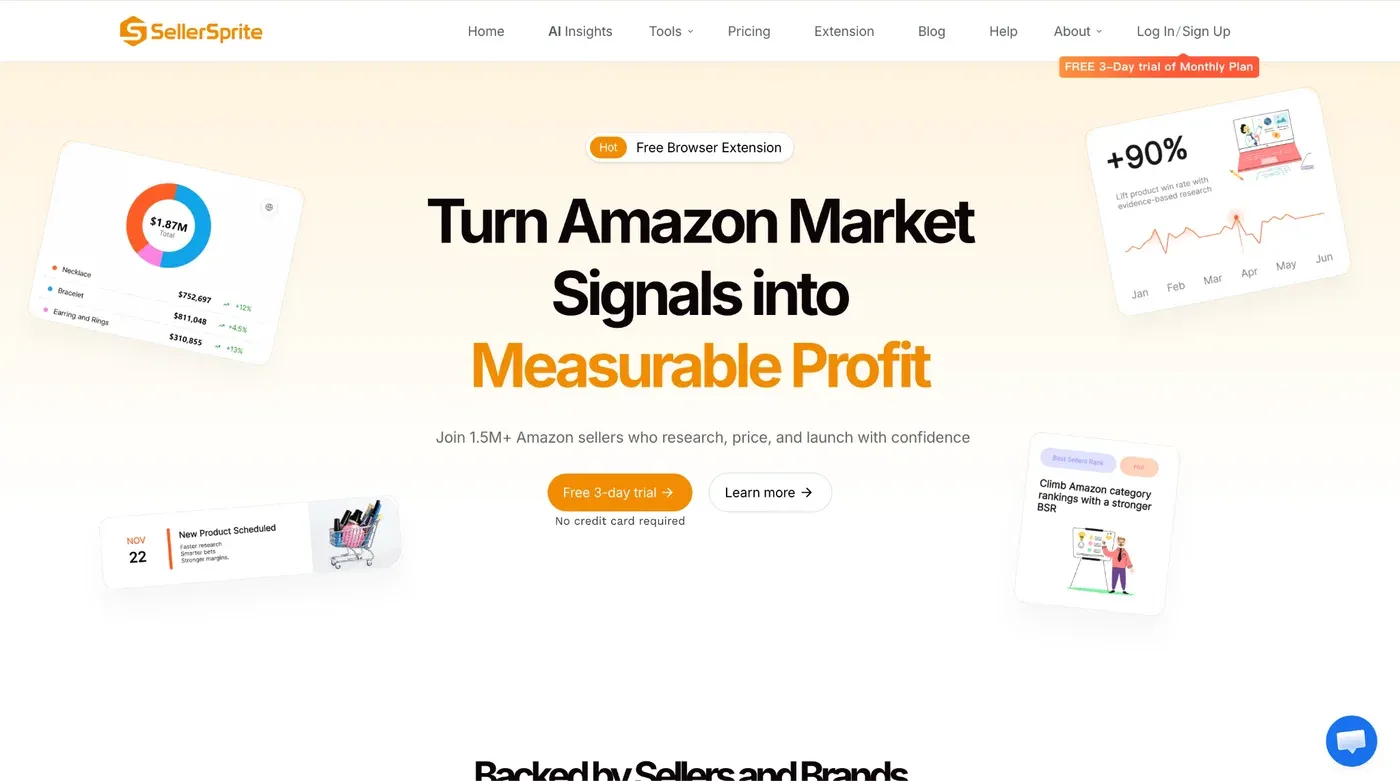
SellerSprite is a research suite that competes with Helium 10 on data at a lower price. It covers keyword mining, reverse ASIN, product and category research, ad insights and review analysis across 10 Amazon marketplaces. It also offers an API and an MCP server that connects AI assistants to its data.
Ideal For
- Sellers who want reverse-ASIN depth without Helium 10 pricing
- PPC-focused sellers who want keyword conversion rates and bid data
- Sellers in Japan, India and Mexico, alongside the US and Europe
Top Features
- Keyword Mining and Reverse ASIN, including reverse lookup across multiple ASINs at once
- ABA Opportunity Finder, built on Amazon Brand Analytics search terms
- Keyword Conversion Rate and a Realtime Bid Tracker for ad planning
- A free Index Checker and AI Listing Builder
Why They Stand Out
SellerSprite packs a lot of keyword and ad data into plans that cost less than the big suites, and its free plan lets you try the core tools before paying. For value-driven sellers who live in reverse-ASIN data, it’s one of the strongest alternatives to Helium 10.
Pros
- Wide keyword feature set, including multi-ASIN reverse lookup
- Free plan plus a free 3-day trial of the monthly plan
- 10 marketplaces on every plan: US, Japan, UK, Germany, France, Italy, Spain, Canada, India and Mexico
- Child accounts for small teams from the Standard plan up
Cons
- No coverage for Middle East marketplaces
- No unconditional refunds; only the unused part of a subscription is refunded
- Dense interface with a lot of metrics to learn
- Monthly usage limits reset even on annual plans
Pricing
- Free: limited access to core features
- Basic: $390/year
- Standard: $79/month, or $790/year
- Advanced: $1,290/year
- VIP: $1,890/year
Final Verdict
SellerSprite is a strong value pick for sellers who want Helium 10-style keyword research for less. Its keyword data doesn’t flow into a listing audit or a checked rewrite, so you’ll still write and check the copy yourself. It’s also the wrong tool for the UAE, Saudi Arabia or Egypt.
5. DataDive
Overview
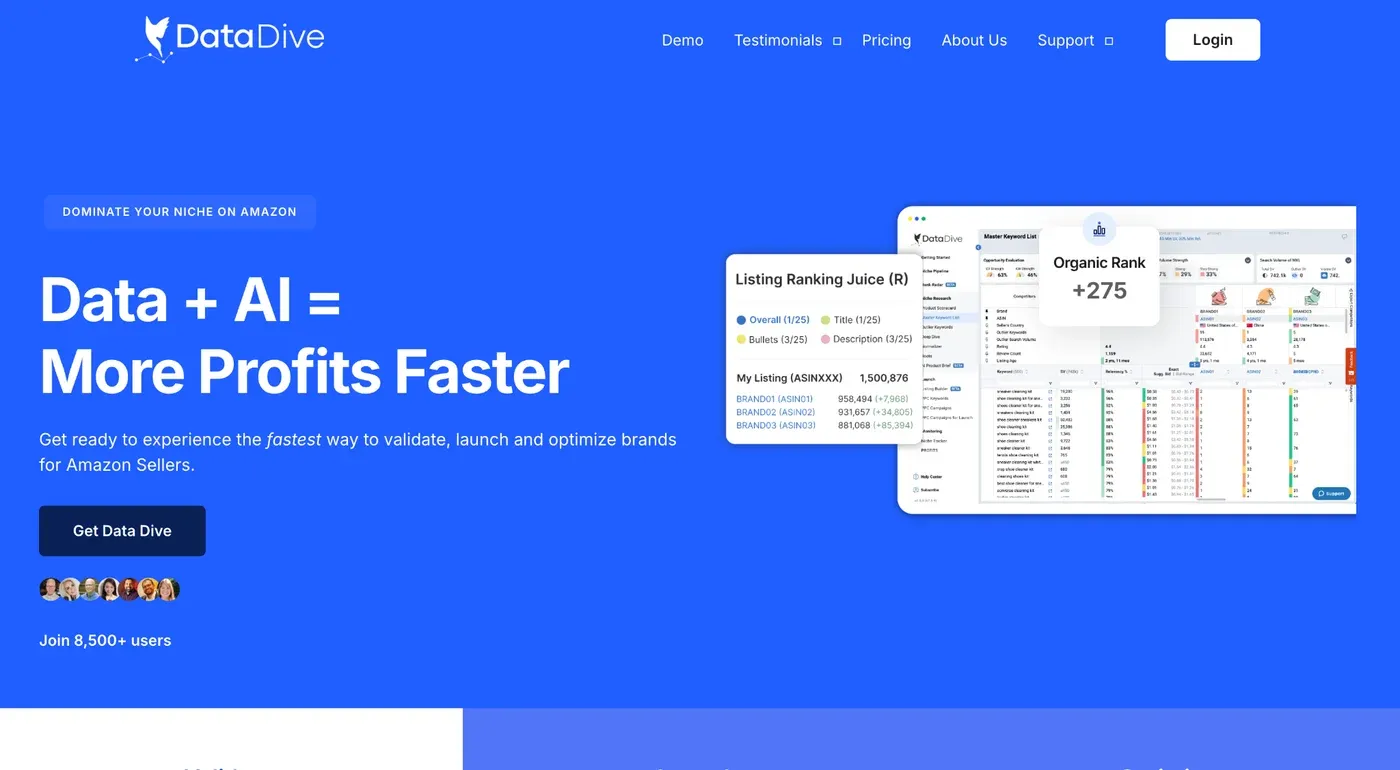
DataDive is a niche research tool built by an eight-figure private-label seller. You run a “Dive” on a set of competitor ASINs, and it builds a Master Keyword List showing every term competitors rank for, their organic and sponsored rank on each, and a relevancy percentage. It then helps you track rank and build a listing around that list.
Ideal For
- Private-label brands validating a niche before ordering inventory
- Sellers planning launch PPC around specific keyword clusters
- Agencies doing pre-launch research for clients
Top Features
- Master Keyword List with competitor organic and sponsored rank per keyword
- Roots clusters keywords by shared root word and totals their volume
- Rank Radar tracks daily rank, including PPC and Search Query Performance data
- AI Listing Builder with COSMO and Rufus modes for US and UK listings
Why They Stand Out
DataDive answers a specific question well: is this niche worth entering, and which keywords define it? Its relevancy scoring cuts a long keyword list down to the terms most competitors share. For launch planning, it’s one of the sharpest tools available.
Pros
- Niche-level keyword view instead of one ASIN at a time
- Root clustering makes large lists manageable
- Daily rank tracking tied to PPC data
- 10 Amazon marketplaces
Cons
- The Standard plan at $149/month is the practical starting point
- No free trial on the public pricing page
- Reviewers estimate 5 to 10 hours of learning before it pays off
- More than most sellers need for maintaining a few established listings
Pricing
- Starter: $39/month, or $32/month billed annually
- Standard: $149/month, or $124/month billed annually
- Higher tiers: up to $490/month
Final Verdict
DataDive fits brands that launch several products a year and want rigorous niche analysis first. For fixing an existing listing, it’s more tool and more cost than most sellers need.
6. ZonGuru
Overview
ZonGuru is an all-in-one toolkit for small private-label sellers. Keywords on Fire, its main keyword tool, builds lists from seed terms or competitor ASINs with volume, competition and relevance scores. The Seller plan adds daily rank tracking plus customer tools like review requests and email automation.
Ideal For
- Small catalogs that want keyword research plus customer messaging
- New sellers who want a gentler learning curve
- Sellers in North America, Europe or Australia
Top Features
- Keywords on Fire for seed and reverse-ASIN keyword lists
- Listing Optimizer, which scores keyword placement in your copy
- Keyword Tracker with daily rank per buyer keyword (Seller plan)
- Review and email automation for active sellers
Why They Stand Out
ZonGuru combines keyword research with the day-to-day tools a small seller needs after launch, at a low entry price. For a seller with a few SKUs who wants one tool for keywords and customers, it’s one of the smartest budget choices.
Pros
- Low annual entry price
- Daily keyword rank tracking on the Seller plan
- Standalone Keywords on Fire option at $19/month
- 7-day free trial
Cons
- Seller plan pricing scales with SKU count, from $79/month up to $249/month
- The keyword database is shallower than Helium 10’s, per several independent reviews
- Listing Optimizer scores keyword placement only, not images, reviews or other listing factors
- No coverage for Middle East marketplaces
Pricing
- Researcher: $49/month, or $29/month billed annually
- Seller: from $79/month ($49/month billed annually) for 1–20 SKUs, rising with SKU count to $249/month
- Keywords on Fire only: $19/month
Final Verdict
ZonGuru works well for small catalogs that want keywords and customer automation on one bill. Once your SKU count grows, the price climbs, and heavier keyword users tend to outgrow its data. Read Amazon SEO Ranking vs ZonGuru for how the two compare on listing work.
7. AMZScout
Overview
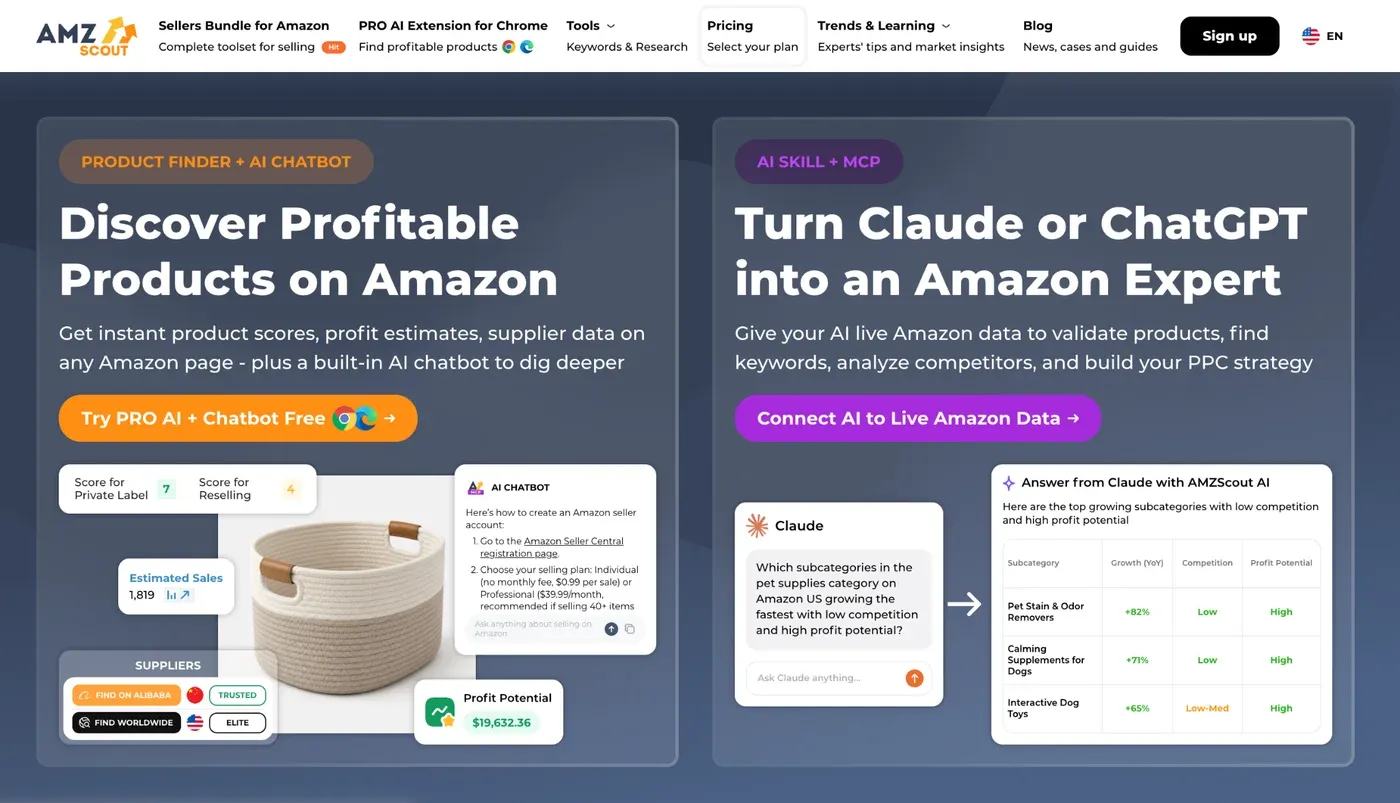
AMZScout is a product research toolkit with keyword tools attached. Its bundle includes the PRO AI Extension, a product database of more than 550 million products, Keyword Search, Reverse ASIN Lookup and a Keyword Tracker. It’s sold as one flat bundle with monthly, yearly or lifetime payment.
Ideal For
- New sellers hunting for products on a budget
- Sellers who want a browser extension overlay on Amazon search pages
- Sellers who prefer paying once for lifetime access
Top Features
- Keyword Search for seed-based keyword ideas with volume
- Reverse ASIN Lookup for competitor keywords
- Keyword Tracker for rank monitoring
- PRO AI Extension with sales estimates on Amazon pages
Why They Stand Out
AMZScout’s pricing is simple, and its annual and lifetime options are cheap over time. For sellers who mainly want product ideas with some keyword support, it’s one of the most affordable routes.
Pros
- One bundle, no confusing tiers
- Low effective monthly cost on the yearly plan
- Lifetime option for long-term sellers
- 10-day money-back guarantee
Cons
- Keyword tools are secondary to product research
- No listing-scoring rubric; its AI Listing Builder writes copy without grading what’s live
- Some useful features sit in add-on packs at extra cost
- The lifetime plan is a large upfront commitment
Pricing
- Monthly: $59.99
- Yearly: $399.99 (currently with 3 extra months)
- Lifetime: $1,599.99
- Add-on packs: $99.99/year each
Final Verdict
AMZScout is a sensible budget choice for product hunting. If keyword research for existing listings is your main job, its keyword tools are thinner than the dedicated options above. The Amazon SEO Ranking vs AMZScout comparison covers the difference.
8. SellerApp
Overview
SellerApp combines keyword research, a Listing Quality Index, product research and PPC automation, with managed advertising services on top. It works across 16 or more Amazon marketplaces and positions itself around advertising, reporting $3 billion in ad revenue managed across 33,000+ brands.
Ideal For
- Sellers whose keyword research mainly feeds Amazon PPC
- Brands that may want managed ad services later
- Sellers who want a free tier to start
Top Features
- Keyword research with conversion-oriented metrics
- Listing Quality Index, which scores listings against best practices
- PPC automation on the Smart plan
- API and managed services for larger accounts
Why They Stand Out
SellerApp ties keyword research to ad management more tightly than most tools. For sellers who treat organic and paid search as one budget, it’s one of the strongest options.
Pros
- Freemium plan with no time limit
- Keyword data aimed at buyer intent, not raw volume
- Wide marketplace list
- 50% discount on annual billing
Cons
- Ads automation requires the Smart plan, advertised at $149/month for 3 months and $250/month after
- Listing Quality Index weights aren’t published
- White-label reporting sits in a separate agency program
- Keyword data is one part of an ads-first product
Pricing
- Freemium: $0, limited tracking
- Pro: $99/month
- Smart: $149/month for the first 3 months, then $250/month
- Enterprise: custom
Final Verdict
SellerApp suits sellers who run PPC through their research tool. For organic listing work, you’ll pay for ad features you may not use. See Amazon SEO Ranking vs SellerApp.
9. Keyword Tool (keywordtool.io)
Overview
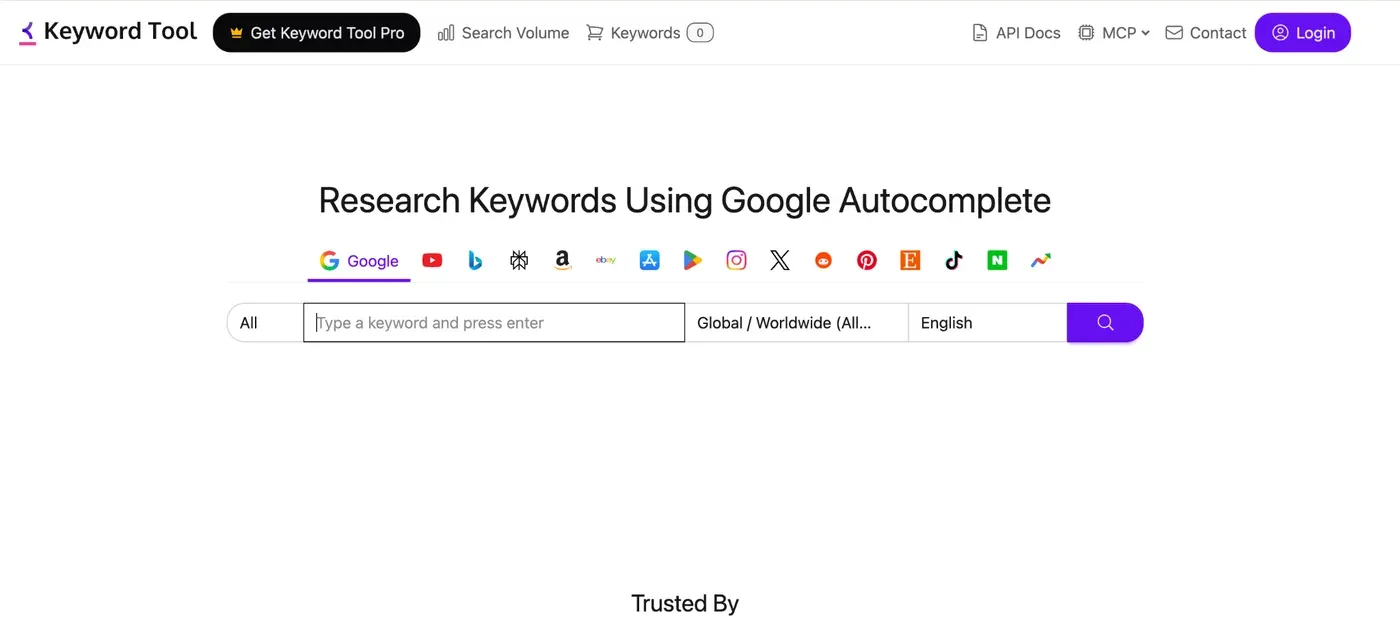
Keyword Tool generates keyword ideas from autocomplete on Amazon, Google, YouTube, eBay, Etsy and other sites. The free version returns suggestions without volume. Paid plans add search volume, and for Amazon that volume is an estimate.
Ideal For
- Marketers researching Amazon alongside Google and YouTube
- Sellers who want quick long-tail ideas from Amazon autocomplete
- Content teams building product pages off Amazon as well
Top Features
- Amazon autocomplete ideas, often hundreds per seed term
- Multi-site research from one account
- Bulk volume analysis on paid plans
- API on higher tiers
Why They Stand Out
It’s one of the fastest ways to see how shoppers phrase searches across several sites at once, and the free version needs no sign-up. For cross-channel marketers, it’s one of the handier idea generators.
Pros
- Free version with no account needed
- Covers many search sites besides Amazon
- Simple interface
- 30-day money-back guarantee
Cons
- No reverse ASIN, competitor ranking or listing tools for Amazon
- Paid plans start at $89/month, which is high for idea generation alone
- Independent reviews note keyword overlap and no difficulty scoring
- Amazon volume is estimated rather than drawn from Amazon’s own data
Pricing
- Free: keyword ideas, no volume
- Pro Basic: $89/month, or $69/month billed annually
- Pro Plus: $99/month, or $79/month billed annually
- Pro Business: $199/month, or $159/month billed annually
Final Verdict
Keyword Tool’s free version is worth a bookmark for brainstorming. As a paid Amazon keyword tool, it lacks the competitor and listing features sellers need, and it costs more than several dedicated Amazon tools.
10. Amazon Brand Analytics
Overview
Amazon Brand Analytics is Amazon’s own reporting suite inside Seller Central. Its Search Analytics reports include Search Query Performance, Top Search Terms and Search Catalog Performance. It’s free for brand owners enrolled in Amazon Brand Registry with a Professional selling account.
Ideal For
- Brand-registered sellers who want first-party search and conversion data
- Sellers checking which queries already drive impressions, clicks and purchases
- Anyone validating third-party volume estimates
Top Features
- Search Query Performance walks each query through impressions, clicks, add-to-carts and purchases, with your brand’s share at each step
- Top Search Terms ranks popular searches marketplace-wide and shows the top clicked products for each
- Search Catalog Performance shows how your products convert from search
- History of roughly three years for many dashboards
Why They Stand Out
This is the only data in the list that comes from Amazon itself rather than a model. For brand owners, it’s one of the most reliable ways to see where shoppers drop out between search and purchase.
Pros
- Free with Brand Registry
- First-party query and conversion data
- Shows funnel drop-off, which no third-party tool can measure
- Covers searches your ads have never touched
Cons
- Unavailable to resellers and unbranded sellers
- Top Search Terms gives a search frequency rank, not an absolute monthly volume
- Raw reports with no keyword suggestions, clustering or listing guidance
- Requires a $39.99/month Professional selling plan
Pricing
Free with Amazon Brand Registry and a Professional selling plan ($39.99/month plus selling fees).
Final Verdict
Every brand-registered seller should use Brand Analytics, whatever else they pay for. It works best as a check on third-party estimates, since it doesn’t suggest keywords or help you write copy. Resellers can’t use it at all.
How to Choose the Best Amazon Keyword Research Tool
Price and feature lists make most tools look similar. The best Amazon keyword tool for you is the one that passes these seven checks for your catalog and markets.
1. Where Does the Search Volume Come From?
Ask what the volume number is built from: Amazon autocomplete, a modelled estimate, or Amazon’s own data. Autocomplete gives ideas with no demand figure. Modelled estimates differ between vendors, sometimes widely, so a tool that presents them as exact counts is overselling. Look for estimates marked as estimates, and relevance filtering that keeps off-topic ideas out of your list. If you’re brand-registered, compare a vendor’s numbers with your Search Query Performance data on terms you already rank for. This guide to Amazon keyword search volume explains how the estimates are built.
2. Does It Cover the Marketplaces You Sell In?
Check two numbers separately: marketplaces with search volume, and marketplaces where the reverse-ASIN and gap tools work. They’re often different. SellerSprite covers 10 marketplaces with no Middle East coverage. Amazon SEO Ranking has volume for 16, including Egypt, Saudi Arabia and the UAE, and its advanced tools cover four. Pick by your markets, not by the headline number.
3. Do the Keywords Reach Your Listing?
A keyword list in a spreadsheet won’t move your rank until someone writes it into the title, bullets and backend terms. Check whether the tool drafts copy from your chosen keywords, shows which ones made it in, and checks the result against Amazon’s limits. In most categories that means a title up to 75 characters, bullets under 200 characters, and 249 bytes of backend terms that don’t repeat visible words.
4. Is the AI Copy Safe to Paste?
Most suites now include an AI listing writer. Ask what it checks before you see the draft. Does it use the listing’s own spec table, or can it invent a “protein” claim on a fruit snack? Does it catch a bullet that says “20 packets” when the title says 8? Does it flag health claims Amazon restricts? Copy that fails these checks costs more than the keyword research saved.
5. Can You Score New Copy Before It Goes Live?
Changing a live listing and waiting a month to see what happened is slow and risky. A tool that scores draft copy against the same rubric as your live listing lets you compare before and after first. Check whether that rubric is published: a score is only useful if you, or a client, can see what it measures. This matters most for new listings, which have no ranking data yet.
6. How Does the Price Scale?
Look past the entry price at usage caps on the keyword tools, and at whether price rises with your SKU count (ZonGuru’s does). Also check whether the advertised price needs an annual commitment: a $29/month annual rate is $348 up front.
7. Can You Test It on Your Own Listing First?
Run the tool on a product and keyword you know well. If the volume, competitor data or rewritten copy looks wrong for your niche, it’ll look wrong everywhere. Helium 10, SellerSprite and SellerApp have free plans with keyword caps. Amazon SEO Ranking’s free plan audits and rewrites your own listing, and its 7-day Pro trial covers the keyword tools.
Best Amazon Keyword Tools: Everything You Need to Know
Star ratings are editorial judgments based on each vendor’s published features and pricing and on independent reviews, as of September 2026. “Keywords to Listing Copy” rates how far each tool takes you from a keyword list to checked, ready-to-paste listing copy.
| Company | Pros | Cons | Ease of Use | Integrations | Support | Affordability | Keywords to Listing Copy |
|---|---|---|---|---|---|---|---|
| Amazon SEO Ranking | Keywords flow into audit and checked rewrite; 16 marketplaces for volume; Claude connector | Keyword tools start on Pro; advanced tools cover 4 marketplaces; no rank tracker | ★★★★ | ★★★★ | ★★★★ | ★★★★ | ★★★★★ |
| Helium 10 | Deepest keyword database; Cerebro reverse ASIN; full seller suite | $129/mo entry; usage caps on Platinum; learning curve | ★★★ | ★★★★ | ★★★★ | ★★ | ★★★ |
| Jungle Scout | Keyword plus product research; clean interface; long history | Starter caps and no export; no free trial; thin listing tools | ★★★★ | ★★★ | ★★★★ | ★★★ | ★★★ |
| SellerSprite | Multi-ASIN reverse lookup; ad data; low annual price | No Middle East; partial refunds only; dense interface | ★★★ | ★★★★ | ★★★ | ★★★★ | ★★ |
| DataDive | Niche-level keyword list; root clustering; rank tracking | $149/mo real entry; no trial; steep learning curve | ★★ | ★★★ | ★★★ | ★★ | ★★★★ |
| ZonGuru | Low entry; daily rank tracking; customer automation | SKU-scaled price; shallower data; keyword-only listing score | ★★★★ | ★★★ | ★★★ | ★★★ | ★★★ |
| AMZScout | Simple bundle; cheap yearly; lifetime option | Keywords secondary; add-on packs; no listing score | ★★★★ | ★★ | ★★★ | ★★★★ | ★★ |
| SellerApp | Freemium; intent-focused keywords; PPC link | Ads need $250/mo plan; unpublished score weights; ads-first | ★★★ | ★★★★ | ★★★ | ★★★ | ★★ |
| Keyword Tool | Free ideas; many sites; simple | No Amazon competitor tools; $89/mo entry; estimated volume | ★★★★★ | ★★ | ★★ | ★★ | ★ |
| Amazon Brand Analytics | First-party data; free; funnel metrics | Brand Registry only; no absolute volume; raw reports | ★★ | ★ | ★★ | ★★★★★ | ★ |
Find Your Keywords and Fix Your Listing with Amazon SEO Ranking
If you already sell on Amazon, a keyword list only helps once it’s in your title, bullets and backend terms. Amazon SEO Ranking takes you from search volume to a rewritten listing in one session, checks that copy for claims and pack-count errors, then scores it as a draft so you can compare it with your live listing before you change anything in Seller Central.
Pro is $79/month with 2,000 keyword lookups, flat regardless of catalog size, and monthly plans start with a 7-day free trial. Want to see how your listing scores first? The free plan gives you three audits a month with AI rewrites, no card required.
Start the 7-day Pro trial or run a free Amazon listing audit.
FAQ
What is the best Amazon keyword research tool in 2026?
The best Amazon keyword research tool in 2026 for sellers improving existing listings is Amazon SEO Ranking, which pairs search volume for 16 marketplaces with an AI rewrite that places your chosen keywords, reports where they landed and checks the copy before you paste it. For the deepest keyword database and reverse-ASIN research across many markets, Helium 10 leads, at $129/month on monthly billing. SellerSprite offers similar research depth from $390/year. Brand-registered sellers should also use Amazon Brand Analytics, which is free.
What should I consider when choosing the right Amazon keyword research tool?
When choosing the right Amazon keyword research tool, consider the source of its search volume, the marketplaces it covers, and whether its keywords reach your listing as copy that’s safe to paste. Check whether AI-written copy is tested for claims, pack counts and Amazon’s length limits, and whether you can score it before it goes live. Look at usage caps, SKU-based pricing and annual commitments, not only the entry price. Test on your own product during a free plan or trial before paying.
How does Amazon SEO Ranking differ from similar alternatives?
Amazon SEO Ranking differs from similar alternatives by connecting keyword research to a scored listing audit and a checked AI rewrite. Suites like Helium 10 and Jungle Scout give you keyword lists and leave the writing to you or to a general AI tool. Amazon SEO Ranking’s rewrite places your target keyword early in the title, reports keyword coverage across the listing, and checks the copy for Amazon’s length limits, pack-count contradictions and unsupported claims. On monthly billing, Pro at $79 costs 39% less than Helium 10 Platinum and Agency at $249 costs 31% less than Diamond.
How do I get started with Amazon SEO Ranking?
Getting started with Amazon SEO Ranking takes about a minute: create a free account, paste an ASIN or Amazon URL, and pick the marketplace. The first audit returns a 0–100 score against 12 criteria in 10 to 20 seconds, with an AI rewrite of anything that fails. To use the keyword tools, start the 7-day Pro trial, which includes 2,000 keyword lookups a month. You won’t be charged until the trial converts, and every charge has a 14-day money-back guarantee.
How easy is it to switch to Amazon SEO Ranking?
Switching to Amazon SEO Ranking is easy because it needs no Seller Central connection or data migration. You paste ASINs one at a time or upload an Excel or CSV file to Bulk Optimization, which handles up to 100 ASINs per run on Pro and 500 on Agency. Keyword lists from another tool can be pasted into the Search volume tool to get fresh estimates. Many sellers keep a research suite for product sourcing and use Amazon SEO Ranking for listing work.
Is Amazon SEO Ranking’s keyword data as deep as Helium 10’s?
Amazon SEO Ranking’s keyword data isn’t as deep as Helium 10’s for reverse-ASIN research across many marketplaces. Its Search volume tool covers 16 marketplaces, but "What I rank for", Competitors and Keyword gap cover four: the US, Egypt, Saudi Arabia and the UAE. Helium 10’s Cerebro covers far more markets, with longer volume history. If your main job is research in Europe or Japan, Helium 10 or SellerSprite will serve you better, and Amazon SEO Ranking can still audit and rewrite the listing.
Can I use ChatGPT for Amazon keyword research?
You can use ChatGPT for Amazon keyword ideas, but it has no Amazon search volume data, so any volumes it gives you are guesses. General AI tools also don’t see your live listing or its spec table, which is how they end up adding unsupported claims or miscounting Amazon’s 75-character title and 249-byte backend limits. A safer workflow takes volume from an Amazon keyword tool and checks the AI draft against the listing’s facts before you paste it. Amazon SEO Ranking’s Claude connector lets Claude call real keyword volume and those listing checks directly.
Is there a free Amazon keyword research tool?
There are several free Amazon keyword research tools, each with limits. Amazon Brand Analytics is free for brand-registered sellers with a $39.99/month Professional plan and gives first-party query data, but no absolute search volume. Helium 10’s free plan allows a few Cerebro and Magnet searches a day, and SellerSprite has a free plan with limited access. Keyword Tool’s free version and Amazon’s own search bar autocomplete give keyword ideas without volume; this roundup of free Amazon keyword tools compares them in more detail.
See how your own listing scores against 12 published criteria. No credit card, no trial signup.
Run free audit