Tools & Comparisons
Amazon SEO Ranking vs. SellerApp: Which Is Better in 2026?
Key Takeaways (TL;DR)
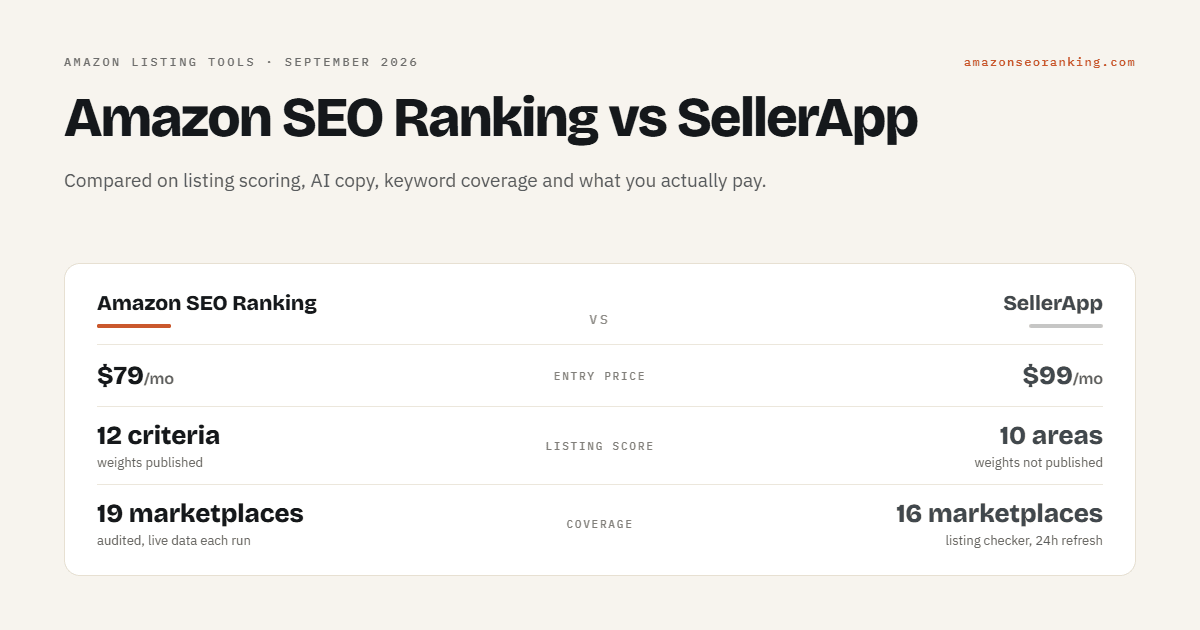
Anyone comparing Amazon SEO Ranking vs SellerApp is really choosing between two different jobs: fixing what a listing says, or managing what a seller spends on ads. Here's the short version.
- Primary difference: Amazon SEO Ranking audits and rewrites one listing at a time against a published 12-criteria rubric. SellerApp is a wider Amazon seller suite where the listing score sits next to PPC automation, product research and managed services.
- Best overall choice: For sellers whose next task is "make this live listing rank better," Amazon SEO Ranking at $79/month. For sellers running paid campaigns who want listing scoring bundled in, SellerApp.
- Listing audit winner: Amazon SEO Ranking. Both tools score 0–100. SellerApp examines 10 areas and publishes its bands – above 85 is good, 40 to 60 average, below 40 poor – but not the weight of each area. Amazon SEO Ranking publishes 12 criteria, weighted equally.
- AI copy winner: Amazon SEO Ranking. Rewrite is generated against the specific criterion that failed, with a compliant title, five bullets and backend terms in one pass, output in 12 languages.
- Keyword data winner: SellerApp. Its keyword visibility and backend keyword tracking run across its full marketplace list. Amazon SEO Ranking's Volume Checker covers 16 marketplaces; its deeper keyword tools (Magic Tool, Ranked Keywords, Competitors, Keyword Gap) cover 4: US, Egypt, Saudi Arabia and UAE.
- Pricing winner: split. Month to month, Amazon SEO Ranking is 20% cheaper at entry ($79 vs $99) and 24% cheaper at the tier above ($189 vs $250). On an annual contract the result flips, because SellerApp discounts annual subscriptions by 50% against our 16%.
- Ease of use winner: Amazon SEO Ranking. Paste an ASIN, get a score in 10 to 20 seconds, no account connection. SellerApp wants Seller Central connected before most of its data means anything.
Amazon SEO Ranking vs SellerApp in 2026: At a Glance
| Criteria | Amazon SEO Ranking | SellerApp |
|---|---|---|
| Best For | Sellers and agencies fixing live listings | Sellers running Amazon PPC who also want listing scores |
| Key Features | 12-criteria audit with published weights, AI copy rewriter, bulk optimization, white-label PDFs | Listing Quality Index, PPC automation, product research, keyword tracker, managed services |
| Free Plan | Yes, 3 audits/month, no card | Yes, Freemium, no card, no time limit |
| Entry Paid Price | $79/mo (Pro) | $99/mo (Pro) |
| Next Tier Up | $189/mo (Agency) | $149/mo for 3 months, then $250/mo (Smart) |
| Annual Discount | 16% | 50% |
| Free Trial | 7 days on every paid plan | Freemium tier instead of a trial |
| Audit Data Freshness | Live pull at run time | Refreshed every 24 hours |
| Marketplaces (listing audit) | 19 | 16 named in SellerApp's own listing-checker FAQ |
| PPC Management | None | Yes, core to the product |
| Product Research | None | Yes |
| API | Included on Agency ($189/mo) | Separate, priced on monthly usage |
| Ease of Use | ⭐⭐⭐⭐⭐ | ⭐⭐⭐ |
| Overall Rating | ⭐⭐⭐⭐⭐ for listing SEO | ⭐⭐⭐⭐ as a general seller suite |
Amazon SEO Ranking and SellerApp: The Basics If You're New Around Here
What Are Amazon Listing Optimization Tools?
An Amazon listing optimization tool reads a live product detail page and tells you where it falls short of what Amazon's search algorithm and style rules reward. Most of them score the listing, flag the weak parts, and suggest replacement copy. They exist because Amazon's rules are specific and mostly unadvertised. Titles have character ceilings that vary by category. Bullet headers in ALL CAPS get downranked. Backend search terms live in a 249-byte field that no shopper and no competitor can see, so a mistake there produces no visible symptom at all. The pressure behind this category is real. Independent sellers account for more than 60% of sales in Amazon's store, and more than 75,000 of them passed $1 million in sales in 2025, a 36% rise on the year before. More sellers clearing that bar means more listings competing for the same first page. The category has also split. Some tools chase the whole seller workflow, from sourcing through ads. Others do one part of it properly. SellerApp and Amazon SEO Ranking sit on opposite sides of that split, which is why the comparison is worth making at all.
What Is SellerApp?
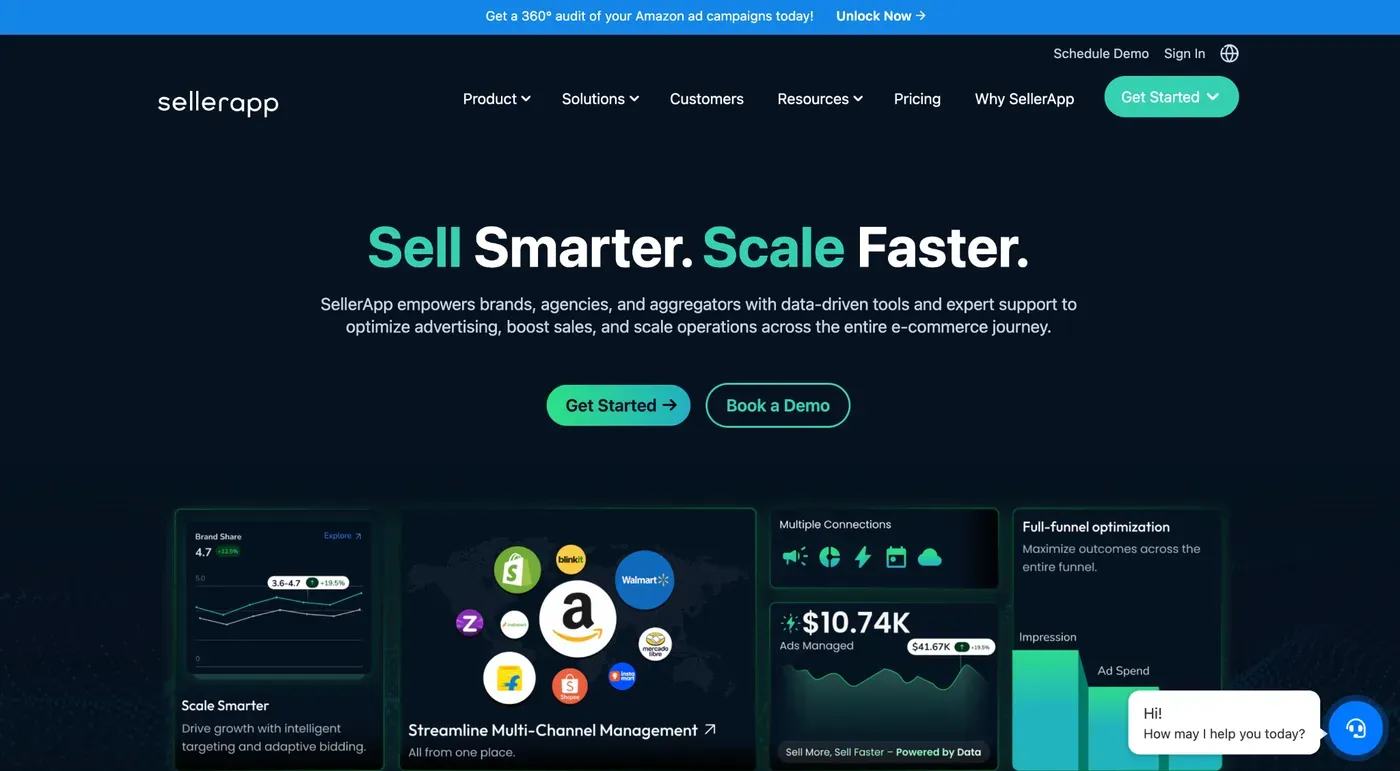
SellerApp is an Amazon seller suite covering product research, keyword research, listing quality, PPC automation and business alerts, with a managed-services arm sitting alongside the self-serve software. It's run out of Spring, Texas, and its site cites a community of over 31,000 sellers. Its centre of gravity is advertising. Ads Automation sits on the Smart plan and above, and the managed AMS Growth plan starts at $750 per month with weekly updates and monthly planning sessions. The listing tooling is genuine, but it isn't what the product leads with. For listing work specifically, the relevant piece is the Listing Quality Index. It splits a listing into Discoverability and Desirability, checks title, bullet points, description, image and video count, and reviews and ratings, then returns a 1 to 100 score. SellerApp also sells listing work as a service: its managed listing optimization starts at $200 per parent ASIN.
What Is Amazon SEO Ranking?
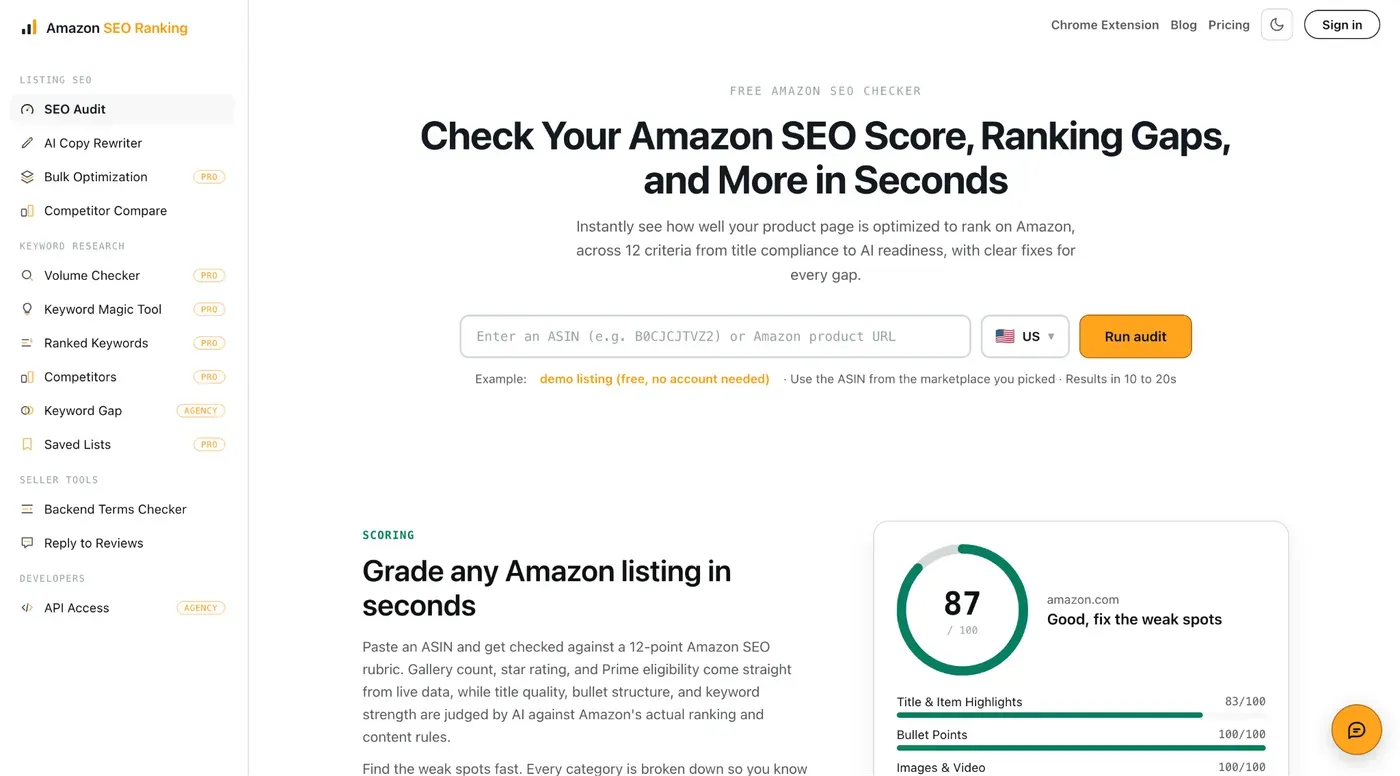
Amazon SEO Ranking audits a live Amazon listing against a 12-criteria rubric and rewrites whatever fails. Paste an ASIN or a product URL, pick a marketplace, and you get a 0–100 score in roughly 10 to 20 seconds. The 12 criteria sit in seven categories: Title and Item Highlights, Bullet Points, Images and Video, Backend and Attributes, Reviews and Social Proof, Stock and Fulfillment, and AI-Readiness for Rufus and COSMO. Gallery count, star rating and Prime eligibility come from the live page. Title, bullet and keyword quality are graded by AI. Nothing is ever written back to Amazon; the audit is read-only. Around that sit the AI Copy Rewriter, bulk optimization for up to 500 ASINs per run, a six-tool keyword suite, a backend search terms checker, competitor comparison, an API and white-label PDF reports. There's no product research, no PPC and no inventory management, deliberately.
Amazon SEO Ranking vs SellerApp: A Detailed Review
1. Listing Audit and Scoring Methodology
Amazon SEO Ranking. Twelve criteria, seven categories, every one weighted equally and published on the site before you sign up. A client can ask why their listing scored 64 and you can show them the arithmetic. The AI-Readiness category checks whether a listing gives Rufus and COSMO the structured attribute detail they need to surface it in a conversational answer. That's the part most rubrics haven't caught up with yet. Every audit pulls the page live. Run the same ASIN twice in a day and the second run reflects whatever changed in between. Limitation: nine of the twelve criteria are AI-graded rather than measured, so copy-quality scores can shift a point or two between runs on borderline listings.
SellerApp. The Listing Quality Index checks 10 areas against Amazon's standard practices and returns a score with published bands: above 85 good, 60 to 40 average, below 40 poor. Publishing the bands puts SellerApp ahead of most of this category already. You can benchmark against competitor listings and set LQI alerts that fire when a product's listing quality changes. That alerting is useful and we won't pretend otherwise. Two limits. The weight of each of the 10 areas isn't published, so a score is hard to defend line by line to a client. And the listing is re-checked every 24 hours, so a fix you push at 9am may not show up in the score until tomorrow.
🏆 Winner: Amazon SEO Ranking. Twelve published, equally weighted criteria beat ten unpublished ones, and live data beats a daily refresh when you're iterating on copy. SellerApp's competitor benchmarking and change alerts are the better monitoring layer, though, and we'd point a seller there if watching scores over time matters more than defending a single number.
2. AI Copy Generation
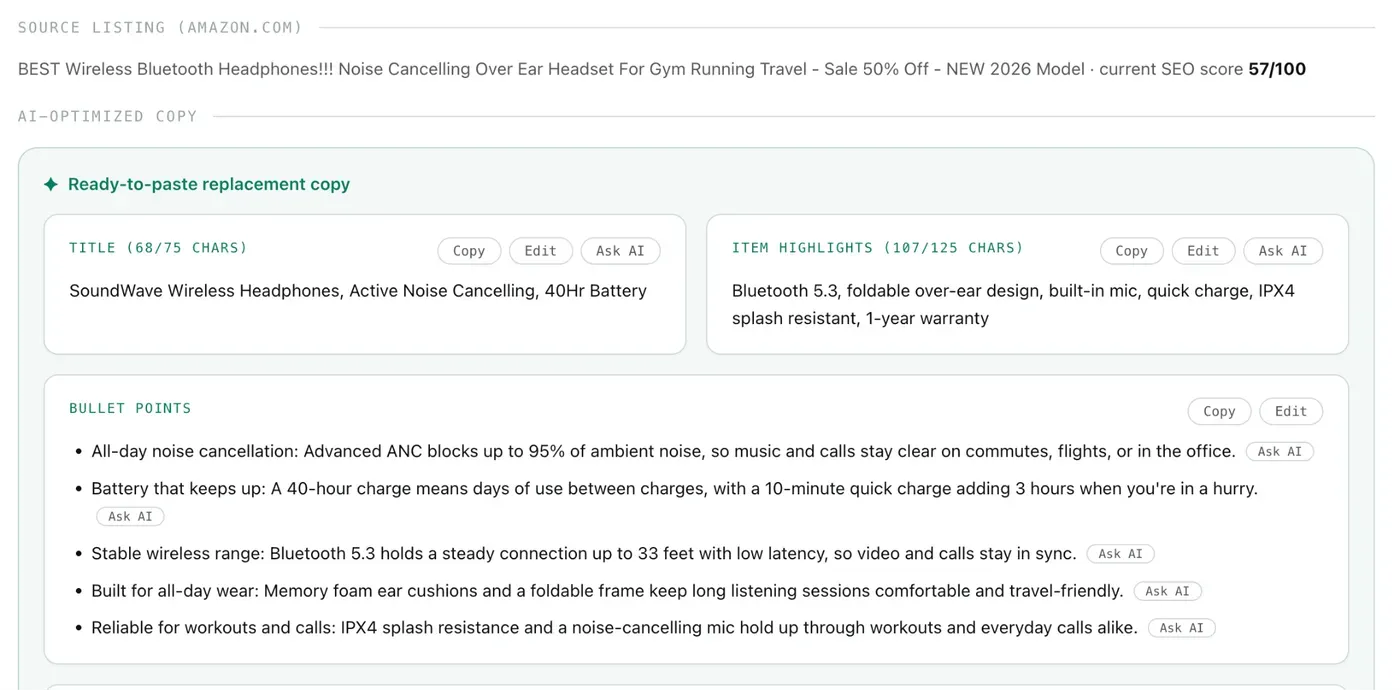
Amazon SEO Ranking. The rewriter is wired to the audit. Whichever criterion failed is what the generation targets, so a listing that lost points on bullet headers gets rewritten bullets rather than a fresh draft of everything. One run produces a title of 60 to 75 characters in Brand + Product + attribute order, Item Highlights up to 125 characters, five benefit-led bullets with sentence-case headers, a description, and backend search terms that never repeat a keyword already visible on the page. Output comes in 12 languages, which matters if you're listing on amazon.de or amazon.co.jp from an English source. Everything is editable, and "Ask AI" can redo a single bullet without touching the rest.
SellerApp. SellerApp gives recommendations based on Amazon listing best practices, with detailed guidance for each metric that's lagging, plus a free standalone product description editor. Its generation is aimed at building a good listing rather than repairing a specific scored failure. For a full professional rewrite, SellerApp routes you to its managed service at $200 per parent ASIN, which is a different kind of purchase entirely.
🏆 Winner: Amazon SEO Ranking. The tie between "criterion 7 failed" and "here is criterion 7 rewritten" removes a step that otherwise happens in your head. At $200 per ASIN, SellerApp's done-for-you route costs more than a month of our Agency plan running 500 listings.
3. Keyword Research and Marketplace Coverage
Amazon SEO Ranking. Six tools: Volume Checker with a computed competition score drawn from top-listing review counts and Amazon's Choice density, Keyword Magic Tool for expansion, Ranked Keywords, Competitors, Keyword Gap across multiple ASINs, and Saved Lists with monthly volume-history snapshots. The data is real Amazon on-platform search volume, not an SEO tool's estimate of it. Pro includes 2,000 keyword volume lookups a month, Agency 10,000. Here's the honest constraint: the Volume Checker covers 16 marketplaces, but the deeper keyword tools cover 4 only — US, Egypt, Saudi Arabia and UAE. The audit runs on 20; those deeper tools don't.
SellerApp. Keyword Explorer, a keyword ranking tracker, and keyword visibility scoring on your top five keywords plus backend keyword strength monitoring run across SellerApp's full marketplace list. Keyword tracking sits on the Pro plan at $99/month. If you sell across European or Asian storefronts and need volume figures for each, SellerApp gives you that and we don't.
🏆 Winner: SellerApp. Four marketplaces against sixteen-plus isn't a close call. A seller whose German or Japanese keyword research matters should buy SellerApp for this, or run our audit on 20 marketplaces and source volume data separately.
4. Bulk Work, White-Label Reporting and API Access
Amazon SEO Ranking. Bulk Optimization runs the full audit-plus-rewrite pipeline across 100 ASINs per run on Pro and 500 on Agency. Agency also includes white-label PDF reports with a methodology and data-source disclosure section built in, so the client receives the rubric alongside the score. The API is included in the $189 Agency price: POST /api/v1/audit spends one audit credit and returns cached results if the listing hasn't changed since the last run, GET /api/v1/audits costs no quota. Rate limits are 20 requests a minute and 300 an hour, with up to 10 bearer-token keys per account. At 500 optimizations a month, the Agency plan works out at about $0.38 per listing.
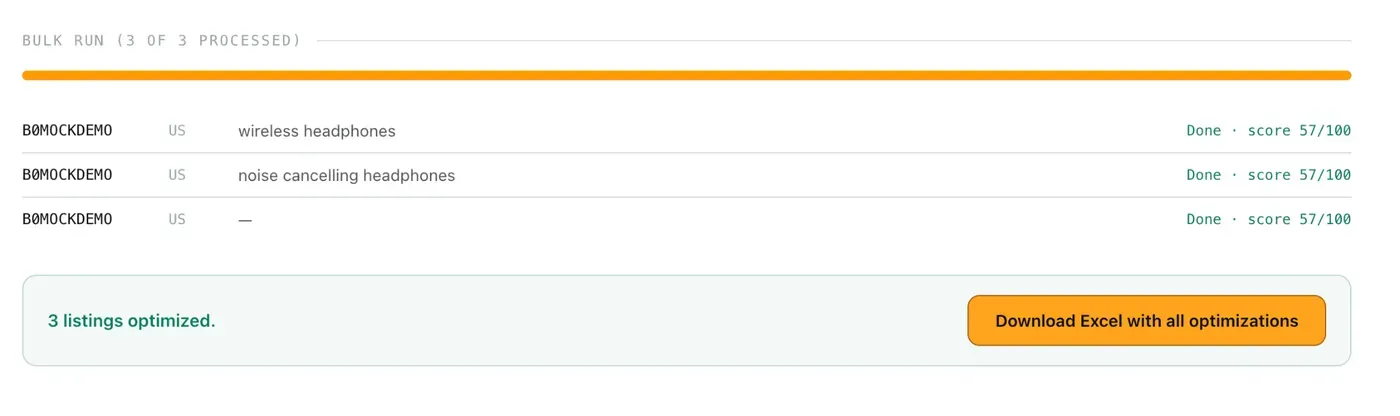
SellerApp. The agency program starts at $300 a month plus 0.5% to 2.5% of your Amazon ad spend, and covers ad automation across multiple accounts, customizable report templates and account audits. SellerApp's REST APIs are priced separately on monthly usage, with data updated once every 24 hours, and cover product details, Seller Central, Vendor Central, reviews, listing quality and advertising data. That API surface is broader than Amazon SEO Ranking. The pricing is also variable and quoted rather than listed.
🏆 Winner: Amazon SEO Ranking, for listing work only. A percentage of ad spend on top of $300 is an advertising pricing model, and it prices listing-only agencies out of the room. For an agency whose deliverable is a listing report, $189 flat with the API and white-label PDFs included is the cheaper and more predictable buy. An agency also managing client ad budgets should be looking at SellerApp instead.
5. Scope Beyond Listing SEO
Amazon SEO Ranking. Nothing. No product research, no sourcing, no PPC, no inventory or order management. The one adjacent tool is Reply to Reviews, which drafts responses from pasted review text. That's a deliberate limit, not a roadmap gap. If you need to decide what to sell, we're the wrong tool.
SellerApp. Product research, profit dashboards, business alerts, PPC analysis and automation, plus managed services running from listing creation through full account management, and a set of free tools including an FBA calculator, sales estimator and ACoS calculator.
🏆 Winner: SellerApp. If you want one login for research, ads and listings, stop reading and buy SellerApp.
6. Ease of Use
Amazon SEO Ranking. Paste an ASIN or URL, choose a marketplace, wait about 15 seconds. No Seller Central connection, no onboarding call, no demo booking. The free tier gives you three audits a month with no card, so you can score your own worst-performing ASIN before deciding anything. The tradeoff is a thin interface. There's no dashboard tracking your whole catalog at a glance unless you run bulk.
SellerApp. The Freemium tier opens without a credit card, and a free Listing Quality Checker runs without an account. Past that, most of the value needs Seller Central connected and a dashboard learned, and SellerApp's own pricing page routes you toward quick questions about ASIN count, ad spend and monthly revenue, or a call with an expert, to land on the right plan. That's appropriate for a suite covering ads and inventory. It's also more setup than a seller who wants one listing scored this afternoon will want to do.
🏆 Winner: Amazon SEO Ranking. Time from landing page to a usable score is under a minute here and considerably longer there. SellerApp's onboarding is the price of its breadth, which is a fair trade if you're using the breadth.
7. Pricing
Amazon SEO Ranking. Four tiers, all listed publicly:
- Free: $0. Three audits a month, AI Copy Rewriter on every one, backend terms and review reply tools, all 20 marketplaces. No card.
- Pro: $79/month. 100 audits, 2,000 keyword volume lookups, bulk to 100 ASINs per run, compliance and AI vision scans, score history and alerts.
- Agency: $189/month. 500 audits, 10,000 keyword lookups, bulk to 500 ASINs, white-label PDFs, API access, priority support.
- Enterprise: custom, with SSO and a dedicated account manager.
Annual billing saves 16%. Every paid plan opens with a 7-day trial, and there's a 14-day money-back guarantee on any charge including annual renewals. Flat rate, no per-seat fee, no SKU scaling.
SellerApp. Freemium at $0 with no credit card and no time limit; Pro from $99/month adding insights, keyword tracking, listing quality and email support; Smart from $149/month for the first three months and $250 after, adding ads automation, quarterly business reviews and chat support; then a custom tier. Annual subscriptions save 50%. Read the Smart plan footnote carefully. The $149 rate applies to the first 3 months only, so the fourth invoice is $250. Add-ons sit outside all of this: the agency program at $300 plus a share of ad spend, managed listing optimization at $200 per parent ASIN, AMS Growth from $750 a month. Refunds are handled case by case by email rather than as a standing guarantee.
🏆 Winner: Split. Monthly, Amazon SEO Ranking is 20% cheaper at entry and 24% cheaper at the tier above. Annually, SellerApp's 50% discount takes Pro to roughly $49.50 a month against Amazon’s roughly $66, so a seller willing to commit for a year and use the wider feature set gets more for less there.
Amazon SEO Ranking vs SellerApp: The Verdict, Feature by Feature
| Feature / Criteria | Amazon SEO Ranking | SellerApp | Verdict |
|---|---|---|---|
| Listing audit methodology | ⭐⭐⭐⭐⭐ | ⭐⭐⭐⭐ | Amazon SEO Ranking – 12 equally weighted criteria published vs 10 unweighted areas |
| Data freshness | ⭐⭐⭐⭐⭐ | ⭐⭐⭐ | Amazon SEO Ranking – live pull vs 24-hour refresh |
| AI copy generation | ⭐⭐⭐⭐⭐ | ⭐⭐⭐ | Amazon SEO Ranking – rewrite tied to the failed criterion |
| Keyword research coverage | ⭐⭐⭐⭐ | ⭐⭐⭐⭐⭐ | SellerApp – our Volume Checker's 16 vs SellerApp's 16-plus, but our deeper tools cover only 4 |
| Listing audit marketplaces | ⭐⭐⭐⭐⭐ | ⭐⭐⭐⭐ | Amazon SEO Ranking – 20 vs 16 named |
| Bulk processing | ⭐⭐⭐⭐⭐ | ⭐⭐⭐ | Amazon SEO Ranking – 500 ASINs per run on a $189 plan |
| White-label reporting | ⭐⭐⭐⭐⭐ | ⭐⭐⭐⭐ | Amazon SEO Ranking – included at $189 vs $300 plus ad-spend share |
| API access | ⭐⭐⭐⭐ | ⭐⭐⭐⭐ | Tie – Amazon’s is included and documented, Seller’s is broader but quoted |
| PPC management | - | ⭐⭐⭐⭐⭐ | SellerApp |
| Product research | - | ⭐⭐⭐⭐⭐ | SellerApp |
| Managed services | - | ⭐⭐⭐⭐⭐ | SellerApp |
| Free tier | ⭐⭐⭐⭐⭐ | ⭐⭐⭐⭐⭐ | Tie – both real, both no card |
| Pricing (monthly) | ⭐⭐⭐⭐⭐ | ⭐⭐⭐ | Amazon SEO Ranking – $79 vs $99, $189 vs $250 |
| Pricing (annual) | ⭐⭐⭐ | ⭐⭐⭐⭐⭐ | SellerApp – 50% annual discount vs our 16% |
| Pricing transparency | ⭐⭐⭐⭐⭐ | ⭐⭐⭐ | Amazon SEO Ranking – flat tiers vs promo rates and ad-spend percentages |
| Ease of use | ⭐⭐⭐⭐⭐ | ⭐⭐⭐ | Amazon SEO Ranking – ASIN in, score out, no account connection |
| Customer support | ⭐⭐⭐⭐ | ⭐⭐⭐⭐⭐ | SellerApp – chat, account managers, quarterly reviews |
Final Verdict: Which Should You Choose?
Choose Amazon SEO Ranking If:
- Your next task is a specific listing that isn't ranking, and you want the score, the reason and the replacement copy in one sitting.
- You bill clients for listing work and need a methodology you can show them. The white-label PDF ships with the rubric and data sources attached.
- You sell the same product across several marketplaces and want all 20 audited, including Poland, Sweden and Turkey.
- You're paying month to month and $79 against $99 matters.
- You want to test scoring on your own ASIN before paying anything.
Choose SellerApp If:
- You run Amazon PPC and want listing quality scored inside the same dashboard as your campaigns.
- Your keyword research spans European or Asian marketplaces where we have no volume data.
- You're still deciding what to sell, and need product research and sourcing alongside listing tools.
- You'll commit to an annual contract, where the 50% discount makes the wider feature set cheaper per month than our Pro plan.
- You want a dedicated account manager or a team to do the optimization for you.
- Plenty of sellers run both. SellerApp handles the ad spend and the research; Amazon SEO Ranking scores and rewrites the listings underneath. At $79 on top of an existing suite, that stacks more comfortably than it sounds.
FAQ
What is the main difference between Amazon SEO Ranking and SellerApp?
The main difference between Amazon SEO Ranking and SellerApp is scope: Amazon SEO Ranking does one job, and SellerApp does several. Amazon SEO Ranking audits a live listing against 12 published criteria and rewrites whatever fails, with no product research or PPC tools at all. SellerApp bundles listing quality scoring with product research, keyword tracking, PPC automation and managed services starting at $750 a month. Amazon SEO Ranking costs $79 a month at entry against SellerApp's $99. Pick on whether you need listing SEO specifically or a general seller suite.
Which is better, Amazon SEO Ranking or SellerApp?
Amazon SEO Ranking is better for listing SEO and SellerApp is better as an all-round seller suite, so the answer depends on which one you're buying. Amazon SEO Ranking publishes all 12 audit criteria, each weighted equally, pulls listing data live, and covers 20 marketplaces for its audit. SellerApp scores 10 listing areas without publishing their weights and refreshes that score once every 24 hours, but adds PPC automation and product research that Amazon SEO Ranking doesn't offer. For a seller whose listings are written and whose ads are the problem, SellerApp wins outright. For a seller about to rewrite a title, Amazon SEO Ranking does.
What is Amazon SEO Ranking better for?
Amazon SEO Ranking is better for auditing and rewriting live Amazon listings, particularly across multiple marketplaces. It scores a listing 0–100 against 12 criteria in roughly 10 to 20 seconds, then generates a compliant title, five bullets, a description and backend search terms aimed at whatever failed. Bulk Optimization runs the same pipeline across 500 ASINs on the $189 Agency plan, at about $0.38 per listing. It also covers 20 Amazon marketplaces for the audit, including Poland, Sweden and Turkey.
What is SellerApp better for?
SellerApp is better for Amazon advertising, product research and multi-marketplace keyword data. Its Ads Automation sits on the Smart plan at $149 a month for the first three months and $250 after, and its managed AMS Growth service starts at $750 a month. Keyword tracking and visibility scoring run across its full marketplace list, where Amazon SEO Ranking's deeper keyword tools cover only 4 (its Volume Checker covers 16). SellerApp also offers done-for-you listing optimization at $200 per parent ASIN for sellers who'd rather not do the work themselves.
Is Amazon SEO Ranking more affordable than SellerApp?
Amazon SEO Ranking is more affordable than SellerApp on monthly billing and more expensive on annual billing. Monthly, Amazon SEO Ranking's Pro plan costs $79 against SellerApp's $99, and its Agency plan costs $189 against SellerApp's $250 Smart rate after the three-month promotional period ends. SellerApp discounts annual subscriptions by 50%, which takes its Pro plan to roughly $49.50 a month against Amazon SEO Ranking's roughly $66 with a 16% annual discount. Both offer a genuine free tier with no credit card required. Agencies should compare $189 flat against SellerApp's $300 plus 0.5% to 2.5% of ad spend.
Which tool is easier to use, Amazon SEO Ranking or SellerApp?
Amazon SEO Ranking is easier to use, mainly because it asks for less before it gives you anything. You paste an ASIN or product URL, pick a marketplace, and get a score in about 10 to 20 seconds with no Seller Central connection and no account for the first three audits. SellerApp's Freemium tier also opens without a credit card, but most of its data needs Seller Central connected, and its pricing page routes new users through qualifying questions or a call with a specialist. The tradeoff runs the other way once you're set up, since SellerApp's dashboard covers ads and inventory that Amazon SEO Ranking has no view of.
Which integrates better with Seller Central?
SellerApp integrates better with Seller Central, because it connects directly to pull advertising, sales and inventory data. Amazon SEO Ranking deliberately never connects to a seller account: it reads the public product page and returns copy you paste into Seller Central yourself. That means no permissions to grant and nothing written back to your listings, but it also means no sales or ad metrics in the audit. Agencies wanting programmatic access to Amazon SEO Ranking use the API on the $189 Agency plan, rate-limited to 20 requests a minute and 300 an hour.
We already have SellerApp. Is there a reason to add Amazon SEO Ranking?
Adding Amazon SEO Ranking to SellerApp makes sense in two situations, and in others it doesn't. The first is client reporting, where a published, equally weighted 12-criteria rubric is defensible in a way an unweighted 10-area score isn't. The second is marketplace coverage, since SellerApp's listing-checker FAQ names 16 marketplaces and Amazon SEO Ranking audits 20. If you're happy with your LQI scores and don't report them to anyone, the $79 is hard to justify on top of what you already pay. Three free audits a month will tell you which camp you're in.
Does SellerApp publish how its listing quality score is calculated?
SellerApp publishes what its listing quality score covers but not how it's weighted. Its documentation states that 10 critical areas are examined against Amazon's standard practices, split across Discoverability and Desirability, and names title, bullet points, description, image and video count, and reviews and ratings among them. It also publishes the score bands: above 85 is good, 60 to 40 is average, below 40 is poor. What isn't published is how much each of those 10 areas contributes to the final number. Amazon SEO Ranking publishes all 12 of its criteria, each weighted equally, for exactly this reason.
See how your own listing scores against the same 12 criteria this comparison is based on. No credit card, no trial signup.
FREE AUDITMore from the blog