Amazon SEO & Algorithm
Do Amazon Reviews Affect Ranking? What the Rating Actually Does
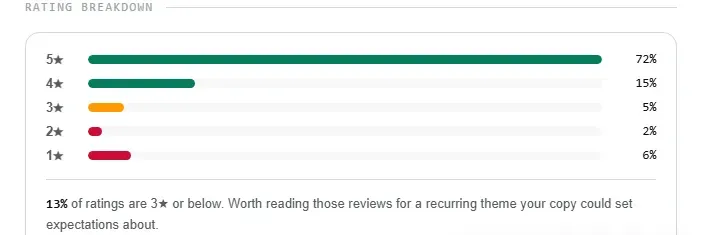
Reviews affect rank twice over. Average rating is a direct input to the ranking stage, and both rating and review count are the strongest levers on conversion rate, which is itself a ranking input. The two effects compound, which is why a rating trending down is worth fixing before almost anything else on a listing.
For where reviews sit among every other ranking factor, see Amazon SEO in 2026; for how rating feeds conversion specifically, see Does Conversion Rate Affect Ranking?
Two separate signals, not one
Average star rating is scored directly, with roughly 4.3 as the pass bar this site's own audit checks against. Amazon doesn't publish an official cutoff, but ratings below that range measurably suppress both trust and conversion in most categories. Review count, by contrast, only matters in relation to competitors on the same keyword, which is data no outside tool can see. It isn't a fixed target so much as a rough parity check against whatever's already ranking.
Recency and velocity matter more than the total
A listing with 400 reviews and nothing new in eight months reads differently to Amazon than one with 60 reviews and a steady trickle of recent ones. The second is active evidence the product is currently selling and satisfying customers; the first is a snapshot from a while ago. If you're comparing yourself to a competitor, check when their reviews were posted, not just how many there are.
Q&A is a review-adjacent signal sellers ignore
The Q&A section on a listing is unpaid, unsolicited customer content, which makes it exactly the kind of thing AI shopping layers like Rufus weight heavily when summarising a product. A backlog of unanswered questions is a small, easy fix that most competitors leave sitting there.
What to do about a rating that's slipping
- Read the last 20 to 30 reviews in full, not just the star counts. The pattern in what's being complained about is the actual fix.
- Respond publicly to negative reviews where Amazon allows it; it signals to future shoppers that issues get addressed.
- Check whether the complaint is really a listing problem. A size or compatibility issue described inaccurately in the bullets shows up as "wrong product" reviews that better copy would prevent.
- Never solicit reviews with an incentive, a discount, or a free-product exchange. Amazon's terms prohibit it outright, and it's the fastest way to lose the listing entirely, not just the rank.
For public reviews specifically, the Reply to Reviews tool drafts a response from the review text, useful for working through a backlog without writing each one from scratch.
FAQ
How many reviews does an Amazon listing need?
Enough to be roughly comparable to what's already ranking for your target keyword. There's no fixed number that applies everywhere. A new listing with 20 reviews can outrank an old one with 200 if its rating and recent velocity are stronger; raw count matters less than most sellers assume.
Why does this site's audit use a 4.3 rating threshold?
4.3 is the pass bar the scoring engine checks average rating against; below it, the rating criterion fails. It's not an official Amazon cutoff. It reflects that ratings below roughly 4.3 measurably suppress both conversion and shopper trust in most categories.
Is it worth responding to negative reviews on Amazon?
Yes, where Amazon allows a public response. It signals to future shoppers that issues get addressed, and it's one of the few review-related levers a seller can pull directly without touching incentives or manipulation, which Amazon's terms prohibit outright.
The audit checks your rating against the same pass bar this guide covers, plus every other factor that's dragging conversion down alongside it.
Audit a listing freeMore from the blog