The best Amazon competitor analysis tool depends on the question you're asking. If the question is "why does that listing outrank mine, and what do I change?", we think the answer is Amazon SEO Ranking: it scores your listing and two rivals against the same 12 published criteria, then rewrites the criteria your listing failed, which is usually where the rival beats you. For category market share and sales estimates, Helium 10, Jungle Scout and SmartScout go further.
Amazon SEO Ranking is our product, so weigh that verdict with this in mind. We compared ten tools on what each one can see about a competitor, what it estimates, and what it costs. Prices are published monthly rates as of 8 November 2026.
Key Takeaways (TL;DR)
- The best overall Amazon competitor analysis tool: Amazon SEO Ranking, for sellers who want to outrank specific listings. It scores you and up to two rivals on 12 published criteria, then rewrites each criterion your listing failed.
- Why you need it: the listing above yours usually wins on fields you can change, like the title, gallery and bullets. Without a side-by-side score, you're guessing which gap matters.
- Who it's for: private-label sellers, sellers in several Amazon storefronts, agencies that report to clients, brand eRetail teams, and teams that run listing work through Claude.
- How to choose: decide whether you need listing fixes, keyword gaps or market share. Then check which numbers are read from Amazon and which are modelled, and test the tool on your own ASIN.
- Expected price: Amazon SEO Ranking is free for 3 audits a month, then $79/mo (Pro) or $249/mo (Agency), with a 7-day free trial on monthly plans. Across the market, competitor analysis runs from free (Brand Analytics, Keepa's price charts) to $359/mo for Helium 10 Diamond, before add-ons.
Top Amazon Competitor Analysis Tools in 2026 at a Glance
Monthly prices on 8 November 2026. Most tools are cheaper on annual billing.
| Company | Best For | Key Features | Pricing |
|---|---|---|---|
| Amazon SEO Ranking | Finding why a rival outranks you, and fixing it | Side-by-side audit on 12 published criteria, Keyword gap (up to 20 ASINs), AI rewrite of failed fields | Free, Pro $79, Agency $249 |
| Helium 10 | Research, keywords and PPC in one suite | Xray, Cerebro reverse ASIN, Market Tracker | Free (limited), Platinum $129, Diamond $359 |
| Jungle Scout | Product research and brand market share | Product Database, Competitive Intelligence, share of voice | $49 to $149 |
| SmartScout | Mapping brands and sellers in a category | Brands database, Seller Map, Traffic Graph | $49 to $299 |
| Data Dive | Keyword lists built from competitor ASINs | Dives, Master Keyword List, Rank Radar | $39 to $490 |
| Keepa | Price, rank and stock history | Price and sales rank charts, Buy Box history, Product Finder | Free charts, Pro €29 |
| SellerApp | Listing quality next to PPC automation | Listing Quality Index, reverse ASIN, API | Freemium, Pro $99, Smart $250 |
| ZonGuru | Small catalogs that also need operations tools | Niche Finder, Listing Optimizer, review and order tools | From $49, rising with SKU count to $249 |
| AMZScout | Low-cost product research | Product Database, Product Tracker, sales estimates | $59.99 (cheaper annual or lifetime) |
| Amazon Brand Analytics | First-party search share for your own brand | Search Query Performance, Top Search Terms | Free with Brand Registry |
What Are Amazon Competitor Analysis Tools?
Amazon competitor analysis tools collect data about the listings, brands and sellers you compete with, and put it next to your own. Some read a competitor's product page as it stands today. Some record how its price, sales rank and stock change over time. Others model what Amazon doesn't publish, such as monthly sales, revenue, search volume and market share.
Those three kinds of data carry different levels of certainty, and most buying mistakes in this category come from mixing them up.
- Read from the listing: title, bullets, images, price, rating, review count, badges, Prime status. Anyone can check these, and a good tool reports them exactly.
- Recorded over time: price history, Best Sellers Rank history, offer counts, stock-outs. Keepa built its business on this.
- Modelled: sales and revenue estimates, keyword search volume, market share and the keywords a rival ranks for. These are estimates, and two tools can disagree by a wide margin.
The category splits along those lines. Suites like Helium 10 and Jungle Scout lead with modelled sales and keyword data for product research. SmartScout maps whole categories by brand. Amazon SEO Ranking works from what's on the page: it reads the live listing at run time, scores it against fixed rules, and shows exactly where a rival's page is stronger than yours.
Why Do You Need an Amazon Competitor Research Tool?
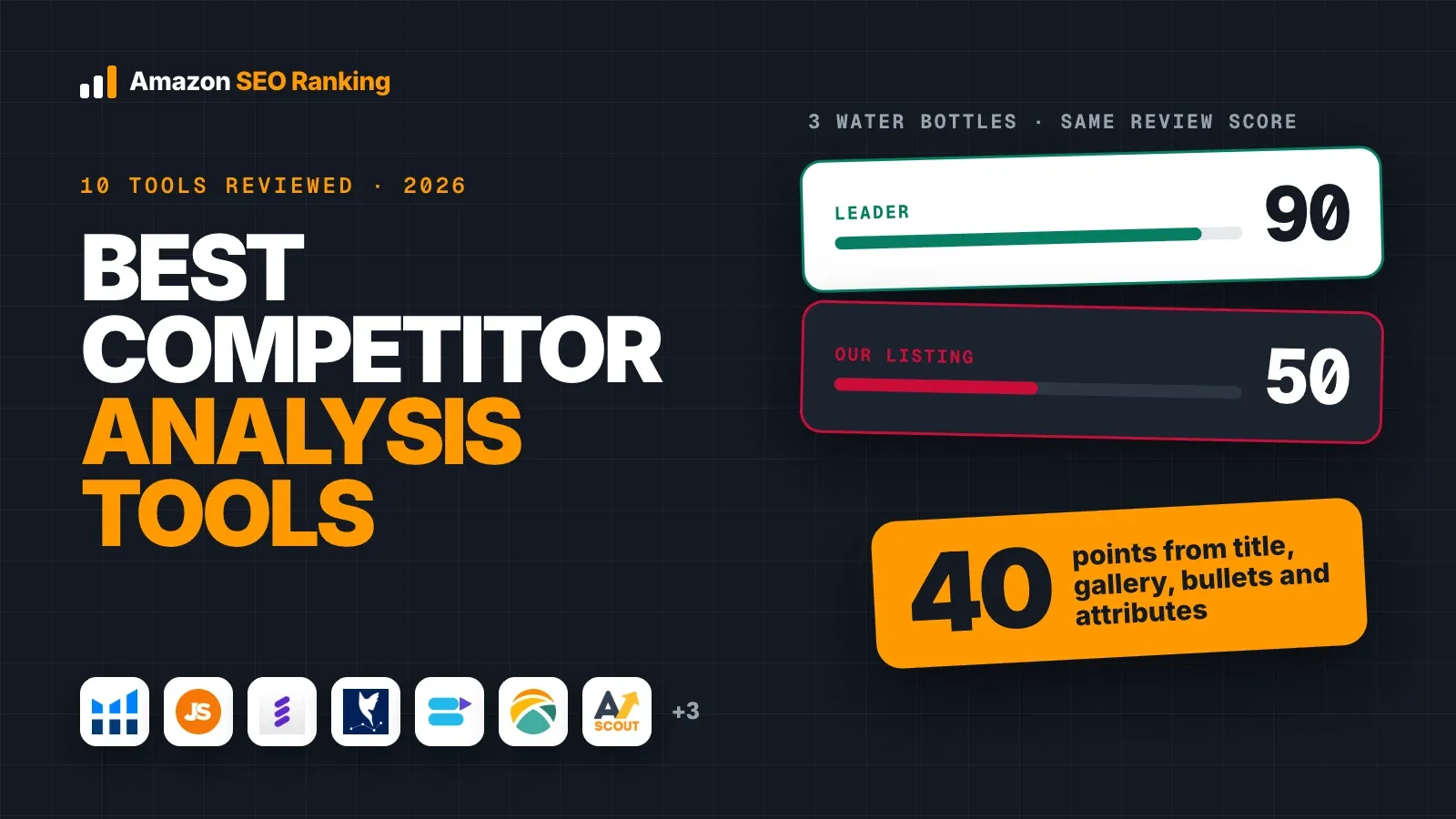
When a listing drops on page one, the first instinct is to blame reviews or ad spend. Often the gap sits in fields you control. In our own Amazon competitor listing comparison of three live US water bottle listings, all three scored the same on reviews, yet ours trailed the leader 50 to 90. The whole 40-point gap came from the title, gallery, bullets and attributes.
Rules also changed this year. Amazon now caps titles at 75 characters in all categories except media, since July 27, 2026, so a competitor who rewrote early may be getting the click on a title that still reads cleanly on mobile. You won't see that by scrolling search results once a month.
Amazon's own data only goes so far. If you're brand registered, the Brand Analytics Search Terms report shows the top three products clicked for each search term, with click share and conversion share, according to ChannelX. That tells you who is winning a search. It doesn't tell you why, or what to change on your page.
Doing it by hand is slow. Auditing one listing and drafting fixes takes around 60 minutes by our own measure, so comparing yourself with two rivals eats an afternoon. A side-by-side audit takes about 20 seconds per listing, and gives the same score every time it's run on an unchanged listing.
The keyword side needs the same care. In the water bottle example, 195 keywords appeared in the rivals' rankings but not ours. About 20 were relevant; the rest were other brands' names, misspellings and colors we don't sell. A good tool helps you cut that list down before you rewrite anything.
Who Needs Amazon Competitor Analysis Tools?
The best Amazon seller competitor analysis looks different depending on who's asking. These are the five groups we see using competitor analysis most, and what each one needs from it.
Private-Label Sellers Being Outranked
A seller with a handful of products usually has one question: why does that listing rank above mine for my main keyword? They need a clear list of the fields where the rival is stronger, in order of how many points each fix is worth.
Budget matters here. Paying $129 a month for a 20-tool suite to answer one question is hard to justify, and a free plan that runs a full comparison on their own ASIN lets them judge the tool before paying.
Sellers in Several Amazon Storefronts
The listing that leads on amazon.com may not exist on amazon.de, and the competitor that beats you in the UK can be a local brand you've never heard of. These sellers need a separate comparison for each storefront, with fixes written in that marketplace's language.
Coverage is the deciding factor. Amazon SEO Ranking's audit and rewrite cover 23 Amazon storefronts, including Ireland, Belgium and South Africa, while keyword volume covers 16.
Agencies Reporting to Clients
An agency has to explain the comparison to someone else. A score from an unpublished formula is hard to defend when a client asks why their listing got 50 and the rival got 90.
Agencies need a published method, white-label reports, bulk runs across a catalog and keyword gap analysis across several ASINs. Per-listing cost matters too: agencies typically bill $50 or more per listing for manual listing work, so the tool has to cost a fraction of that.
Amazon SEO Ranking was built for that conversation. Every criterion and pass rule is published, so a 40-point gap can be traced line by line, and the white-label PDF report (Agency) includes a methodology and data-source section the client can read. On Agency, 500 audits a month work out to about $0.50 per listing.
Brand eRetail and Search Teams
Search specialists at consumer-goods brands own content for a portfolio of products, often across several marketplaces. Their competitor work is ongoing: tracking which brands hold page one, which listings are weakest in their own range, and where a rival's page is stronger.
They tend to combine first-party data from Brand Analytics with a tool that scores listings across many ASINs. Amazon SEO Ranking's portfolio comparison lines up every tracked listing's latest audit by category, marks the best and weakest listing in each, and shows which one to use as the template.
Teams Running Listing Work Through AI Assistants
More sellers now ask Claude or another assistant to research competitors and draft copy. A general assistant can't see the live listing or real search volume, and it miscounts characters.
These teams need competitor data the assistant can call directly. Amazon SEO Ranking's Claude connector gives Claude the same audit and copy checks as the website on Pro, plus Keyword gap on Agency.
Best Amazon Competitor Analysis Tools: In-Depth Reviews
We reviewed each tool on what it shows about competitors, how much of that is read from Amazon versus modelled, and what it costs at each tier.
1. Amazon SEO Ranking
Overview
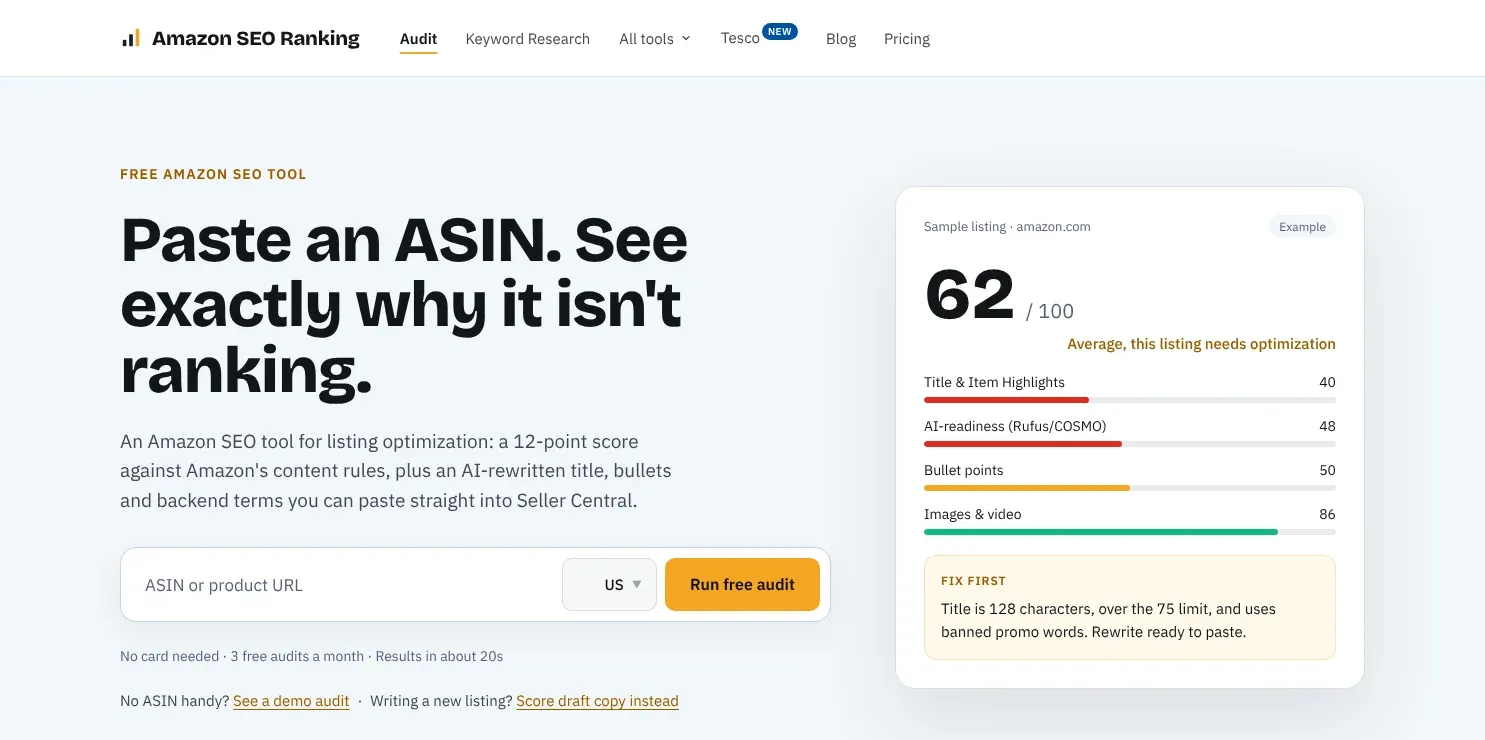
Amazon SEO Ranking is a listing audit and AI rewrite tool for Amazon sellers and agencies. Its competitor analysis starts from one question: where is the listing above you stronger than yours, and what should you change first?
Competitor Compare runs the same 12-criteria audit on your listing and up to two rivals, side by side, on any of 23 Amazon storefronts. Every audit reads the live product page at run time. Keyword tools add what each ASIN ranks for and where you're missing, and the AI rewrite fixes the fields where you lost points.
Ideal For
- Private-label sellers outranked by listings that don't look better on paper
- Agencies that need a comparison a client can check line by line
- Sellers comparing listings across several Amazon storefronts
- Brand teams finding the weakest listings in their own portfolio
- Teams that run competitor research inside Claude
Top Features
- Competitor Compare: your listing and up to two rivals scored on the same 12 equally weighted criteria. Results show each rival's lead ("+8 ahead"), the three biggest gaps with the figures behind them (for example "4 images vs 9 images"), and a category table with a Gap column.
- Keyword gap (Agency): rank positions for up to 20 ASINs side by side, filtered to your gaps or your wins, with brand names excluded in one step.
- What I rank for and Competitors (Pro): every keyword an ASIN ranks for, and the ASINs competing for the same searches. Brand-new listings fall back to the top organic results for a phrase from their title.
- Fixes tied to each failed criterion: the AI rewrite starts from the criteria you failed, grounded in your spec table and brand fact sheet, and every draft is checked for length limits, health claims and pack-count mismatches.
- Draft audit: score the new copy against your live images and rating before you save it in Seller Central.
- Portfolio comparison: every tracked listing's latest audit by category, with the best and weakest listing marked.
Why We Stand Out?
The score explains itself. All 12 criteria and their pass rules are published, and each counts equally. When a rival scores 40 points higher, you can trace every point to a criterion, which is what makes the comparison usable in a client report.
It works from what's on the page. Every audit reads the current listing, so you're comparing against the rival's page as it stands today. A criterion the data can't confirm, such as a Prime flag Amazon doesn't report reliably, is marked "Not verified" and left out of the score instead of counted as a fail.
It flags a rival's claims before you copy them. The free consistency check catches health claims, unsupported product claims and pack counts that disagree with the spec table. In our water bottle comparison, it flagged a competitor's "BPA-free" bullet that nothing in its spec table backed up.
Trusted by eRetail Search specialists at Nestlé and eCommerce SEO services agencies such as Reach AI.
Pros
- Published scoring method, so every gap has a reason
- The comparison leads to a rewrite of the criteria you failed, which you can score as a draft
- Free plan runs a full comparison (your listing plus two rivals) with no card
- 23 storefronts on the audit, with rewrites in each marketplace's language
- Keyword gap, white-label PDF reports and API on Agency; Claude connector on Pro and Agency
Cons
- No sales, revenue or market share estimates, and no price history
- No PPC or ad intelligence
- Advanced keyword tools (What I rank for, Competitors, Keyword gap) cover 4 marketplaces: US, Egypt, Saudi Arabia and the UAE
Pricing
The free plan includes 3 audits a month. Competitor Compare uses one audit per listing, so that's one full comparison of you plus two rivals, and a listing that hasn't changed reuses its last audit for free.
Pro is $79/mo or $799/yr with 100 audits and 2,000 keyword lookups. Agency is $249/mo or $2,490/yr with 500 audits, 10,000 lookups, Keyword gap, white-label reports and the API. Monthly plans start with a 7-day free trial, and every charge has a 14-day money-back guarantee.
Final Verdict
If you already know who you compete with and want to know why they rank above you, Amazon SEO Ranking gives the most direct answer here: a scored, field-by-field gap, then a rewrite of the criteria your listing failed. It costs 31 to 39% less than Helium 10 month to month, and the price stays flat whatever the size of your catalog.
2. Helium 10
Overview
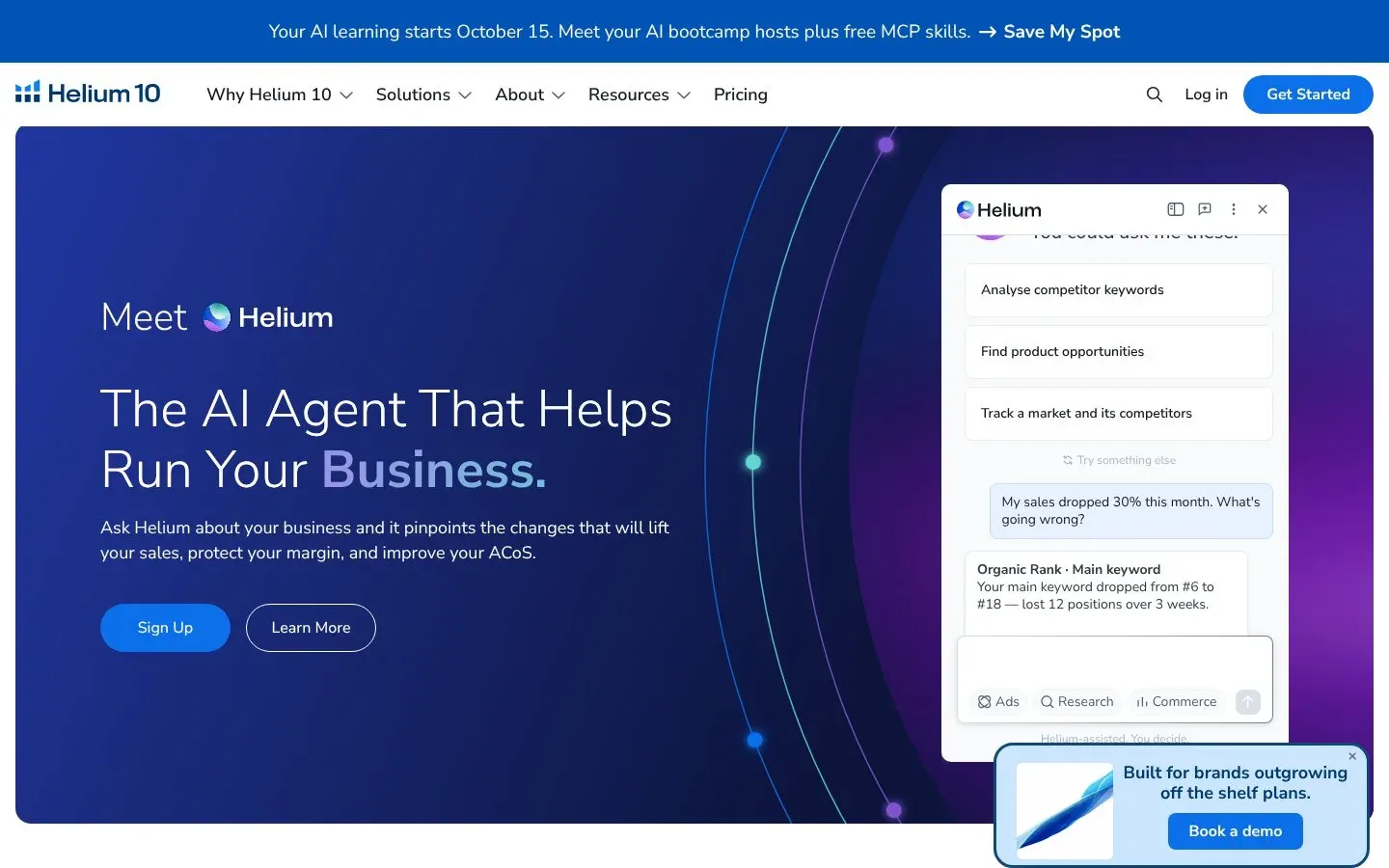
Helium 10 is the largest Amazon seller suite, with research, keyword, listing, PPC and operations tools in one subscription. For competitor work, the main pieces are Xray (product and sales data in a Chrome extension), Cerebro (reverse ASIN keyword lookup) and Market Tracker.
Ideal For
- Sellers who want research, keywords and PPC in one login
- Product researchers checking sales estimates on a page of results
- Brands tracking a few markets over time
Top Features
- Xray shows estimated sales, revenue and review counts for every product on a search results page
- Cerebro lists the keywords a competitor ASIN ranks for, with estimated volume
- Market Tracker follows market share for markets you build from ASINs or keywords
- Market Tracker 360, a paid add-on sold through sales, tracks categories and brands with longer history
Why They Stand Out?
Breadth is the reason to pick Helium 10. Competitor research sits next to product research, PPC automation and inventory tools, and its keyword tools reach more marketplaces than most tools here. For a seller who wants one subscription covering every stage, it's one of the strongest choices.
Pros
- Widest set of tools in one subscription
- Reverse ASIN data across many marketplaces
- Sales estimates on every search page through Xray
- Free plan for trying a few tools
Cons
- The Listing Analyzer doesn't publish how it scores
- EcomCrew reports that Platinum now caps keyword research at 100 searches a month
- Category-level tracking costs extra on top of Diamond
- Most sellers use two or three of the 20+ tools they pay for
Pricing
Free plan with limited daily use. Platinum is $129/mo ($99/mo annual) and Diamond is $359/mo ($279/mo annual). Market Tracker 360 is a separate add-on quoted by sales.
Final Verdict
Helium 10 suits sellers who want product research, keyword data and PPC in one place, and who will use enough of the suite to justify the price. As a tool for working out why one listing beats yours, it gives you data rather than a scored gap, and the method behind its listing score isn't published.
3. Jungle Scout
Overview
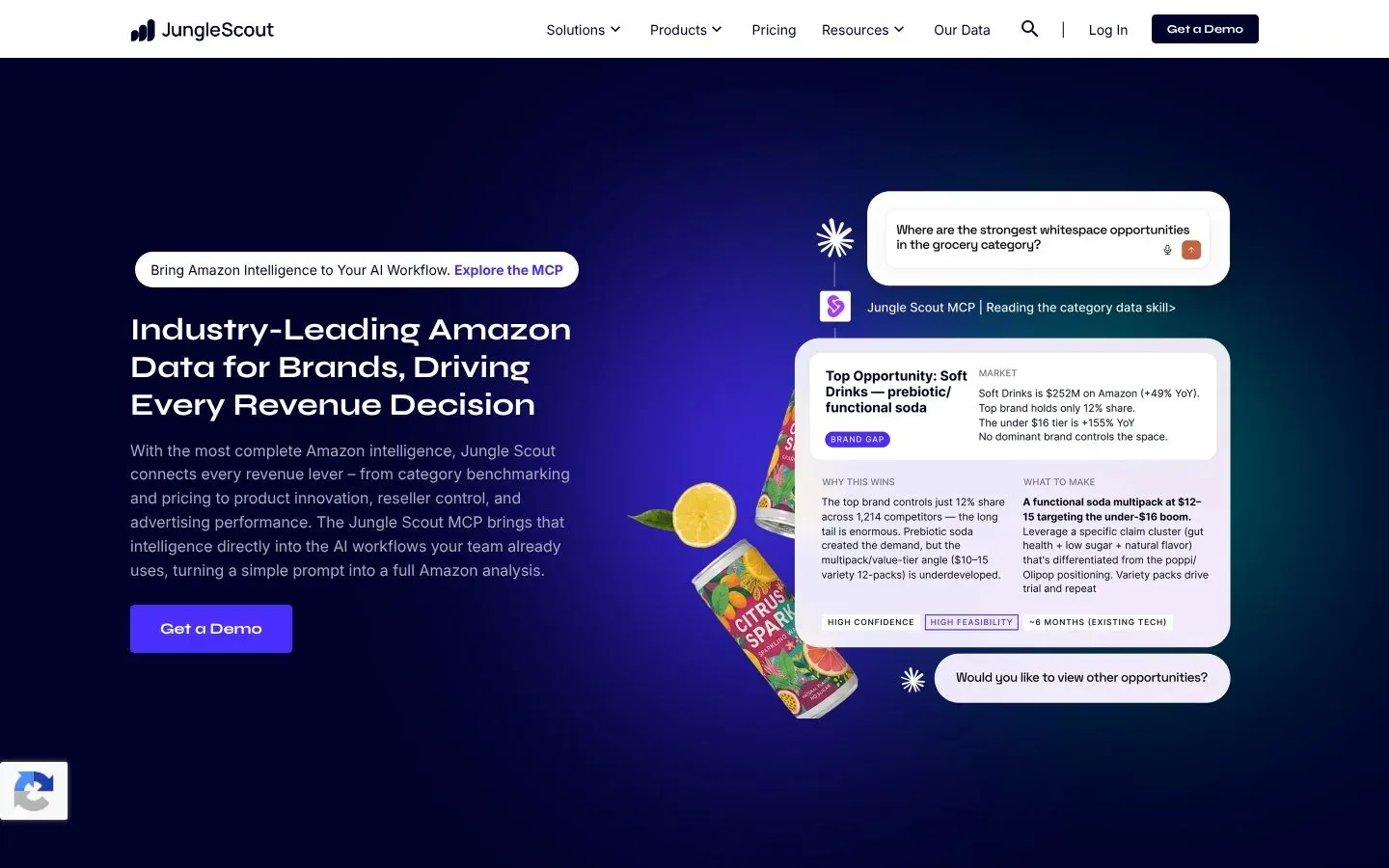
Jungle Scout started as a product research tool and is still strongest at the decision before a listing exists: what to sell, how much it sells and who supplies it. Its Competitive Intelligence module, on the top Brand Owner plan, tracks revenue, unit sales, prices and share of voice for a market segment you define.
Ideal For
- New sellers choosing a product
- Brand owners tracking market share in defined segments
- Sellers who want supplier research alongside competitor data
Top Features
- Product Database and Extension for sales estimates on any product
- Competitive Intelligence with share of voice for specific keywords
- Supplier Database for sourcing
- AI Assist for drafting listing copy
Why They Stand Out?
Jungle Scout makes market-share tracking accessible below enterprise pricing. Competitive Intelligence shows how revenue and share move across a segment of competitors over time, which is one of the smartest choices for a brand owner watching a specific niche.
Pros
- Easy product research flow for new sellers
- Market segment and share-of-voice tracking on Brand Owner
- Supplier database included
- Enterprise option (Cobalt) for large brands
Cons
- No free plan
- The $49 Starter plan is research-only, with thin listing tools
- Listing copy isn't graded against a published standard
- Competitive Intelligence segments beyond the included ones cost extra
Pricing
Starter $49/mo, Growth Accelerator $79/mo and Brand Owner + Competitive Intelligence $149/mo ($129/mo annual). Cobalt is custom-priced.
Final Verdict
Jungle Scout is a strong fit for sellers choosing a product and for brand owners who want market share on a budget. It tells you who is gaining share and roughly how much they sell. It doesn't show which fields on your listing are weaker than theirs.
4. SmartScout
Overview
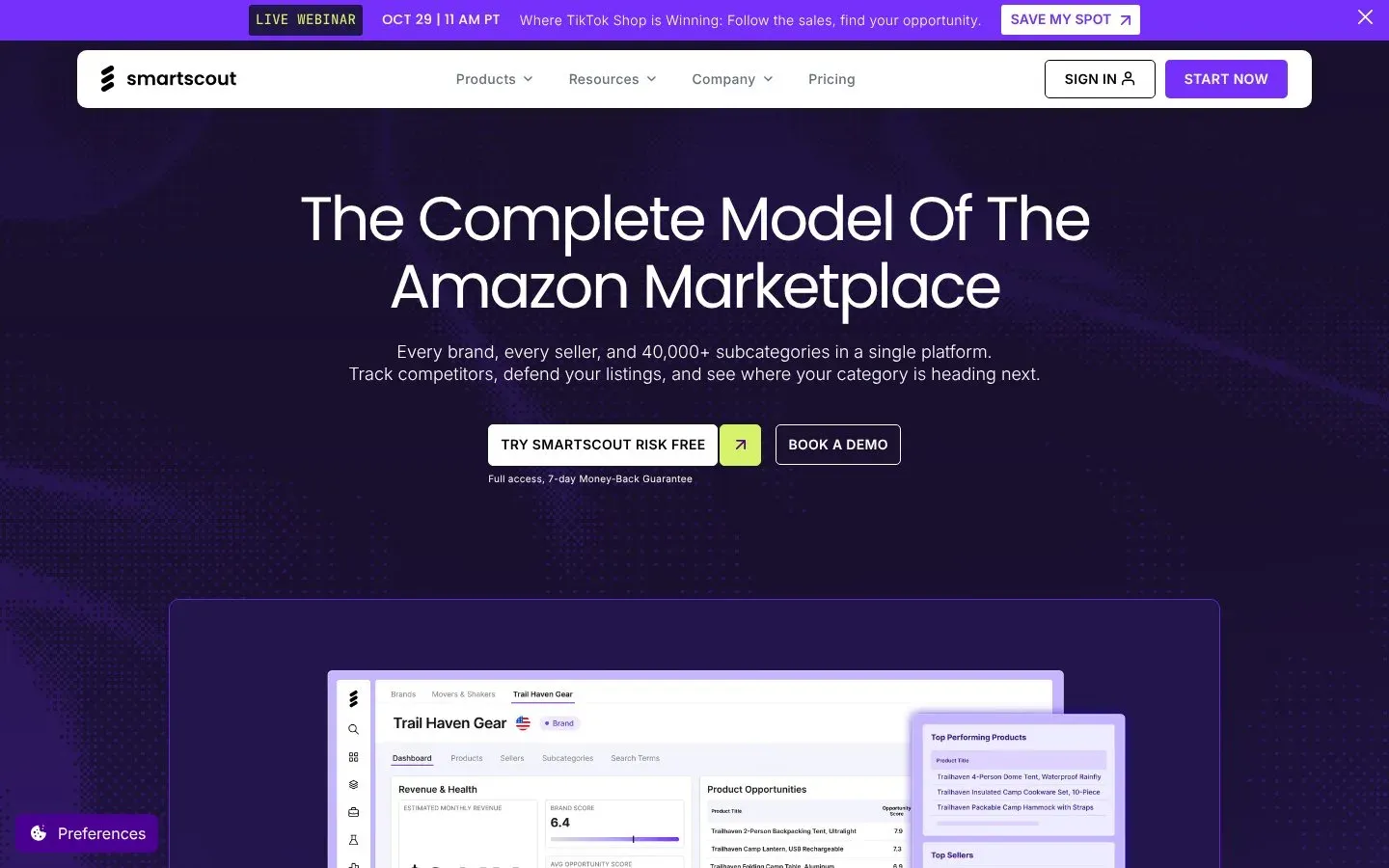
SmartScout looks at Amazon from the top down: categories, then brands, then sellers and products. It's built for mapping who competes in a space, how traffic flows between listings, and which brands are growing.
Ideal For
- Wholesale and brand-sourcing sellers
- Agencies prospecting brands
- Brands sizing up a new category
Top Features
- Brands and Products databases with estimated revenue and share
- Seller Map showing where sellers are based
- Traffic Graph showing how listings link to each other
- AI listing drafts and an AI visibility grade
Why They Stand Out?
No other tool here maps the relationships between brands, sellers and listings as clearly. For finding which brands dominate a category, or which sellers carry a brand, SmartScout is one of the strongest choices.
Pros
- Category and brand views most tools don't offer
- Traffic Graph shows which listings feed traffic to others
- Several seats on most plans
- 7-day money-back guarantee
Cons
- No free trial on paid plans
- Heavy for a private-label seller with one product
- Prices rose in 2026, according to pricing trackers
- Listing-level gaps aren't scored against rules
Pricing
Basic, Essentials and Business plans run from about $49/mo to $299/mo month to month, with lower annual rates and custom Enterprise pricing. Check the live page before buying, since third-party trackers recorded a price rise in September 2026.
Final Verdict
SmartScout fits sellers and agencies who need to understand a whole category before acting. For a seller trying to fix one listing against two rivals, it answers a bigger question than the one they're asking.
5. Data Dive
Overview
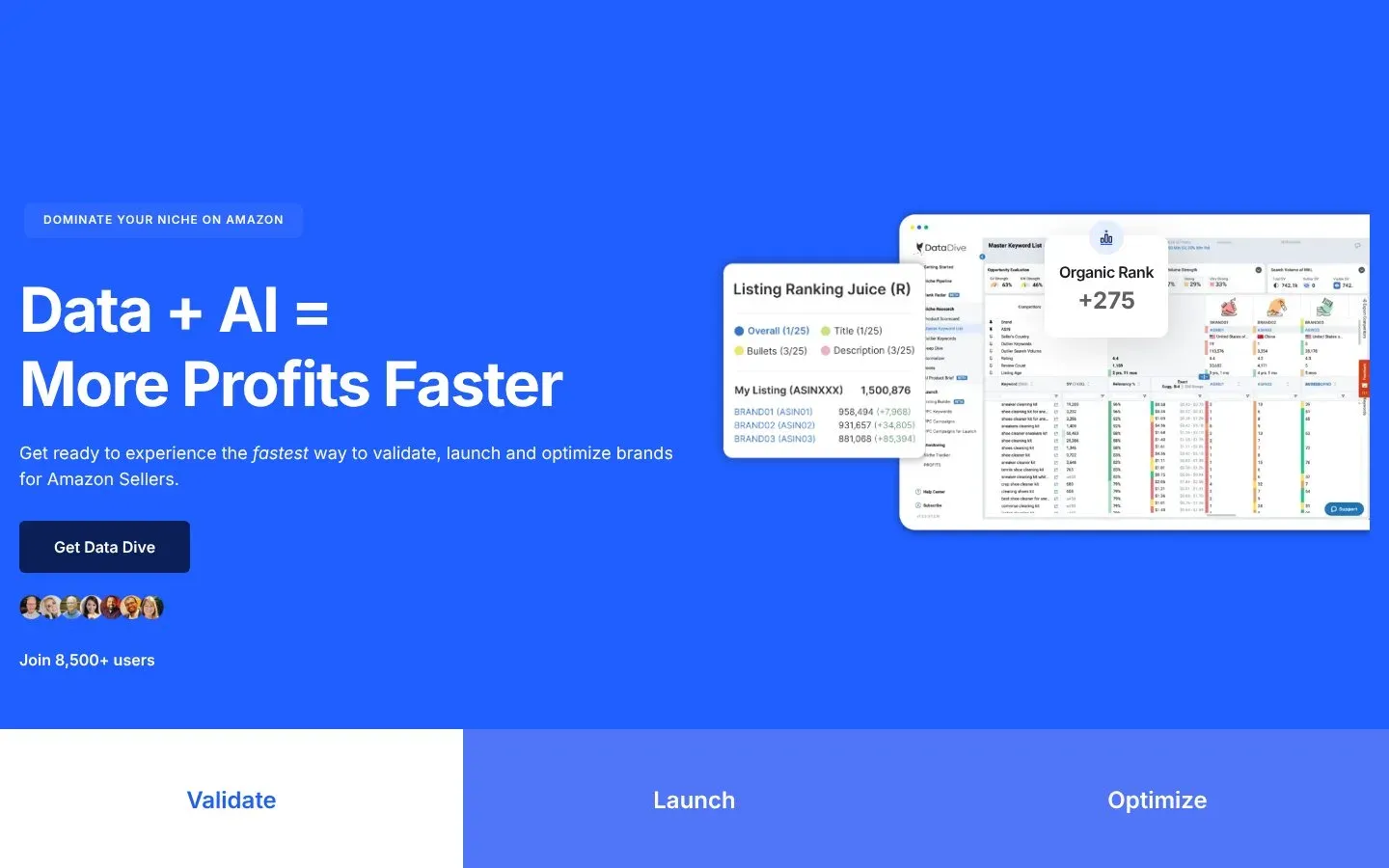
Data Dive builds keyword research from your competitors. You pick the top ASINs for a niche, and a "Dive" combines their ranking keywords into one master list, scored by relevance, with a rank tracker on top.
Ideal For
- Private-label sellers launching into a known niche
- Sellers building keyword lists for a rewrite
- PPC managers who want competitor-based keyword sets
Top Features
- Dives that merge competitor ASIN keywords into a master list
- Rank Radar for daily keyword rank tracking
- Relevance scoring to cut off-topic keywords
- AI Copywriter and AI Product Brief
Why They Stand Out?
Data Dive is built around competitor ASINs from the first click, so its keyword lists reflect what the listings above you rank for. Its rank tracker is one of the strongest in this group.
Pros
- Keyword lists built directly from competitors
- Strong rank tracking
- Relevance filtering on keyword lists
- Team seats and API on higher plans
Cons
- No free plan
- Assumes you know how to read keyword data
- Scoring centers on keywords, not images, claims or reviews
- Starter caps you at 100 Dive ASINs and 25 tracked keywords
Pricing
Starter $39/mo, Standard $149/mo and Enterprise $490/mo, with about 16% off on annual billing.
Final Verdict
Data Dive is a good pick for sellers who think in keywords and want lists built from the listings above them. It won't tell you whether your gallery, bullets or claims are the reason you're behind.
6. Keepa
Overview
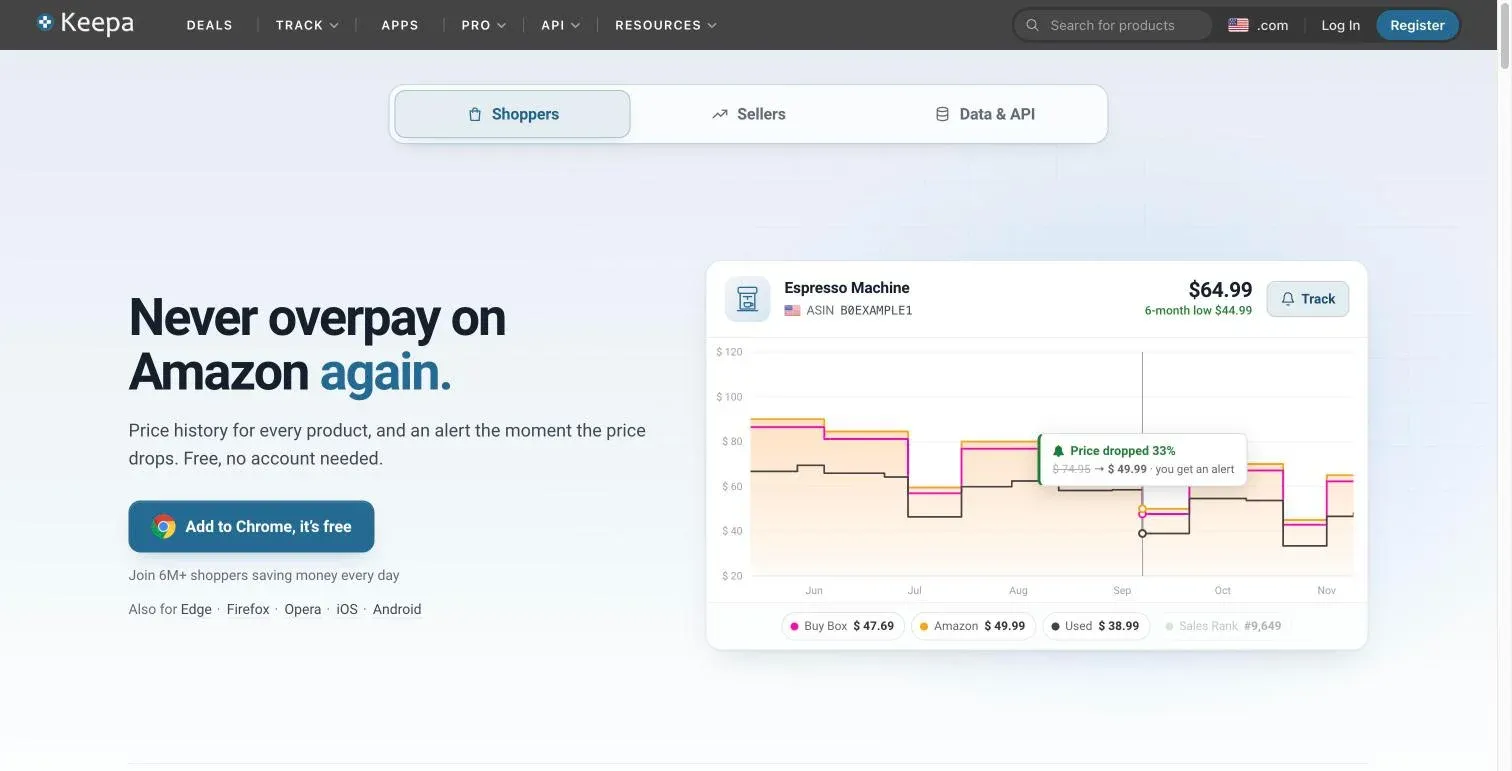
Keepa records price, sales rank, offer counts and stock for Amazon products over time. The browser extension shows price history on every product page for free, and Keepa Pro adds the seller data: sales rank details, Buy Box history, Product Finder and best seller lists.
Ideal For
- Sellers checking whether a rival discounts to win rank
- Wholesale and arbitrage sellers
- Anyone who wants history rather than estimates
Top Features
- Price and sales rank history charts on every product page
- Buy Box and offer count history
- Product Finder for filtering products by history
- API, sold separately, for programmatic access
Why They Stand Out?
Keepa shows what happened instead of what a model predicts. If a rival climbed after a price cut or a stock-out on another listing, Keepa's history will show it, which makes it one of the smartest low-cost additions to any other tool here.
Pros
- Free price history for everyone
- Recorded history instead of modelled estimates
- Low monthly price for Pro
- Used by millions of shoppers and sellers
Cons
- No keyword or listing analysis
- No free trial on Pro, and billing in euros only
- Charts take practice to read
- API is a separate subscription
Pricing
Free extension and price charts. Keepa Pro is €29/mo or €290/yr. API plans start at about €49/mo.
Final Verdict
Keepa answers "what did this competitor do with price and stock?" better than any tool here. It says nothing about keywords or listing content, so it works best next to a listing or keyword tool.
7. SellerApp
Overview
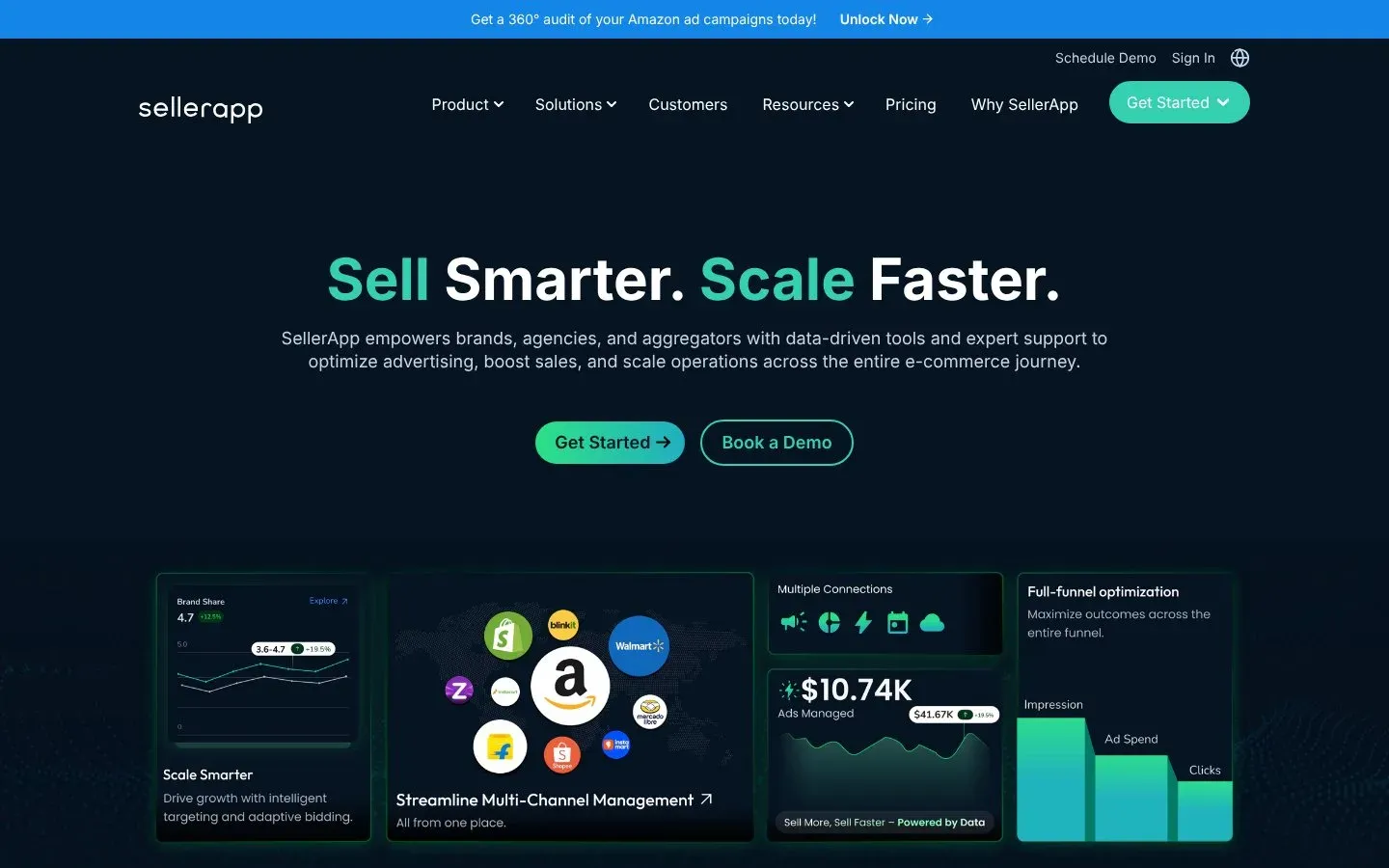
SellerApp combines listing analysis, keyword research and PPC automation, with managed services for sellers who want the work done for them. Its Listing Quality Index scores listings on a structured set of factors.
Ideal For
- Sellers who want PPC automation and listing scores together
- Agencies that need an API and white-label reports
- Sellers who may hand work to a managed service later
Top Features
- Listing Quality Index for scoring listings
- Reverse ASIN and keyword research across 18+ marketplaces
- PPC automation
- Public API and white-label reporting
Why They Stand Out?
SellerApp is the closest like-for-like tool to Amazon SEO Ranking, with a structured listing score, an API and white-label reports, plus PPC tools we don't offer. For sellers who want listing analysis and ad management from one vendor, it's one of the strongest choices.
Pros
- Structured listing score
- PPC automation and managed services
- Wide keyword marketplace coverage
- Freemium tier
Cons
- Listing Quality Index weights aren't published
- A+ Content help comes through the managed service, not self-serve
- Advertised discounts apply only to the first months
- Interface takes time to learn
Pricing
Freemium tier, Pro at $99/mo and Smart at $250/mo at the regular rate.
Final Verdict
SellerApp suits sellers who want PPC and listing scores under one roof. If you need to explain to a client exactly why a listing scored what it did, the unpublished weights are a limit.
8. ZonGuru
Overview
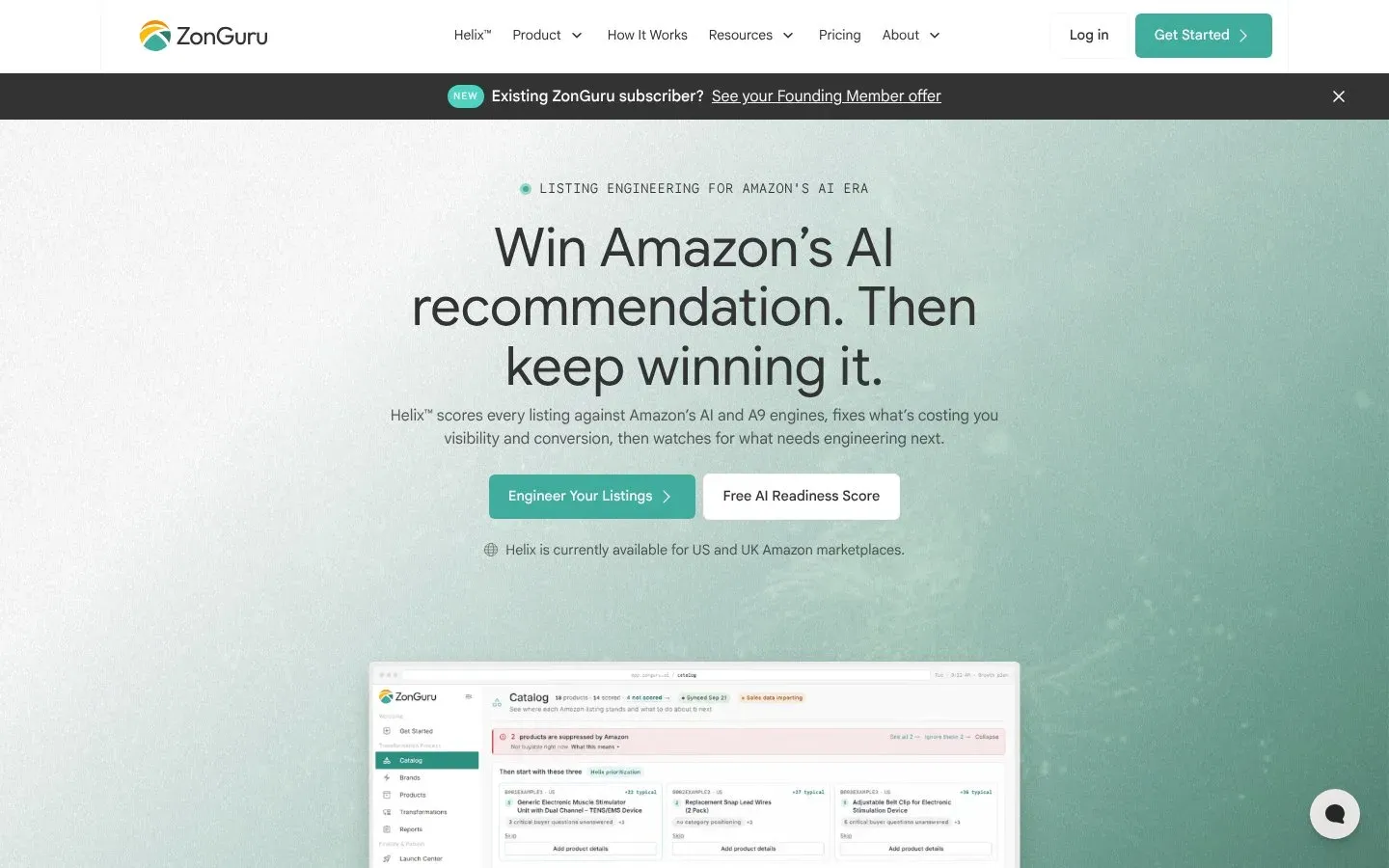
ZonGuru combines product research, a listing optimizer and operations tools for small catalogs: order management, review requests, email sequences and inventory tracking.
Ideal For
- Sellers with a small number of SKUs
- Sellers who want review requests and inventory tools with research
- New sellers who prefer a guided workflow
Top Features
- Niche Finder for product research
- Listing Optimizer that scores keyword placement
- Automated review requests and email sequences
- Inventory and order tracking
Why They Stand Out?
ZonGuru covers day-to-day operations that most research tools skip. For a seller with a few products who wants research and operations in one place, it's one of the smarter choices at entry level.
Pros
- Operations tools alongside research
- Low entry price for small catalogs
- 7-day free trial
- Simple workflow for beginners
Cons
- Listing Optimizer scores keyword placement only, not images, reviews or stock
- Scoring formula isn't published
- Price rises with your SKU count
- Fewer competitor tracking features than the large suites
Pricing
Plans start at about $49/mo ($29/mo annual) and scale with active SKUs, reaching $249/mo at 101 to 1,000 SKUs.
Final Verdict
ZonGuru fits small catalogs that want operations tools with their research. As a competitor analysis tool it's light: its listing score only covers keywords, and costs climb as the catalog grows.
9. AMZScout
Overview
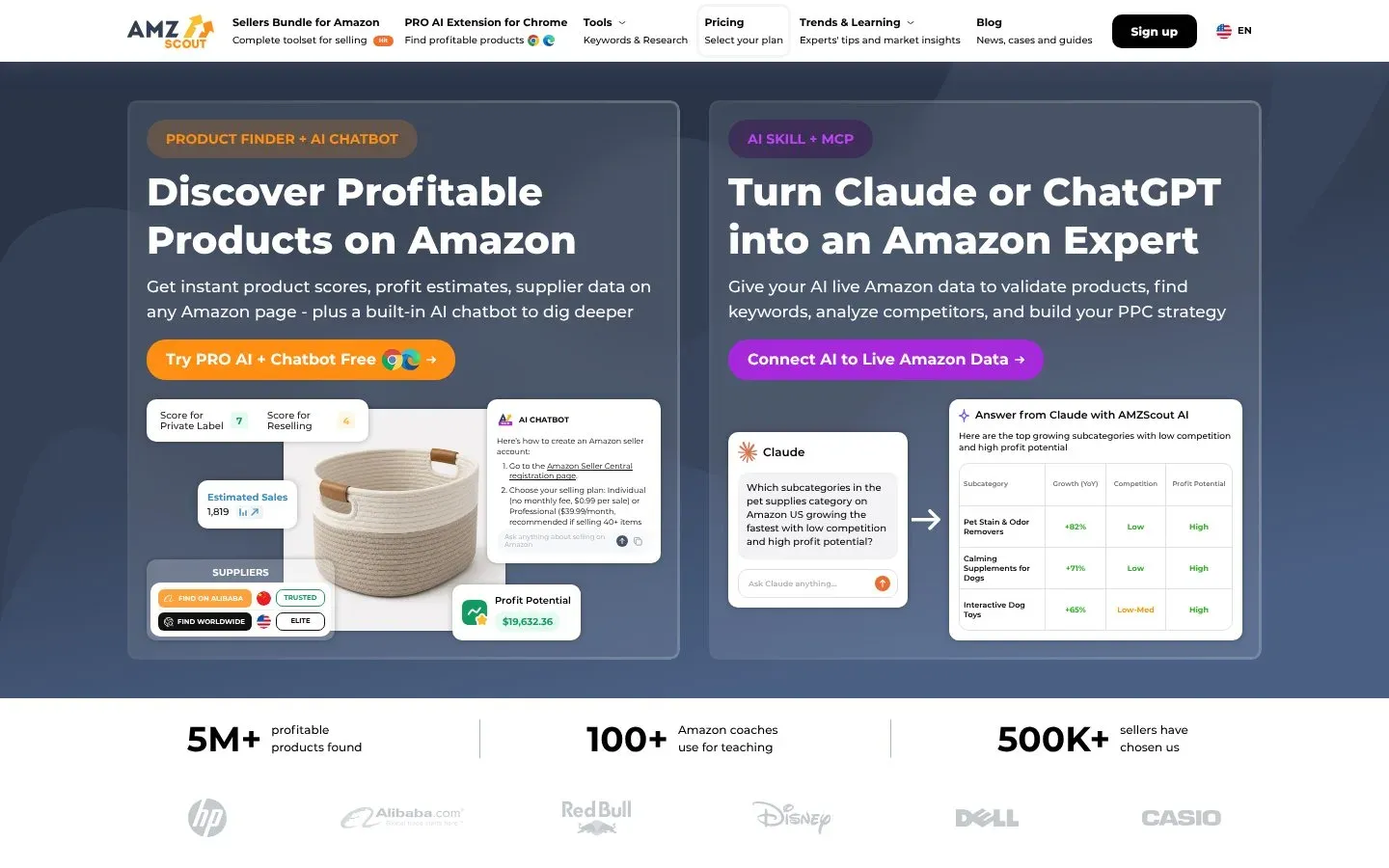
AMZScout is a product research and sourcing toolkit with a Product Database, Product Tracker and Alibaba-connected supplier search. It's one of the cheaper ways to see sales estimates for competing products.
Ideal For
- Budget-conscious sellers researching products
- Sellers sourcing from Alibaba
- Sellers who'd rather pay once than monthly
Top Features
- Product Database with sales estimates
- Product Tracker for following competitor sales and price
- Supplier search connected to Alibaba
- AI Listing Builder for drafting copy
Why They Stand Out?
AMZScout's annual and lifetime pricing makes it one of the cheapest ways to get sales estimates on competitors. For a seller on a tight budget who mainly needs product research, it's one of the smartest choices.
Pros
- Low annual and lifetime pricing
- Simple product tracking
- Supplier search built in
- Browser extension for quick checks
Cons
- No free plan; a money-back guarantee instead
- No listing scoring rubric
- The AI Listing Builder writes copy but doesn't grade what's live
- Keyword data is less detailed than the large suites
Pricing
From $59.99/mo month to month, roughly $33 to $50/mo on annual plans, or a one-time lifetime purchase of $1,599.99.
Final Verdict
AMZScout is good value for product research and sourcing. It does a different job from listing-level competitor analysis and won't show why a rival's page outranks yours.
10. Amazon Brand Analytics
Overview
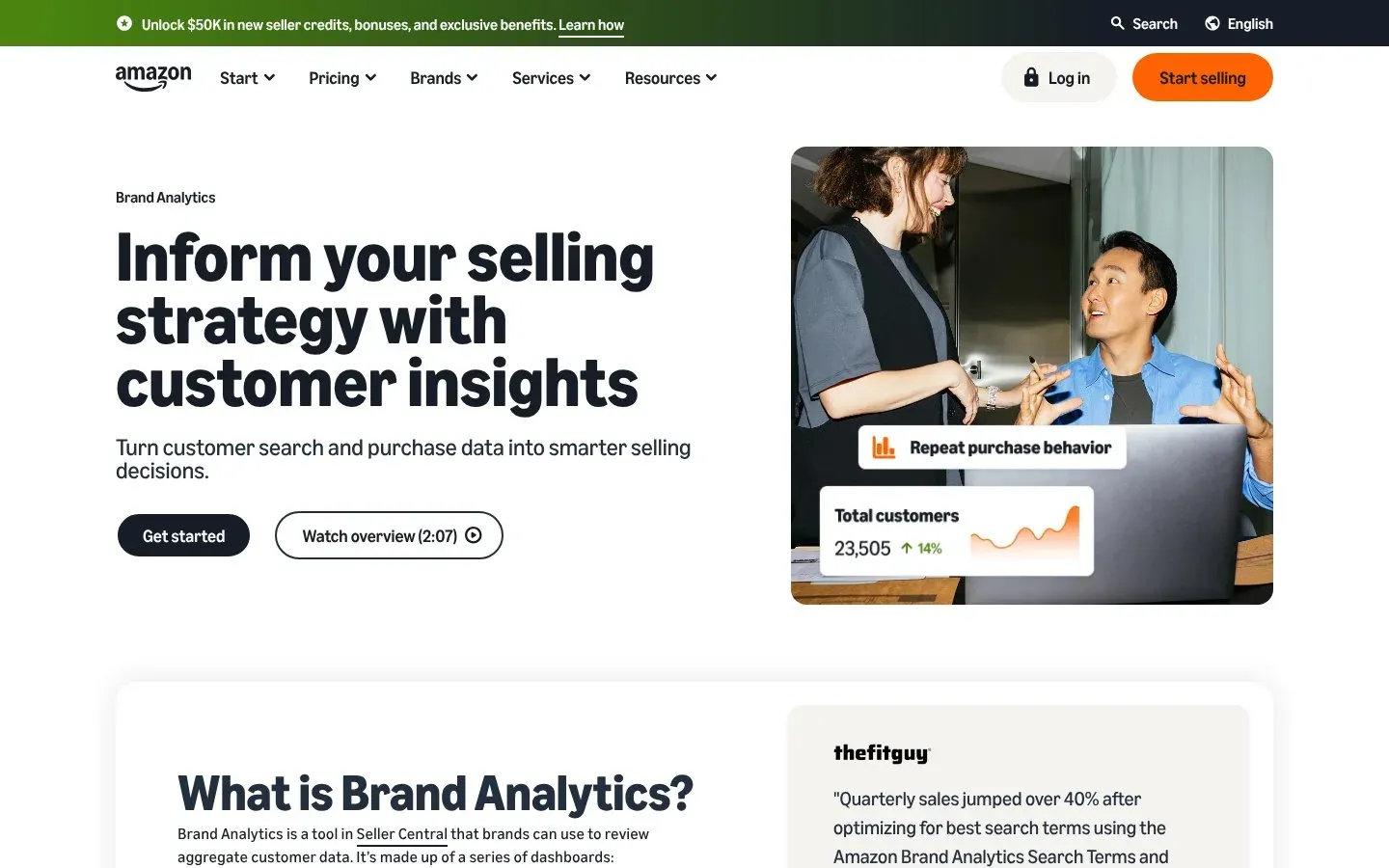
Brand Analytics is Amazon's free reporting suite for brand-registered sellers. The Search Query Performance report shows impressions, clicks, cart adds and purchases for the searches that lead to your products, with your brand's share of each.
Ideal For
- Brand-registered sellers
- Brand teams measuring search share
- Anyone who wants first-party data before paying for estimates
Top Features
- Search Query Performance with your share of each search
- Top Search Terms with the three most-clicked products per term
- Market Basket and repeat purchase reports
Why They Stand Out?
It's the only source here built on Amazon's own data rather than estimates. For measuring your brand's share of a search, it's one of the strongest starting points, and it costs nothing.
Pros
- Free
- First-party data, not modelled
- Click and purchase share by search term
- Shows which products win each search
Cons
- Requires Brand Registry and a registered trademark
- Focused on your own brand's searches
- Shows who wins a search, not why
- No listing analysis or recommendations
Pricing
Free with Amazon Brand Registry.
Final Verdict
Every brand-registered seller should use Brand Analytics, since it's free and first-party. It tells you which competitors are winning your searches. You'll need another tool to find out what on their page is doing better than yours.
How to Choose the Best Amazon Competitor Analysis Tool
Before you compare features, decide what you want the tool to tell you. The best Amazon competitor research tool for you is the one that answers your question with data you can check, and these seven questions help you find it.
1. Ask Whether You Need to Know Who's Winning, or Why
Market-share dashboards show who is gaining sales in your category. They don't show why a specific listing ranks above yours, which is the question most sellers are asking when rank drops.
Amazon SEO Ranking answers the why directly. Competitor Compare scores your listing and two rivals on the same criteria, and Keyword gap shows the phrases they rank for and you don't. A market-share chart tells you that you're losing; it doesn't tell you what to rewrite.
2. Separate What's Read From Amazon From What's Modelled
Titles, bullets, images, price and rating are on the page, so a tool can report them exactly. Sales, revenue, search volume and market share are estimates, and estimates from different vendors can disagree sharply on the same product.
Ask each vendor which numbers they read and which they model. Amazon SEO Ranking reads the live listing on every audit, shows search volumes as estimates ("≈368,000"), and marks any criterion it can't confirm as "Not verified" instead of guessing.
3. Check That the Score Explains Itself
A competitor score is only useful if you can see why it came out the way it did. If a vendor won't publish its criteria, you can't tell whether a 20-point gap comes from images or from keywords.
Amazon SEO Ranking publishes all 12 criteria and their pass rules, each worth the same. Helium 10, Jungle Scout, SellerApp and ZonGuru return scores, where they have them, without publishing how they're calculated.
4. Make Sure the Analysis Ends in a Fix You Can Test
Competitor data becomes useful the moment it changes your listing. Look for a tool that turns the gap into specific copy, and lets you check that copy before it goes live.
In Amazon SEO Ranking, "Rewrite the weak parts" works from the criteria you failed, and the draft audit scores the new copy against your live images and rating. You see the before-and-after score while the copy is still a draft.
5. Check That the AI Copy Won't Add Claims You Can't Back Up
Copying a rival's bullets is how unbacked claims spread, and a general AI rewrite does the same thing. It writes "detox" on a fruit snack or "20 packets" on an 8-count box, and those end in suppressed listings and "not as described" returns.
Amazon SEO Ranking grounds every rewrite in your listing's spec table and your brand fact sheet (approved facts, banned claims, market rules). It then checks the copy in code for health claims, unsupported claims, pack-count mismatches and Amazon's length limits before you see it. The same check flags claims on competitor listings, like the unbacked "BPA-free" in our water bottle example.
6. Check That Each Storefront Gets Its Own Audit
A listing optimized for amazon.com isn't optimized for amazon.de, and the rival that leads in the UK may not sell in Germany at all. A tool built around one storefront leaves you guessing on the others.
Amazon SEO Ranking audits and compares listings on 23 storefronts, including Ireland, Belgium and South Africa, and writes each rewrite in that marketplace's language (Belgian listings come back in French). Bulk Optimization does the same per row, so a catalog listed in five storefronts gets five sets of local copy.
7. Test It on Your Own ASIN Before You Pay
Demo data always looks good. Run the tool on your listing and the two above it, then check whether the gaps it finds match what you'd spot yourself.
Amazon SEO Ranking's free plan covers one full comparison a month, no credit card required. Helium 10's free plan opens a few tools with daily limits, and Jungle Scout, AMZScout and SmartScout have no free plan.
Everything You Need to Know About Amazon Competitor Analysis Tools
Ratings are our editorial view, based on published features and pricing on 8 November 2026. "Listing fixes" rates how directly the tool turns competitor findings into changes on your listing.
| Company | Pros | Cons | Ease of Use | Integrations | Support | Affordability | Listing Fixes |
|---|---|---|---|---|---|---|---|
| Amazon SEO Ranking | Published 12-criteria score; rewrite of failed criteria; free full comparison | No sales estimates; no price history; advanced keywords in 4 marketplaces | ⭐⭐⭐⭐⭐ | ⭐⭐⭐⭐ | ⭐⭐⭐⭐ | ⭐⭐⭐⭐⭐ | ⭐⭐⭐⭐⭐ |
| Helium 10 | Widest suite; reverse ASIN; Xray sales data | Unpublished listing score; Platinum keyword cap; add-ons cost extra | ⭐⭐⭐ | ⭐⭐⭐⭐⭐ | ⭐⭐⭐⭐ | ⭐⭐ | ⭐⭐⭐ |
| Jungle Scout | Product research; share of voice; supplier database | No free plan; thin Starter plan; no published listing standard | ⭐⭐⭐⭐ | ⭐⭐⭐⭐ | ⭐⭐⭐⭐ | ⭐⭐⭐ | ⭐⭐ |
| SmartScout | Category and brand maps; Traffic Graph; several seats | No free trial; heavy for one product; prices rose in 2026 | ⭐⭐⭐ | ⭐⭐⭐ | ⭐⭐⭐ | ⭐⭐ | ⭐⭐ |
| Data Dive | Competitor-based keyword lists; rank tracking; relevance filter | No free plan; keyword-only scoring; learning curve | ⭐⭐⭐ | ⭐⭐⭐ | ⭐⭐⭐⭐ | ⭐⭐⭐ | ⭐⭐⭐ |
| Keepa | Free history; recorded not modelled; low Pro price | No keyword or listing analysis; no trial; euros only | ⭐⭐⭐ | ⭐⭐⭐⭐ | ⭐⭐ | ⭐⭐⭐⭐⭐ | ⭐ |
| SellerApp | Structured listing score; PPC automation; API | Unpublished weights; managed A+ only; promo pricing | ⭐⭐⭐ | ⭐⭐⭐⭐ | ⭐⭐⭐⭐ | ⭐⭐⭐ | ⭐⭐⭐ |
| ZonGuru | Operations tools; low entry price; free trial | Keyword-only listing score; SKU-based pricing; light tracking | ⭐⭐⭐⭐ | ⭐⭐⭐ | ⭐⭐⭐ | ⭐⭐⭐ | ⭐⭐ |
| AMZScout | Cheap annual and lifetime plans; product tracker; sourcing | No free plan; no listing rubric; thinner keyword data | ⭐⭐⭐⭐ | ⭐⭐ | ⭐⭐⭐ | ⭐⭐⭐⭐ | ⭐ |
| Amazon Brand Analytics | Free; first-party data; click and purchase share | Brand Registry only; own brand only; no recommendations | ⭐⭐⭐ | ⭐⭐ | ⭐⭐ | ⭐⭐⭐⭐⭐ | ⭐ |
Compare Your Listing With Two Competitors Free
Amazon SEO Ranking scores your listing and up to two rivals against the same 12 equally weighted criteria, with every pass rule published, so the gap between you and the listing above comes with its reasons. The fixes target the criteria you failed, every rewrite is checked for length limits, unsupported claims and pack-count mismatches, and you can score the new copy before it goes live. It covers 23 Amazon storefronts.
The free plan includes 3 audits a month with no credit card required, enough for one comparison of you plus two competitors, and the Compare demo runs on sample listings without using an audit. Trusted by eRetail Search specialists at Nestlé and eCommerce SEO services agencies such as Reach AI.
Try our Amazon competitor analysis tool on your ASIN and the two listings above it, or compare Pro and Agency plans for keyword gaps, white-label reports and the Claude connector.
FAQ
What is the best Amazon competitor analysis tool in 2026?
The best Amazon competitor analysis tool in 2026 for outranking specific listings is Amazon SEO Ranking, because it scores your listing and two rivals on the same 12 published criteria and rewrites the criteria your listing failed. For category market share and sales estimates, Helium 10, Jungle Scout and SmartScout go further. Amazon SEO Ranking's free plan runs one full comparison a month.
How do I choose the right Amazon competitor analysis tool?
To choose the right Amazon competitor analysis tool, consider which job you need done first: fixing a listing gap, finding keyword gaps or tracking market share. Then check which numbers the tool reads from Amazon and which it models, since sales and search volume are always estimates. Look for a published scoring method, marketplace coverage that matches where you sell, and a free way to test it on your own ASIN. Amazon SEO Ranking covers 23 storefronts for its audit and publishes all 12 criteria.
How does Amazon SEO Ranking differ from similar alternatives?
Amazon SEO Ranking differs from similar alternatives by focusing on the listing itself: it scores you and up to two rivals against 12 published criteria and rewrites the criteria your listing failed, which you can test as a draft. Helium 10 and Jungle Scout focus on modelled sales, product research and PPC, and their listing scores don't publish how they're calculated. Pro costs $79/mo, against $129/mo for Helium 10 Platinum month to month. It doesn't offer sales estimates, price history or PPC tools.
How do I get started with Amazon SEO Ranking?
To get started with Amazon SEO Ranking, create a free account and paste your ASIN plus up to two competitor ASINs into Competitor Compare. The comparison uses one audit per listing, so the 3 free monthly audits cover one full run, with no credit card required. Results show each rival's lead, the three biggest gaps and a category table. From there, open your listing's audit and use Rewrite the weak parts to draft new copy for the criteria you failed.
How easy is it to switch to Amazon SEO Ranking?
Switching to Amazon SEO Ranking is easy because there's nothing to migrate: it reads listings directly from Amazon by ASIN. You can run it alongside your current tool and compare the results on the same listings. Agencies can upload an Excel file of up to 500 ASINs per run to Bulk Optimization on the Agency plan. Monthly plans start with a 7-day free trial and can be cancelled anytime.
Can Amazon SEO Ranking show a competitor's sales or revenue?
Amazon SEO Ranking can't show a competitor's sales or revenue, because it works from what's on the listing rather than modelled estimates. It reads the live product page, including title, bullets, images, rating and Prime status, and scores it against fixed rules. Sales figures from any tool are estimates built from Best Sellers Rank. If you need them, pair Amazon SEO Ranking with Keepa's rank history or a research suite such as Jungle Scout.
Is there a free Amazon competitor analysis tool?
There is free Amazon competitor analysis available from three sources: Amazon Brand Analytics (free with Brand Registry), Keepa's free price history charts, and Amazon SEO Ranking's free plan. Brand Analytics shows the top three clicked products for each search term, and Keepa shows price history on any product page. Amazon SEO Ranking's free plan includes 3 audits a month, enough to compare your listing with two rivals on 12 criteria. None of the three requires a credit card.
Put your listing next to up to two competitors and see which criteria they win. Free, no card required.
Compare my listing free