The best Amazon listing monitoring tools tell you two things: that something on your product page changed, and whether the page still meets Amazon's rules after the change. Most tools in this list do the first job well. They alert you when a hijacker joins your listing, when you lose the Buy Box, or when a title, bullet or image is edited. Fewer check whether the listing you're left with is still a good one.
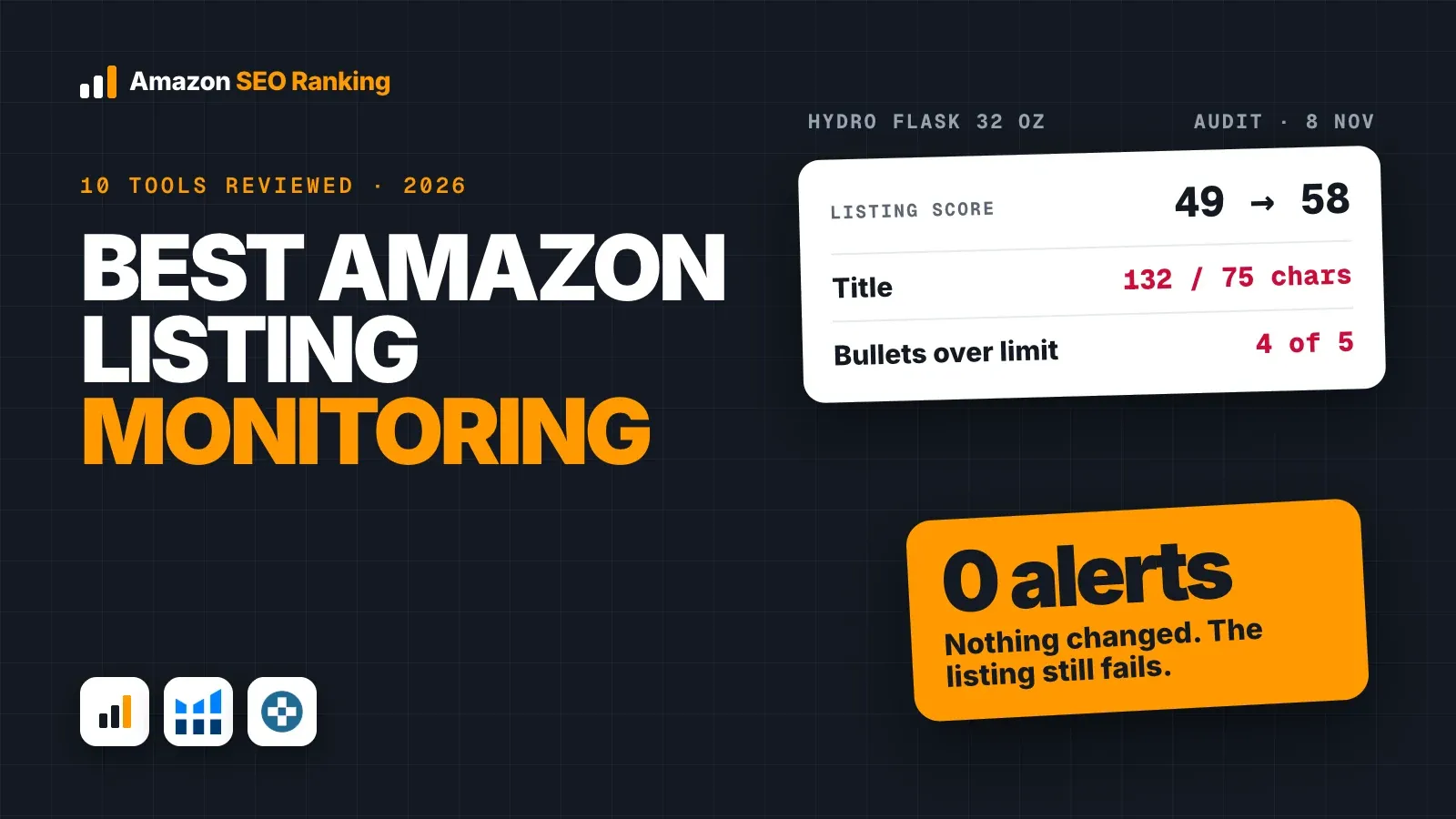
We saw the gap on a Hydro Flask 32 oz bottle (ASIN B0BG6PZGQN) we've audited four times in Amazon SEO Ranking. Its score moved from 49 to 58 across those readings. On 8 November 2026 the audit still found a 132-character title, against Amazon's 75-character limit, and four of five bullets running 237 to 276 characters. A hijacker alert would stay quiet on that listing. Nothing about it is a "change", yet it's the kind of title Amazon can rewrite or suppress.
For sellers who want monitoring that ends in a fixed listing, we think the best pick is Amazon SEO Ranking. Its audit finds the problems already sitting on a page, against 12 criteria it publishes in full, and rewrites the fields that fail. It then keeps a score history for every audited listing and emails you when a tracked listing's score moves (5 listings on Pro, 25 on Agency). It doesn't send hijacker, Buy Box or price alerts. For those, SellerSonar and AmzMonitor are the strongest low-cost monitors, Helium 10 suits sellers already in its suite, and SellerPulse, FeedbackWhiz and AMALYTIX fit brands that connect Seller Central.
Key Takeaways (TL;DR)
- The best Amazon listing monitoring tool for listing quality: Amazon SEO Ranking. Its audit shows which of 12 published criteria a listing fails and rewrites the copy, and its score history and alerts show when a listing's quality moves. Pair it with a change-alert tool if hijackers and the Buy Box are your main risk.
- Why you need it: listings decay without anyone noticing, through Amazon's rule changes, catalog edits, other sellers and storefronts that drift apart, and the loss shows up in sales days later. Monitoring shortens the time between a problem and your fix.
- Who it's for: private label brand owners, sellers updating listings, brands with large or multi-marketplace catalogs, agencies watching client ASINs, and teams working inside Claude.
- How to choose: make sure each alert leads to a fix, that you can see why a score changed, and that the tool scores every storefront you sell in. Then cover hijackers with a tool that checks often enough.
- Expected price: Amazon SEO Ranking Pro is $79/mo with 100 audits, unlimited score history and alerts on 5 listings, and Agency is $249/mo with 500 audits and alerts on 25, with a 7-day free trial on monthly plans and a free plan with 3 audits a month. Across the market, monitoring runs from free price alerts (Keepa) and $12/mo (AmzMonitor) to custom annual contracts (DataHawk) and $1,199/mo for 10,000 products (FeedbackWhiz Alerts, Brands 10K).
Top Amazon Listing Monitoring Tools in 2026 at a Glance
Prices are each vendor's published monthly rate on 8 November 2026 unless marked. "Check speed" is how often the tool looks at a listing on the plan named.
| Company | Best For | Key Features | Pricing |
|---|---|---|---|
| Amazon SEO Ranking | Monitoring listing quality and fixing what slipped | Score history, score-change email alerts, 12-criteria audit, claim checks, AI rewrite | Free (3 audits/mo, history for 1 listing), Pro $79/mo, Agency $249/mo |
| Helium 10 | Sellers who want alerts inside a large suite | Alerts with before-and-after screenshots, hijacker detection | Platinum $129/mo (5 ASINs), Diamond $359/mo (200 ASINs) |
| SellerSonar | Low-cost monitoring with many alert types | 40+ alert types, SharkGuard hijacker check, Slack alerts | Free (5 ASINs), Pro $23.98/mo (150 ASINs, every 4 hours) |
| AmzMonitor | The cheapest paid change alerts | 20+ change types, keyword rank, MAP alerts | $12/mo (20 ASINs) to $200/mo (1,200 ASINs) |
| SellerPulse | Brand protection plus FBA operations data | Hijacker, adult-flag and content alerts on all SKUs | From $89/mo, scaled by monthly orders |
| FeedbackWhiz Alerts | Resellers and brands that also want review tools | Listing, suppression and account-health alerts, daily reports | From $69/mo (100 listings) |
| AMALYTIX | Sellers and vendors who want daily alerts by rule | 67 alert types, Slack and Teams delivery | From $89/mo (500 products) |
| DataHawk | Large brands that want alerts inside analytics | Custom triggers, root-cause diagnosis, Walmart support | Custom annual pricing |
| sellerboard | Profit tracking with basic listing alerts | Listing, seller-count, Buy Box and fee-change alerts | From $19/mo ($15/mo annual) |
| Keepa | Price, Buy Box and stock history | Free price and availability alerts, Sales Rank charts | Free; Pro €29/mo |
What Is an Amazon Listing Monitoring Tool?
An Amazon listing monitoring tool watches your product pages and tells you when something on them changes. It records a baseline for each ASIN, checks again on a schedule, and sends an alert when a tracked field moves. Typical fields are the title, bullets, images, brand and category, the price, who holds the Buy Box, how many sellers are on the listing, the star rating, and whether the page is still searchable.
Tools collect that data in one of two ways. Some read the public product page, as a shopper would, which means you can add any ASIN in seconds, including a competitor's. Others connect to Seller Central or Vendor Central through Amazon's Selling Partner API, which adds data only the account owner sees, such as fee changes, inventory and account health. SellerSonar and AmzMonitor work from public data. AMALYTIX, sellerboard and FeedbackWhiz connect to your account.
How often a tool checks matters as much as what it checks. AMALYTIX and DataHawk look once a day. SellerSonar checks every 4 hours on Pro and hourly on Business, and AmzMonitor lets you pick anything from every 2 to every 24 hours, with fewer ASINs at the faster settings.
Amazon listing monitoring software and listing audit software overlap but answer different questions. A monitor asks, "Is this page different from yesterday?" An audit asks, "Does this page meet Amazon's rules and give shoppers what they search for?" Amazon SEO Ranking sits on the audit side and adds monitoring on top: a score history per listing and an email when a tracked listing's score moves.
Why Do You Need Amazon Listing Monitoring Software?
Your product page isn't fully yours. Other sellers on the same ASIN can submit contributions, Amazon merges data from several sources, and a hijacker can add a cheaper offer under your brand. In CIRP's survey of US Amazon customers, 90% began their shopping at Amazon.com in 2024, so a page that loses its Buy Box or drops out of search loses most of its traffic, and you usually find out from a sales report.
Hijackers are the risk most monitoring tools are built for. In its 2026 Trustworthy Shopping Experience Report, Amazon said it seized more than 15 million counterfeit products worldwide in the previous year, so a brand with a few hero products should have a new-seller alert on them.
Rule changes are the risk most monitoring tools miss. Amazon cut the title limit to 75 characters in most categories from 27 July 2026. A listing that met the old 200-character rule now breaks the new one without anyone touching it, and a change-alert tool has nothing to report. Policy and listing-rule changes like this arrive most weeks, and each one can turn a compliant page into one Amazon rewrites or suppresses.
Storefronts drift apart too. A seller who lists the same product on amazon.com, amazon.de and amazon.co.jp often checks only the home marketplace. The copy, images, ratings and Prime status differ per storefront, so the same product can score well in one and fail in another, and no alert on the US page will tell you.
The Hydro Flask listing shows what that looks like. Amazon SEO Ranking audit of B0BG6PZGQN on amazon.com, 8 November 2026:
| Category | Score | What the audit found |
|---|---|---|
| Title & Item Highlights | 33 | 132-character title, against a 75-character limit; repeated ideas ("Non Spill" and "Leakproof") |
| Bullet Points | 47 | Four of five bullets over 200 characters (237 to 276); ALL CAPS labels on bullets 1 to 3 |
| Backend & Attributes | 60 | Category path sits under Storage & Organization instead of a water bottle node |
| AI-Readiness (Rufus/COSMO) | 60 | Few use cases (gym, commute, school); a typo in the bullets |
| Images & Video | 80 | 6 images, one short of a full 7-image gallery |
| Reviews & Social Proof | 100 | Passed |
| Stock & Fulfillment | 100 | Passed |
Overall, the listing scored 58, up from 49, 53 and 56 at earlier readings. The claim check also flagged "BPA-free" as a claim the spec table doesn't back. Reading the spec table next to the bullets shows one more problem the check didn't flag: the bullets mention dishwasher-safe care, while the spec table lists "Hand Wash Only". A shopper who reads both sees a contradiction, and contradictions like that become "not as described" returns.
None of those problems would trigger a hijacker, Buy Box or price alert, because none of them is a change. You find standing problems like these by running an audit, then use score history and alerts to see when the listing moves after that. That's why the best Amazon listing monitoring setup for most brands covers both kinds of risk: changes made to the page, and problems sitting on it.
Who Needs Amazon Listing Change Alerts?
Five groups get the most from listing monitoring. If your main worry is pricing against other resellers on shared listings, a repricer with Buy Box tracking will serve you better than any tool here.
Private Label Brand Owners Protecting Their Listings
A brand owner's biggest monitoring risk is someone else on their ASIN. A hijacker can undercut the price, take the Buy Box and ship a counterfeit that earns your listing one-star reviews. Some also edit the page, and eComEngine's help center describes hijackers trying to get a listing flagged as an adult product so it drops out of search.
Brand owners need Amazon hijacker alerts on new sellers, plus alerts on Buy Box ownership and content edits, delivered fast enough to act the same day. SellerSonar, AmzMonitor, SellerPulse and FeedbackWhiz all cover this. Amazon SEO Ranking doesn't watch sellers or the Buy Box. Its role is the page itself: once you've removed a hijacker, the audit and claim checks show whether their edits left anything behind in the title, bullets or attributes.
Sellers Updating or Relaunching a Listing
A seller who edits a listing wants to know two things. Did Amazon accept the change as written, and did it make the page better?
Amazon SEO Ranking covers both. Score history shows the listing's number before and after the edit, and the draft audit scores new copy against the live listing's images, rating and Prime status before you paste it into Seller Central. If Amazon later rewrites the title or moves the category, the listing's score changes, and an alert on that listing points you to the criterion that dropped. If a listing disappears from search altogether, our guide to fixing a search suppressed listing on Amazon covers the five common causes.
Brand eCommerce Teams Managing Large Catalogs
eCommerce and eRetail search teams at consumer-goods brands own the listing content for a whole portfolio, often across several storefronts. Their risk is less a single hijacker than slow drift: pack sizes that disagree across variants, claims that legal never approved, and a German page that fell behind the US one.
These teams need every listing checked against the same standard, and a way to see which ones are weakest. Amazon SEO Ranking audits listings in 23 Amazon storefronts and keeps score history for every audited listing on Pro and Agency. Its portfolio comparison lines up the latest audit of each listing by category, flags the weakest area across the catalog and names the listing to use as a template. The brand fact sheet holds approved facts and banned claims, and every rewrite is checked against it. Bulk Optimization audits and rewrites up to 500 ASINs in one run on Agency, each in its storefront's language, and Enterprise adds unlimited score monitoring and your own legal guidelines applied to the copy.
For alerts on every SKU's sellers and Buy Box, SellerPulse monitors all SKUs on every plan, and AMALYTIX and FeedbackWhiz scale to thousands of products. UK brands that also supply Tesco.com can check those pages against Tesco's rules in Amazon SEO Ranking's free Tesco Listing Checker (not affiliated with Tesco PLC).
Agencies Monitoring Client ASINs
Agencies watch listings they don't own, often without access to the client's Seller Central. Public-data monitors such as SellerSonar and AmzMonitor work for that, since adding an ASIN needs no login. The agency then has to explain each alert to the client and fix the listing.
Amazon SEO Ranking's Agency plan includes score-change alerts on 25 listings, ranking visibility for every tracked ASIN, 500 audits a month, white-label Amazon SEO reports and API access at a flat $249. Every audit reads the public product page, so the client doesn't have to share Seller Central access.
Teams Working Inside Claude
Some teams now check listings through an AI assistant. The assistant needs real listing data and rule checks it can call, rather than guessing from memory.
Amazon SEO Ranking's Claude connector, included on Pro and Agency, lets Claude list every audited listing with its latest score and score history, audit a live listing, and check rewritten copy against Amazon's limits and claim rules in one conversation. The Hydro Flask figures above came from those calls. DataHawk also offers an MCP connection to its data.
Best Amazon Listing Monitoring Tools: In-Depth Review & Comparison
The order below reflects how well each tool helps a seller go from a listing problem to a fixed listing. A tool further down can still be the right pick if what you need is the fastest hijacker alert at the lowest price.
1. Amazon SEO Ranking
Overview
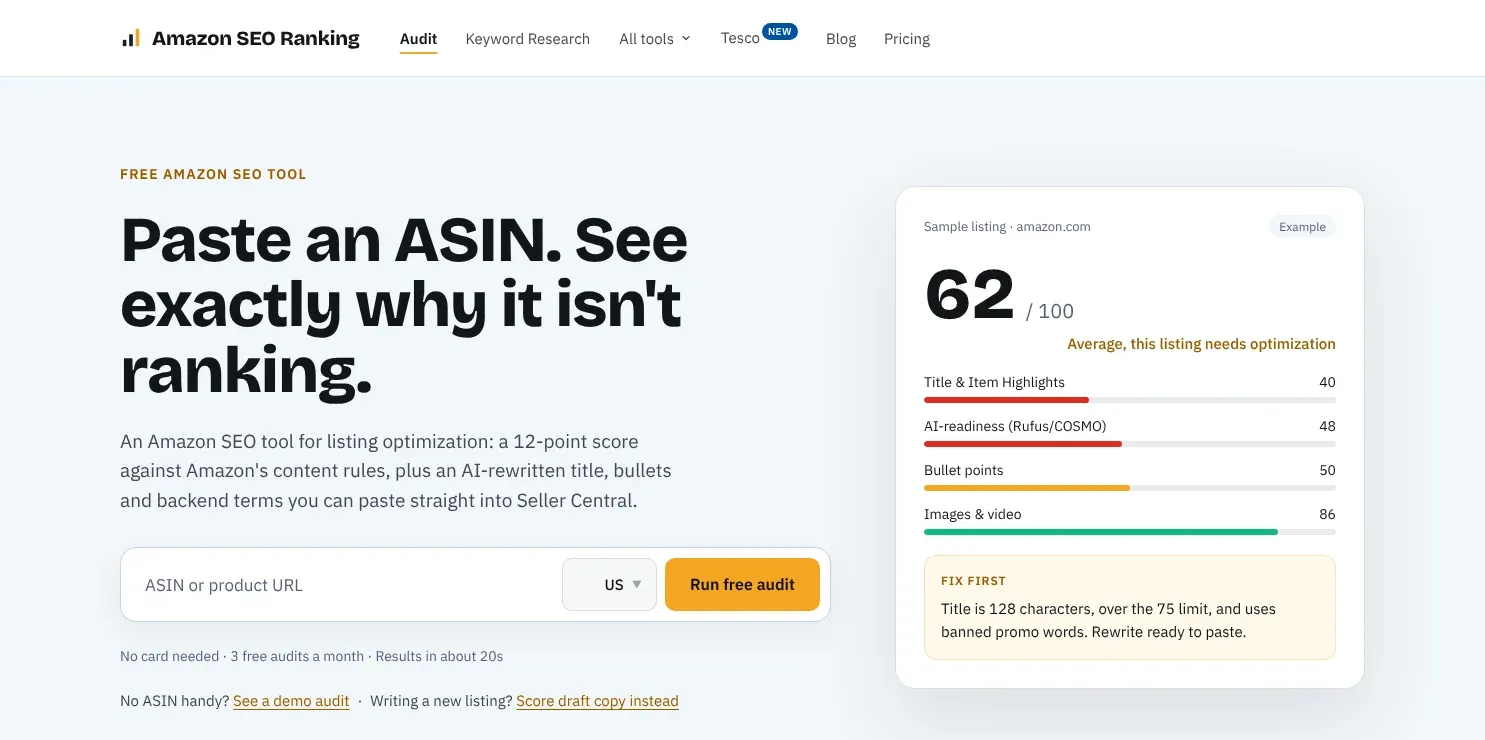
Amazon SEO Ranking is a self-serve Amazon SEO tool built for one job: making a live listing rank better. It audits a listing against 12 equally weighted criteria in seven categories, then uses AI to rewrite whatever fails in ready-to-paste form. Its monitoring features sit on top of the audit. Score history records each listing's score over time, score-change email alerts tell you when a tracked listing's score moves, and the portfolio comparison shows every tracked listing's latest audit side by side.
An unchanged listing reuses its last audit, so the same page keeps the same score and you don't get alerts from re-grading noise. Scores from before 27 October 2026, when grading moved to a newer AI model, can differ slightly from later ones.
Ideal For
The tool fits sellers whose next step after an alert is the listing:
- Sellers checking whether a listing edit held and helped
- Brands that want to know when a listing falls below Amazon's rules
- Teams cleaning up a listing after a hijacker or a bad contribution
- Agencies tracking client listings without Seller Central access
- Teams that audit and rewrite listings inside Claude
Top Features
These cut the most time between a listing problem and a fix:
- A 12-criteria audit that reads the live page in any of 23 Amazon storefronts and names the fixes worth the most points
- Score history for every audited listing (1 listing on Free, unlimited on Pro and Agency)
- Score-change email alerts on 5 listings with Pro and 25 with Agency
- Consistency checks on every audit, free of AI calls, that flag pack counts that disagree and health or product claims the spec table doesn't support
- An AI rewrite grounded in the listing's spec table and your brand fact sheet, with a draft audit before you paste
- Portfolio comparison that flags each catalog's weakest category and best template listing
- Ranking visibility on Agency, showing how many keywords each tracked ASIN holds at #1, #2-3, #4-10 and #11-100
Why We Stand Out?
Most monitoring tools tell you a field changed. Ours tells you whether the listing is any good, and what a change did to it. The first audit finds the problems already on the page. When a score drops later, the audit shows which of the 12 criteria failed and why, in plain text: a title now over 75 characters, a bullet over 200 on mobile, a gallery down to 5 images, a Prime flag that couldn't be confirmed. The fix sits in the same account. The rewrite keeps your main keyword early in the title, holds Amazon's limits, and flags health claims and pack counts that disagree before you see it.
The score behind every alert is published, criterion by criterion. A criterion the data can't confirm is marked "Not verified" and left out of the score, so you don't get an alert for a false failure. The same product is scored separately in each of 23 storefronts, and rewrites come back in that storefront's language, so a German page that has fallen behind the US one shows up as its own score. On price, Pro is $79 a month for 100 audits, unlimited score history, Bulk re-audits of 100 listings per run and alerts on 5. Agency is $249, about 31% less than Helium 10 Diamond at $359, with 500 audits, alerts on 25, ranking visibility, white-label reports and the API.
Pros
- Alerts tied to a published 12-criteria score, with the failed criterion named
- The audit finds standing problems that change alerts miss, such as titles broken by the 75-character rule
- Monitoring, audit, claim checks and AI rewrite in one account
- Public-data audits, so no Seller Central access is needed
- Free plan with 3 full audits a month and no credit card
Cons
- No hijacker, new-seller, Buy Box, price or review alerts; SellerSonar, AmzMonitor or SellerPulse cover those
- Score-change alerts cover 5 listings on Pro and 25 on Agency; larger catalogs re-check with Bulk runs or move to Enterprise for unlimited monitoring
- No account data such as fees, inventory or account health
Pricing
The Free plan includes 3 full audits a month, score history for 1 listing and a keyword preview, with no credit card.
Pro is $79/mo or $799/yr, with 100 audits, unlimited score history, alerts on 5 listings, Bulk Optimization up to 100 ASINs and the Claude connector. Agency is $249/mo or $2,490/yr, with 500 audits, alerts on 25 listings, ranking visibility, Bulk up to 500 ASINs, white-label reports and API access. Enterprise is custom, with unlimited score monitoring.
Monthly plans start with a 7-day free trial, and every charge has a 14-day money-back guarantee.
Final Verdict
If the question behind your monitoring is "is this listing still good, and what do I fix", Amazon SEO Ranking answers both. Brands whose main risk is hijackers or the Buy Box should run it next to a change-alert tool such as SellerSonar or AmzMonitor.
2. Helium 10
Overview
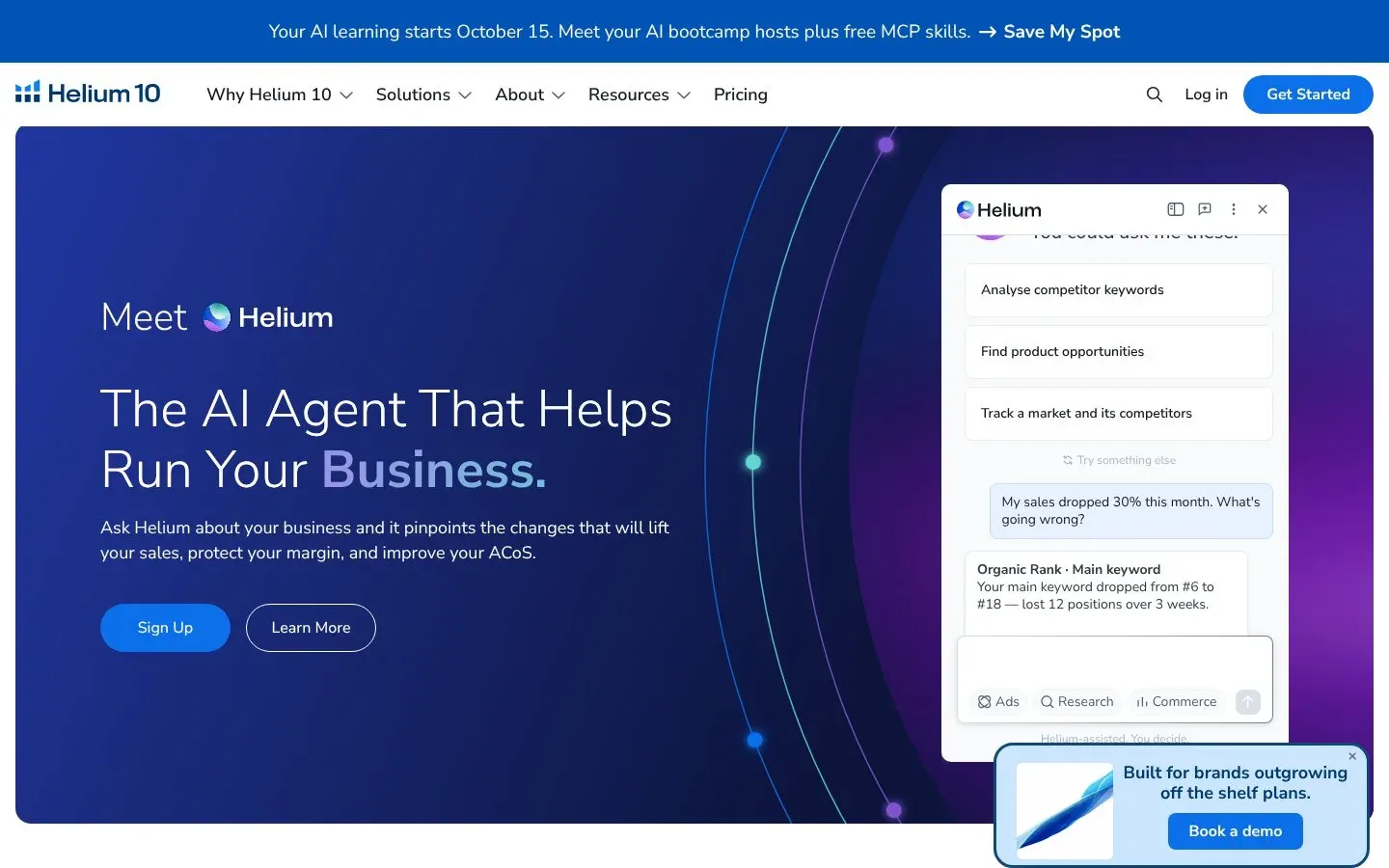
Helium 10 is the largest Amazon seller suite, and Alerts is its monitoring tool. It replaced the older Hijacker Alert and tracks seven listing elements, including hijackers, title changes, product page changes and price. Each alert shows 24-hour and 7-day changes, and before-and-after screenshots show how the listing looked on desktop and mobile before and after the edit.
Alerts became much smaller on the entry paid plan in 2026. Platinum now covers 5 ASINs and Diamond 200, according to RevenueGeeks' August 2026 plan breakdown.
Ideal For
Helium 10 fits sellers already working inside its suite:
- Private label sellers running research, listings and PPC in one login
- Sellers protecting a handful of hero ASINs
- Teams that want visual before-and-after evidence for Seller Support cases
- Diamond subscribers with up to 200 ASINs to watch
Top Features
Alerts connects to the rest of the suite:
- Hijacker detection with seller details
- Title, page and price change tracking
- Before-and-after screenshots on desktop and mobile
- 24-hour and 7-day change summaries
Why They Stand Out?
Helium 10 is one of the strongest choices for sellers who want alerts next to keyword research, listing tools and ads. The before-and-after screenshots are useful evidence when you ask Seller Support to restore a listing.
It also has a free plan, so you can see how Alerts works on a couple of ASINs before you pay.
Pros
- Before-and-after screenshots of each change
- Alerts inside a suite you may already use
- 200 ASINs on Diamond
- Free plan to test
Cons
- Only 5 ASINs on Platinum, which EcomCrew reported in April 2026 as a cut that sellers pushed back on
- Platinum costs $129/mo month to month
- You pay for 20-plus tools if monitoring is all you need
- Fewer alert types than dedicated monitors
Pricing
The Free plan opens a few tools with limited use. Platinum is $129/mo, or $99/mo billed annually, with Alerts on 5 ASINs. Diamond is $359/mo, or $279/mo billed annually, with Alerts on 200 ASINs. Enterprise is custom.
Final Verdict
Helium 10 suits sellers who use the suite and want hijacker alerts on a few key products, with screenshots as evidence. If change alerts across many ASINs are what you need, SellerSonar and AmzMonitor cover far more listings for less.
3. SellerSonar
Overview
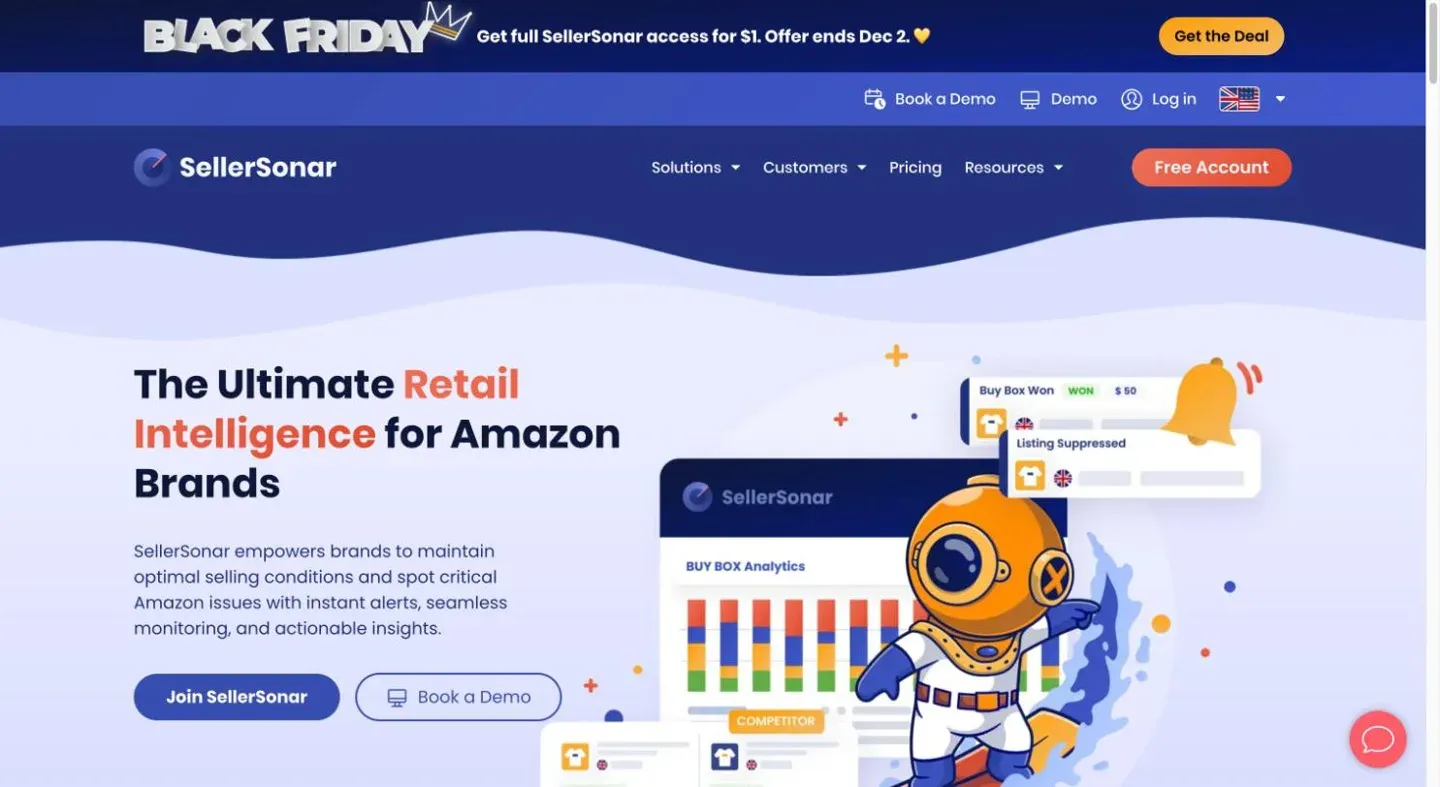
SellerSonar is monitoring software built around alerts. It tracks more than 40 alert types across listing content, suppression, retail issues, rankings, badges, the Buy Box, reviews and competitors. SharkGuard, its hijacker check, flags unauthorized sellers on every paid plan.
It reads public ASIN data, so it needs no Seller Central connection and covers 23 Amazon marketplaces.
Ideal For
SellerSonar fits sellers who want broad alerts at low cost:
- Brand owners watching for hijackers and content edits
- Agencies monitoring client ASINs without account access
- Sellers who want alerts in Slack
- Small sellers starting on the free tier
Top Features
The alert list is the product:
- SharkGuard hijacker detection on every paid plan
- Content, suppression, retail-issue, ranking and badge alerts on Pro
- Buy Box Lost/Won and review alerts from Premium
- AI Competitors Tracker and Share of Voice on Business
Why They Stand Out?
SellerSonar is one of the smartest choices for broad monitoring at a low price. Pro covers 150 ASINs for $23.98 a month, and Slack alerts are included on every paid plan.
Setup takes minutes because nothing connects to your account, which also makes it practical for watching competitors' listings.
Pros
- 40+ alert types across 23 marketplaces
- Hijacker detection from the entry plan
- Free tier with 5 ASINs and 10 keywords
- Slack alerts on every paid plan
Cons
- Buy Box Lost/Won and review alerts start on Premium
- Pro checks every 4 hours; hourly needs Business
- No SMS alerts
- Few public reviews (RevenueGeeks found 2 on Trustpilot)
Pricing
The Free tier covers 5 ASINs and 10 keywords. Pro is $23.98/mo ($19.98 annual) for 150 ASINs, checked every 4 hours. Premium is $47.98/mo ($39.98 annual) for 300 ASINs, every 2 hours. Business is $89.98/mo ($74.98 annual) for 500 ASINs, hourly. A one-time $5 charge opens a 14-day full trial.
Final Verdict
SellerSonar suits brands and agencies that want hijacker and content alerts across many ASINs for little money. Most buyers will need Premium for Buy Box and review alerts, and it doesn't tell you how to fix the listing once something changes.
4. AmzMonitor
Overview
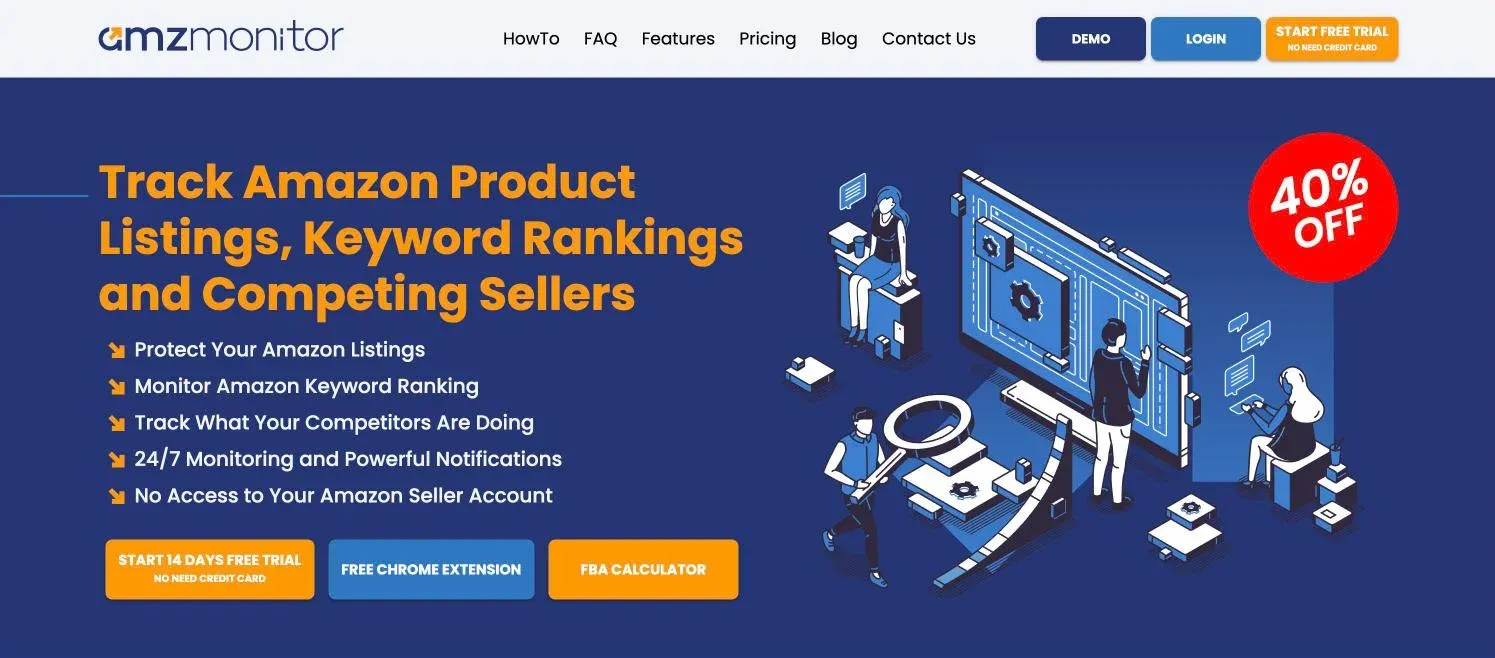
AmzMonitor, from PecanTech LLC, watches listings, keywords, sellers and competitors and emails you when something moves. It tracks more than 20 change types: edits to the title, bullets, description, images, brand and category, price and Buy Box changes, new sellers, suppression, MAP violations, reviews and daily keyword rank.
You choose how often it checks, from every 2 hours to every 24 hours. ASIN limits are set at the 24-hour interval, so faster checks lower them.
Ideal For
AmzMonitor fits sellers who mostly want alerts:
- Small sellers on a tight budget
- Brands enforcing a minimum advertised price
- Sellers who want keyword rank and listing alerts together
- Agencies that don't have client account access
Top Features
Monitoring covers the listing and its sellers:
- Listing content, suppression and Buy Box alerts
- New-seller and competitor price alerts
- MAP violation alerts
- Daily keyword rank and 6 months of alert history
Why They Stand Out?
AmzMonitor is one of the cheapest ways to get paid change alerts. The entry plan is $12 a month, with a 14-day trial and no card.
It also covers MAP violations, which few monitors here do, and lets you trade check speed for ASIN count.
Pros
- Entry plan at $12/mo
- 20+ change types, including MAP
- 18 marketplaces, no Seller Central access needed
- 14-day trial with no card; 30-day money-back on paid plans
Cons
- Email-only alerts for now; Slack and API listed as coming soon
- Entry plan covers 20 ASINs and 40 keywords
- Faster checks lower the ASIN limit
- No listing audit or sales data
Pricing
Plans run from Let's Meet at $12/mo (20 ASINs, 40 keywords) through Bronze $20, Silver $35, Gold $60 and Platinum $110, to Diamond at $200/mo (1,200 ASINs, 2,000 keywords). Annual billing saves about 17%.
Final Verdict
AmzMonitor suits sellers who want cheap, broad change alerts by email. You'll need another tool to judge whether a changed listing still meets Amazon's rules.
5. SellerPulse
Overview
SellerPulse, from eComEngine, combines listing monitoring with FBA operations data. It watches every SKU on every plan, 24 hours a day, for changes in the number of offers (with each seller's address, rating and fulfillment channel), content edits to the title, bullets, images and brand, suppression, Buy Box wins and losses, and attempts to flag a listing as adult.
The same account adds FBA fee, returns and inventory analytics, plus FeedbackFive review features.
Ideal For
SellerPulse fits established FBA brands:
- Brand owners who want every SKU monitored
- FBA sellers tracking fees and inventory alongside listings
- Sellers who want suggested next steps after a hijack
- Brands that already use FeedbackFive
Top Features
Alerts sit next to operations data:
- Hijacker alerts with seller details
- Adult-flag and content-change alerts
- Suppression and Buy Box alerts
- Recommended actions such as test buys and cease-and-desist letters
Why They Stand Out?
SellerPulse is one of the strongest choices for brands that want all SKUs covered without counting ASINs. Pricing scales by orders, so a large catalog with modest sales isn't penalized.
The recommended actions after a hijack alert help sellers who haven't dealt with one before.
Pros
- All SKUs monitored on every plan
- Adult-flag alerts, a hijacker tactic few tools check
- FBA fee, returns and inventory data in the same account
- 14-day trial
Cons
- Starts at $89/mo
- Price rises with monthly orders
- Sellers with 10,000+ ASINs may face extra data costs
- No listing quality score
Pricing
Plans start at $89/mo and scale by monthly orders, from 2,000 to 100,000+. All plans include all features. A 14-day trial is offered.
Final Verdict
SellerPulse suits FBA brands that want every SKU watched and operations data in one place. A seller with a few ASINs pays more here than with SellerSonar or AmzMonitor.
6. FeedbackWhiz Alerts
Overview
FeedbackWhiz Alerts is now part of Threecolts' Seller 365 bundle. It monitors listing changes, account health, suppression status and key product data around the clock, with alerts for hijackers, Buy Box changes and competitor activity. Daily reports go out by email or Slack, and AI summaries condense your reviews.
Plans are split between resellers and brands, with monitored listing limits from 100 to 10,000.
Ideal For
FeedbackWhiz fits sellers who want alerts with review tools:
- Resellers watching shared listings
- Brands with 1,000 to 10,000 products
- Sellers who also sell on Walmart
- Teams that want daily summary reports
Top Features
Alerts sit inside a wider bundle:
- Listing change, suppression and account-health monitoring
- Hijacker and Buy Box alerts
- AI review summaries
- Daily reports by email or Slack
Why They Stand Out?
FeedbackWhiz is one of the stronger choices for sellers who want monitoring and review management together. Account-health alerts come from the Seller Central connection, which public-data tools can't see.
Brand plans scale to 10,000 products, and Walmart review alerts help multichannel sellers.
Pros
- Account-health and suppression alerts
- Up to 10,000 products on Brands 10K
- Walmart review alerts
- 14-day trial
Cons
- Entry plan at $69/mo covers 100 listings
- Brand plans get expensive fast ($599/mo for 5,000)
- Part of a bundle, so you pay for tools beyond monitoring
- The full 14-day trial needs an account connection
Pricing
Reseller Standard is $69/mo ($65 annual) for 100 listings and Reseller Pro $199/mo for 500. Brands 1K is $179/mo ($149 annual), Brands 5K $599/mo and Brands 10K $1,199/mo. The trial gives 7 days, plus 7 more when you connect Amazon or Walmart.
Final Verdict
FeedbackWhiz Alerts suits sellers who want account-health monitoring and review tools in one bundle. For listing alerts alone, the per-listing cost is higher than the dedicated monitors.
7. AMALYTIX
Overview
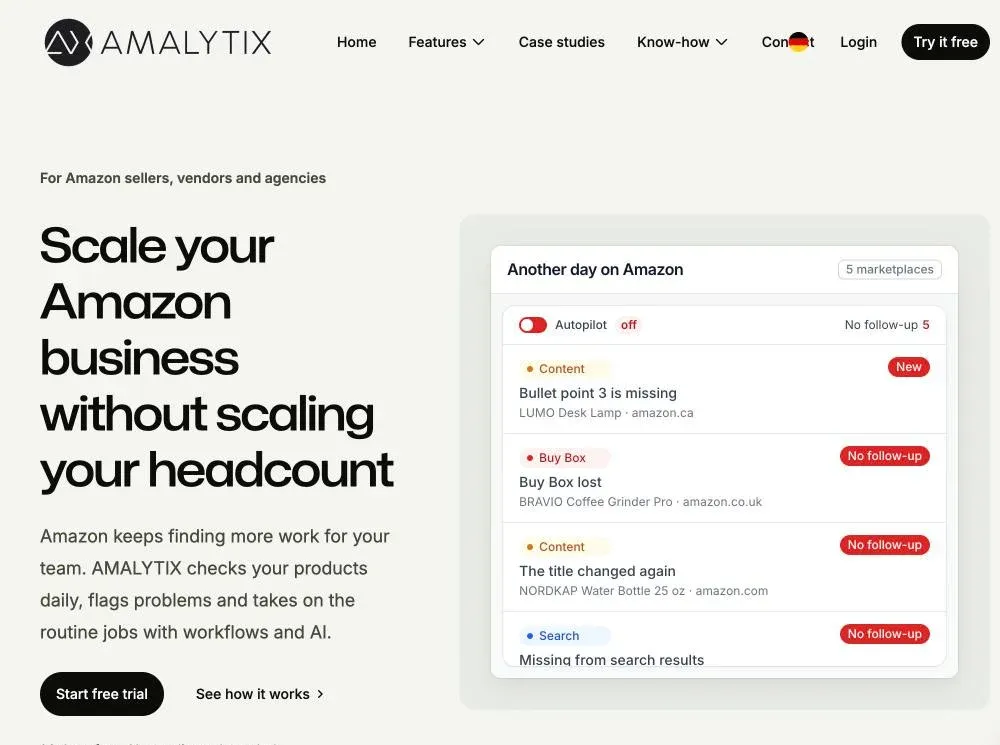
AMALYTIX is a German analytics tool for Amazon sellers and vendors. Its alerts cover 67 types across seven areas: Buy Box and prices, content, availability, reviews, keywords and badges, inventory and orders, and account, deals and ads. Rules can be filtered by brand, tag, product list or marketplace.
Each product is checked once a day, and alerts arrive each morning. AMALYTIX says plainly that it isn't continuous live monitoring.
Ideal For
AMALYTIX fits sellers who prefer a daily digest:
- Vendors who need alerts on Vendor Central data
- European sellers across several marketplaces
- Teams that work in Slack or Microsoft Teams
- Brands that want rule-based alerts by product group
Top Features
Rules decide who hears what:
- 67 alert types, including a Chinese-seller detection alert
- Delivery to the app, email, Slack or Teams
- Rules filtered by brand, tag or product list
- Sales and seller feedback dashboards
Why They Stand Out?
AMALYTIX is one of the strongest choices for vendors, a group most monitors here don't serve. The 67 alert types are the widest list we found.
A once-a-day morning digest also keeps alert noise down for teams that don't need hourly checks.
Pros
- 67 alert types for sellers and vendors
- Slack and Microsoft Teams delivery
- 14-day trial with no card
- Rules by brand, tag and product list
Cons
- Checks once a day only
- One seller account per AMALYTIX account
- Extended Buy Box monitoring starts on Large
- Vendor plans cost more than seller plans
Pricing
Seller plans start at Medium, $89/mo for 500 products, then Large at $179/mo for 1,500 and Extra-Large at $299/mo for 5,000, with 17% off yearly. Vendor plans are priced separately.
Final Verdict
AMALYTIX suits vendors and sellers who want a broad, rule-based daily alert digest. If you need to know about a hijacker within hours, its once-a-day check is too slow.
8. DataHawk
Overview
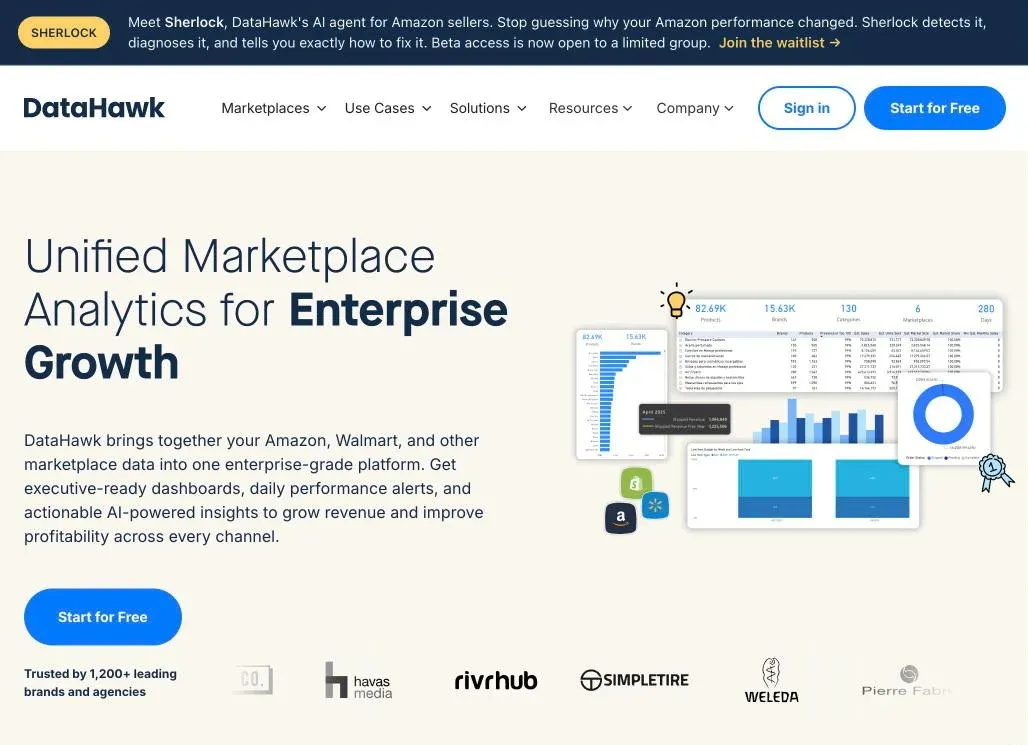
DataHawk is an analytics tool for large Amazon and Walmart brands, and Alerts is one of its modules. You set preset or custom triggers on listing details (title, description, bullets, A+ content, images, videos), reviews and ratings, and Buy Box and pricing (BSR, number of sellers, Buy Box owner, availability). Recipient groups route each alert to the right team.
DataHawk checks each product once a day, usually between midnight and 6 a.m. UTC. A separate module, Sherlock, diagnoses why performance changed.
Ideal For
DataHawk fits larger brands:
- Brands doing high Amazon sales that want one analytics account
- Teams that route alerts to SEO, pricing and brand-protection staff
- Brands selling on Amazon and Walmart
- Analysts who want data in BI tools or an AI assistant
Top Features
Alerts feed a wider analytics stack:
- Custom triggers with operators
- Recipient groups by team
- Sherlock root-cause diagnosis
- MCP and BI connections
Why They Stand Out?
DataHawk is one of the strongest choices for brands that want alerts tied to sales and keyword data. Sherlock's diagnosis gets closer to "why" than most monitors do.
Recipient groups help large teams where content, pricing and brand protection sit with different people.
Pros
- Custom triggers across listing, review and Buy Box data
- Root-cause diagnosis with Sherlock
- Amazon and Walmart in one workspace
- MCP connection for AI assistants
Cons
- No public pricing; custom annual contracts
- Daily checks only
- Demo-led onboarding
- More than a small seller needs
Pricing
DataHawk sells custom annual plans based on sales volume and the number of products, keywords and categories tracked. Contact sales for a quote.
Final Verdict
DataHawk suits large brands that want monitoring inside a full analytics stack. Small sellers will find the contract and setup heavy for listing alerts.
9. sellerboard
Overview
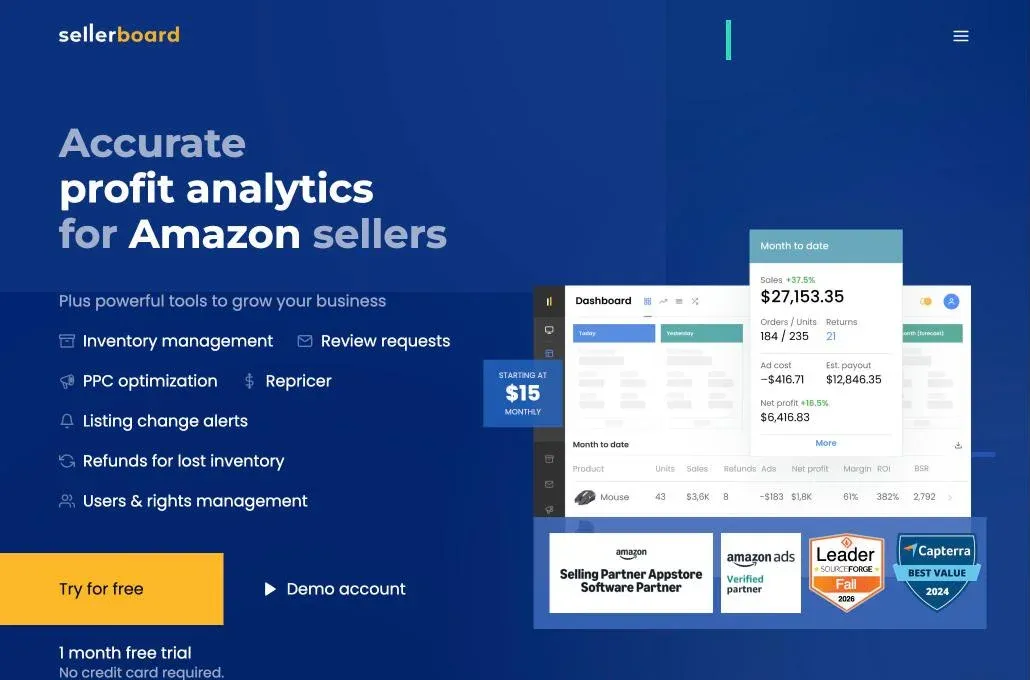
sellerboard is a profit analytics tool for Amazon sellers, with listing alerts included. It watches for changes to the listing name, description, main image and category, new parent or child ASINs, changes in the number of sellers, Buy Box losses, and changes to FBA fees and product dimensions.
Alerts arrive by email or in the dashboard, and you choose which types you want under Settings.
Ideal For
sellerboard fits sellers who want profit data first:
- FBA sellers tracking profit per product
- Sellers who want fee and dimension change alerts
- Small sellers who want basic listing alerts cheaply
- Sellers already using sellerboard for reimbursements
Top Features
Alerts sit inside a profit dashboard:
- Listing change alerts on title, description, main image and category
- Seller-count and Buy Box alerts
- FBA fee and dimension change alerts
- Low inventory alerts
Why They Stand Out?
sellerboard is one of the smartest choices for sellers who need profit tracking and want basic monitoring included. Fee and dimension alerts catch overcharges that public-data monitors can't see.
At $19 a month, it costs less than most dedicated monitors.
Pros
- Listing alerts included in a $19/mo profit tool
- FBA fee and dimension change alerts
- Variation family change alerts
- Free trial
Cons
- Fewer listing alert types than dedicated monitors
- No bullet or keyword alerts listed
- Plans scale by orders
- The trial requires a credit card, per RevenueGeeks
Pricing
Standard is $19/mo ($15/mo annual) for 3,000 orders, Professional $29/mo, Business $39/mo and Enterprise $79/mo for 50,000 orders.
Final Verdict
sellerboard suits sellers who mainly want profit data and are happy with basic listing alerts on top. Brands with real hijacker or content risk need a dedicated monitor as well.
10. Keepa
Overview
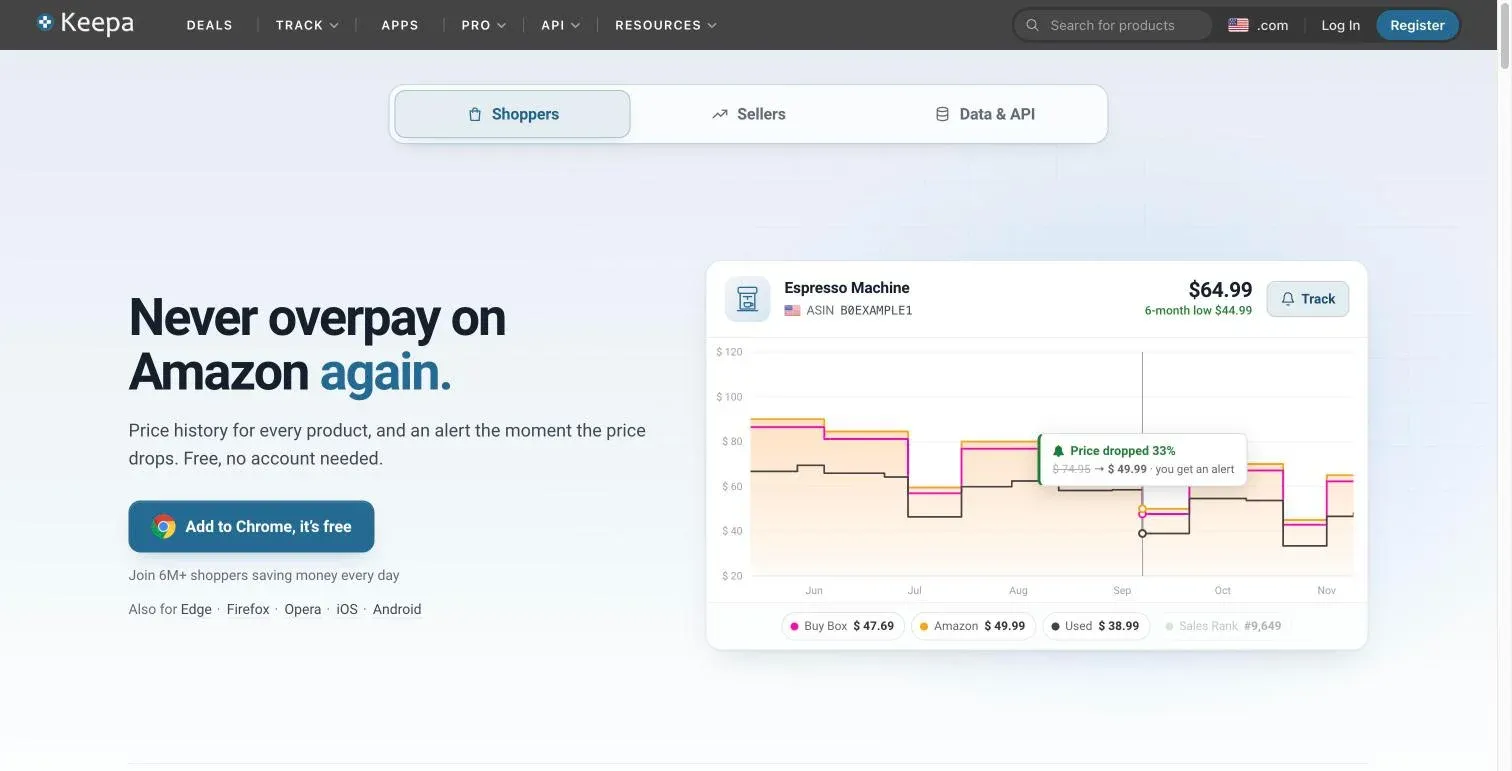
Keepa is the best-known Amazon price history tracker. Its free browser extension charts price history on every product page and sends price-drop and availability alerts. Keepa Pro adds Sales Rank history, Buy Box statistics, stock data and bulk research tools.
Keepa raised Pro from €19 to €29 a month in March 2026.
Ideal For
Keepa fits sellers who watch prices:
- Resellers and arbitrage sellers sourcing products
- Brands watching a competitor's price and stock
- Sellers checking Buy Box history before entering a listing
- Developers who want price data through an API
Top Features
Keepa tracks the numbers behind a listing:
- Price history charts for Amazon, Buy Box and third-party offers
- Free price-drop and availability alerts
- Sales Rank and Buy Box history on Pro
- API from about €49/mo
Why They Stand Out?
Keepa is one of the most useful free tools for price and stock monitoring. Its history goes back years on most products, which helps when you need to show when a price or Buy Box pattern changed.
It covers 11 Amazon marketplaces, and the free alerts need no subscription.
Pros
- Free price and availability alerts
- Long price history
- Sales Rank and Buy Box data on Pro
- API access
Cons
- Alerts focus on price and stock, not content edits or hijackers
- No free trial on Pro
- No refunds on subscriptions
- 2026 price rise to €29/mo
Pricing
The extension and alerts are free. Keepa Pro is €29/mo or €290/yr. The API is a separate product from about €49/mo.
Final Verdict
Keepa suits sellers who need price, stock and Buy Box history. It won't tell you that your title or images changed, so brands need a listing monitor alongside it.
How to Choose the Best Amazon Listing Monitoring Tool
Every tool here sends alerts, so the best Amazon listing monitoring tool for you is the one whose alerts end in a better listing. Run the same five ASINs through each tool you test, including one with a known problem and one you change on purpose, and see what each tool tells you to do next.
1. Make Sure an Alert Leads to a Fix
An alert that says "title changed" leaves you to work out whether the new title is a problem, and which field to restore or rewrite. That gap is where most of the time goes after an alert, and most monitors stop before it.
Ask each tool what it shows after the alert. Amazon SEO Ranking's Amazon listing quality checker names the failed criteria on any ASIN, lists the fixes worth the most points and rewrites the copy in the same account. For copy you've drafted yourself, the free checker for Amazon listing requirements and character limits shows exactly where Amazon cuts a title or bullet, with no account needed.
2. Check That You Can See Why a Score Changed
Several tools give listings a score, but few publish how it's calculated. If a score drops from 72 to 64 and you can't see which rule caused it, you can't fix it, and you can't explain it to a client or a manager.
Look for a published method and a per-criterion breakdown. Amazon SEO Ranking publishes all 12 criteria and their pass rules, and marks a criterion it can't confirm as "Not verified" instead of failing it, so an unreliable Prime flag doesn't cost points or trigger a false alarm.
3. Ask Whether It Catches Claims and Contradictions
Some of the costliest listing problems are inside the copy: a health claim Amazon restricts, a "20 packets" bullet on an 8-count box, or a care instruction that contradicts the spec table. They lead to suppression, "not as described" returns and one-star reviews, and a change alert won't flag them.
Check whether the tool reads the copy against the product's facts. Amazon SEO Ranking runs consistency checks on every audit, with no AI call, for pack counts that disagree across the title, bullets, description and spec table, and for health or product claims the spec table or your brand fact sheet doesn't back. On the Hydro Flask, that's how "BPA-free" was flagged.
4. Score Every Storefront You Sell In
A listing that's healthy on amazon.com can be weak on amazon.de or amazon.co.jp, because each storefront has its own copy, images, ratings and Prime status. Monitoring only the home marketplace hides the others.
List every storefront you sell in and check that each gets its own score. Amazon SEO Ranking audits listings in 23 Amazon storefronts and writes rewrites in each storefront's language. For change alerts, SellerSonar covers 23 marketplaces, AmzMonitor 18 and Keepa 11.
5. Check Copy Before It Goes Live
The cheapest listing problem to fix is the one you never publish. Most monitors only see a listing after it's live, so a bad edit costs sales before the alert arrives.
Look for a way to score new copy first. Amazon SEO Ranking's draft audit scores pasted copy against the live listing's images, rating and Prime status and shows the before-and-after score, and every AI rewrite is checked for Amazon's limits and restricted claims before you see it.
6. Cover Hijackers and the Buy Box at the Right Speed
Hijackers and Buy Box losses cost money by the hour, so they need a change-alert tool that checks often. SellerSonar checks every 4 hours on Pro and hourly on Business, AmzMonitor lets you pick 2 to 24 hours with fewer ASINs at faster settings, and AMALYTIX and DataHawk check once a day. Amazon SEO Ranking doesn't cover this job.
Decide how the tool should collect data. Public-data monitors such as SellerSonar and AmzMonitor start in minutes and work on any ASIN, which suits agencies without client logins. Connected tools such as AMALYTIX, FeedbackWhiz and sellerboard add fee, inventory and account-health alerts. Check that alerts reach a channel your team reads (Slack on SellerSonar and AMALYTIX, Teams on AMALYTIX), and turn off alert types nobody will act on.
7. Price the Whole Job, Then Test
Compare what you'll pay for monitoring plus fixing, not alerts alone. A $24 alert tool still leaves someone to audit and rewrite each changed listing by hand; Amazon SEO Ranking's Pro plan includes 100 audits and the AI rewrite for $79. Also check that the vendor is still active: AMZAlert, once a common pick, went offline in 2025 without a shutdown notice, according to RevenueGeeks.
For many brands, the best setup is two tools: a change-alert monitor for hijackers and the Buy Box, and Amazon SEO Ranking to find what's wrong and fix it. Its monthly plans start with a 7-day free trial, and if you also track keyword positions, our roundup of the best Amazon rank tracker tools compares ten of them.
Everything You Need to Know About Amazon Listing Monitoring Software
Ratings are our judgment for listing monitoring, based on the published features and prices above. "Alert coverage" rates the range of changes a tool watches (sellers, Buy Box, content, price, reviews). "Listing quality checks" rates how well a tool tells you whether the listing meets Amazon's rules and what to fix.
| Company | Pros | Cons | Ease of Use | Integrations | Support | Affordability | Alert Coverage | Listing Quality Checks |
|---|---|---|---|---|---|---|---|---|
| Amazon SEO Ranking | Published score; catches rule breaks; audit and rewrite | No hijacker or Buy Box alerts; 5 or 25 alerted listings; no account data | ⭐⭐⭐⭐⭐ | ⭐⭐⭐⭐ | ⭐⭐⭐⭐ | ⭐⭐⭐⭐ | ⭐⭐ | ⭐⭐⭐⭐⭐ |
| Helium 10 | Screenshots; suite; 200 ASINs on Diamond | 5 ASINs on Platinum; $129/mo; fewer alert types | ⭐⭐⭐ | ⭐⭐⭐⭐⭐ | ⭐⭐⭐⭐ | ⭐⭐ | ⭐⭐⭐ | ⭐⭐⭐ |
| SellerSonar | 40+ alerts; hijacker check on Pro; Slack | Buy Box Lost/Won on Premium; 4-hour Pro checks; few reviews | ⭐⭐⭐⭐ | ⭐⭐⭐⭐ | ⭐⭐⭐ | ⭐⭐⭐⭐⭐ | ⭐⭐⭐⭐⭐ | ⭐⭐ |
| AmzMonitor | $12 entry; MAP alerts; no-card trial | Email only; 20 ASINs on entry; limits shrink with speed | ⭐⭐⭐⭐ | ⭐⭐ | ⭐⭐⭐ | ⭐⭐⭐⭐⭐ | ⭐⭐⭐⭐ | ⭐ |
| SellerPulse | All SKUs; adult-flag alerts; FBA data | From $89/mo; order-based pricing; no quality score | ⭐⭐⭐⭐ | ⭐⭐⭐ | ⭐⭐⭐⭐ | ⭐⭐⭐ | ⭐⭐⭐⭐ | ⭐⭐ |
| FeedbackWhiz Alerts | Account health; 10,000 products; Walmart | $69 for 100 listings; costly brand plans; bundle | ⭐⭐⭐⭐ | ⭐⭐⭐⭐ | ⭐⭐⭐⭐ | ⭐⭐ | ⭐⭐⭐⭐ | ⭐⭐ |
| AMALYTIX | 67 alert types; vendors; Teams and Slack | Daily checks; one seller account; Buy Box extras on Large | ⭐⭐⭐ | ⭐⭐⭐⭐ | ⭐⭐⭐⭐ | ⭐⭐⭐ | ⭐⭐⭐⭐⭐ | ⭐⭐ |
| DataHawk | Custom triggers; Sherlock; Walmart | No public price; daily checks; heavy setup | ⭐⭐ | ⭐⭐⭐⭐⭐ | ⭐⭐⭐⭐ | ⭐ | ⭐⭐⭐⭐ | ⭐⭐⭐ |
| sellerboard | Cheap; fee alerts; profit data | Few content alerts; no bullet alerts; card for trial | ⭐⭐⭐⭐ | ⭐⭐⭐ | ⭐⭐⭐ | ⭐⭐⭐⭐⭐ | ⭐⭐ | ⭐ |
| Keepa | Free alerts; long history; API | Price and stock only; no Pro trial; no refunds | ⭐⭐⭐⭐ | ⭐⭐⭐ | ⭐⭐ | ⭐⭐⭐⭐⭐ | ⭐⭐ | ⭐ |
Catch and Fix Listing Problems with Amazon SEO Ranking
If a listing has slipped, an alert is only the start. Amazon SEO Ranking audits the live page against 12 published criteria, names what failed in each storefront, and rewrites the copy so it fits Amazon's limits, checked for claims and pack counts before you paste. Score history and alerts then show you when a listing moves again. The Hydro Flask audit above took about 20 seconds.
It's trusted by eRetail Search specialists at Nestlé and eCommerce SEO services agencies such as Reach AI. Start a 7-day free trial of Pro for 100 audits, unlimited score history and AI rewrites; you can cancel anytime, and every charge has a 14-day money-back guarantee.
Want to see your listing's score first? Run a free Amazon listing audit with no credit card required.
FAQ
What is the best Amazon listing monitoring tool in 2026?
The best Amazon listing monitoring tool in 2026 for sellers who want to fix what slipped is Amazon SEO Ranking, because it tracks each listing's score against 12 published criteria, emails you when it changes, and rewrites the fields that fail. For hijacker, Buy Box and content-change alerts, SellerSonar covers 150 ASINs for $23.98 a month and AmzMonitor starts at $12 a month. SellerPulse suits FBA brands that want every SKU monitored from $89 a month.
What should I look for in an Amazon listing monitoring tool?
In an Amazon listing monitoring tool, look first at whether an alert leads to a fix: the failed rule named, the fixes ranked and the copy rewritten. Check that the score's method is published, that the tool catches claims and pack counts that contradict the product, and that it scores every storefront you sell in. For hijackers and the Buy Box, add a change-alert tool that checks every few hours, since daily checks are only enough for content and quality.
How does Amazon SEO Ranking differ from similar alternatives?
Amazon SEO Ranking differs from similar alternatives by monitoring listing quality against 12 published criteria instead of watching sellers, prices and the Buy Box. Its audit finds problems that aren't edits, such as a title that broke Amazon's 75-character rule, its score alerts show when a listing's quality moves, and the same account rewrites the listing. SellerSonar, AmzMonitor and SellerPulse send hijacker and Buy Box alerts, which Amazon SEO Ranking doesn't. Pro is $79/mo against Helium 10 Platinum at $129/mo, and Agency is $249/mo against Diamond at $359/mo.
How do I get started with Amazon SEO Ranking?
You get started with Amazon SEO Ranking by creating a free account and running a free audit on your ASIN, which needs no credit card. The free plan keeps score history for 1 listing and includes 3 audits a month. To set score-change alerts, start the 7-day free trial of monthly Pro, which covers alerts on 5 listings and unlimited score history. Agency raises alerts to 25 listings.
How easy is it to switch to Amazon SEO Ranking?
Switching to Amazon SEO Ranking is easy because there's nothing to migrate or connect: every audit reads the public product page from the ASIN. Enter the ASINs you monitor today, audit each one to set a baseline, and turn on alerts for the ones that matter most. Many brands keep their change-alert tool for hijackers and add Amazon SEO Ranking for listing quality. Monthly plans start with a 7-day free trial, so you can test it before cancelling anything.
Does Amazon SEO Ranking send hijacker or Buy Box alerts?
Amazon SEO Ranking doesn't send hijacker, new-seller, Buy Box, price or review alerts. Its alerts fire when a tracked listing's audit score changes, on 5 listings with Pro and 25 with Agency, and the audit shows which of the 12 criteria moved. Brands that need hijacker and Buy Box alerts should pair it with SellerSonar, AmzMonitor or SellerPulse. Once a hijacker is removed, its audit and claim checks show whether their edits left problems in the title, bullets or attributes.
How do I know if someone changed my Amazon listing?
You know if someone changed your Amazon listing by comparing the live page against a saved copy, either by hand or with a monitoring tool that alerts you on edits. Tools such as SellerSonar, AmzMonitor, SellerPulse and Helium 10 email you when the title, bullets, images, brand or category change, and Helium 10 adds before-and-after screenshots. Seller Central's Manage All Inventory page also shows suppressed listings and their reasons. Amazon SEO Ranking's score history shows when a listing's score moved, and its audit names the criterion behind it.
Is there a free Amazon listing monitoring tool?
There are free Amazon listing monitoring tools, but each one is limited. Keepa's free extension sends price-drop and availability alerts, SellerSonar's free tier monitors 5 ASINs and 10 keywords, and Helium 10's free plan includes a small Alerts allowance. AmzMonitor offers a 14-day trial with no card. Amazon SEO Ranking's free plan includes 3 full listing audits a month and score history for 1 listing, with no credit card.
How often should an Amazon listing monitoring tool check my listings?
An Amazon listing monitoring tool should check every few hours for hijackers and Buy Box changes, and once a day is enough for content and listing quality. SellerSonar checks every 4 hours on Pro and hourly on Business, AmzMonitor lets you choose from 2 to 24 hours, and AMALYTIX and DataHawk check once a day. Faster checks usually cost more or cover fewer ASINs, so match the speed to the risk.
Score your live listing against 12 published criteria and see which fields to fix first. Free audit, 3 a month, no card required.
Run free audit