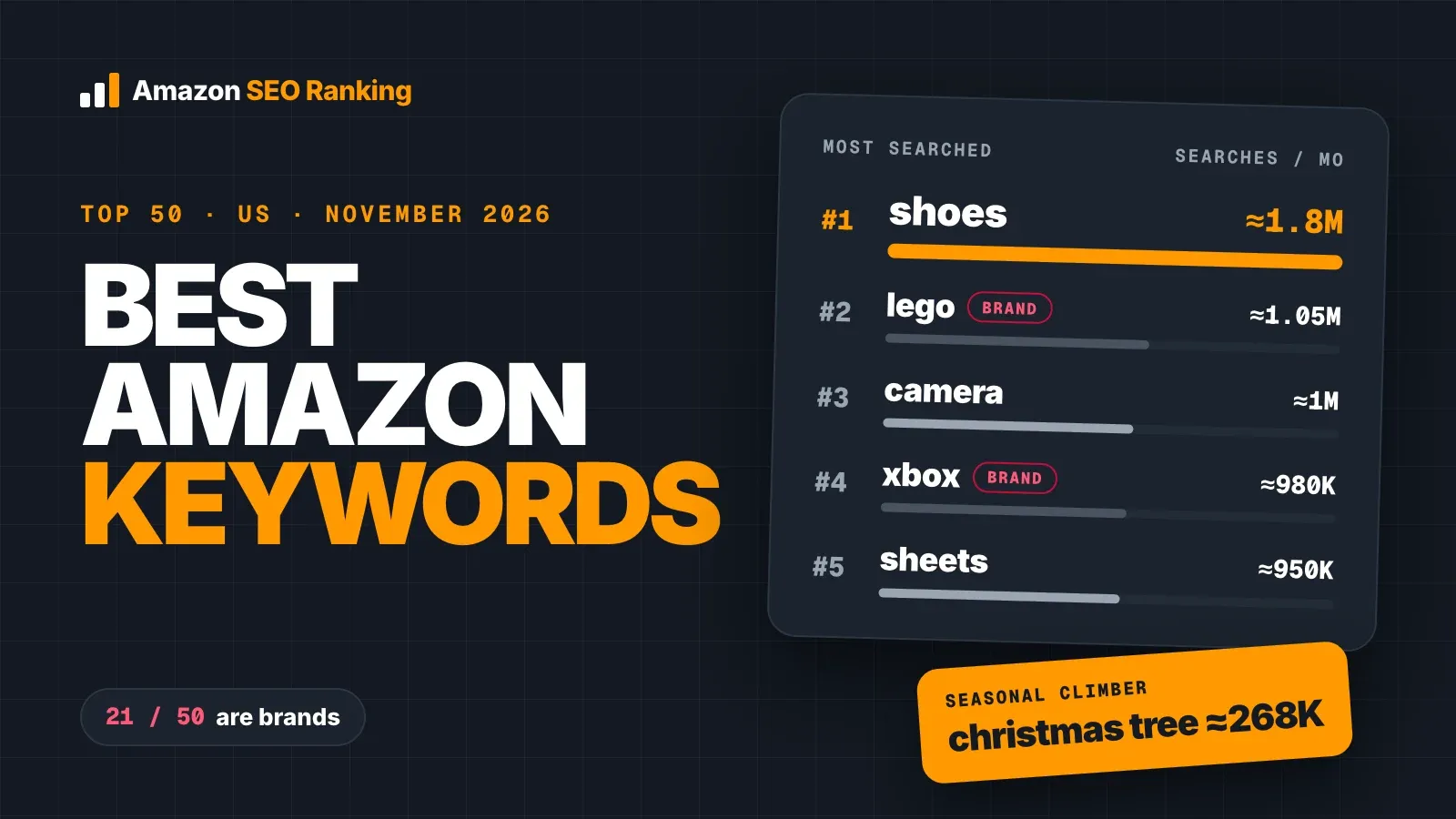
These are the best Amazon keywords by shopper demand. The most searched keywords on Amazon in the US right now are "shoes" (about 1.8 million estimated monthly searches), "lego" (about 1.05 million), "camera", "xbox" and "sheets" (each around 950,000 to 1 million). That's from 236 high-demand search terms we ran through Amazon SEO Ranking's Search volume tool on 9 November 2026. The full top 50 is below, along with category leaders, this month's seasonal climbers and a UK comparison.
Those head terms are a map of where shopper demand sits. They're rarely the best Amazon keywords for your own listing. Of the top 50, 21 are another company's brand or product line, and most of the rest are one-word searches that millions of listings compete for. The keywords that earn a place in a title are usually the longer, more specific phrases that sit underneath these head terms, and this guide shows how to find them in your niche.
We'll refresh the numbers every month, so the list tracks Amazon keyword search trends as the seasons change.
Key Takeaways (TL;DR)
- Top keywords on Amazon (US, November 2026): shoes, lego, camera, xbox, sheets, laptop, dresses, water, roku and crocs lead our list of product searches.
- Brands take a big share: 21 of the top 50 are brand or product-line names (Lego, Kindle, iPhone, Ugg, Yeti). Amazon tells sellers not to put other brands' names in their search terms.
- Specific beats generic more often than you'd expect: "magnesium glycinate" gets about twice the searches of "magnesium", and "nintendo switch 2" now outranks "nintendo switch".
- November is a seasonal month: "christmas tree" (≈268,000), "black friday deals" (≈178,000) and "stocking stuffers" (≈144,000) are up there with year-round staples.
- Words change by country: UK shoppers search "trainers" almost three times as often as "sneakers", and "jumper" six times as often as "sweater".
- How to use it: start from the head term in your category, find the specific phrases under it with real volume, and place them within Amazon's field limits.
Best Amazon Keywords: at a Glance
All figures are estimated monthly US searches on Amazon unless marked, pulled from Amazon SEO Ranking's Search volume tool on 9 November 2026.
| Insight | What the data shows | What it means for a listing |
|---|---|---|
| Most searched product keyword | "shoes" at ≈1,802,530 | Head terms show demand, but one-word searches are the hardest to rank for |
| Brand share of the top 50 | 21 of 50 are brand or product-line names | High volume you can't use unless you are that brand |
| Specific vs generic | "magnesium glycinate" ≈325,716 vs "magnesium" ≈167,439 | Check the specific version of your product name before assuming the short one wins |
| Newest model vs old | "nintendo switch 2" ≈246,391 vs "nintendo switch" ≈203,082 | Model and version words belong early in the title |
| Seasonal pull | "christmas tree" ≈268,382, "prime day deals" ≈5,161 | Event keywords swing by month; plan seasonal copy ahead |
| Long tail | 12 longer "space heater" phrases add ≈15,590 searches to the head term's ≈54,379 | Long-tail phrases are easier to win and often fit in bullets |
| Country differences | UK: "trainers" ≈22,402 vs "sneakers" ≈8,340 | Research each storefront in its own words |
How We Ranked the Most Searched Keywords on Amazon
We built a seed list of 236 head terms covering every large Amazon category: electronics, home and kitchen, fashion, health, pets, toys, baby, office and seasonal searches. We added the terms that show up most often on public top-search lists, so nothing obvious was missing. Then we ran all of them through Amazon SEO Ranking's Amazon keyword search volume tool for the US marketplace on 9 November 2026.
The figures are estimates of monthly Amazon searches, not exact counts. That applies to any list of the most searched keywords: Amazon doesn't publish search volumes, so every tool models them. Ours come from DataForSEO's Amazon data, and lower volumes are reported in steps, which is why some long-tail phrases share the same number. Compare keywords inside one tool rather than across tools, since each data provider models volume differently.
Three kinds of search were left out of the ranking because they aren't product searches:
- searches for Amazon itself ("amazon" at ≈86.2 million, "prime video" at ≈4.5 million);
- bare company names such as "apple" (≈2.8 million), "nike" (≈1.6 million) and "samsung" (≈590,000);
- words that aren't products, such as "free", "women" and "men".
Brand product lines such as Lego, Kindle and Crocs stay in, because shoppers type them to find a type of product. We publish the method for the same reason we publish the 12 criteria behind our listing audit: you should be able to see how a number was built before you act on it.
One limit to keep in mind: this ranks the terms we checked, so a high-volume keyword outside our seed list won't appear. That's also why we refresh the list monthly and add new terms as they surface.
The 50 Most Searched Keywords on Amazon (US)
These are the amazon most searched keywords from our November 2026 check, ranked by estimated monthly US searches. "Brand" marks searches for one company's product.
| # | Keyword | Est. monthly searches | Category | Brand? |
|---|---|---|---|---|
| 1 | shoes | ≈1,802,530 | Fashion | No |
| 2 | lego | ≈1,053,932 | Toys | Yes |
| 3 | camera | ≈1,016,345 | Electronics | No |
| 4 | xbox | ≈1,014,101 | Electronics | Yes |
| 5 | sheets | ≈949,137 | Home | No |
| 6 | laptop | ≈740,781 | Electronics | No |
| 7 | dresses | ≈701,025 | Fashion | No |
| 8 | water | ≈699,230 | Grocery | No |
| 9 | roku | ≈673,013 | Electronics | Yes |
| 10 | crocs | ≈658,090 | Fashion | Yes |
| 11 | printer | ≈589,648 | Electronics | No |
| 12 | needoh | ≈553,520 | Toys | Yes |
| 13 | coffee | ≈548,620 | Grocery | No |
| 14 | gift card | ≈543,085 | Gift cards | No |
| 15 | iphone 17 | ≈536,016 | Electronics | Yes |
| 16 | kindle | ≈510,547 | Electronics | Yes |
| 17 | iphone 17 pro max | ≈496,298 | Electronics | Yes |
| 18 | ipad | ≈489,079 | Electronics | Yes |
| 19 | tv | ≈445,583 | Electronics | No |
| 20 | iphone | ≈410,352 | Electronics | Yes |
| 21 | pokemon cards | ≈399,058 | Toys | Yes |
| 22 | ugg | ≈390,493 | Fashion | Yes |
| 23 | blender | ≈387,725 | Kitchen | No |
| 24 | gaming pc | ≈373,551 | Electronics | No |
| 25 | cat food | ≈364,799 | Pets | No |
| 26 | toilet paper | ≈353,691 | Household | No |
| 27 | yeti | ≈345,276 | Kitchen | Yes |
| 28 | apple watch | ≈329,494 | Electronics | Yes |
| 29 | magnesium glycinate | ≈325,716 | Health | No |
| 30 | paper towels | ≈302,491 | Household | No |
| 31 | wallet | ≈297,741 | Fashion | No |
| 32 | ps5 | ≈294,637 | Electronics | Yes |
| 33 | jewelry | ≈287,942 | Fashion | No |
| 34 | books | ≈281,435 | Books | No |
| 35 | dog toys | ≈276,273 | Pets | No |
| 36 | christmas tree | ≈268,382 | Seasonal | No |
| 37 | headphones | ≈259,481 | Electronics | No |
| 38 | dog food | ≈256,227 | Pets | No |
| 39 | gift cards | ≈250,542 | Gift cards | No |
| 40 | nintendo switch 2 | ≈246,391 | Electronics | Yes |
| 41 | earrings | ≈243,361 | Fashion | No |
| 42 | owala | ≈241,491 | Kitchen | Yes |
| 43 | pool | ≈240,482 | Outdoor | No |
| 44 | phone | ≈235,732 | Electronics | No |
| 45 | monitor | ≈233,675 | Electronics | No |
| 46 | stanley | ≈229,823 | Kitchen | Yes |
| 47 | keurig | ≈221,408 | Kitchen | Yes |
| 48 | fitbit | ≈217,817 | Electronics | Yes |
| 49 | mattress | ≈215,424 | Home | No |
| 50 | amazon gift card | ≈213,965 | Gift cards | Yes |
Electronics is the biggest group, with 19 of the 50. Fashion has 7, and everyday household buys (toilet paper, paper towels, water, coffee) take 4 spots, which shows how much routine restocking happens through Amazon search.
A few entries surprise people. "Needoh", a squishy fidget toy, sits at #12 with more searches than "kindle". And "gift card" and "gift cards" both make the list, with the singular getting more than twice the searches of the plural, which is worth knowing before you choose which form goes in a title.
Top Amazon Search Terms by Category
The overall list is dominated by electronics and brands. If you sell in another category, the top search terms on Amazon in your own aisle matter more than the top 50. Here are the leaders we found in six categories.
Electronics
| Keyword | Est. monthly searches |
|---|---|
| camera | ≈1,016,345 |
| xbox | ≈1,014,101 |
| laptop | ≈740,781 |
| roku | ≈673,013 |
| printer | ≈589,648 |
| tv | ≈445,583 |
| gaming pc | ≈373,551 |
| headphones | ≈259,481 |
Electronics searches split between brand names (Xbox, Roku, iPhone, Kindle) and plain product types. For third-party sellers, the product-type terms are where the opening is: "headphones" (≈259,481) gets about 3.7 times the searches of "earbuds" (≈70,237), and accessory searches such as "iphone 17 pro max case" (≈67,394) and "hdmi cable" (≈68,329) carry real volume for small brands.
Model numbers move fast here. "iphone 17" (≈536,016) has already passed plain "iphone" (≈410,352) and "iphone 16" (≈196,424), so case and charger sellers who still lead with last year's model are writing for a shrinking search.
Home and Kitchen
| Keyword | Est. monthly searches |
|---|---|
| sheets | ≈949,137 |
| blender | ≈387,725 |
| toilet paper | ≈353,691 |
| paper towels | ≈302,491 |
| keurig | ≈221,408 |
| mattress | ≈215,424 |
| microwave | ≈206,859 |
| air fryer | ≈205,176 |
"Sheets" is the fifth most searched term on our whole list. Kitchen appliances follow closely, and "air fryer" (≈205,176), "coffee maker" (≈172,713) and "mini fridge" (≈138,043) all have six-figure demand.
Cold-weather products are rising with the season. "Space heater" sits at ≈54,379 and "electric blanket" at ≈40,092 this month.
Health and Supplements
| Keyword | Est. monthly searches |
|---|---|
| magnesium glycinate | ≈325,716 |
| creatine | ≈200,501 |
| magnesium | ≈167,439 |
| blood pressure monitor | ≈164,111 |
| glp 1 | ≈162,241 |
| berberine | ≈150,123 |
| protein powder | ≈148,029 |
| ashwagandha | ≈116,688 |
Supplements are one of the busiest categories for amazon top keyword searches. Six of the eight leaders are supplements (magnesium glycinate, creatine, magnesium, berberine, protein powder and ashwagandha), and every one of them is searched by name rather than by benefit.
These are also the listings where keyword choices get sellers into trouble. A product sold to "glp 1" or "berberine" shoppers can't claim weight loss or other health outcomes in its copy, and health claims are one of the policy risks that get listings suppressed. Amazon SEO Ranking's audit and every AI rewrite flag health claims ("detox", "weight loss", "meal replacement") before you paste anything into Seller Central.
Fashion and Shoes
| Keyword | Est. monthly searches |
|---|---|
| shoes | ≈1,802,530 |
| dresses | ≈701,025 |
| crocs | ≈658,090 |
| ugg | ≈390,493 |
| wallet | ≈297,741 |
| jewelry | ≈287,942 |
| earrings | ≈243,361 |
| sunglasses | ≈213,479 |
"Shoes" tops the whole list, yet adding a word cuts the volume sharply: "womens shoes" gets ≈117,772 searches and "mens shoes" ≈83,402. Shoppers type the broad word first and narrow down with Amazon's filters.
Seasonal footwear is strong in November. "Ugg" (≈390,493), "boots" (≈166,916) and "slippers" (≈91,929) are all well above the summer favourite "hey dude" (≈65,076).
Pets
| Keyword | Est. monthly searches |
|---|---|
| cat food | ≈364,799 |
| dog toys | ≈276,273 |
| dog food | ≈256,227 |
| cat litter | ≈137,370 |
| cat tree | ≈55,688 |
| dog bed | ≈53,594 |
Cat food out-searches dog food on Amazon, by about 42%. Consumables lead the category, which fits a repeat-purchase pattern similar to toilet paper and paper towels.
"Dog toys" is the exception, at ≈276,273. None of the pet head terms we checked is a brand name, which means the words in your title and bullets carry more weight here than in toys or electronics.
Toys and Collectibles
| Keyword | Est. monthly searches |
|---|---|
| lego | ≈1,053,932 |
| needoh | ≈553,520 |
| pokemon cards | ≈399,058 |
| toys | ≈183,746 |
| labubu | ≈157,042 |
Every leader here except "toys" is a brand. Lego, Needoh, Pokémon and Labubu together add up to about 2.16 million monthly searches, more than ten times the generic "toys".
That makes toys a hard category to win on head terms alone. Gift-led phrases are the unbranded alternative, and they're climbing now: "stocking stuffers" (≈144,364) and "advent calendar" (≈63,692).
Amazon Keyword Search Trends for November 2026
Many of the top keyword searches on Amazon change with the calendar. These are the seasonal terms we saw in November, next to one from the summer for contrast.
| Keyword | Est. monthly searches | Season |
|---|---|---|
| christmas tree | ≈268,382 | Holiday |
| christmas decorations | ≈200,127 | Holiday |
| halloween costumes | ≈190,328 | October, still fading |
| black friday deals | ≈177,799 | Black Friday |
| stocking stuffers | ≈144,364 | Holiday |
| christmas lights | ≈117,361 | Holiday |
| advent calendar | ≈63,692 | Holiday |
| gifts for women | ≈63,505 | Holiday |
| gifts for men | ≈62,794 | Holiday |
| prime day deals | ≈5,161 | Summer (off-season) |
"Black friday deals" gets about 34 times the searches of "prime day deals" this month. The same event keywords flip in July, so a keyword list built in one season can mislead you in another.
For sellers, two things follow. Gift-led phrases ("gifts for her" at ≈77,380, "gifts for him" at ≈44,132) belong in bullets and backend terms from late October. And seasonal products need their listing copy ready before the search climbs, since a rewrite and re-index take time you don't have in December. Amazon SEO Ranking's draft audit scores new copy against your live listing's images, rating and Prime status before you paste it into Seller Central, so you can test the seasonal version first.
To follow your own keywords through the year, save them to a list. Saved lists keep a monthly volume snapshot of each keyword, with a trend line over the last 6 months and the change from the previous month, so you see the climb before the season arrives.
What the Top Keywords on Amazon Tell Sellers
Reading a list of the most searched words on Amazon is the easy part. The patterns underneath are what change how you write a listing.
Brand Names Take 21 of the Top 50
Lego, Kindle, iPhone, Yeti, Stanley, Owala and 15 other brand or product-line names make up 42% of the top 50. They look like the biggest opportunities on any keyword list, and they're off limits to everyone except the brand owner.
Amazon's search terms guidance tells sellers not to include brand names, their own or other brands', or other product identifiers in their search terms, and using a rival's name in visible copy invites trademark complaints. Strip brand terms out of any list before you sort it by volume.
If you own the brand, the picture flips: those searches are yours, and the job is making sure your listings win them. Keyword gap (Agency) lines up the rank positions of up to 20 ASINs on the same keywords, so a brand team can see where a rival outranks its own product.
Specific Searches Beat Generic Ones More Often Than You'd Expect
The shortest term isn't always the biggest. "Magnesium glycinate" (≈325,716) gets about twice the searches of "magnesium" (≈167,439). "Nintendo switch 2" (≈246,391) has passed "nintendo switch" (≈203,082), and "gift card" beats "gift cards".
So check the exact form shoppers use before you write. Singular or plural, model number or no model number, ingredient or category: each one can change the volume by half or more.
Long-Tail Phrases Add Up
Every head term has a tail of longer phrases under it. "Space heater" gets ≈54,379 searches. Our Keyword ideas tool found 12 close-match phrases with volume under it, led by "space heaters for indoor use" (≈11,220) and "space heater large room" (≈1,496), adding about 15,590 more searches.
Those longer phrases describe the product better and face fewer competitors. A listing that ranks for ten of them can get more traffic than one stuck on page three for the head term, and they fit naturally into bullets and the backend field.
Different Countries Use Different Words
The best keywords for Amazon in one storefront can be the wrong words in another. We ran the same products through the UK marketplace:
| Product | US keyword (searches) | UK keyword (searches) |
|---|---|---|
| Athletic shoes | sneakers (≈127,908) | trainers (≈22,402) vs sneakers (≈8,340) |
| Knitwear | sweater (≈47,086) | jumper (≈12,342) vs sweater (≈1,870) |
| Toilet tissue | toilet paper (≈353,691) | toilet roll (≈5,236) vs toilet paper (≈5,123) |
| Winter bedding warmer | electric blanket (≈40,092) | electric blanket (≈5,460), hot water bottle (≈6,058) |
A US listing copied to amazon.co.uk with "sneakers" in the title misses most of the searches. Translation tools won't catch this, because "sneakers" is correct English; UK shoppers type it far less often.
The fix is to check the listing where it's sold. Amazon SEO Ranking audits the same ASIN separately in each of 23 Amazon storefronts, so the score and the fixes reflect amazon.co.uk or amazon.de rather than your home marketplace. The AI rewrite then comes back in that marketplace's language (German for amazon.de, French for amazon.fr), in 12 languages in all.
How to Find the Best Keywords for Amazon in Your Niche
The top 50 tells you where demand is. Your own keyword list comes from the head term in your category and the phrases under it. This is the process we'd follow, and our guide to Amazon keyword research covers each step in more depth.
- Start from your category's head term. Find the one- or two-word search that describes your product type, such as "space heater", "dog toys" or "water bottle". Use the category tables above as a starting point.
- Expand it into specific phrases. Run the head term through an Amazon keyword generator that grades ideas by relevance, so off-topic phrases drop out before you look at volume. Ours generates ideas in the US, Saudi Arabia, the UAE and Egypt.
- Remove brand names and claims. Delete every phrase containing another company's brand, and any phrase that would need a health or performance claim you can't support.
- Check volume and competition together. A phrase with 2,000 searches and weak competitors can be worth more than one with 50,000 searches and listings with tens of thousands of reviews. Amazon SEO Ranking scores competition from the top listings' review counts and their Amazon's Choice and Best Seller badges.
- Check every storefront separately. If you sell in the UK or Germany, check search volume for your list in that marketplace's own words (Search volume covers 16 marketplaces), then audit the listing on that storefront rather than assuming the US version works there.
If you're testing before paying, the free Amazon keyword tool shows the first 3 results of each search, up to 30 lookups a month, with no credit card.
Where to Put Top Amazon Keywords in Your Listing
Finding top Amazon keywords only helps once they're in the fields Amazon reads, within its limits. Since July 2026, Amazon caps titles at 75 characters in most categories, which leaves room for the main keyword and one or two modifiers.
| Field | Limit | What goes there |
|---|---|---|
| Title | 75 characters in most categories | Brand, main keyword, one or two high-volume modifiers |
| Item Highlights | 125 characters | The next most important phrases |
| Bullet points | 5 bullets, up to 255 characters each (200 shows in full on mobile) | Secondary and long-tail phrases, written as benefits |
| Description | 2,000 characters | Supporting phrases and synonyms |
| Backend search terms | 249 bytes | Synonyms, spelling variants, other-language terms; no words already in the title or bullets |
Amazon SEO Ranking's AI Copy Rewriter does this placement for you. You choose a target keyword, which goes early in the title, and secondary keywords, which are worked into Item Highlights, bullets and the description. A coverage check shows where each one landed, and the 75-character title and 249-byte backend limits are enforced in code before you see the copy.
The most common mistake we see is repeating the same keyword across the title, bullets and backend. Amazon indexes a word once, so every repeat in the backend wastes bytes you could spend on a synonym. Our free Amazon backend keywords checker shows which backend words already appear in your visible copy.
The second is stuffing the title. A 75-character title with three keyword variants reads badly and can still get trimmed by Amazon. For the rest of the rules, see our page on Amazon listing requirements and character limits, and our guide on how to rank for keywords on Amazon covers what happens after the keywords are in.
Everything You Need to Know About the Best Amazon Keywords
| Topic | Summary |
|---|---|
| Most searched keyword (product) | "shoes", ≈1.8 million estimated monthly US searches |
| Most searched overall | "amazon" itself, ≈86.2 million, followed by "prime video" |
| Biggest category in the top 50 | Electronics, 19 of 50 |
| Brand share of the top 50 | 21 of 50, off limits to non-owners in search terms |
| Biggest seasonal term this month | "christmas tree", ≈268,382 |
| Specific beating generic | "magnesium glycinate" ≈325,716 vs "magnesium" ≈167,439 |
| Long tail example | 12 "space heater" phrases add ≈15,590 searches to the head term |
| Country difference | UK "trainers" ≈22,402 vs "sneakers" ≈8,340 |
| Data source | Amazon SEO Ranking Search volume (DataForSEO estimates), US and UK, 9 November 2026 |
| Volume accuracy | Estimates, not counts; compare keywords inside one tool |
| Where keywords go | Title (75 chars), Item Highlights (125), bullets, description, backend (249 bytes) |
| Refresh | Monthly |
Find Your Best Amazon Keywords with Amazon SEO Ranking
The keywords on this page came from the same tool you can run on your own product. Amazon SEO Ranking checks search volume for up to 1,000 keywords at once in 16 Amazon marketplaces, and grades keyword ideas by relevance in the US and the Middle East. Then it audits your live listing against 12 published criteria in any of 23 storefronts, and the AI Copy Rewriter places your target and secondary keywords, checked for health claims, unsupported claims and Amazon's length limits before you see the copy.
It's built for sellers and agencies improving listings they already have: a solo seller about to update a listing, a brand checking the same product in the US and UK, or an agency building keyword lists for several clients. It's trusted by eRetail Search specialists at Nestlé and eCommerce SEO services agencies such as Reach AI.
Holiday searches are climbing now, and a listing updated in December misses most of them. Run a free listing audit on your ASIN today: 3 full audits a month with AI fixes included, and no credit card required. For full keyword lists, see Pro and Agency pricing; monthly plans start with a 7-day free trial, and every charge has a 14-day money-back guarantee.
FAQ
What are the most searched keywords on Amazon?
The most searched keywords on Amazon in the US are "shoes" (about 1.8 million estimated monthly searches), "lego" (about 1.05 million), "camera", "xbox" and "sheets", based on 236 head terms we checked on 9 November 2026. If you count searches for Amazon itself, "amazon" leads with about 86 million and "prime video" follows with about 4.5 million. Laptop, dresses, water, roku and crocs complete the top 10 product searches. Electronics makes up 19 of the top 50.
What is the number one most searched item on Amazon?
The number one most searched item on Amazon in the US is shoes, with about 1.8 million estimated monthly searches in November 2026. Lego is second at about 1.05 million, followed by cameras and Xbox at a little over 1 million each. Rankings shift with the season and with new launches, such as the iPhone 17 at about 536,000. Different data providers also model volume differently, so the exact order varies between tools.
How do I find the top search terms on Amazon for my product?
To find the top search terms on Amazon for your product, start from your category's head term and expand it into specific phrases with a keyword tool that shows estimated volume. Remove phrases with other brands' names, then compare volume with competition. For example, "space heater" gets about 54,000 searches, and "space heaters for indoor use" adds about 11,000 more while describing the product more precisely. Run the list separately in every marketplace you sell in.
How often do the top Amazon keywords change?
The top Amazon keywords change every month for seasonal searches, while year-round staples such as shoes, laptop and toilet paper stay near the top. In November 2026, "black friday deals" gets about 178,000 searches against about 5,000 for "prime day deals", and the two swap places in July. New product launches also climb fast, as the iPhone 17 did when it passed plain "iphone". We refresh this list monthly for that reason.
What are the best keywords for Amazon listings?
The best keywords for Amazon listings are specific phrases that describe your exact product, have real search volume and don't contain another company's brand. Head terms like "shoes" have the most searches but millions of competing listings. A phrase such as "space heater large room", with about 1,500 searches, is easier to rank for and tells Amazon what the product is. Put the strongest phrase in the 75-character title and the rest in Item Highlights, bullets and backend terms.
Is Amazon search volume data accurate?
Amazon search volume data from third-party tools is an estimate, because Amazon doesn't publish exact search counts. Tools model volume from different sources, so two tools can give the same keyword different numbers. Compare keywords against each other inside one tool rather than across tools. Brand-registered sellers can check a tool against Amazon's own Search Query Performance report for their top queries.
Do the most searched keywords on Amazon differ by country?
The most searched keywords on Amazon differ by country, both in which products lead and in the words shoppers use. In the UK, "trainers" gets about 22,400 searches against about 8,300 for "sneakers", while US shoppers search "sneakers" about 128,000 times a month. UK shoppers also type "jumper" six times as often as "sweater". Research each storefront in its own language and spelling, and audit the listing on that storefront, instead of copying a US keyword list.
Should I target a top keyword if it doesn't match my product?
You shouldn't target a top keyword if it doesn't match your product, because Amazon ranks listings that shoppers click and buy, and irrelevant traffic doesn't convert. A seller of stainless steel bottles who adds "stanley" (about 230,000 searches) also risks a trademark complaint. Lower-volume phrases that describe the product, such as "insulated water bottle" with about 10,000 searches, reach shoppers who want what you sell. Volume is only useful when the shopper searching it would buy your product.
Check your own listing against the keywords that matter in your niche. Free audit, 3 a month, no card required.
Run free audit