The best Amazon listing optimization tool for most sellers whose listings are already live is Amazon SEO Ranking: it scores a listing against 12 published criteria, rewrites what fails from the product's own spec table, and checks the copy before you paste it. If you also need product research, PPC or inventory tools in the same login, Helium 10 and Jungle Scout are the stronger all-in-one picks. If keyword data is your bottleneck, Data Dive and SellerSprite go deeper.
Amazon SEO Ranking is our product, so read our verdict with that in mind. The other nine reviews are based on each vendor's published plans and features as of 2 November 2026, and each one says plainly what that tool does better or what it covers that we don't.
This guide covers what Amazon listing optimization software does, who needs it, ten tools reviewed with prices, a buyer's checklist, and a summary table you can scan in a minute.
Key Takeaways (TL;DR)
- The best overall Amazon listing optimization tool: Amazon SEO Ranking. It publishes how its score works (12 criteria, each worth the same), and every AI rewrite is checked for Amazon's limits, health claims and pack counts that don't match the product.
- Why you need it: since July 27, 2026, Amazon caps most titles at 75 characters and rewrites longer ones itself. Checking that, plus bullets, backend bytes and claims, by hand takes around an hour per listing.
- Who it's for: sellers with listings that are live but not ranking, agencies auditing client catalogs, and brand teams that sell in more than one Amazon storefront.
- How to choose: decide whether you need listing work or a full suite, check whether the tool explains its score, and test it on your own ASIN before paying.
- Expected price: Amazon SEO Ranking is free for 3 audits a month, $79/mo on Pro and $249/mo on Agency. Across the market, listing features cost from $0 (Amazon's own Seller Central tools) to $490/mo (Data Dive's top plan).
Best Amazon Listing Optimization Tools in 2026 at a Glance
Prices are the vendors' published rates on 2 November 2026, month to month unless marked. Annual billing is cheaper on most of them.
| Company | Best For | Key Features | Pricing |
|---|---|---|---|
| Amazon SEO Ranking | Fixing live listings that don't rank | 12-criteria audit with published rules, AI rewrite grounded in the spec table, claim and pack-count checks, draft scoring, 23 storefronts | Free (3 audits/mo), Pro $79/mo, Agency $249/mo |
| Helium 10 | Sellers who want research, listings, ads and ops in one suite | Listing Builder, Listing Analyzer, Cerebro and Magnet keyword tools, Scribbles | Limited free plan, Platinum $129/mo, Diamond $359/mo |
| Jungle Scout | New sellers choosing and launching products | Listing Builder with an optimization score, AI Assist, Keyword Scout | Starter $49/mo, Growth Accelerator $79/mo, Brand Owner + CI $149/mo |
| SellerApp | Brands that want listing quality next to PPC automation | Listing Quality Index, keyword tracking, ads automation, managed services | Freemium, Pro $99/mo, Smart $250/mo after a 3-month intro rate |
| Data Dive | Experienced sellers who treat keywords as a data project | Master Keyword List, AI Copywriter, Rank Radar, API and MCP on higher plans | $39 to $490/mo across three plans |
| ZonGuru | Small catalogs that want AI listings plus light operations | Listing Optimizer 4.0, Keywords on Fire, review and email automation | From $29/mo billed annually, scaling with SKU count |
| SmartScout | Wholesale and brand research with an AI listing writer on the side | AI Listing Architect, Amazon AI Scorecard, brand and seller databases | Basic from $29/mo, Essentials $97/mo, Business $187/mo |
| SellerSprite | Budget keyword research with a free listing builder | Free AI Listing Builder, reverse ASIN on multiple ASINs, 9 marketplaces | Free plan, paid from about $39/mo |
| AMZScout | Product research first, listing drafts second | Listing Quality Score, AI Listing Builder (add-on pack), PRO AI Extension | $59.99/mo or $399.99/yr |
| Amazon Seller Central tools | Any seller who wants a free baseline | Enhance My Listing, AI listing creation from a URL, image or text | Free with a Seller Central account |
What Is Amazon Listing Optimization Software?
Amazon listing optimization software checks and improves the parts of a product detail page that decide whether shoppers find it and buy: the title, Item Highlights, bullet points, description, backend search terms, images and A+ content. The better tools do three jobs. They find the keywords shoppers type, they measure the listing against Amazon's rules and those keywords, and they help you write the fix.
The market splits into four groups. All-in-one suites (Helium 10, Jungle Scout, SellerApp, ZonGuru) bundle a listing builder with product research, PPC and operations. Keyword-first tools (Data Dive, SellerSprite) start from search data and turn it into copy. Research tools with a listing add-on (SmartScout, AMZScout) are built for choosing products, with listing writing on the side. Focused listing tools, like ours, audit what's live and fix it.
Amazon itself is now a fifth option. Its free Seller Central tools write and suggest listing copy, and its title rules decide what the other tools have to check.
Why Do You Need an Amazon Listing Optimization Tool?
Amazon's listing rules changed sharply in 2026. Titles in every category except media must now be 75 characters or fewer, spaces included, down from around 200 in most categories. A new 125-character Item Highlights field holds the detail that no longer fits. Titles still over the limit after July 27 are rewritten to Amazon's own AI recommendation, so a seller who doesn't check loses control of the most important line on the page.
The checks themselves are tedious. Bullets can run to 255 characters, but anything past about 200 is cut off on mobile. The backend search terms field is invisible to shoppers, and over its byte limit Amazon ignores the whole line. Claims like "detox" or "non-toxic" can get a listing flagged. Doing all of this by eye, and drafting the fixes, takes around an hour per listing. For 200 ASINs in four storefronts, that's 800 listings.
AI writers made drafting faster and added a new risk. Amazon says 900,000 sellers have adopted its generative AI listing tools, and general AI assistants write listings in seconds. Neither reads your spec table the way a buyer does. A rewrite that says "set of 2" on a single-item box, or "protein" on a fruit snack, reads fine and turns into returns. A good listing tool checks the copy against the product before it goes live.
The cost gap is the last reason. Agencies typically bill $50 or more per listing to rewrite by hand. On Amazon SEO Ranking's Agency plan, 500 optimizations a month work out to about $0.50 per listing, with a person still reviewing the output.
Who Needs Amazon Listing Optimization Tools?
Five groups get the most from these tools. What each needs decides which tool fits.
Solo Sellers and Small Catalogs
A seller with a handful of ASINs needs to know why one listing ranks and another doesn't, and copy they can paste into Seller Central without hiring a copywriter. Price matters, and so does testing on their own listing before paying.
For this group, a free plan that runs real audits is worth more than a long feature list. Most suites in this guide offer a trial or a money-back window instead of a usable free tier. Amazon SEO Ranking's free plan runs 3 full audits a month on your own ASINs, with AI rewrites and no credit card.
Brands Selling in Several Amazon Storefronts
The same product has its own title, bullets, backend line and language on amazon.com, amazon.de and amazon.co.jp. A listing that passes in the US can fail in Germany. Brands in this group need audits per marketplace and rewrites in each marketplace's language.
Coverage differs a lot between tools. Amazon SEO Ranking audits and rewrites listings in 23 Amazon storefronts, and each rewrite comes back in that marketplace's language (Belgian listings in French), so the same ASIN can be checked in every market it sells in.
Agencies Managing Client Listings
Agencies need throughput, reports they can put their own logo on, and a score they can explain when a client asks why a listing got 62. A black-box score is hard to bill for.
Bulk audits, white-label PDFs and API access matter most here. So does a flat price: tools that charge by SKU count get expensive as client catalogs grow. Amazon SEO Ranking's Agency plan covers all three, with Bulk runs of up to 500 ASINs at a flat $249 a month, which works out to about $0.50 per listing.
Brand eCommerce and Retail Search Teams
Search specialists at large consumer-goods companies own listing content across a portfolio. They care about brand-approved facts, banned claims and legal wording more than speed, because one wrong claim on a hundred listings is a compliance problem.
This group needs AI copy grounded in a brand fact sheet, and a check that flags anything the fact sheet doesn't support. Amazon SEO Ranking saves approved facts, banned claims and market rules in a brand fact sheet that applies to every rewrite and bulk run. It's trusted by eRetail Search specialists at Nestlé and eCommerce SEO services agencies such as Reach AI.
Teams Working Through AI Assistants
More sellers now run research and copy through Claude or another assistant. On its own, an assistant can't see the live listing or real search volume, and it miscounts characters.
These teams need a tool the assistant can call directly: live audits, keyword data and copy checks inside the chat. Several tools in this guide now offer a connector or MCP server, on plans ranging from mid-tier to enterprise. Amazon SEO Ranking includes its Claude connector from Pro at $79 a month, with the live audit, keyword data and copy checks available inside the chat.
Best Amazon Listing Optimization Tools: In-Depth Reviews
The order below reflects how well each tool does one job: making an existing listing rank and convert better. A tool lower on the list can still be the right pick if your main need is product research or ads.
1. Amazon SEO Ranking
Overview
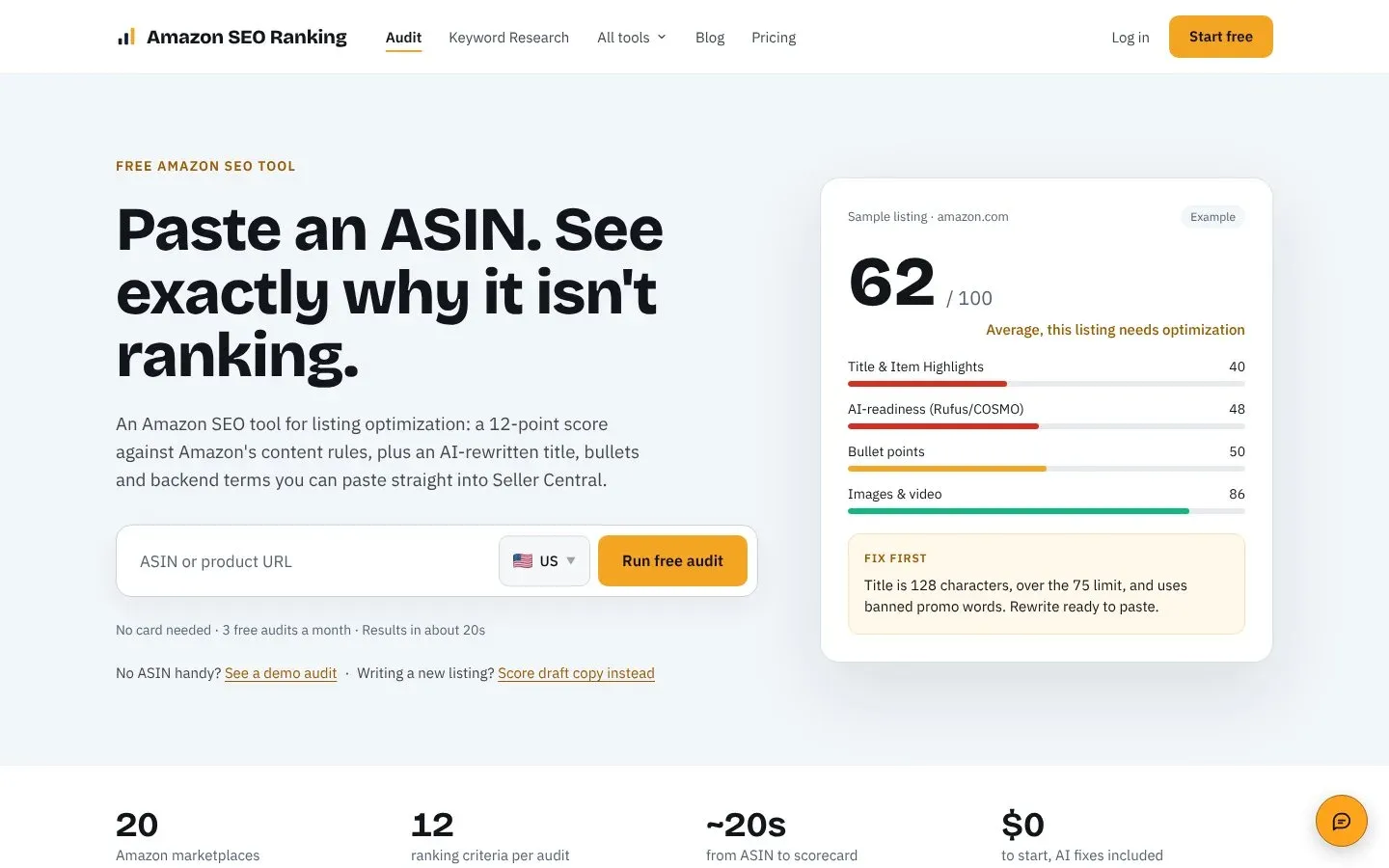
Amazon SEO Ranking is a self-serve listing tool built for one job: making a live Amazon listing rank better. You paste an ASIN, and it pulls the live listing from any of 23 Amazon storefronts and scores it 0 to 100 against 12 equally weighted criteria in seven categories: title and Item Highlights, bullet points, readiness for Alexa for Shopping (formerly Rufus) and COSMO, images and video, backend and attributes, reviews, and stock and fulfillment. An audit takes about 20 seconds and changes nothing on Amazon.
It then rewrites whatever failed: title, Item Highlights, bullets, description and backend search terms, ready to paste. Rewrites use the listing's spec table and your brand fact sheet as the source of truth. Every rewrite is checked in code for Amazon's length limits and pack counts that disagree across fields, with health and unsupported claims flagged, and the full Compliance Risk Scanner runs automatically on Pro and Agency. It's trusted by eRetail Search specialists at Nestlé and eCommerce SEO services agencies such as Reach AI.
Ideal For
The tool fits teams whose listings are live and whose problem is ranking and conversion:
- Amazon sellers with live listings that aren't ranking for their main keywords
- Agencies auditing and rewriting client catalogs at volume
- Brands selling the same product in several Amazon storefronts
- Brand search teams that need AI copy to stay inside approved claims
- Teams that run listing work through Claude
Top Features
These are the features that save the most time or prevent the most expensive mistakes:
- SEO audit with a published method. Every criterion and pass rule is published, so you can see why a point was lost and check it yourself. A criterion the data can't confirm, such as Prime eligibility outside the US, is marked "Not verified" and left out of the score.
- Two AI-readiness criteria that check whether the listing states the facts Alexa for Shopping and COSMO can match and quote: who the product is for, what it's used for, what it's made of. Our Rufus and COSMO SEO guide explains what Amazon has published about both.
- AI Copy Rewriter that targets the criteria that failed, writes in 12 languages following the marketplace, and shows where each target keyword landed.
- Claim and consistency checks that catch "20 packets" in a bullet on an 8-count product before a shopper does.
- Draft audit: score new copy against the live listing's images, rating and Prime status before you publish, with the score before and after.
- Bulk audit and rewrite from an Excel file: 100 ASINs per run on Pro, 500 on Agency.
- Keyword research on Amazon search volume (shown as estimates) in 16 marketplaces, plus competitor comparison against up to two rival ASINs.
- A free Backend Keyword Checker and Character Limit Checker that need no account.
- A Claude connector on Pro and Agency, and an API with white-label PDF reports on Agency.
Why We Stand Out?
Most tools here give you a listing score without publishing how it's calculated. Ours publishes all 12 criteria, and each counts equally, about 8.3 points of the 100. For an agency, that's what makes a score something you can defend to a client. An unchanged listing reuses its last audit, so the same copy never gets two different scores.
The second difference is what happens after the score. Each AI fix is tied to the criterion that failed, and the copy is grounded in the product's own facts, so a rewrite of an 8 mm TPE yoga mat starts from "8 mm" and "TPE" instead of whatever the old bullets claimed. Then the claim checks run, and you can score the rewrite as a draft before Amazon sees it. The draft is scored against the live listing's images, rating and Prime status, with the score before and after, so you see what the change does to the whole listing and not only to the copy.
The third is price for the job. The big suites' core plans run $99 to $129 a month for 20-plus tools. Pro is $79 a month for the listing work, and the free plan runs 3 complete audits a month on your own ASINs with no card.
Pros
- Published scoring method: 12 criteria, pass rules public, equal weights
- AI rewrites grounded in the spec table and your brand fact sheet, with claim and pack-count checks
- Draft audits score copy before it goes live
- Free plan with 3 full audits a month, no credit card; flat pricing regardless of catalog size
- Audit and rewrite cover 23 Amazon storefronts
Cons
- No product research, sourcing or supplier tools; if you're still choosing what to sell, Jungle Scout or Helium 10 fits better
- No PPC management or inventory tools
- The advanced keyword tools (Keyword ideas, What I rank for, Competitors, Keyword gap) cover only 4 marketplaces: US, Egypt, Saudi Arabia and UAE
Pricing
The Free plan includes 3 audits a month, the AI Copy Rewriter on every audit, A+ Content drafts, competitor comparison and a keyword preview. Pro is $79/mo or $799/yr, with 100 audits, 2,000 keyword lookups, Bulk up to 100 ASINs, the compliance and image scans, and the Claude connector. Agency is $249/mo or $2,490/yr, with 500 audits, 10,000 keyword lookups, Keyword gap, white-label reports and API access. Enterprise is custom.
Monthly plans start with a 7-day free trial, and every charge has a 14-day money-back guarantee. Cancel anytime from the My Plan page.
Final Verdict
If your listings are live and the question is why they aren't ranking, Amazon SEO Ranking gives the clearest answer of the tools here, because you can see exactly how the score is built. The AI fixes are tied to what failed and checked against the product before you paste them. Run a free Amazon listing audit on your weakest ASIN and judge the scoring on your own data.
2. Helium 10
Overview
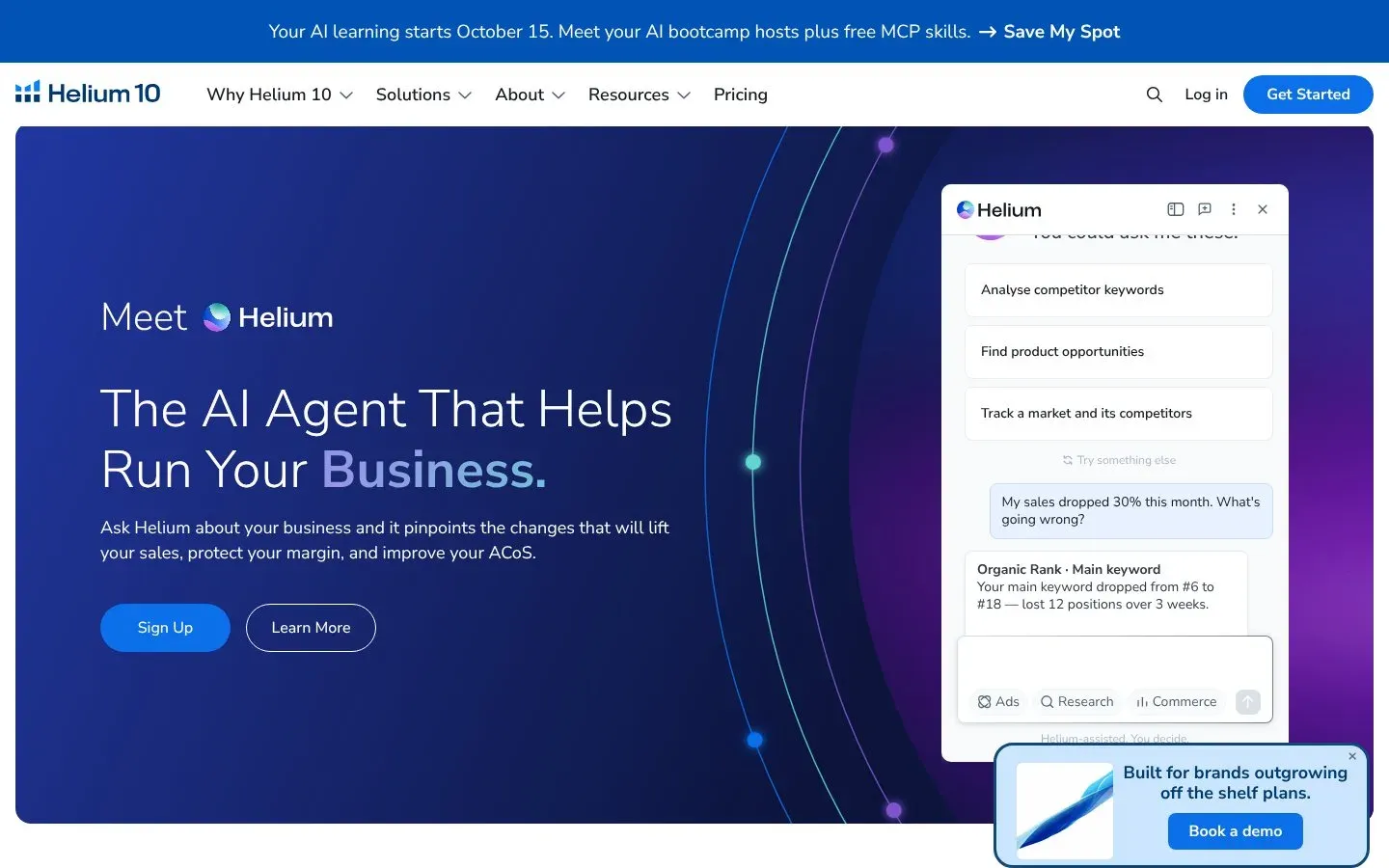
Helium 10 is the largest all-in-one suite for Amazon sellers, with research (Black Box, Xray), keyword tools (Cerebro, Magnet), listing tools (Listing Builder, Listing Analyzer, Scribbles), Helium 10 Ads and operations tools like refund recovery and inventory forecasting. Its listing tools sit next to keyword data that covers more Amazon marketplaces than most tools here.
The 2026 changes matter for anyone buying it for listing work. Helium 10 dropped its Starter plan, so the first paid tier is Platinum. EcomCrew reported in 2026 that Helium 10 also removed Ads access from Platinum after folding it in earlier in the year.
Ideal For
Helium 10 fits sellers who want one login for most of their Amazon business:
- Private label sellers running research, listings and PPC together
- Brands that want keyword tools reaching many marketplaces
- Sellers who need inventory and refund tools next to listing work
- Teams that would rather pay more for one suite than combine several tools
Top Features
The listing features connect to the rest of the suite, which is the main reason to choose it:
- Listing Builder with a score for character counts and keyword use, and sync to Seller Central
- Cerebro reverse ASIN and Magnet keyword research feeding the Listing Builder
- Listing Analyzer for comparing a listing with competitors
- An AI integration for external assistants on Diamond
Why They Stand Out?
Helium 10 is one of the strongest choices when a seller needs product research, keywords, listings and ads under one subscription. Its keyword tools reach more marketplaces than most listing-focused tools, and the Listing Builder pulls keywords straight from Cerebro and Magnet.
For a team that would otherwise pay for three or four tools, the suite can cost less in total, even at its higher price.
Pros
- Broad toolset across research, listings, ads and operations
- Keyword data across many Amazon marketplaces
- Listing Builder connected to its keyword research
- A free plan to explore the interface
Cons
- Listing Analyzer doesn't publish how its score is calculated
- The free plan opens only a few tools, with limited use
- Platinum costs $129/mo, and ads tools now sit on Diamond
- Most of the 20-plus tools go unused if you only need listing work
Pricing
Helium 10 has a limited free plan. Platinum is $129/mo, or $99/mo billed annually. Diamond is $359/mo, or $279/mo billed annually. Enterprise is custom.
On listing work alone, Amazon SEO Ranking Pro costs 39% less than Platinum month to month ($79 vs $129).
Final Verdict
Helium 10 is a strong pick for sellers who want research, keywords, listings and PPC in one place and will use most of it. For sellers who only need to fix live listings, it's a lot of suite to pay for, and its listing score doesn't explain itself. Our Amazon SEO Ranking vs Helium 10 comparison goes through the differences line by line.
3. Jungle Scout
Overview
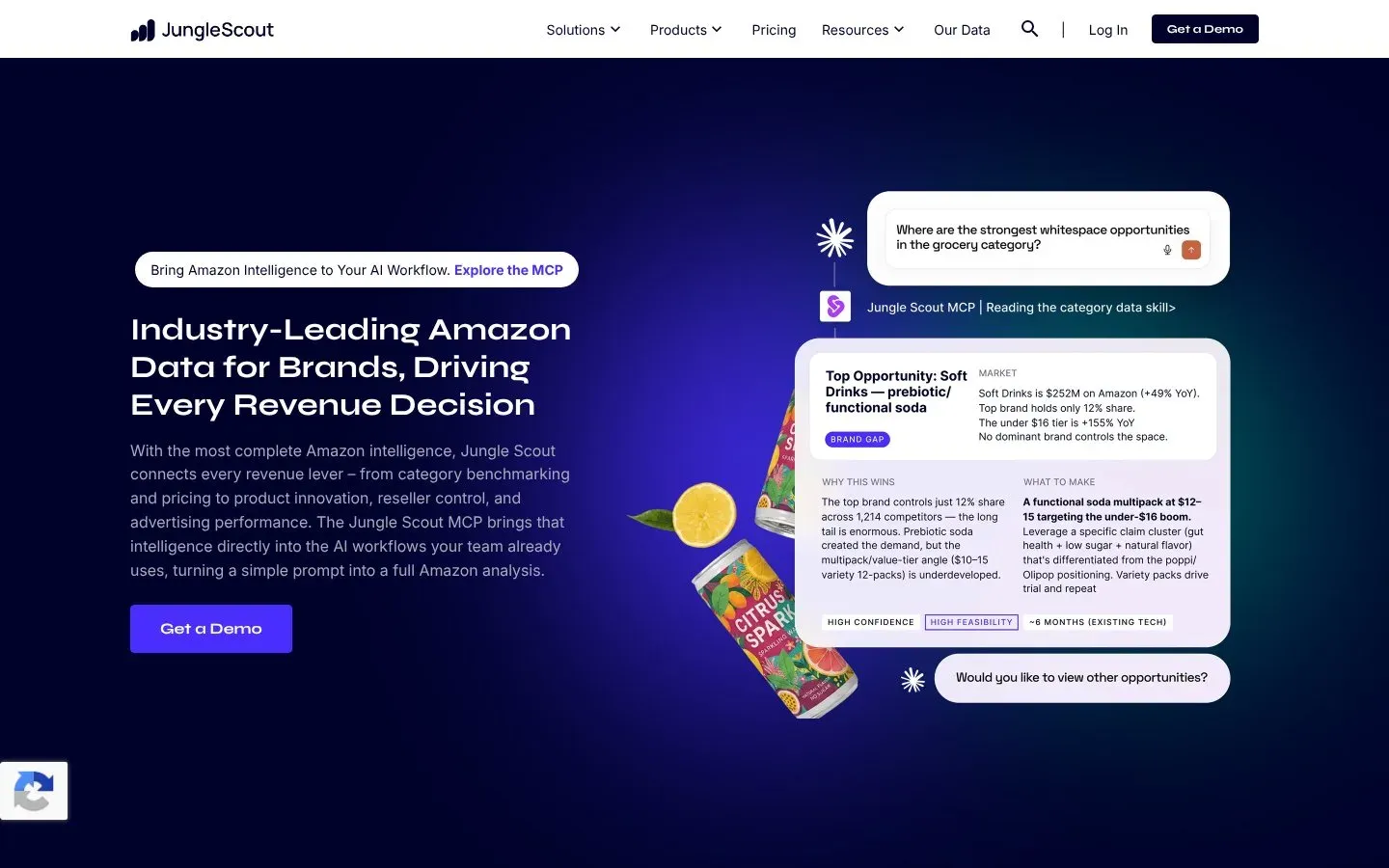
Jungle Scout is best known for the decision before a listing exists: what to sell. Its Product Database, Opportunity Finder, supplier database and browser extension help new sellers check demand and competition. The Listing Builder adds an optimization score and AI Assist for drafting copy.
Seller plans are sold as Catalyst (Starter, Growth Accelerator and Brand Owner + CI), with Cobalt for enterprise brands.
Ideal For
Jungle Scout fits sellers early in the product cycle:
- New sellers validating their first product idea
- Private label sellers sourcing from suppliers
- Brands that want category benchmarks and market share data
- Sellers who want a guided, beginner-friendly interface
Top Features
Most of the value sits in research, with listing tools that cover the basics well:
- Listing Builder with an optimization score that grades a draft before it goes live
- AI Assist for drafting titles, bullets and descriptions
- Keyword Scout with reverse ASIN search
- Product Database and supplier database for choosing products
Why They Stand Out?
Jungle Scout is one of the smartest choices for a seller who hasn't launched yet. The research tools answer "should I sell this?" with sales estimates and competition data, and the Listing Builder then turns the chosen keywords into a first draft.
Its interface is among the easiest in this group, which matters for a first-time seller.
Pros
- Strong product and supplier research
- Clean interface for beginners
- Listing Builder scores drafts before launch
- Annual Growth Accelerator rate ($588/yr) is low for what it includes
Cons
- No free plan; a 7-day money-back guarantee instead
- The listing score doesn't publish its method
- Starter is mainly research, with thin listing tools
- Extra users cost $49/mo each on the plans that allow them
Pricing
Starter is $49/mo ($29/mo billed annually). Growth Accelerator is $79/mo ($49/mo billed annually, $588/yr). Brand Owner + CI is $149/mo ($129/mo billed annually). Cobalt is custom. All plans have a 7-day money-back guarantee.
Brand Owner + CI is cheaper than Amazon SEO Ranking's Agency plan ($149 vs $249/mo), though Agency is built for listing audits at volume.
Final Verdict
Jungle Scout is a strong first tool for sellers choosing and launching products. Once listings are live and the work shifts to fixing what doesn't rank, its listing score gives less to act on than a tool built around auditing.
4. SellerApp

Overview
SellerApp is an Amazon growth suite that combines a structured Listing Quality Index with keyword tracking, PPC automation and managed services. It's the closest like-for-like competitor to a dedicated listing audit tool, with an API and white-label options for agencies.
It also sells done-for-you services, including one-off listing audits, for brands that would rather hand the work over.
Ideal For
SellerApp fits brands that want listing quality and advertising in one place:
- Brands spending heavily on Amazon PPC
- Agencies that need an API and white-label reporting
- Sellers who want managed services as an option
- Teams tracking keyword positions daily
Top Features
The listing features are strongest when paired with its ads tools:
- Listing Quality Index scoring titles, bullets, images and reviews
- Competitor benchmarking on listing quality
- Keyword tracking and PPC insights
- Ads automation on higher plans
Why They Stand Out?
SellerApp is one of the strongest choices for brands that want listing quality and PPC managed side by side. The Listing Quality Index is a real, structured score covering more than keywords.
For agencies, the public API and white-label tools make it practical to build client reporting on top.
Pros
- Structured Listing Quality Index
- PPC automation in the same account
- API and white-label tools for agencies
- Managed services if you'd rather outsource
- A freemium plan
Cons
- The Listing Quality Index's weights aren't published
- Listing Quality isn't included on the freemium plan
- The Smart plan's $149 rate lasts only three months, then rises to $250/mo
- A+ Content help comes through managed services rather than self-serve
Pricing
SellerApp has a Freemium plan for basic research. Pro starts at $99/mo and adds Listing Quality and keyword tracking. Smart is $149/mo for the first three months, then $250/mo, and adds ads automation. Custom plans are on quote.
Amazon SEO Ranking Pro is 20% cheaper than SellerApp Pro ($79 vs $99), and level at the top tier ($249 vs $250).
Final Verdict
SellerApp suits brands that want PPC automation and listing scores together, or the option of managed services. If you don't need the ads side, you're paying for features you won't use, and the score itself still doesn't show its weights.
5. Data Dive
Overview
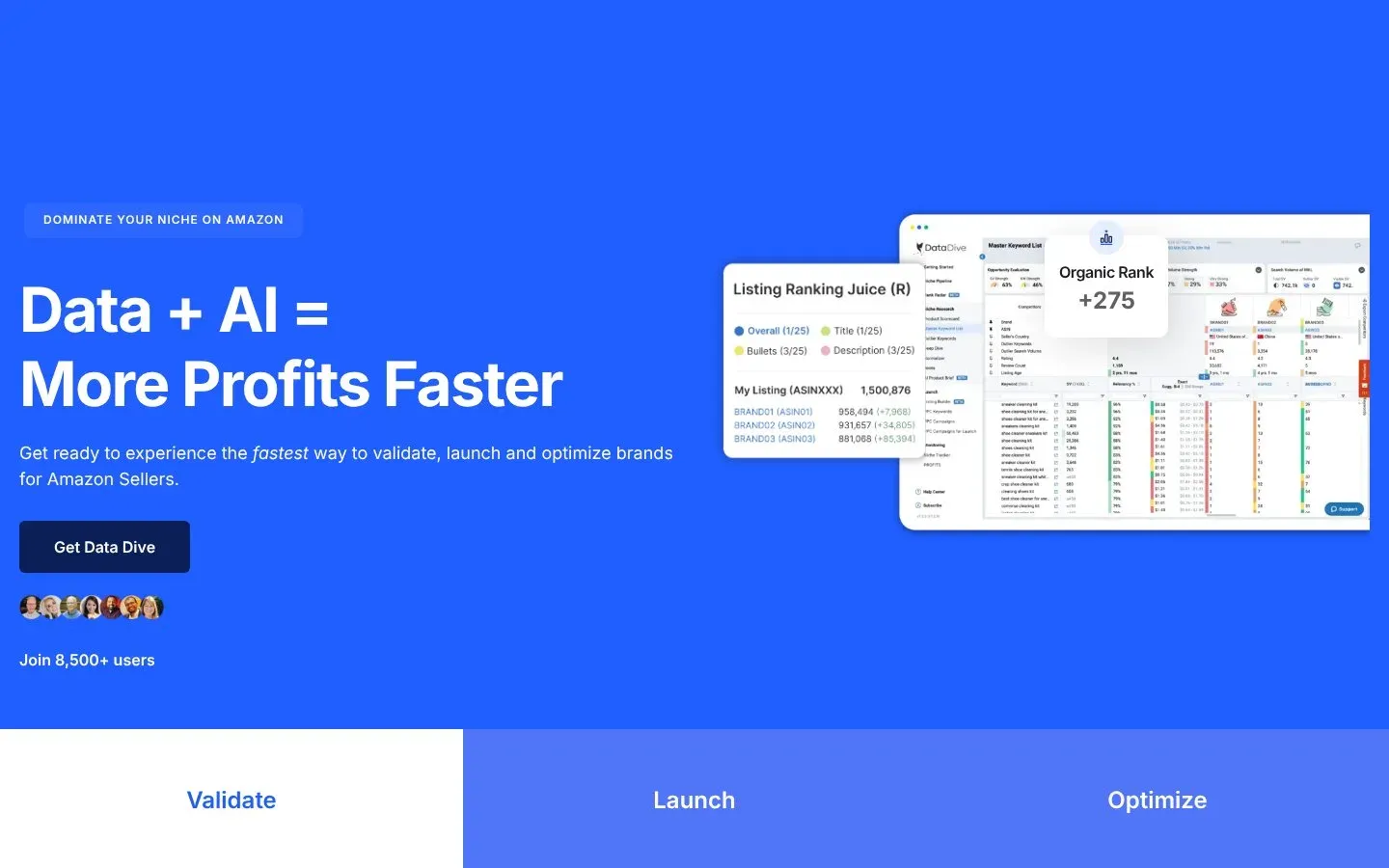
Data Dive is a keyword-first toolkit for experienced private label sellers. A "Dive" pulls the top competitor ASINs for a niche and builds a Master Keyword List from their ranking data and search volume. That list then feeds the AI Copywriter and rank tracking (Rank Radar).
It's built around a method: find every relevant keyword, rank them, and make sure the listing covers the important ones.
Ideal For
Data Dive fits sellers who like working with spreadsheets of keywords:
- Experienced sellers optimizing listings in competitive niches
- Agencies that run a structured keyword process for clients
- Sellers who want keyword data inside an AI assistant via MCP
- Teams that track ranking on many keywords per product
Top Features
Everything starts from the Master Keyword List:
- Master Keyword List built from top competitors' ranking data
- AI Copywriter that writes listings from the chosen keywords
- Rank Radar for tracking keyword positions
- API and MCP server on the Standard and Enterprise plans
Why They Stand Out?
Data Dive is one of the smartest choices for sellers who believe keyword coverage decides ranking and want to measure it carefully. The Master Keyword List gives a clear view of which keywords competitors win and which the listing misses.
It also offers an MCP server for AI assistants, on its higher plans.
Pros
- Keyword research built from competitors' real rankings
- Clear process from keywords to copy
- Rank tracking included
- API and MCP access on Standard and Enterprise
Cons
- No free plan; a 14-day trial on Starter
- Steeper learning curve than most tools here
- Scores keyword coverage more than images, reviews or claims
- Top plan reaches $490/mo
Pricing
Data Dive has three plans, Starter, Standard and Enterprise, ranging from $39 to $490 a month, with about 16% off on annual billing. API and MCP access require Standard or Enterprise.
Final Verdict
Data Dive suits experienced sellers who want the deepest keyword view and are happy to work for it. Its scoring centers on keywords, so you'll still need to check images, claims and Amazon's limits separately.
6. ZonGuru
Overview
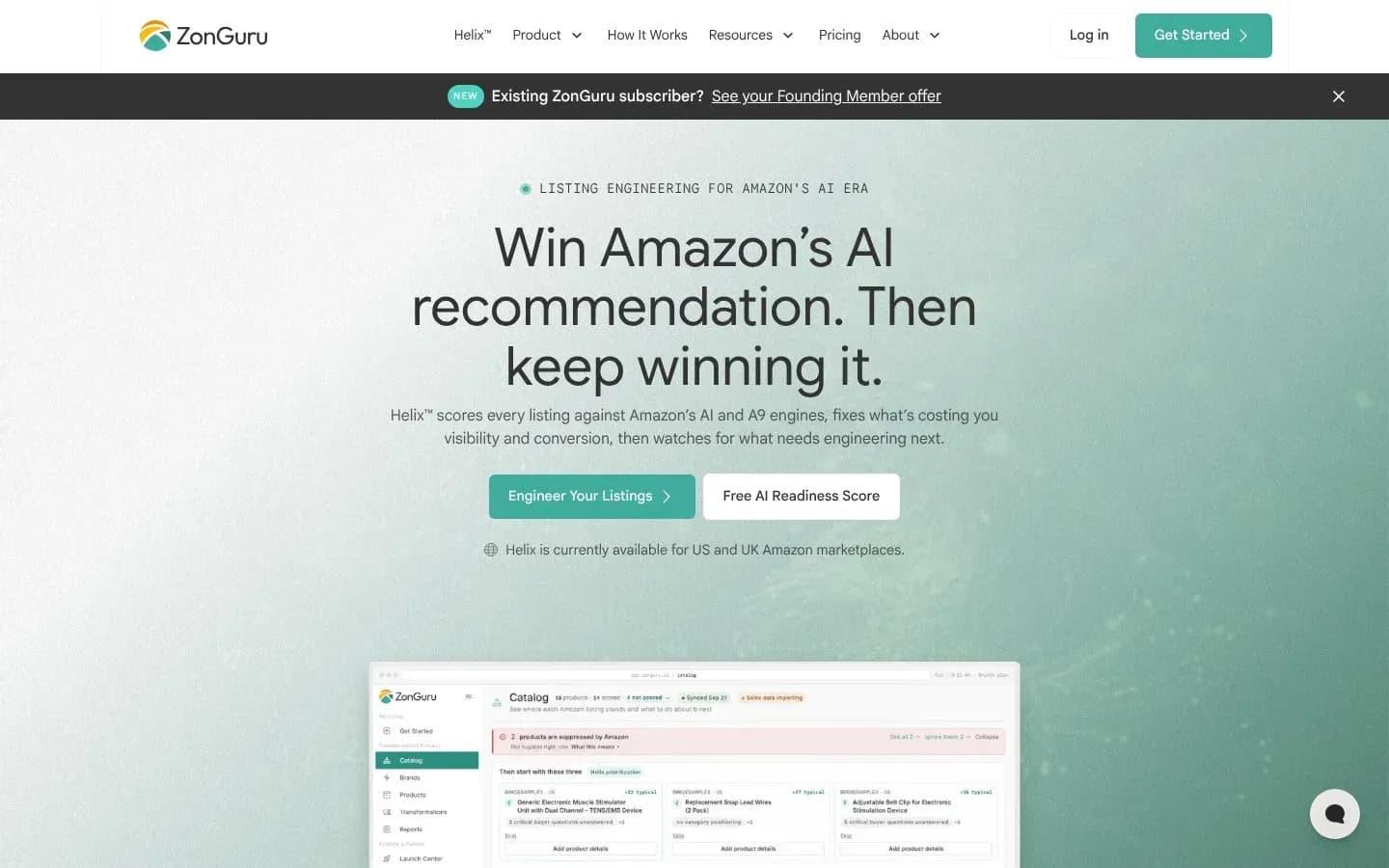
ZonGuru is an Amazon toolkit aimed at smaller catalogs, combining product research, AI listing writing and light operations. Its Listing Optimizer 4.0 uses ChatGPT with ZonGuru's keyword data to write listings that respect character limits, and Keywords on Fire builds the keyword list behind them.
It also covers order management, review requests, email sequences and inventory tracking, which most listing tools don't.
Ideal For
ZonGuru fits small sellers who want listings and day-to-day operations together:
- Private label sellers with up to about 20 SKUs
- Sellers who want automated review requests and buyer emails
- Agencies writing listings with AI for small clients
- Sellers in its 10 supported marketplaces
Top Features
The listing tools are the headline, with operations behind them:
- Listing Optimizer 4.0 with ChatGPT and keyword data, plus comparison against up to 8 other ASINs
- Keywords on Fire keyword research
- Review and email automation
- Business dashboard with orders and inventory
Why They Stand Out?
ZonGuru is one of the stronger choices for a small seller who wants AI-written listings and basic operations in one subscription. Its entry price undercuts most suites here.
The Listing Optimizer's side-by-side comparison with competing ASINs shows keyword gaps quickly.
Pros
- Low entry price for small catalogs
- AI listing writing with keyword data
- Operations tools beyond listing work
- 7-day free trial
Cons
- The Listing Optimizer score covers keyword placement only, not images, reviews or stock
- The scoring formula isn't published
- Price rises with SKU count
- No free plan
- 10 marketplaces supported
Pricing
Researcher starts at $29/mo billed annually. Seller starts at $49/mo billed annually for 1 to 20 SKUs and rises with SKU count. Enterprise is custom. Both plans include a 7-day free trial.
Final Verdict
ZonGuru suits small catalogs that want AI listings plus review and email automation. As the catalog grows, the SKU-based price climbs, and the keyword-only score leaves the rest of the listing unchecked.
7. SmartScout
Overview
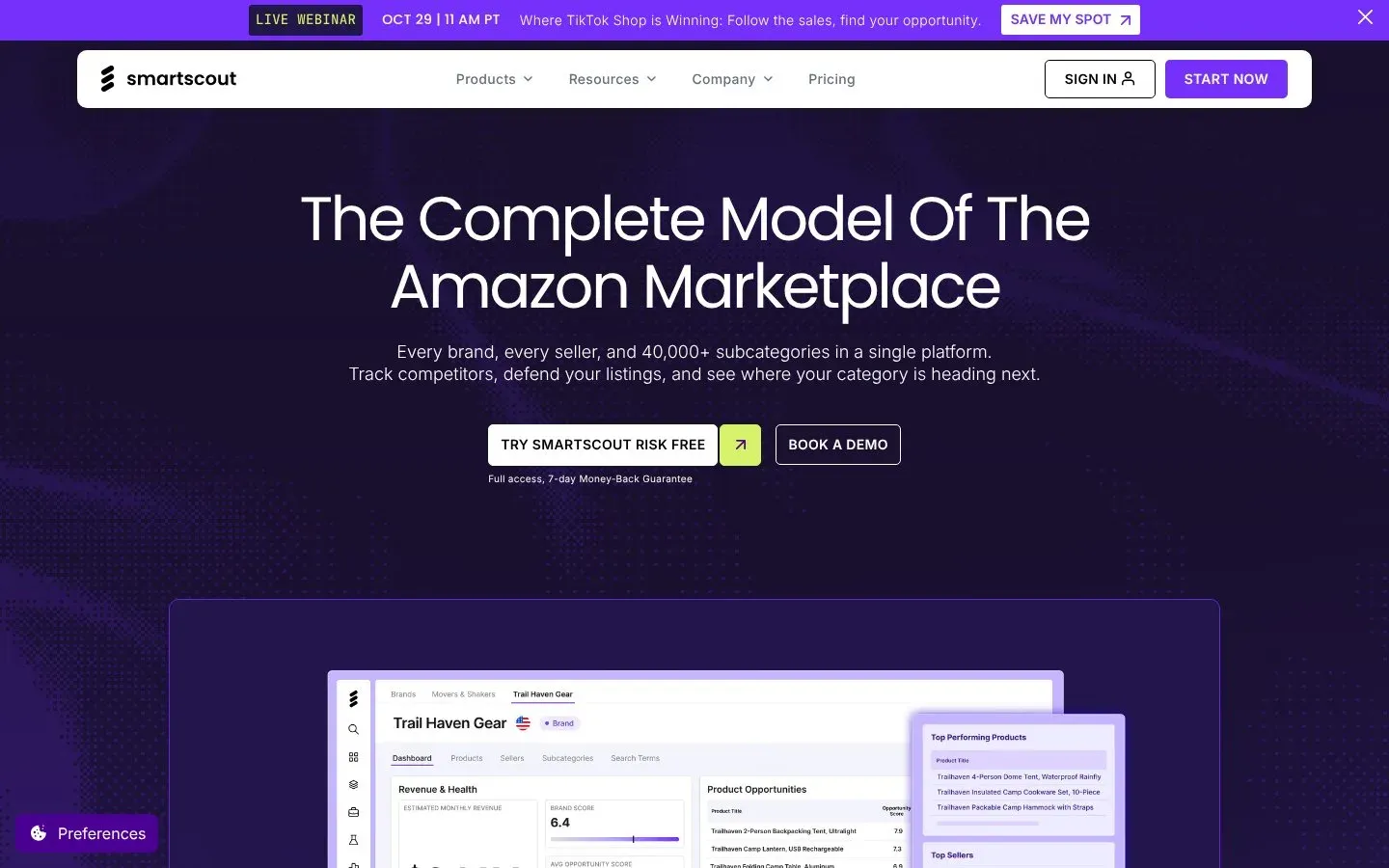
SmartScout is a market research tool best known for its brand, seller and subcategory databases, popular with wholesale sellers. In 2026 it added more AI listing tools: AI Listing Architect writes titles, bullets, descriptions and backend terms from keyword data, and an Amazon AI Scorecard grades a listing for Amazon's AI shopping features.
Listing writing is metered by ASINs per month rather than gated by plan.
Ideal For
SmartScout fits sellers whose main work is research:
- Wholesale sellers mapping brands and sellers
- Brands studying competitors by category
- Sellers who want an occasional AI listing draft
- Sellers who want a quick AI-shopping grade alongside their research
Top Features
The research databases come first, with AI listing tools added on:
- AI Listing Architect for titles, bullets, descriptions and backend terms
- Amazon AI Scorecard with a letter grade and a 15-point breakdown
- Brand, seller and product databases
- MCP server on Enterprise
Why They Stand Out?
SmartScout is one of the strongest choices for wholesale and brand research, and the AI Listing Architect turns that research into a draft without leaving the tool. The AI Scorecard's 15-point breakdown shows more of its reasoning than most listing scores here.
Its Basic plan includes two user seats, which helps small teams. Where Amazon SEO Ranking scores AI-readiness as 2 of its 12 criteria inside a full listing audit, SmartScout grades it separately.
Pros
- Strong brand and seller research
- AI listing drafts on every plan
- AI Scorecard with a visible breakdown
- Two seats on Basic
Cons
- AI Listing Architect is capped at 3 ASINs a month on Basic, then $3 to $4 per extra ASIN
- Listing tools are secondary to research
- MCP server only on Enterprise
- No free plan
Pricing
Basic is $29/mo ($25/mo billed annually), Essentials $97/mo, Business $187/mo, and Enterprise is custom. AI Listing Architect includes 3, 10, 25 or 60 ASINs a month depending on plan.
Final Verdict
SmartScout suits sellers who buy it for research and want AI listing drafts as a bonus. For a catalog that needs regular audits and rewrites, the per-ASIN caps add up.
8. SellerSprite
Overview
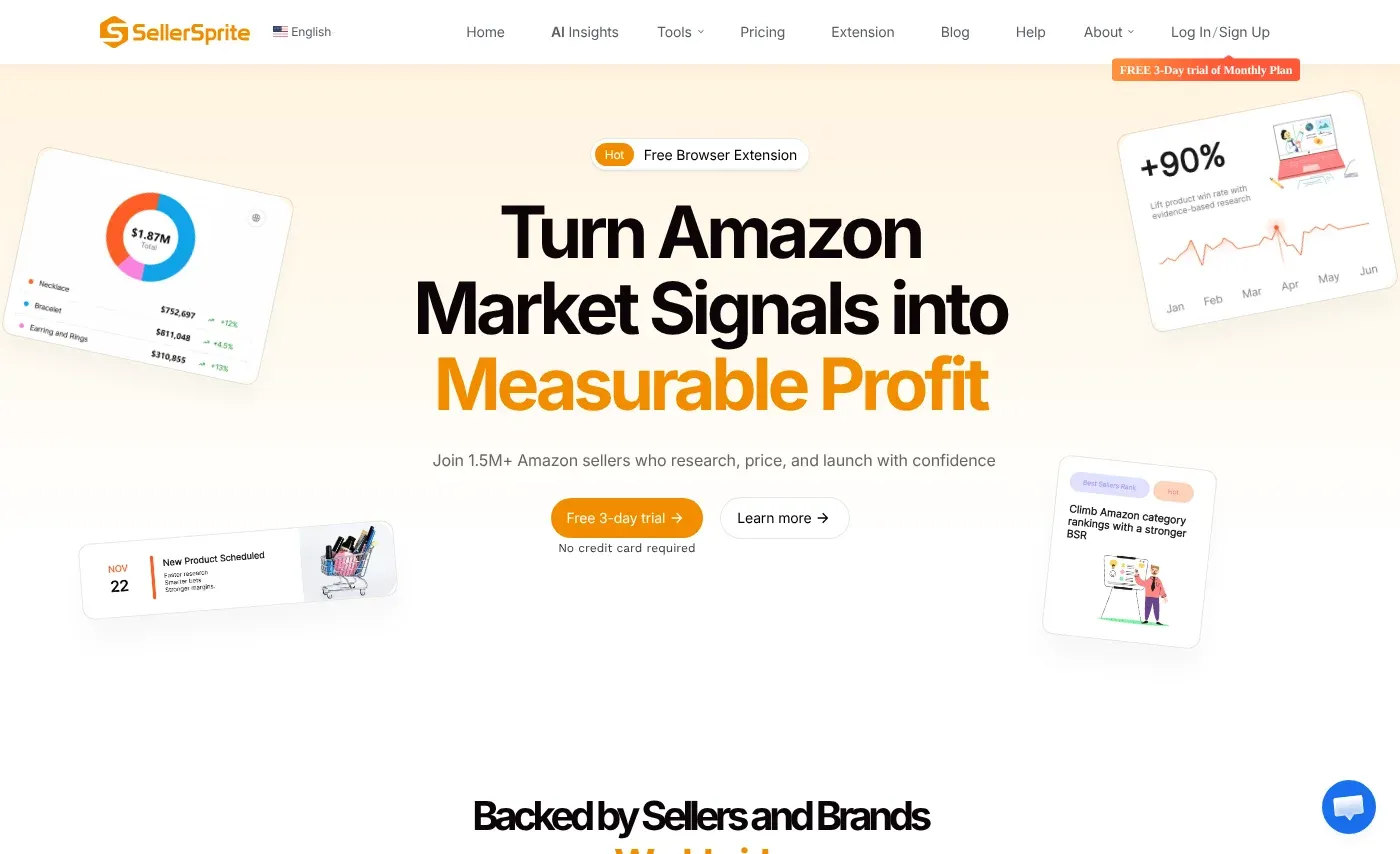
SellerSprite is a keyword and market research tool with low prices. Its AI Listing Builder, which turns keyword research into a title, bullets and description, is free, as are its sales estimator and profit calculator.
Paid plans add multi-ASIN reverse lookup, ads insights and market research across 9 marketplaces.
Ideal For
SellerSprite fits budget-conscious sellers who want strong keyword data:
- Sellers moving off Helium 10 to cut costs
- Researchers who reverse-lookup several ASINs at once
- Sellers in UAE and Saudi Arabia, which it covers
- Teams that want an MCP connection for AI assistants
Top Features
Keyword research is the core, with listing writing free on top:
- Free AI Listing Builder
- Reverse ASIN on multiple ASINs at once
- Ads insights on competitors' PPC
- MCP access through its API plans
Why They Stand Out?
SellerSprite is one of the smartest choices for sellers who want deep keyword research at a low price. The free listing builder lets a seller test the copy side before paying anything.
Its 3-day trial needs no credit card. It beats Amazon SEO Ranking on keyword research depth and marketplace coverage for keywords, and its listing builder is free.
Pros
- Free AI Listing Builder
- Low paid entry price
- Multi-ASIN reverse lookup
- 3-day trial with no card
Cons
- The listing builder writes copy but doesn't audit a live listing against a fixed standard
- Claim and pack-count checks aren't part of its published features
- MCP needs a separate API plan
- 9 marketplaces
Pricing
SellerSprite has a free plan with the AI Listing Builder. Paid plans start at about $39/mo on Basic, with Standard at $79/mo and Advanced and VIP on annual billing.
Final Verdict
SellerSprite suits sellers who want cheap, deep keyword research and a free first draft of their listing. You'll still need another check before that draft goes live.
9. AMZScout
Overview
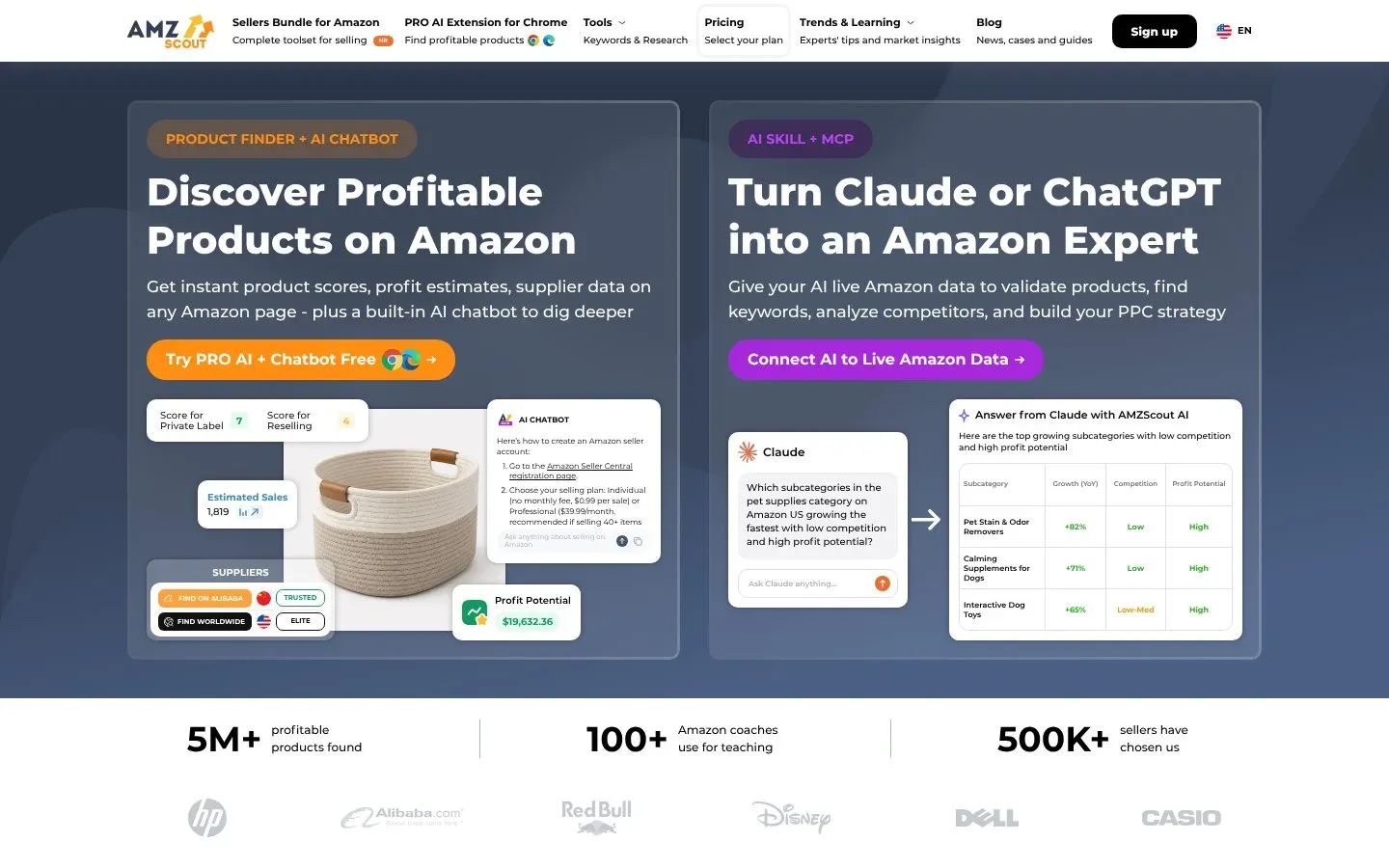
AMZScout is a product research tool, with a PRO AI Extension, a product database and keyword tools. It shows a Listing Quality Score from 1 to 100, and its AI Listing Builder generates listings from your researched keywords, sold in a Private Label add-on pack.
It's built mainly for choosing and sourcing products, including arbitrage and wholesale.
Ideal For
AMZScout fits sellers still deciding what to sell:
- New private label sellers researching products
- Arbitrage and wholesale sellers
- Sellers who prefer annual or lifetime pricing
- Sellers who want a quick quality indicator while browsing Amazon
Top Features
The research tools come first:
- PRO AI Extension with a Listing Quality Score
- Product database with 16 filters
- AI Listing Builder in the Private Label pack
- Keyword search and tracking
Why They Stand Out?
AMZScout is one of the strongest budget choices for product research, especially on annual billing. The Listing Quality Score gives a quick read on competitors' listings while browsing.
Its annual and lifetime options are cheap if you commit upfront, and on an annual plan it costs less than Amazon SEO Ranking's monthly Pro rate. It also covers product research and sourcing, which we don't.
Pros
- Good product research for the price
- Cheap on annual billing
- Quality score visible while browsing Amazon
- Supports arbitrage and wholesale research
Cons
- No listing scoring method you can check
- The AI Listing Builder costs extra as an add-on
- Listing work is secondary to research
- No free plan
Pricing
The AI Bundle costs $59.99/mo, $169.99 for 3 months or $399.99 a year. Add-on packs, including the Private Label pack with the AI Listing Builder, cost extra.
Final Verdict
AMZScout suits sellers choosing products on a budget. It does a different job from a listing audit tool, so pair it with one once your listings are live.
10. Amazon Seller Central Tools
Overview
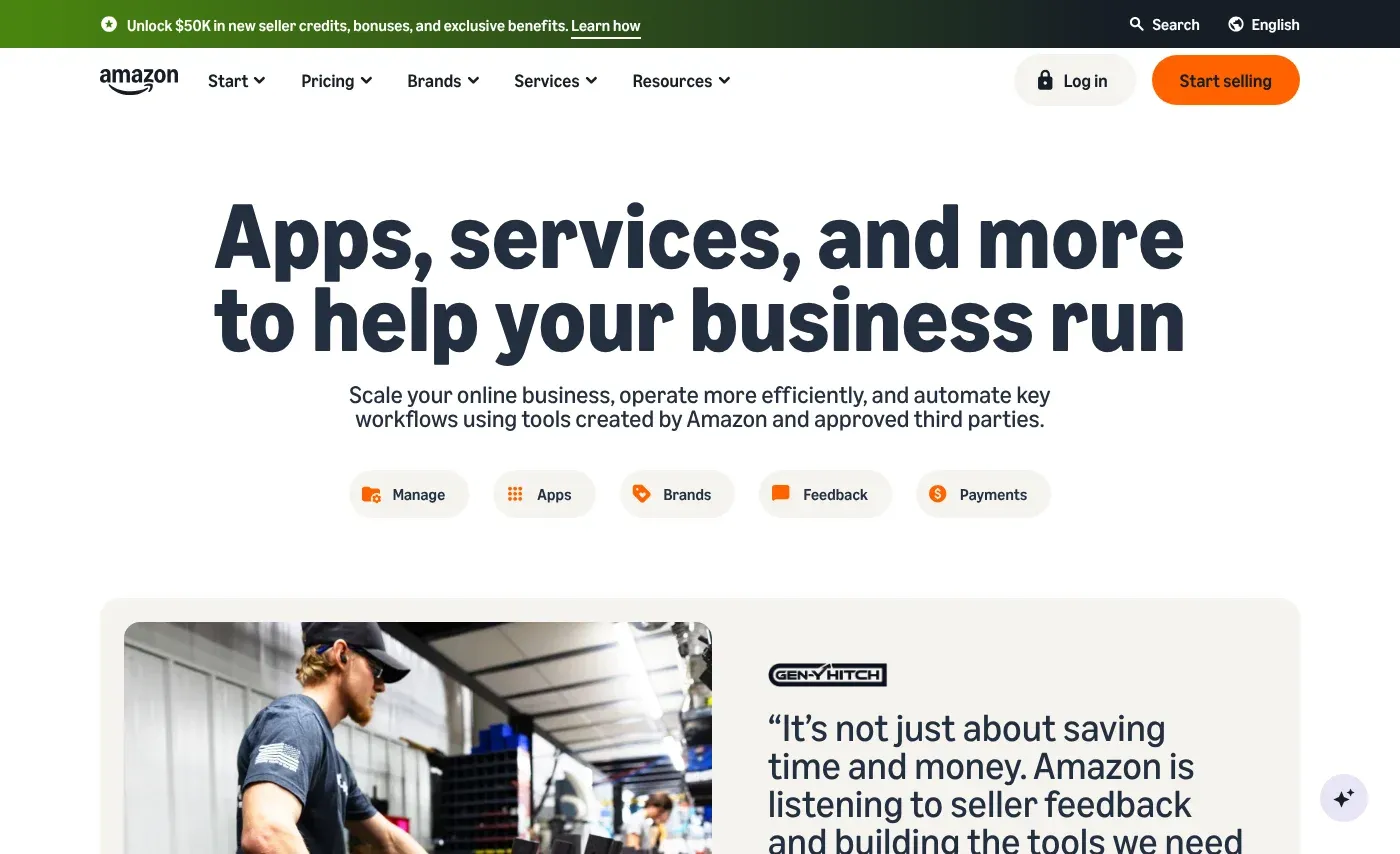
Amazon's own tools are free and already in your account. Enhance My Listing suggests titles, attributes, descriptions and missing details, which sellers can accept, reject or edit. Amazon's generative AI listing tools can also create a listing from a product URL, an image or a few words.
Seller Central's listing quality pages flag missing attributes and suppressed listings, which no outside tool can see.
Ideal For
Amazon's tools are the baseline for everyone:
- Every seller, as a free first pass
- Sellers creating many new listings from minimal details
- Sellers who need to see suppression reasons and missing attributes
- Sellers who don't want another subscription
Top Features
The features cover creation and suggestions:
- Enhance My Listing suggestions on existing listings
- AI listing creation from a URL, image or text
- Listing quality and suppression alerts in Seller Central
- A+ Content help in the A+ Content Manager
Why They Stand Out?
Amazon's tools are one of the smartest places to start because they're free and see data no outside tool can, like why a listing was suppressed and which required attributes are missing.
Their suggestions are written for Amazon's catalog, and you can accept or edit each one before it's applied.
Pros
- Free with a Seller Central account
- Sees suppression reasons and missing attributes
- Fast listing creation from little input
- Suggestions can be accepted, edited or rejected
Cons
- No independent score you can check or compare across listings
- No search volume shown next to the suggestions
- Suggestions don't show which keywords you'd lose by accepting them
- Suggestions aren't checked against a fixed, published standard
Pricing
Free with a Seller Central account.
Final Verdict
Use Amazon's tools as the free baseline, and to read what only Seller Central shows. For an independent check of what Amazon's AI writes, and keyword data to judge it by, pair them with a dedicated tool.
How to Choose the Best Amazon Listing Optimization Tool
The right tool depends on the job, the catalog and who has to trust the score. These seven checks cover most decisions.
1. Decide Which Job You're Buying For
Listing tools and seller suites solve different problems. If you're still choosing products, sourcing or running PPC, an all-in-one suite like Helium 10 or Jungle Scout covers those, and a focused listing tool doesn't.
If your listings are live and the problem is ranking, pay for listing depth. The suites' core plans run $99 to $129 a month for 20-plus tools, and most sellers use two or three.
2. Check Whether the Score Explains Itself
Ask how the Amazon listing quality score is calculated. If the vendor can't tell you which criteria count and how much, you can't tell which fix is worth the most points, or explain the score to a client.
Amazon SEO Ranking publishes all 12 criteria and pass rules, including the two that check readiness for Alexa for Shopping and COSMO. SmartScout's AI Scorecard shows a 15-point breakdown. Most of the others don't publish their method.
3. Test the AI Copy Against Your Spec Table
Run the AI writer on one of your own products and read the result next to the spec table. Look for materials, sizes, counts and claims the product doesn't have.
A good Amazon listing builder uses the product's facts as its source and flags health claims and pack-count mismatches. Copy that reads well and contradicts the box turns into "not as described" returns. Amazon SEO Ranking's rewrites start from the listing's spec table and your brand fact sheet, and flag pack counts that disagree across the title, bullets, description and spec table, such as "20 packets" on an 8-count box.
4. Look for Live Data and Draft Scoring
A score from a stored copy describes the listing as it was. Check whether the tool reads the live page each time. Amazon SEO Ranking pulls the current listing on every audit, and an unchanged listing reuses its last result, so the same copy never gets two different scores.
Then check how a rewrite is scored before it goes live. A listing builder scores the copy's characters and keywords. Amazon SEO Ranking's draft audit scores the new copy against the live listing's images, rating and Prime status and shows the score before and after, so a broken limit or a dropped keyword gets fixed before Amazon indexes the change.
5. Check That Each Storefront Gets Its Own Audit and Rewrite
A listing optimized for amazon.com isn't automatically optimized for amazon.de or amazon.co.jp. List the storefronts you sell in and check that the tool audits the listing in each one and rewrites it in that marketplace's language, since a German listing rewritten in English needs a second rewrite.
Amazon SEO Ranking audits and rewrites in 23 Amazon storefronts and writes in 12 languages, following the marketplace (Belgian listings come back in French). Its keyword search volume covers 16 of those marketplaces, and the advanced keyword tools cover the US, Egypt, Saudi Arabia and UAE, so sellers who need keyword research in many more markets may pair it with a keyword-first tool.
6. Compare the Real Price for Your Catalog
Look past the entry price. SKU-based pricing (ZonGuru), per-ASIN AI caps (SmartScout), paid seats (Jungle Scout) and intro rates that rise later (SellerApp) all change the total.
Then test before paying. A free Amazon listing optimization tool that runs full audits on your own ASINs tells you more than a demo listing. Amazon SEO Ranking's free plan runs 3 a month; Helium 10's free plan opens a few tools; Jungle Scout, Data Dive, ZonGuru, SmartScout and AMZScout offer trials or money-back windows instead.
7. Check How It Fits Your Workflow
If your team works in Claude, check whether the tool has a connector and which plan includes it. Amazon SEO Ranking includes the Claude connector from Pro at $79/mo; Helium 10 keeps its equivalent on Diamond, Data Dive on Standard and above, and SmartScout on Enterprise.
Agencies should also check bulk limits, API access and white-label reports, since those decide how many client listings one person can handle in a week.
Everything You Need to Know About Amazon Listing Optimization Tools
The ratings are our judgment for listing work specifically, based on the published features and prices above. "Score transparency" rates how much of the listing score's method the vendor publishes.
| Company | Pros | Cons | Ease of Use | Integrations | Support | Affordability | Score Transparency |
|---|---|---|---|---|---|---|---|
| Amazon SEO Ranking | Published 12-criteria method; grounded AI rewrites with claim checks; free plan with full audits | No product research; no PPC; advanced keyword tools in 4 marketplaces | ⭐⭐⭐⭐⭐ | ⭐⭐⭐⭐ | ⭐⭐⭐⭐ | ⭐⭐⭐⭐⭐ | ⭐⭐⭐⭐⭐ |
| Helium 10 | Broadest suite; deep keyword data; Listing Builder tied to research | $129/mo entry; score method unpublished; limited free plan | ⭐⭐⭐ | ⭐⭐⭐⭐⭐ | ⭐⭐⭐⭐ | ⭐⭐ | ⭐⭐ |
| Jungle Scout | Strong product research; beginner-friendly; drafts scored before launch | No free plan; thin Starter listing tools; paid seats | ⭐⭐⭐⭐⭐ | ⭐⭐⭐ | ⭐⭐⭐⭐ | ⭐⭐⭐⭐ | ⭐⭐ |
| SellerApp | Structured Listing Quality Index; PPC automation; API and white-label | Weights unpublished; Smart price rises after 3 months; listing quality not on free plan | ⭐⭐⭐ | ⭐⭐⭐⭐ | ⭐⭐⭐⭐ | ⭐⭐⭐ | ⭐⭐⭐ |
| Data Dive | Competitor-based keyword lists; clear process; MCP on higher plans | Learning curve; keyword-centered scoring; up to $490/mo | ⭐⭐ | ⭐⭐⭐⭐ | ⭐⭐⭐ | ⭐⭐⭐ | ⭐⭐⭐ |
| ZonGuru | Low entry price; AI listings; review and email automation | Keyword-only score; SKU-based pricing; 10 marketplaces | ⭐⭐⭐⭐ | ⭐⭐⭐ | ⭐⭐⭐ | ⭐⭐⭐⭐ | ⭐⭐ |
| SmartScout | Brand and seller research; AI drafts on every plan; scorecard breakdown | AI capped per ASIN; listing tools secondary; MCP on Enterprise | ⭐⭐⭐ | ⭐⭐⭐ | ⭐⭐⭐ | ⭐⭐⭐⭐ | ⭐⭐⭐⭐ |
| SellerSprite | Free AI Listing Builder; low price; multi-ASIN reverse lookup | No live audit; claim checks not advertised; MCP on API plans | ⭐⭐⭐⭐ | ⭐⭐⭐ | ⭐⭐⭐ | ⭐⭐⭐⭐⭐ | ⭐ |
| AMZScout | Cheap product research; quality score while browsing; annual deals | Listing builder is an add-on; no checkable method; research-first | ⭐⭐⭐⭐ | ⭐⭐ | ⭐⭐⭐ | ⭐⭐⭐⭐ | ⭐ |
| Amazon Seller Central tools | Free; sees suppression and missing attributes; fast creation | No independent score; no search volume; Amazon rewrites long titles | ⭐⭐⭐⭐ | ⭐⭐ | ⭐⭐ | ⭐⭐⭐⭐⭐ | ⭐ |
Audit Your Listing Free with Amazon SEO Ranking
If your listings are live and not ranking, the fastest test is to audit one. Amazon SEO Ranking pulls the live page, scores it against 12 published criteria, and shows which fixes are worth the most points. Each AI rewrite is grounded in the listing's spec table and your brand fact sheet, checked for claims and pack counts, and can be scored as a draft before you paste it into Seller Central.
It's trusted by eRetail Search specialists at Nestlé and eCommerce SEO services agencies such as Reach AI. For agencies, the Agency plan runs Bulk audits and rewrites of up to 500 ASINs with white-label reports, at about $0.50 per listing against the $50 or more agencies typically bill to rewrite one by hand.
The free plan includes 3 full audits a month with no credit card required. See how our Amazon listing optimization tool works on a demo listing, or go straight to your own ASIN. For a catalog, compare Pro and Agency plans: monthly plans start with a 7-day free trial, and every charge has a 14-day money-back guarantee.
FAQ
What is the best Amazon listing optimization tool in 2026?
The best Amazon listing optimization tool in 2026 for live listings is Amazon SEO Ranking, because it publishes its 12 scoring criteria and checks every AI rewrite for Amazon's limits, claims and pack counts. Helium 10 is the stronger choice if you also need product research, PPC and inventory tools in one suite. Jungle Scout suits sellers who haven't launched yet, and Data Dive suits experienced sellers who want the deepest keyword view. Amazon SEO Ranking's free plan runs 3 audits a month with no card, so you can test it on your own ASIN.
What should I look for in an Amazon listing optimization tool?
In an Amazon listing optimization tool, look for three things: a fit with the job you need done, a score that explains itself, and AI copy checked against your product's facts. Check marketplace coverage for the audit, the rewrite and the keyword data separately. Compare the real price for your catalog, including SKU-based pricing, per-ASIN caps and paid seats. Then test it on your own listing before paying.
How does Amazon SEO Ranking differ from Helium 10 and Jungle Scout?
Amazon SEO Ranking differs from Helium 10 and Jungle Scout by focusing only on listing work, with a published scoring method and AI rewrites checked for claims and pack counts. Helium 10 and Jungle Scout are broader suites that add product research, sourcing and PPC, which Amazon SEO Ranking doesn't offer. On price, Pro is $79/mo against Helium 10 Platinum at $129/mo, and level with Jungle Scout Growth Accelerator at $79/mo. Amazon SEO Ranking also has a free plan with full audits, which Jungle Scout doesn't.
How do I get started with Amazon SEO Ranking?
You get started with Amazon SEO Ranking by pasting an ASIN or Amazon URL into the free audit and choosing the marketplace. The audit takes about 20 seconds and returns a score out of 100, the weakest criteria and the fixes worth the most points. A free account adds the AI Copy Rewriter on every audit, with 3 audits a month and no credit card. No Seller Central access is needed, because the audit only reads the public product page.
How easy is it to switch to Amazon SEO Ranking from another tool?
Switching to Amazon SEO Ranking is easy because there's nothing to migrate: it reads your live listings directly from Amazon by ASIN. You can run it alongside your current suite and compare scores on the same listings. For a catalog, upload an Excel file of ASINs to Bulk Optimization, up to 100 per run on Pro and 500 on Agency. Monthly plans start with a 7-day free trial, so you can test it before cancelling anything.
Can ChatGPT or Amazon's free AI replace a listing tool?
ChatGPT or Amazon's free AI can't replace a listing tool: both draft listings well, but neither gives you an independent score or checks the draft against your spec table. ChatGPT doesn't see the live listing or real Amazon search volume, and it often miscounts characters against the 75-character title limit. Amazon's Enhance My Listing suggestions can be accepted or edited, but they don't show search volume or which keywords you'd lose. A listing tool adds the score, the keyword data and the claim checks, so use the free AI for drafts and a tool to check them.
Are there free Amazon listing optimization tools?
Free Amazon listing optimization tools exist, though most are limited. Amazon's Seller Central tools are free with your account, SellerSprite's AI Listing Builder is free, and Helium 10 and SellerApp have limited free plans. Amazon SEO Ranking's free plan runs 3 full audits a month with AI rewrites, and its Character Limit Checker and Backend Keyword Checker need no account at all. Jungle Scout, Data Dive, ZonGuru, SmartScout and AMZScout have no free plan.
Do Amazon listing optimization tools improve rankings?
Amazon listing optimization tools improve rankings indirectly, by making sure the listing contains the keywords shoppers search for and meets the rules that cost rank when broken. They catch problems such as titles over 75 characters, which Amazon now rewrites, and backend search terms over the byte limit, which Amazon ignores entirely. Ranking also depends on sales, price, reviews and stock, which no listing tool controls. Our guide on how to audit an Amazon listing for SEO shows which fixes to make first.
Audit one live listing and see which fixes are worth the most points. Scored against 12 published criteria in about 20 seconds. Free, 3 audits a month, no card required.
Run free audit