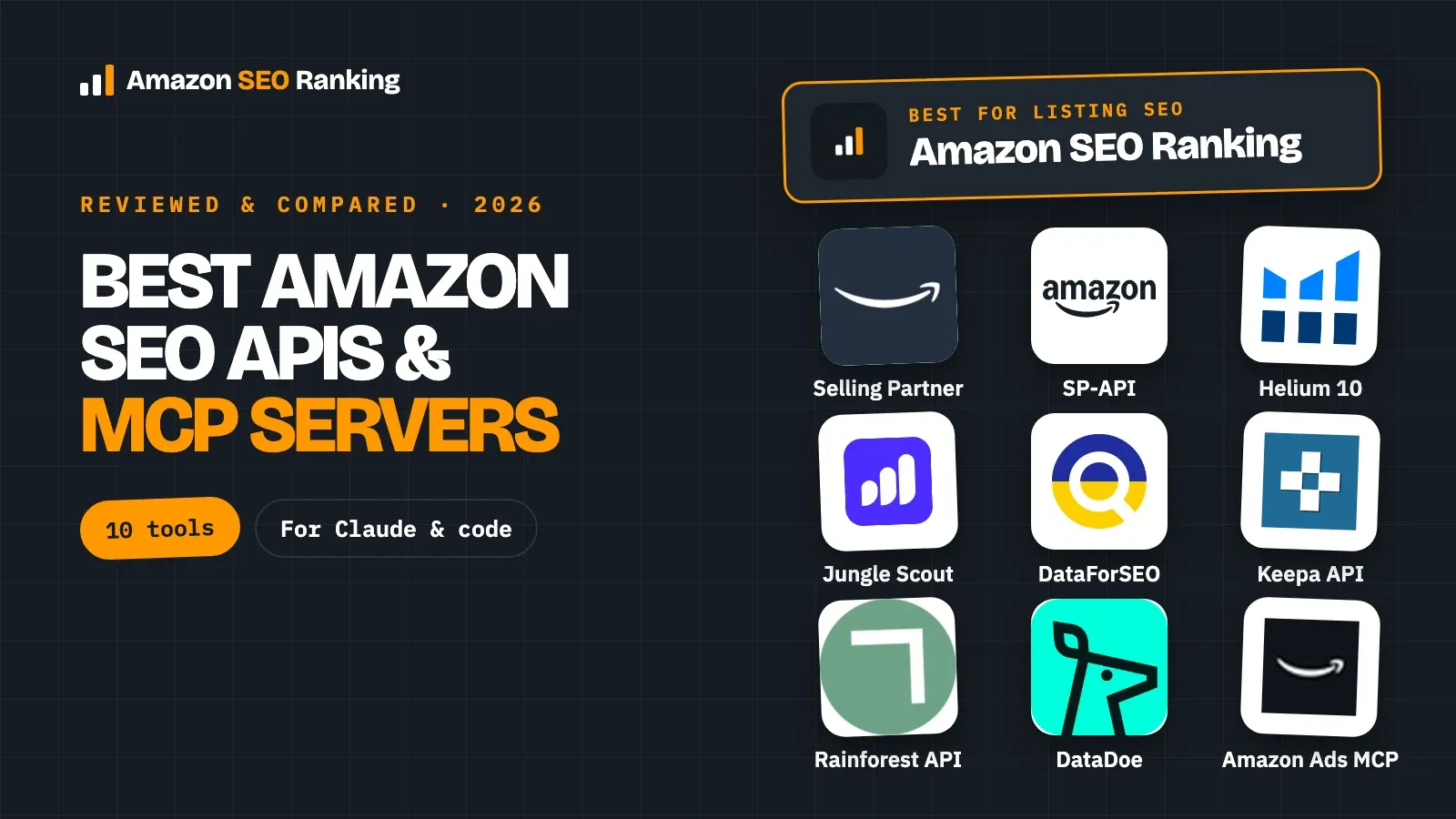
The best Claude Amazon setup for listing work depends on whether your assistant needs to check a listing, research keywords or change it in Seller Central. For auditing live listings and checking AI-written copy against Amazon's rules, it's Amazon SEO Ranking, whose Claude connector scores any ASIN against 12 published criteria and checks copy in code before you paste it. Amazon's own Selling Partner plugin is the official way to read and edit your own Seller Central account from Claude, Helium 10 and Jungle Scout bring their research data, and Keepa, DataForSEO and Rainforest API sell raw Amazon data by the call.
Amazon SEO Ranking is our product, so weigh our verdict with that in mind. The other nine reviews use each vendor's published plans, access rules and features as of November 2026, and each one says what that tool does that ours doesn't.
Most "best Amazon MCP server" lists rank a profit dashboard against an ads tool against a scraping API, as if they answered the same prompt. They don't. This guide sorts the 10 by the job they do in a listing workflow, so you can connect two or three that cover it and skip the rest.
Key Takeaways (TL;DR)
- The best Claude Amazon connector for listing SEO: Amazon SEO Ranking. Its six MCP tools audit live or draft listings in 23 storefronts, check copy for Amazon's length limits, pack counts and claims, and pull Amazon search volume, so Claude can research, write and check in one chat.
- Why you need one: a general AI assistant can't see your live listing, can't count Amazon's limits reliably and has no search data. An API or MCP server gives it the facts and the checks, and Amazon says 90% of selling partners already use third-party AI tools.
- Who it's for: sellers who work in Claude, agencies running client catalogs, developers building internal tools, brands selling in several storefronts and teams that need to push changes back to Seller Central.
- How to choose: decide whether you need to read public listings, read your own account or write changes; then check who can get access (plan, credentials, region) and how each call is priced.
- Expected price: Amazon SEO Ranking has a free plan (3 audits a month, no card), with the Claude connector on Pro at $79/mo and the REST API on Agency at $249/mo. Across the market, Amazon's own SP-API costs nothing extra, the Ads MCP Server has no published fee, pay-per-call APIs start at about a cent per call, and Helium 10's MCP needs Diamond at $359/mo.
Top Amazon SEO APIs and MCP Servers in 2026 at a Glance
Prices are the vendors' published rates in November 2026 unless marked. "Writes to Amazon" means the tool can change a listing, price or campaign in your account.
| Company | Best For | Key Features | Pricing |
|---|---|---|---|
| Amazon SEO Ranking | Auditing listings and checking AI copy inside Claude | 12-criteria audit (live or draft), copy checker for limits and claims, search volume, keyword ideas and gap, REST API, 23 storefronts | Free (3 audits/mo); Claude connector on Pro $79/mo; API on Agency $249/mo |
| Amazon Selling Partner plugin | Reading and editing your own US Seller Central account from Claude | Seller Assistant in Claude, listings, inventory, sales and performance data, actions after your approval | No separate fee published; beta, US stores |
| Amazon SP-API | Developers writing listing changes at scale | Listings Items API (create, patch, delete), Catalog, Product Type Definitions, official dev MCP for building | Free for sellers; proposed developer fees were dropped in May 2026 |
| Helium 10 MCP | Keyword, rank and ads data from an existing Helium 10 account | 40+ MCP tools: keywords, reverse ASIN, Brand Analytics, ads, profit; 24 marketplaces | Diamond plan, $359/mo ($279/mo billed annually) |
| Jungle Scout API & MCP | Enterprise brands using Cobalt market data | Market share, keywords and share of voice, sales estimates, brand performance | MCP: Cobalt, price by demo; API from $29/mo |
| DataForSEO | Pay-per-call Amazon keyword and SERP data for builders | Amazon ranked keywords, product competitors, keyword intersections, Amazon SERP and product data, hosted MCP | $0.012 per task plus $0.00012 per item returned; prepaid balance |
| Keepa API | Price, sales rank and Buy Box history | Product history at 1 token per ASIN, deals, best sellers, seller data; official AI connector (MCP) | From €49/mo (20 tokens/min) |
| Rainforest API | Live public product, search and review data | Real-time JSON for product pages, search results, reviews and offers; Collections for scheduled runs | From $23/mo billed annually (500 credits); free trial |
| DataDoe | A hosted MCP over Seller Central, Vendor Central and Ads | One schema across accounts, MCP, REST and BigQuery, approval-gated writes | $97/mo, unlimited Amazon accounts; free trial |
| Amazon Ads MCP Server | Running Amazon Ads from an AI agent | Create, update and delete campaigns, reporting, pre-built campaign workflows | No published fee; needs Amazon Ads API credentials; open beta |
What Are Amazon SEO APIs and MCP Servers?
An Amazon SEO API is a programmatic way to get or send the data behind a listing's search performance: the listing's own fields, keyword search volume, ranking positions, competitor data or a quality score. Your code calls an endpoint and gets JSON back. Some APIs read public Amazon pages (Rainforest API, DataForSEO, Keepa), some read your own seller account (Amazon's SP-API), and some return the vendor's own analysis, such as Amazon SEO Ranking's audit endpoint.
An MCP server puts the same kind of data in front of an AI assistant. The Model Context Protocol is an open standard that lets Claude, ChatGPT, Cursor and other clients discover a list of tools and call them mid-conversation. Instead of writing code, you ask "what does this ASIN rank for, and does my new title fit the limit?" and the assistant calls the right tools, reads the results and answers.
The two layers overlap. Most MCP servers in this list sit on top of an API (Amazon's Ads MCP Server on the Ads API, Helium 10's MCP on its own data), and a few vendors sell both. For listing work, the tools fall into three groups: checkers that score and validate copy, data sources that supply keywords, ranks and history, and account connectors that read and write your Seller Central data.
Why Do Amazon Sellers Need an API or MCP Server?
A general AI assistant writes listing copy confidently and checks none of it. It doesn't see the live page, the spec table or the reviews. It counts characters badly, and since July Amazon caps titles at 75 characters in most categories and rewrites the ones that break the rule. It also has no Amazon search volume, so its "keywords" are guesses, and it will add "detox" to a fruit snack or "20 packets" to an 8-count box if the prompt leans that way.
Sellers are using these assistants anyway. Amazon reported in September that 90% of its selling partners already use third-party AI tools to run their businesses, and it connected its own Seller Assistant to Claude the same day. The question is no longer whether an assistant touches your listings, but what data and checks it has when it does.
An API or MCP server closes that gap in three ways. It grounds the assistant in real facts (the live listing, search volume, rank positions). It checks the output against rules the model can't hold reliably, such as byte limits and restricted claims. And for account connectors, it removes the copy-paste step, writing approved changes straight to Seller Central.
The cost of doing nothing compounds with catalog size. Third-party sellers accounted for 60% of paid units on Amazon in Q1 2026, according to Marketplace Pulse, and an agency reviewing 50 client listings a week by pasting ASINs into tabs spends more time moving data than reading it.
Who Needs an Amazon MCP Server or API?
Five groups get the most from these tools, and each should connect a different one first.
Sellers Who Write Listings in Claude
Many sellers already draft titles and bullets in Claude, then paste the result into Seller Central and hope it passes. The draft has no search data behind it, nobody counted the bytes, and a claim the product can't support slips through.
Amazon SEO Ranking's Claude connector gives the assistant the checks to run before you paste. keyword_volume and related_keywords pull Amazon search volume, check_listing_copy checks the draft against Amazon's length limits, pack-count consistency and claim rules, and audit_listing scores the draft against the live listing's images, rating and Prime status. Setup is one URL in Claude's connector settings and a sign-in, with no API key, on Pro or Agency.
Agencies Managing Client Catalogs
An agency needs a consistent score it can show a client, bulk throughput and a way to plug results into its own reporting. A score that shifts between two runs of an unchanged listing is hard to defend on a client call.
Amazon SEO Ranking publishes every criterion and pass rule, and an unchanged listing reuses its last audit, so the same ASIN never gets two scores. The Agency plan adds a REST API with 500 audits a month at published rate limits, white-label PDF reports and keyword gap across up to 20 ASINs. It's trusted by eRetail Search specialists at Nestlé and eCommerce SEO services agencies such as Reach AI. At full use, Agency works out to about $0.50 per audited listing. Agencies that also run ads or profit reporting usually add DataDoe or the Amazon Ads MCP Server alongside it.
The same applies to brand eCommerce teams at large consumer-goods companies, who own listing content for a whole portfolio. They get a repeatable score and checks against the brand's approved facts without an enterprise contract or a sales demo.
Developers Building Internal Tools
Developers want clean JSON, predictable pricing and documented limits. They often combine sources: Keepa for history, DataForSEO or Rainforest API for search and product pages, SP-API to write changes.
Amazon SEO Ranking's API fits as the quality layer: POST /api/v1/audit returns the score, seven category scores, ranked recommendations and any criteria marked notVerified, at 20 requests a minute and 300 an hour. It doesn't return raw product data (price, rating or bullet text), so pair it with a data API if you need those fields.
Brands Selling in Several Amazon Storefronts
A listing optimized for amazon.com isn't optimized for amazon.de or amazon.co.jp. Each storefront has its own language and search terms, and the same ASIN can score differently in each. Amazon's Selling Partner plugin is US-only for now.
Amazon SEO Ranking audits listings in 23 Amazon storefronts and returns search volume in 15, so Claude can score a German draft against the amazon.de listing before it goes live. When the audit finds fixes, the web app's rewrite writes them in the marketplace's language, in any of 12 languages. Its advanced keyword tools (keyword ideas, competitors and keyword gap) cover the US, Egypt, Saudi Arabia and the UAE. Helium 10's MCP lists 24 marketplaces for its research data.
Teams That Need Changes Written Back to Amazon
Some teams want the assistant to apply the change, not hand it back. That needs access to your own account through Amazon's SP-API, and every tool that does it asks for permission first.
Amazon's Selling Partner plugin acts on your account after you approve each action, and DataDoe gates writes behind approval too. Developers can call the Listings Items API directly. A sound order is to check the copy first (Amazon SEO Ranking's draft audit), then write it with one of these.
Best Claude Amazon Connectors and APIs: In-Depth Reviews
The order follows one question: how much does the tool help get a listing written, checked and ranking? Tools lower in the list can still be the right first connection if your job is ads, history or raw data.
1. Amazon SEO Ranking
Overview
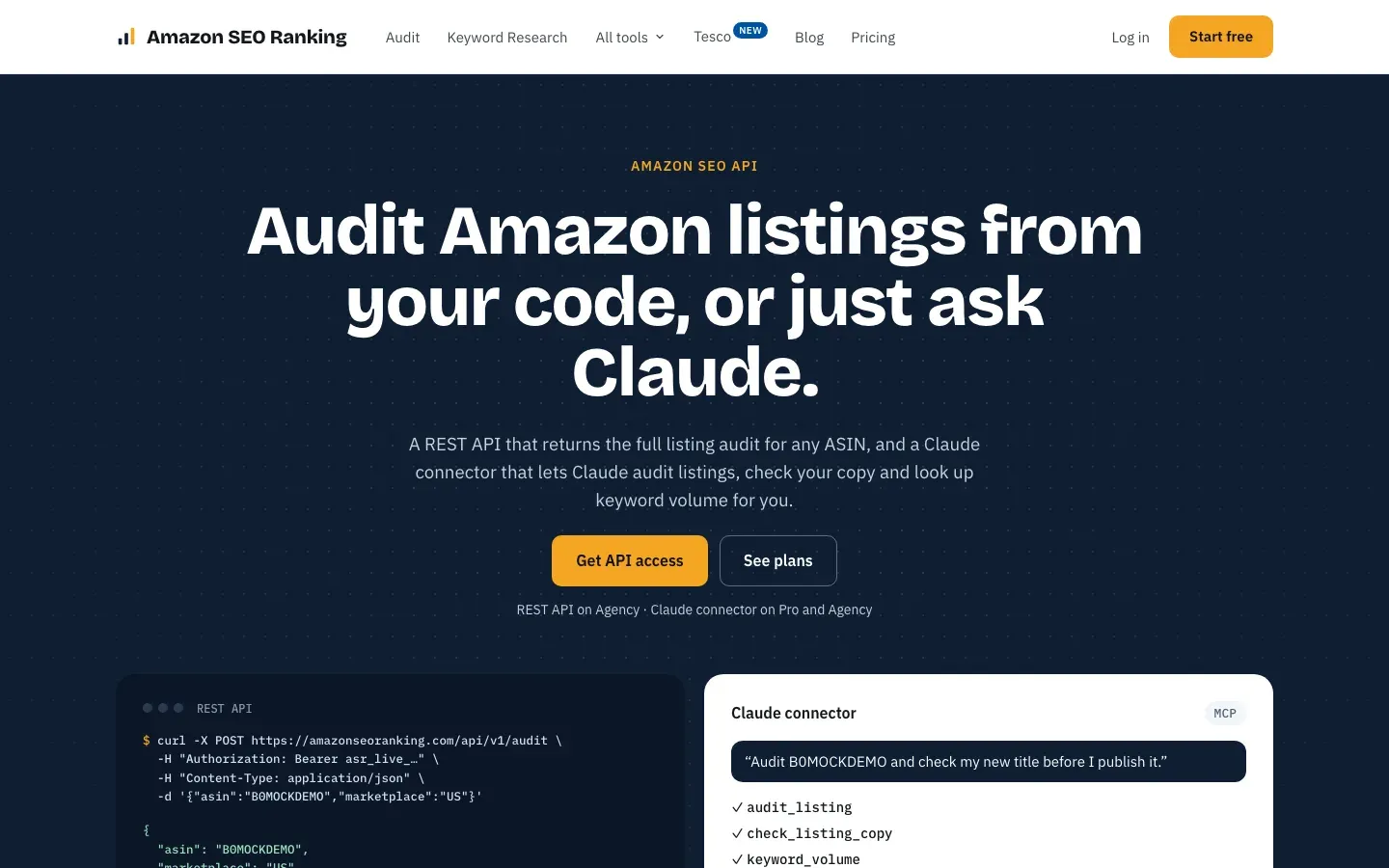
Amazon SEO Ranking is a self-serve tool that audits a live Amazon listing against 12 published criteria and rewrites what fails with AI. Its Claude connector (Pro and Agency) and REST API (Agency) expose the same audit engine and keyword data to AI assistants and your own code, so scores match the web app.
The connector gives Claude six tools: audit_listing (live or draft), check_listing_copy, keyword_volume, related_keywords, keyword_gap (Agency) and list_audits. It works in Claude on the web and desktop and in Claude Code, where Agency accounts can use an API key instead of sign-in. The API's audit endpoint accepts all 23 marketplace codes.
Ideal For
It fits teams whose AI work centres on listing copy:
- Sellers who draft titles and bullets in Claude and want them checked before pasting
- Agencies that need a published, repeatable score in their own reports
- Developers adding a listing-quality score to internal dashboards
- Brands checking the same ASIN across several Amazon storefronts
- Teams that want an assistant to research keywords without a full research suite
Top Features
These cut the steps between a draft and a listing that passes:
- Draft audits from Claude: score copy that isn't live yet against the live listing's images, rating and Prime status, so you see the score change before Amazon does.
- check_listing_copy counts Amazon's length limits in code (75-character title, 125-character Item Highlights, bullets under 200 characters, 249-byte backend terms), flags pack counts that disagree across fields and the spec table, and flags risky backend terms, at no quota cost. On Pro and Agency it adds an AI policy compliance scan.
- Brand facts as an input: pass your approved facts and banned claims, and the checker flags any claim the spec table or your brand facts don't support, such as "detox" or "protein" on a product that can't back it.
- Amazon search volume and keyword ideas, graded Close match, Related or All, so the assistant drops off-topic ideas before it writes.
- Keyword gap across up to 20 ASINs on Agency, showing the searches rivals rank for and you don't.
- A REST API with ranked recommendations and a notVerified list for criteria Amazon's data can't confirm, so a missing Prime flag isn't scored as a fail.
- Published limits: 20 requests a minute, 300 an hour, up to 10 keys per account; unchanged listings reuse their last result for free, and failed audits are refunded.
Why We Stand Out?
Most servers in this list give an assistant data: keywords, ranks, history, account metrics. Ours is the only one whose checks are published and run on draft copy before it goes live. The difference shows when Claude writes a title: with our connector it can pull volume for the main phrase, write the title, confirm it fits 75 characters, confirm the pack count matches the spec table, check every claim against your brand facts and score the whole draft against 12 criteria, in one chat.
The method is published. Gallery count, rating and Prime come from live data, length rules are enforced in code, and title and bullet quality are graded against written pass rules, so an agency can explain every lost point to a client. An unchanged listing reuses its last audit, so the same ASIN never gets two scores. Helium 10 says its MCP can score listings too, but its Listing Analyzer doesn't publish how each check is weighted.
If you'd rather not prompt Claude at all, the same Pro plan includes the web app's AI rewrite, which fixes the criteria the audit failed, and Bulk Optimization, which runs audit and rewrite across up to 100 ASINs at a time (500 on Agency).
Price is the third difference. The connector comes with Pro at $79 a month, against Helium 10's Diamond at $359 for its MCP. The free plan's 3 audits a month let you test the scoring on your own ASIN with no card.
Pros
- Draft audits and a copy checker callable from Claude
- Published 12-criteria method, identical across web, API and connector
- 23 storefronts for audits, 15 for search volume
- Claude connector from $79/mo, with no API key to manage
- Documented rate limits, errors and refunds
Cons
- Doesn't write changes to Seller Central; you paste the approved copy or push it with an account connector
- No product research, sales estimates, price history, profit or ads data
- The REST API returns audit data only (no price, rating or bullet text), and it's on Agency, not Pro
Pricing
Free includes 3 full audits a month with no card. Pro is $79/mo or $799/yr with 100 audits and the Claude connector. Agency is $249/mo or $2,490/yr with 500 audits, the REST API, keyword gap and white-label reports. Monthly plans start with a 7-day free trial. From November 23 to 30, a year of Pro is $348 and a year of Agency is $799.
Final Verdict
For a seller or agency that writes or reviews listings with an AI assistant, Amazon SEO Ranking is the connector that tells Claude whether the copy will pass, with a method you can read. Pair it with an account connector if you want changes written back automatically. See the Amazon SEO API for the endpoints, keys and limits.
2. Amazon Selling Partner Plugin
Overview
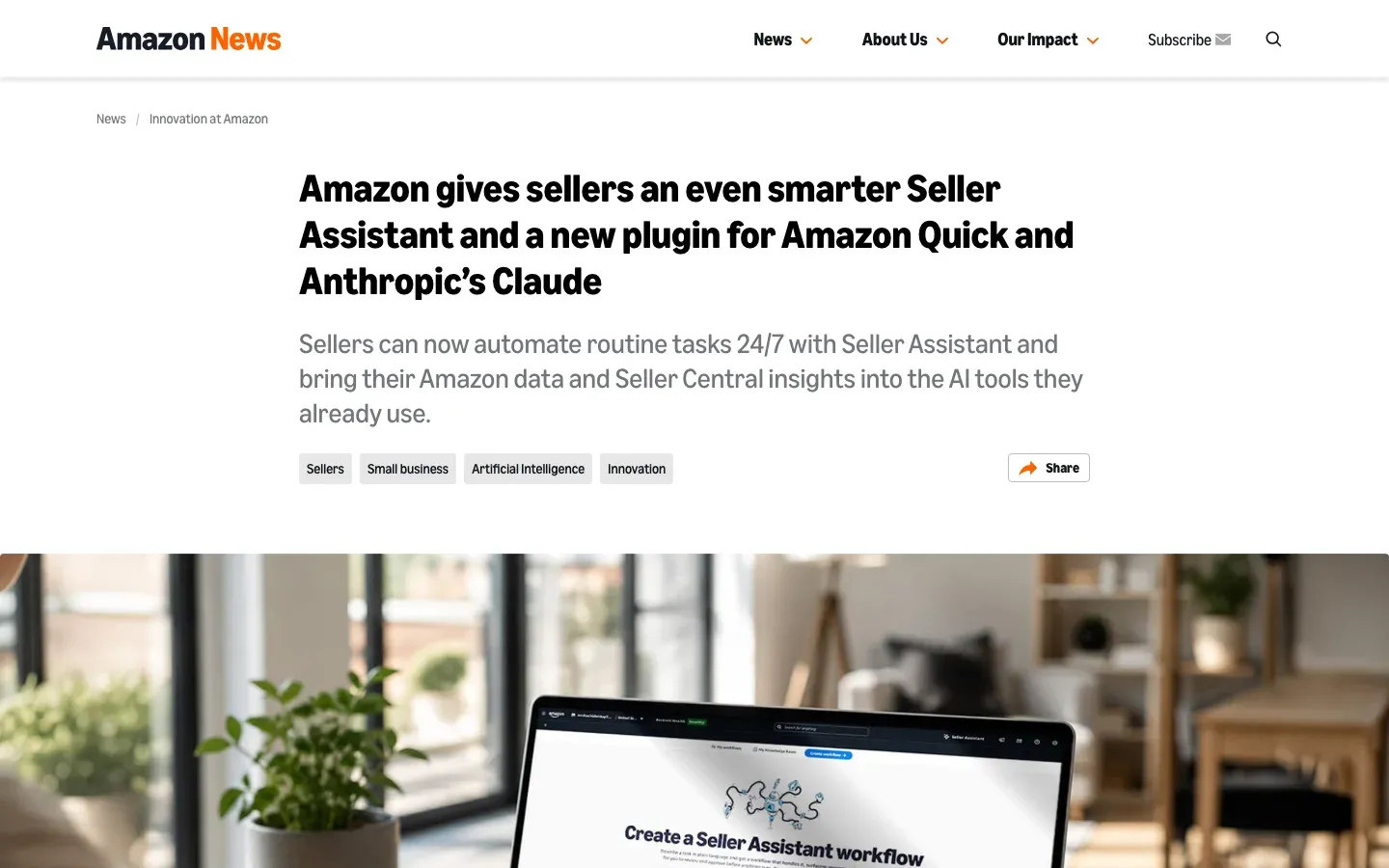
Amazon launched the Selling Partner plugin at Accelerate on September 23, 2026. It brings Seller Assistant, the AI agent inside Seller Central, into Amazon Quick and, in beta, into Claude, where the connector directory lists it as Amazon Selling Partner. Amazon says it connects in roughly 60 seconds with no coding.
The plugin links your listing contributions, real-time performance metrics, inventory and sales analytics to the assistant, and it can act on the account, such as adjusting a price, after you approve each action. The beta covers sellers in Amazon's US stores, with international expansion planned.
Ideal For
- US sellers who want Seller Central data inside Claude
- Sellers who already use Seller Assistant in Seller Central
- Small teams that want account actions with approval and an audit trail
- Sellers trying MCP for the first time
Top Features
- Listings, inventory, sales and performance metrics in Claude
- Actions on your account after you approve each one
- Access limits and complete audit trails, per Amazon
- Free 12-month Amazon Quick Plus for primary account holders who sign up by December 31, 2026
Why They Stand Out?
It's built and run by Amazon, which removes the trust question that third-party connectors raise. For a US seller, it's one of the smartest first connections because it reads the account data no outside tool can see without SP-API access.
Pros
- Official and maintained by Amazon
- Reads and acts on your own account
- Human approval on every action
- No separate fee published
Cons
- Beta, US stores only
- Built around one seller's own account, so agencies with many clients need another route
- No keyword search volume or published listing score
Pricing
Amazon hasn't published a separate fee for the plugin. Primary account holders can also claim a free year of Amazon Quick Plus through December 31, 2026.
Final Verdict
Connect it if you sell in the US and want your own account in Claude. It tells the assistant what's happening in Seller Central; it doesn't tell it whether new copy follows Amazon's listing rules or which keywords have volume.
3. Amazon Selling Partner API (SP-API)
Overview
SP-API is Amazon's official REST API for sellers and vendors. For listing work, the key piece is the Listings Items API, which lets you create, edit and delete listings, including titles, price and inventory. Payloads follow the Product Type Definitions schema for each marketplace and product type.
Amazon also publishes an SP-API Dev Assistant and Workflow Builder MCP for developers building against the API, and dozens of open-source MCP servers wrap SP-API for Claude. Amazon had planned a $1,400 annual developer fee from 2026, then dropped both the annual and usage fees after developer pushback.
Ideal For
- Developers and agencies writing listing changes at volume
- Brands building internal listing tools on their own account
- Teams pairing a copy checker with automated publishing
- Vendors and sellers who need bulk feeds
Top Features
- putListingsItem and patchListingsItem for full and partial listing updates
- Product Type Definitions to validate attributes per category
- Bulk uploads through the JSON listings feed
- Official dev MCP for building integrations with an AI assistant
Why They Stand Out?
SP-API is the route every account connector in this list uses underneath. Going direct gives the most control over what gets written, and it's free for sellers working on their own account.
Pros
- Official, documented and free for sellers
- Full write access to listings
- Bulk feeds for large catalogs
- Proposed developer fees withdrawn
Cons
- Developer registration, OAuth and roles before the first call
- A full update can drop attributes you leave out, per Amazon's docs
- No search volume, quality score or competitor data
- Not usable by non-technical teams without a wrapper
Pricing
Free for sellers with a Professional selling account. The developer fees announced in November 2025 were cancelled in May 2026.
Final Verdict
SP-API is the right base for developers who need to publish listing changes in code. Check the copy first, because the API accepts a valid payload whether or not the title is any good.
4. Helium 10 MCP
Overview
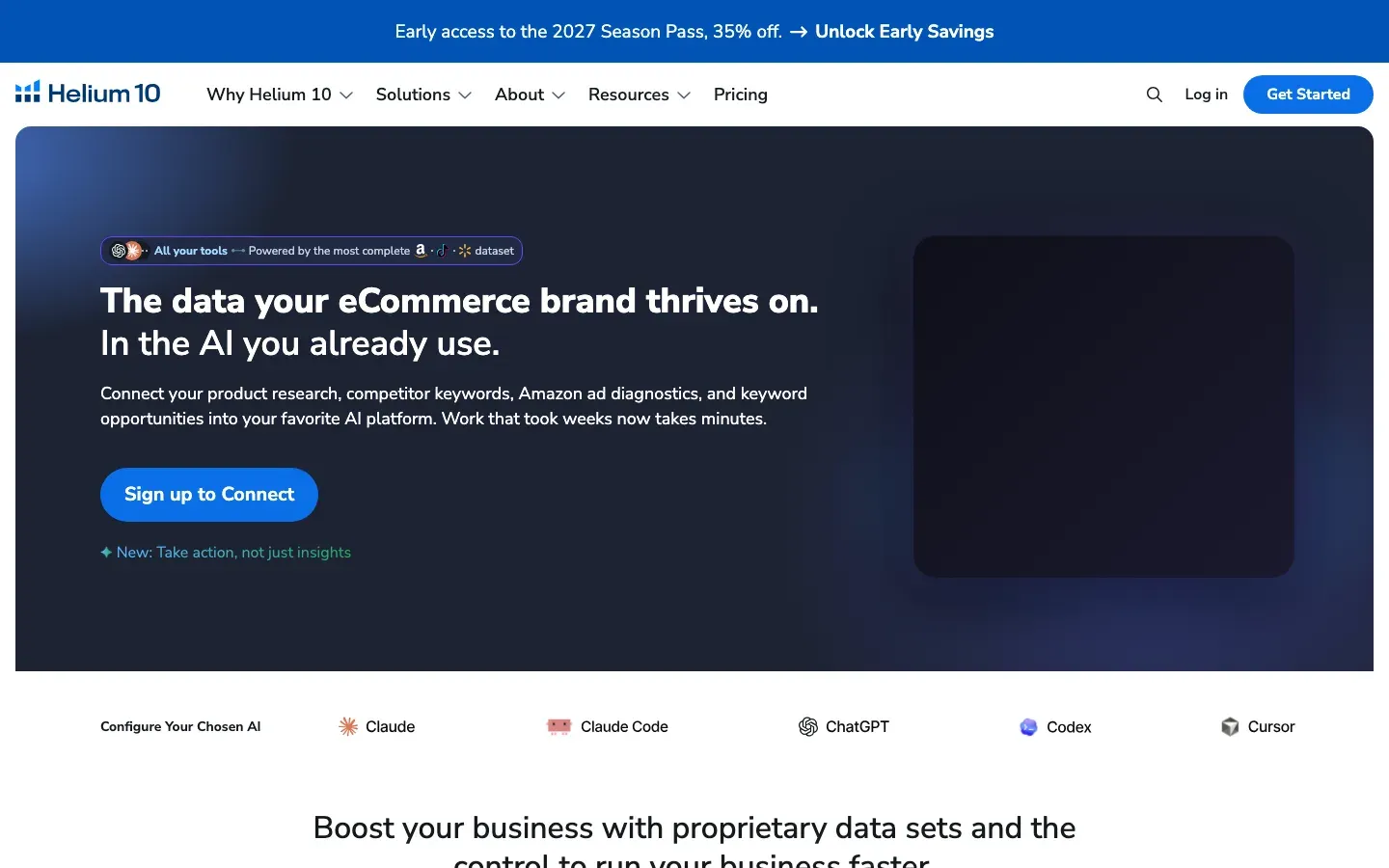
Helium 10 launched its MCP on July 16, 2026, for Diamond plan customers at no extra cost. It exposes more than 40 tools across keyword research, reverse ASIN, product research, Brand Analytics, ads management and account profit, in Claude, ChatGPT, Cursor and custom agents.
It covers 24 marketplaces and pulls Amazon, Walmart and TikTok Shop data through one connection, with multi-account support for agencies.
Ideal For
- Existing Helium 10 Diamond customers
- Agencies pulling research and ads data for several accounts
- Brands selling on Amazon, Walmart and TikTok Shop
- PPC teams who want ads queries in Claude
Top Features
- Reverse ASIN and keyword research from Helium 10's research tools
- Brand Analytics search
- Ads queries and campaign management
- Account profit data
Why They Stand Out?
Helium 10's MCP is one of the strongest choices for keyword and ads depth in an AI assistant, because the data comes from a long-running research suite. For a team already paying for Diamond, it adds AI access at no extra cost.
Pros
- Deep keyword and reverse ASIN data
- Ads and profit in the same connection
- 24 marketplaces plus Walmart and TikTok Shop
- Multi-account for agencies
Cons
- Diamond only, $359/mo ($279/mo billed annually)
- Scores listings, but Listing Analyzer doesn't publish how each check is weighted
- MCP calls are capped (up to 1,000 included with Diamond)
Pricing
Included with Diamond at $359/mo, or $279/mo billed annually. Not available on Platinum. See our Amazon SEO Ranking vs Helium 10 comparison for what each covers.
Final Verdict
Helium 10's MCP suits Diamond customers who want research and ads data in Claude. It feeds the assistant strong keyword data; for a score you can explain line by line, or checks on a draft before it goes live, you'll need another tool.
5. Jungle Scout API & MCP
Overview
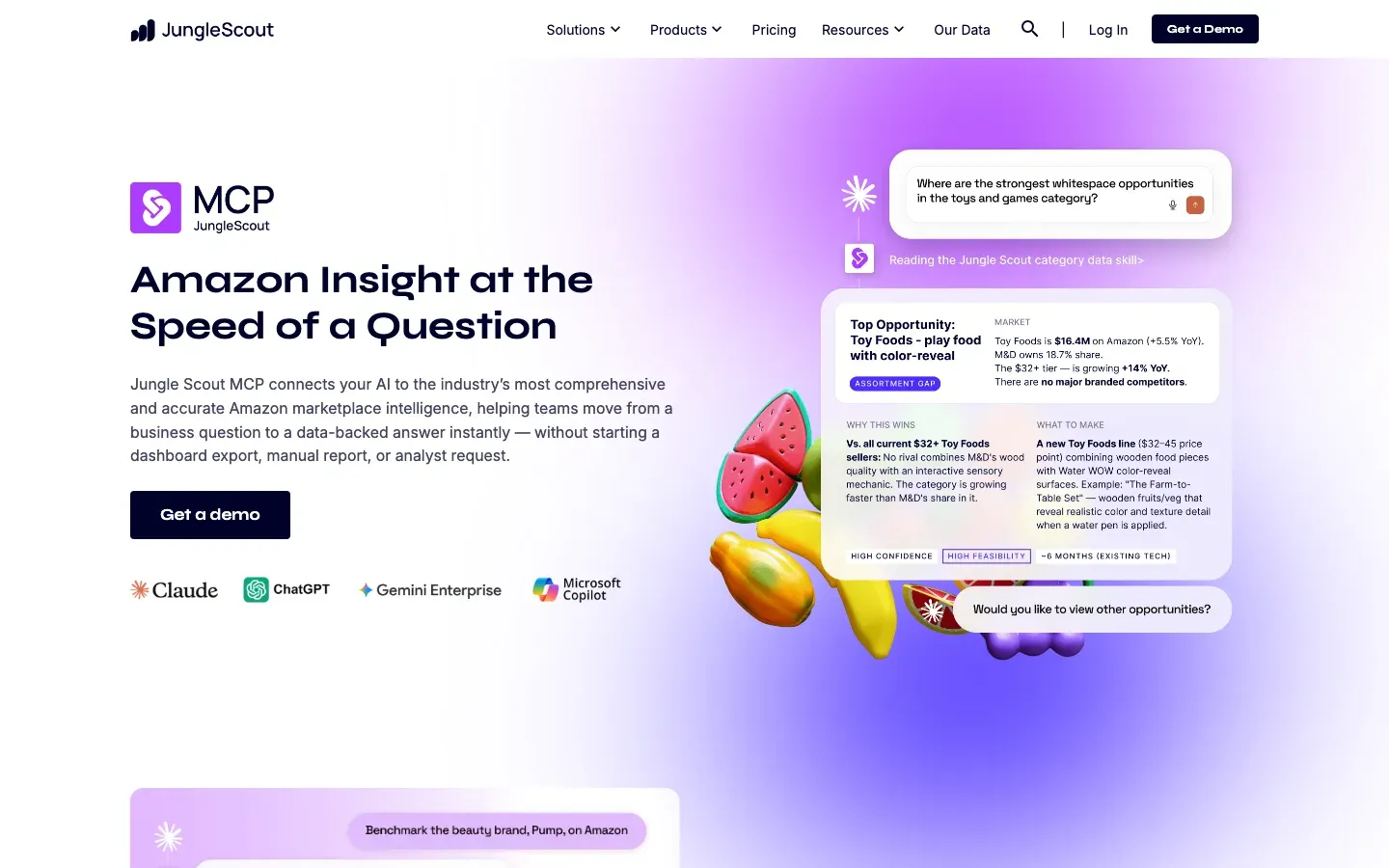
Jungle Scout sells programmatic access to its Amazon data through the Jungle Scout API and a Jungle Scout MCP tied to its Cobalt enterprise product. Depending on data access, the MCP covers market share and category growth, brands and sellers, products and ASINs, pricing tiers, keywords and share of voice.
It works with Claude, ChatGPT, Gemini, Copilot and approved internal AI environments. New customers request a demo; existing customers ask their account representative.
Ideal For
- Large consumer brands on Cobalt
- Category and insights teams tracking share of voice
- Enterprises with approved internal AI environments
- Teams that want market data rather than listing checks
Top Features
- Market share and category growth
- Keyword and share-of-voice data
- Sales estimates and product database queries
- Connected sales and advertising data where available
Why They Stand Out?
Jungle Scout's MCP is one of the smartest choices for enterprise brands that need category-level answers in an assistant. Its data covers the market around a listing, which suits planning and range reviews.
Pros
- Market and share-of-voice data
- Broad AI client support
- Runs in approved internal AI environments
- Backed by a long-running Amazon dataset
Cons
- MCP tied to Cobalt; the API needs a Growth Accelerator or Brand Owner plan or Cobalt
- No published MCP price
- No listing audit or copy checks
Pricing
MCP access depends on a Cobalt subscription, and Jungle Scout publishes no MCP-specific price; pricing comes through a demo. The Jungle Scout API is an add-on for Growth Accelerator, Brand Owner or Cobalt accounts, from $29/mo for 1,000 requests.
Final Verdict
Jungle Scout's API and MCP suit enterprise brands planning around category data. Smaller sellers and agencies will find the access route heavy for listing work.
6. DataForSEO
Overview
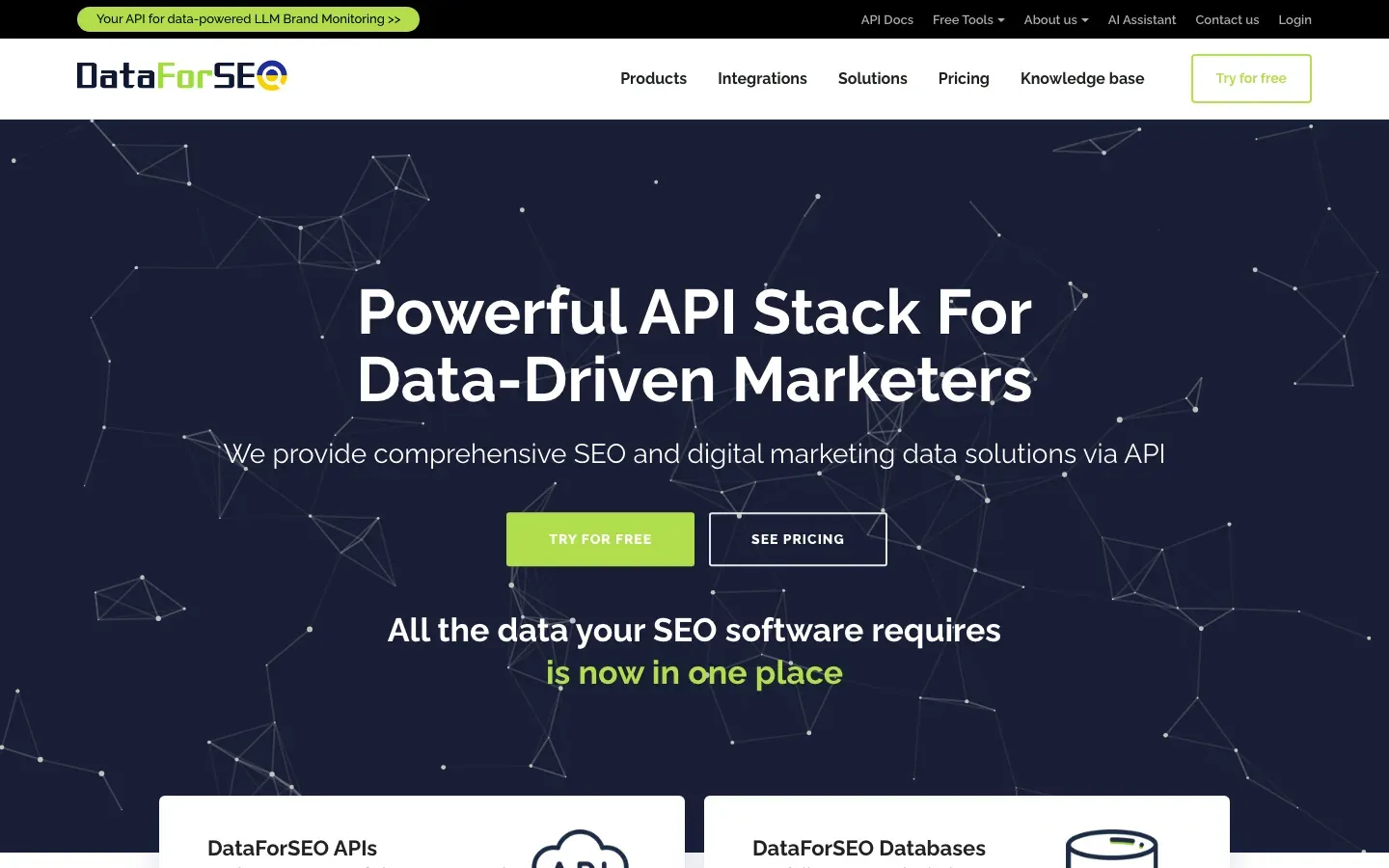
DataForSEO is a pay-as-you-go data API for SEO tools, and its DataForSEO Labs Amazon API returns Amazon ranked keywords, product rank overviews, product competitors and keyword intersections. A separate Merchant API returns Amazon search results, product data and sellers by keyword or ASIN.
DataForSEO runs a hosted MCP server that exposes its API families to Claude and Cursor, billed per call from a prepaid balance.
Ideal For
- Developers building their own Amazon keyword tools
- SEO agencies already using DataForSEO for Google
- Teams that want pay-per-call pricing with no seats
- Builders who want Amazon and Google data from one vendor
Top Features
- Ranked keywords and competitors per ASIN
- Keyword intersections across ASINs
- Amazon SERP and product data through the Merchant API
- Hosted MCP server
Why They Stand Out?
DataForSEO is one of the strongest choices for builders who want Amazon keyword data at low unit cost. Its pricing page puts 1 million keywords or ASINs at $132.
Pros
- Low per-call pricing
- Amazon and Google data in one account
- Hosted MCP plus documented API
- No monthly seat fee
Cons
- Built for developers; no listing UI
- Live mode only on the Labs Amazon endpoints
- Supported Amazon locations aren't listed on the pricing page
- No listing-quality checks
Pricing
The Labs Amazon API charges $0.012 per task plus $0.00012 per item returned, from a prepaid balance, with a free trial.
Final Verdict
DataForSEO suits developers who want cheap Amazon keyword data to build on. You still need to write and check the listing somewhere else.
7. Keepa API
Overview
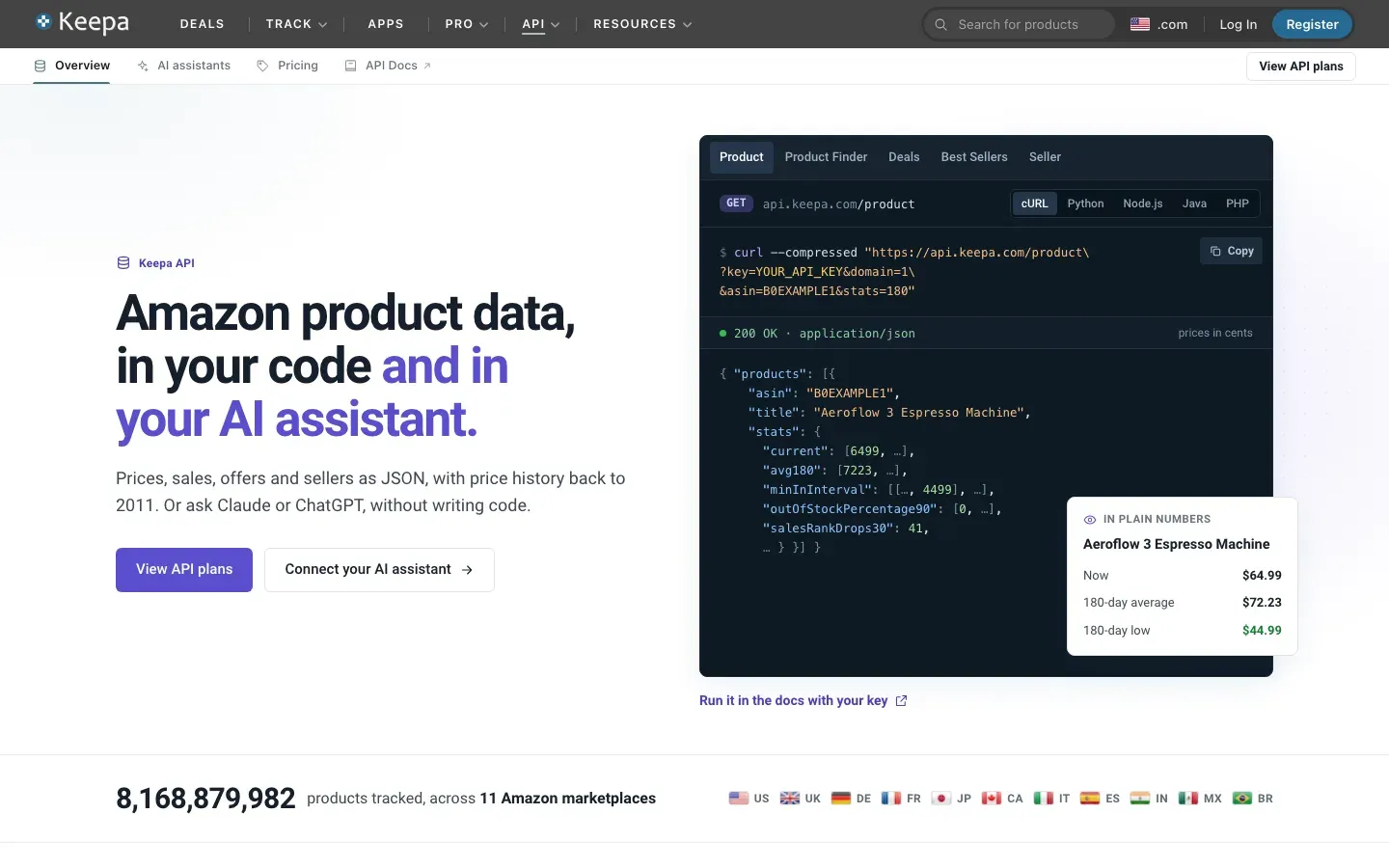
The Keepa API returns the data behind Keepa's charts: price history, sales rank, Buy Box and offers, deals, best sellers and seller information. It's priced by tokens generated per minute, and a product request costs 1 token per ASIN, with offers and searches costing more.
Keepa also runs its own hosted MCP server, its AI connector, which every API plan includes for Claude, ChatGPT and other MCP clients.
Ideal For
- Developers building repricing or sourcing tools
- Analysts who need price and rank history
- Arbitrage and wholesale teams
- Teams that already pay for Keepa data
Top Features
- Price and sales rank history per ASIN
- Buy Box and offer data
- Deals and best seller lists
- Category and seller lookups
Why They Stand Out?
Keepa's history is one of the most trusted datasets in Amazon tooling, and several seller tools build on it. For history questions, it's one of the smartest data sources an assistant can call.
Pros
- Long, trusted price and rank history
- Clear per-request token costs
- Scales from €49 to enterprise volumes
- Official AI connector included in every plan
Cons
- No free API tier
- Unused tokens expire after an hour
- Connector calls draw on the same token budget
- No keyword volume or listing checks
Pricing
From €49/mo for 20 tokens a minute, up to €11,099/mo for 10,000 tokens a minute.
Final Verdict
Keepa's API suits anyone who needs history in their tools or assistant. It explains what happened to price and rank, not what to change in the listing.
8. Rainforest API
Overview
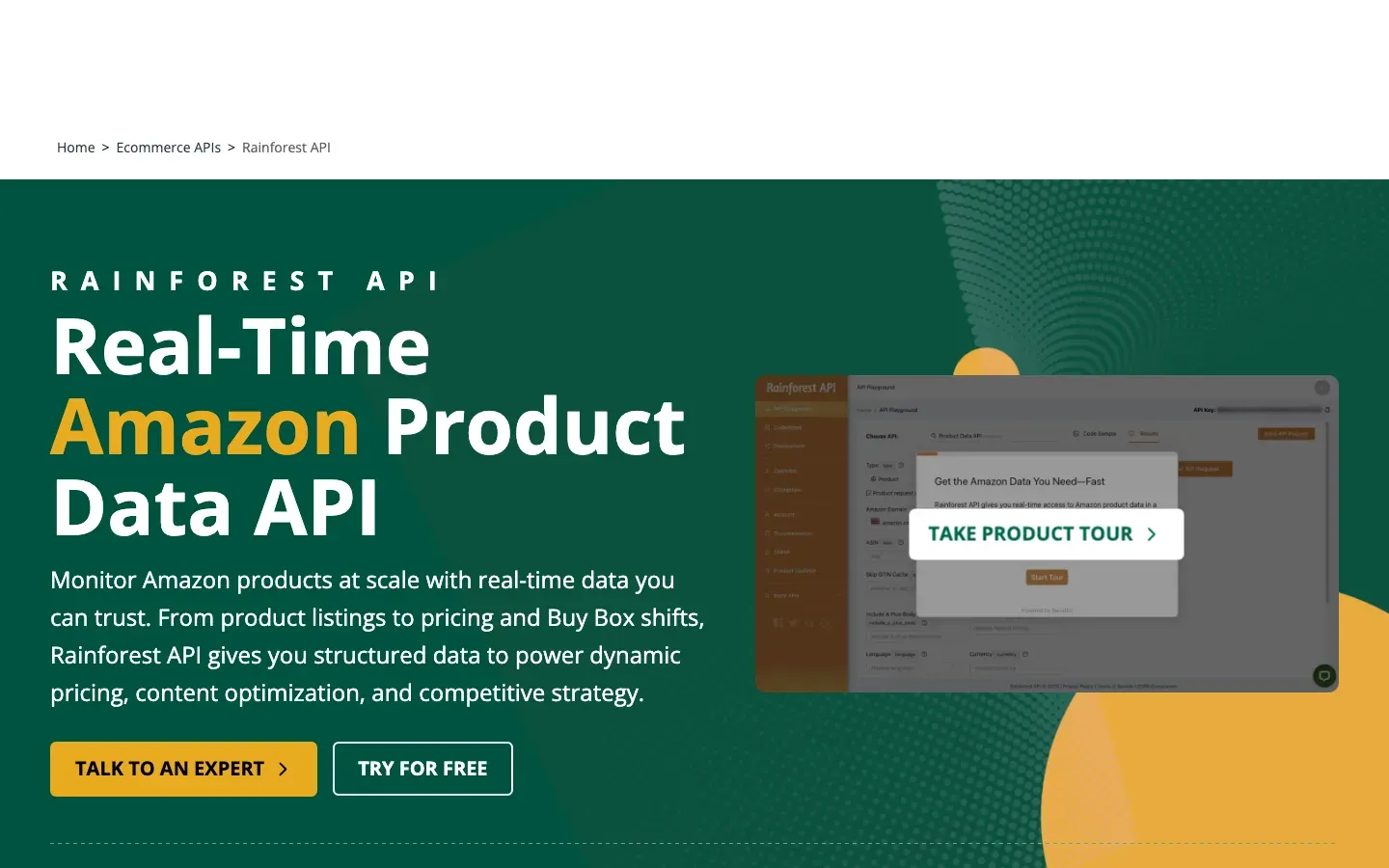
Rainforest API, from Traject Data, returns real-time structured data from Amazon product pages, search results, reviews, offers and best seller lists. Requests run live, and Collections let you queue thousands of requests on a schedule.
It supports all major Amazon marketplaces, with output as JSON or CSV by direct pull, webhook or cloud storage. Traject's pricing page doesn't mention an MCP server.
Ideal For
- Developers monitoring competitor listings
- Brands tracking content changes and unauthorized sellers
- Teams feeding public listing data into their own models
- Builders who don't want to run scrapers
Top Features
- Live product, search, review and offer data
- Scheduled Collections
- Webhook and cloud storage delivery
- Sales estimates
Why They Stand Out?
Rainforest API is one of the strongest choices for public listing data without scraping upkeep. It's a practical source for an internal tool that watches competitor titles and images.
Pros
- Real-time public listing data
- Scheduled bulk runs
- Wide marketplace coverage
- Free trial
Cons
- No MCP server listed
- Entry plans cost more per credit ($0.06 extra credits on Hobbyist)
- Returns raw data, with no analysis
- No seller account access
Pricing
From $23/mo billed annually for 500 credits, up to $9,000/mo for 20 million. Annual billing is 20% off.
Final Verdict
Rainforest API suits developers who need fresh public listing data in their own systems. Pair it with a checker if the goal is better listings rather than monitoring.
9. DataDoe
Overview
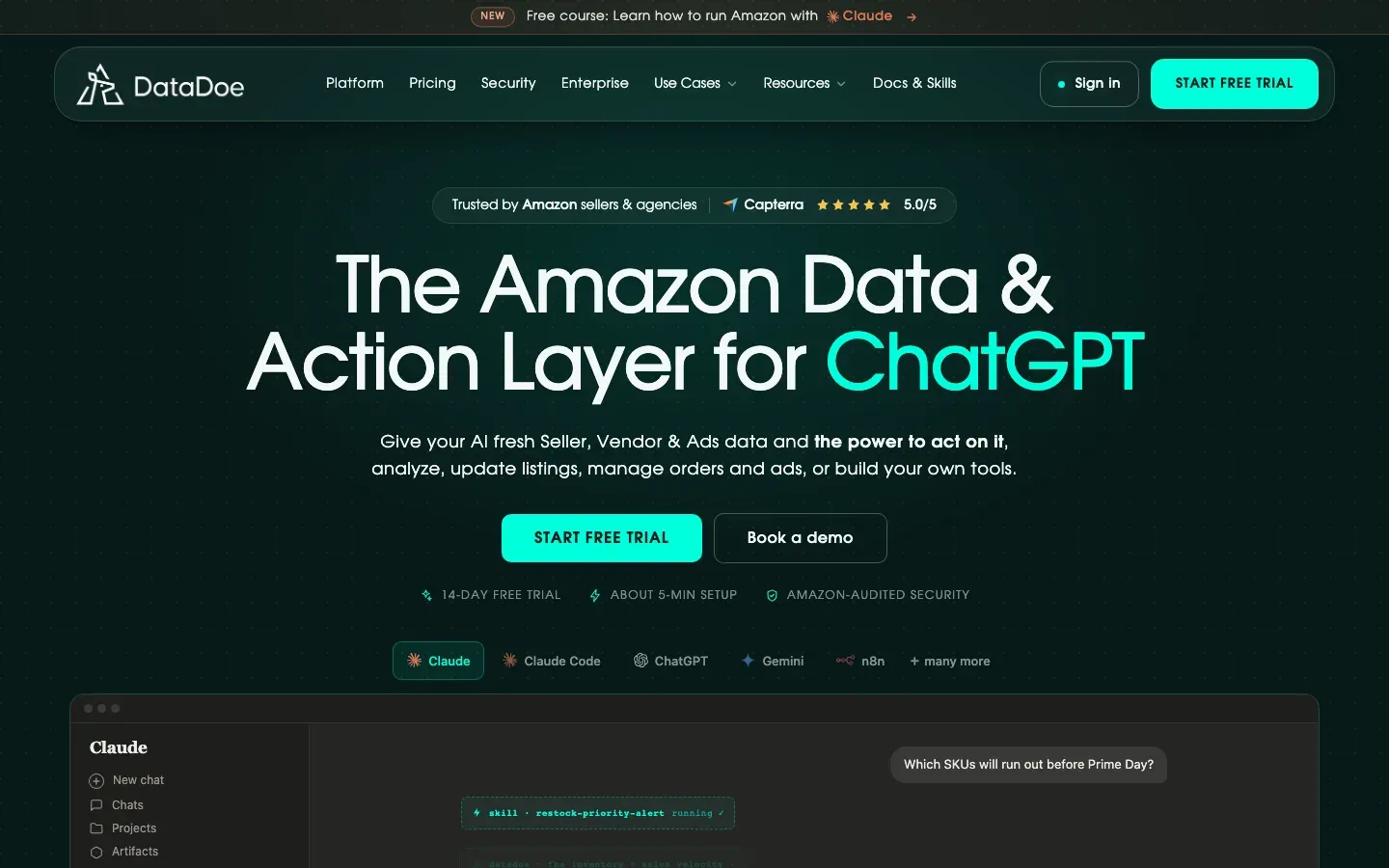
DataDoe is a hosted MCP server and data layer over Amazon Seller Central, Vendor Central and Amazon Ads. It syncs your accounts into one schema and exposes it to Claude, ChatGPT, Cursor and other MCP clients, plus REST and BigQuery.
Writes, such as updating listing titles, bullets and prices or adjusting campaigns, are switched off until you allow them and are approval-gated.
Ideal For
- Agencies running many seller and vendor accounts
- Vendors who need Vendor Central data in an assistant
- Teams combining sales, ads and inventory in one query
- Builders who want BigQuery access
Top Features
- Seller, Vendor and Ads data in one schema
- MCP, REST API and BigQuery
- Approval-gated writes to listings, prices and campaigns
- Unlimited Amazon account connections
Why They Stand Out?
DataDoe is one of the smartest choices for agencies that want every client account in one assistant without registering as SP-API developers. Flat pricing across unlimited accounts helps as the client list grows.
Pros
- Seller, Vendor and Ads in one place
- Unlimited accounts at a flat price
- Writes off until enabled
- Several access routes
Cons
- $97/mo with no free plan
- Caps on monthly AI tokens (2,000) and stored data rows (10 million)
- No keyword volume or listing-quality score
- Third-party access to your account data
Pricing
$97/mo, one plan, with unlimited Amazon account connections and a free trial.
Final Verdict
DataDoe suits agencies and vendors who want account data and actions across many accounts. It reports and acts; it doesn't judge listing copy.
10. Amazon Ads MCP Server
Overview
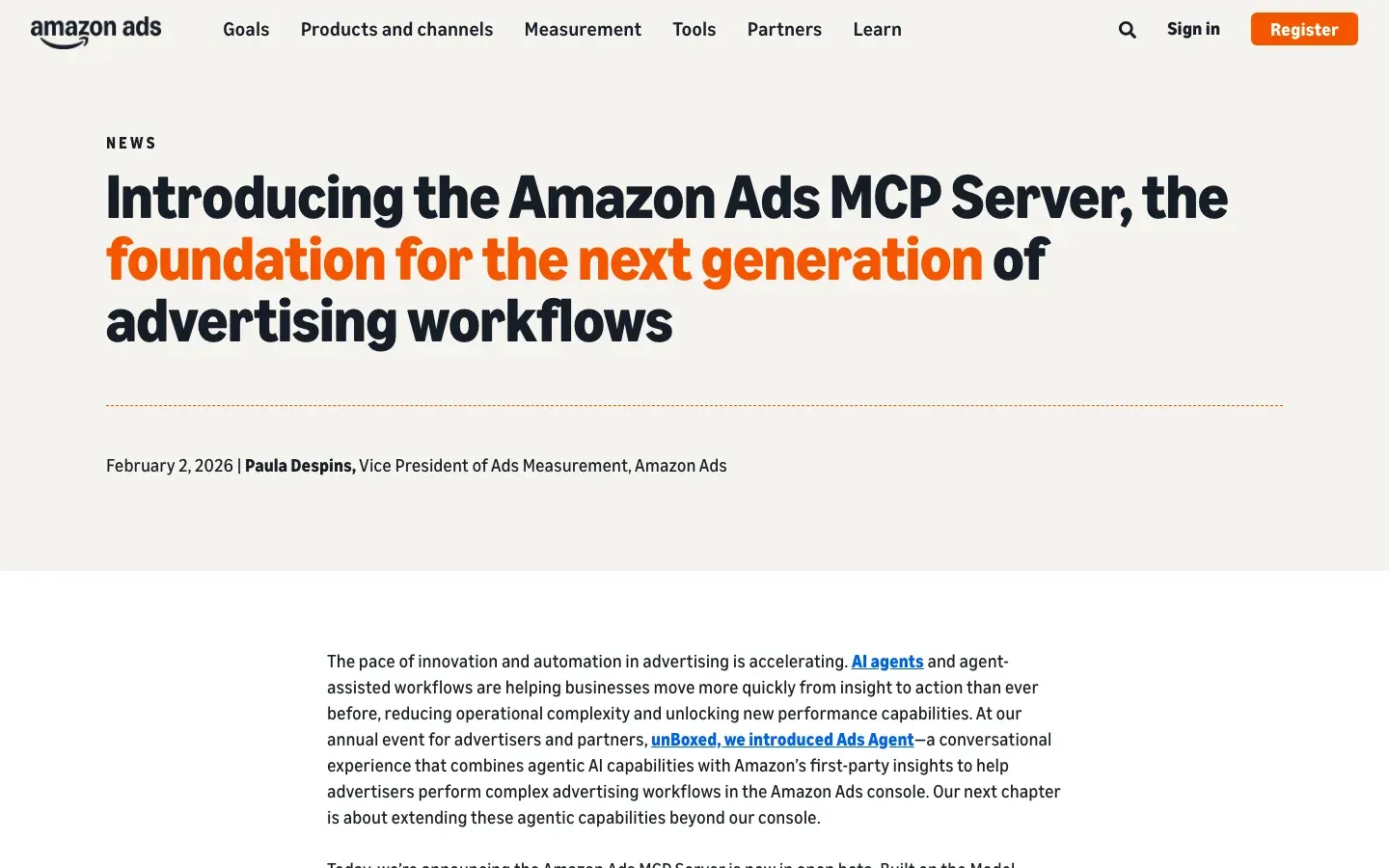
Amazon Ads put its MCP server into open beta on February 2, 2026. It connects AI agents to Amazon Ads API functions: creating, updating or deleting campaigns, running reporting queries, managing account settings and billing.
It includes pre-built workflow tools, such as one that builds a ready-to-launch campaign for review and approval. It's available globally to Amazon Ads partners with active API credentials.
Ideal For
- PPC managers and ads agencies
- Advertisers with Amazon Ads API credentials
- Teams automating campaign builds and reports
- Developers building ads agents
Top Features
- Campaign create, update and delete
- Reporting queries
- Pre-built campaign workflows
- Works with Claude, ChatGPT and other MCP clients
Why They Stand Out?
It's Amazon's own ads server, which makes it one of the strongest choices for ad workflows in an assistant. It's open to anyone who already holds Ads API access.
Pros
- Official, with no published fee
- Covers campaigns and reporting
- Pre-built workflows
- Global availability
Cons
- Needs Amazon Ads API credentials
- Changes run under your API credentials; Amazon describes a review step only for its pre-built campaign workflow
- No organic listing or SEO data
- Beta
Pricing
Amazon hasn't published a fee; access requires active Amazon Ads API credentials.
Final Verdict
Connect it if your AI work is advertising. For organic ranking, the listing itself still needs its own checks.
How to Choose the Best Claude Amazon Connector or API
The best Claude Amazon setup usually combines two or three tools: one to check, one for data and, if you want automation, one to write. These seven checks narrow the list.
1. Name the Job: Check, Research or Change
Write down what you want the assistant to do most. "Is this copy compliant and strong?" is a checker (Amazon SEO Ranking). "Which keywords and how much volume?" is a data source (Amazon SEO Ranking, Helium 10, DataForSEO). "Update the listing" is an account connector (Amazon's plugin, DataDoe or SP-API).
A tool built for another job gives the assistant numbers that don't help. Profit data won't tell Claude that a title runs to 92 characters, and a keyword list won't push the fix to Seller Central.
2. Check Who Can Get Access
Access rules vary more than features. Amazon's plugin is a US beta, the Ads MCP Server needs Ads API credentials, Jungle Scout's MCP needs Cobalt, and Helium 10's needs Diamond.
Self-serve tools let you test today. Amazon SEO Ranking's connector is on Pro with a 7-day trial, and the free plan's 3 audits run the same engine, so you can judge the scoring on your own ASIN first.
3. Work Out the Real Cost Per Call
Pricing models differ: flat plans, tokens per minute, per-task fees and credits. Estimate your monthly calls, then compare. A Keepa token plan expires unused tokens hourly, DataForSEO bills per task and item, and Rainforest draws down monthly credits.
Check what's free inside a plan too. Amazon SEO Ranking's check_listing_copy and list_audits use no quota, unchanged listings reuse their last audit, and failed audits are refunded.
4. Ask Whether It Checks What the Assistant Writes
Most servers in this list feed the assistant data. Few check its output. That matters, because the model still writes the copy, and it still miscounts and overclaims.
Test it: ask the assistant for a title with a pack count that contradicts the spec table and see whether anything catches it. Amazon SEO Ranking's copy checker flags pack-count mismatches, health claims and claims the spec table or your brand fact sheet don't support, and enforces Amazon's length limits in code.
5. Confirm Every Marketplace You Sell In
Coverage ranges from US-only betas to 24 marketplaces. Amazon SEO Ranking audits 23 storefronts and returns search volume in 15; its advanced keyword tools cover four (US, Egypt, Saudi Arabia, UAE).
Check the specific tool, not the vendor. A provider can cover 20 storefronts for one endpoint and four for another.
6. Check the Copy Before Anything Writes to Amazon
Any connector with write access can push a weak or non-compliant title live in seconds. Approval per action helps, but approving a change you can't evaluate isn't a check.
Score the draft first. Amazon SEO Ranking's audit_listing scores draft copy against the live listing's images, rating and Prime status and shows the change against the last live score, without saving the draft. Then publish with a connector that asks before it acts.
7. Ask Whether the Score Is Repeatable and Explainable
A score is only useful in a client report or a team review if the same listing gets the same score every time, and you can say why it lost points. Ask each vendor whether its method is published and what happens when data is missing.
Amazon SEO Ranking publishes all 12 criteria and their pass rules, reuses the last audit for an unchanged listing and returns criteria it can't confirm as notVerified instead of failing them. Its limits are published too: 20 requests a minute and 300 an hour, with 429 responses and a Retry-After header.
Everything You Need to Know About Amazon SEO APIs and MCP Servers
The ratings are our judgment for Amazon listing work, based on the published features, access rules and prices above. "Listing SEO Depth" rates how much the tool helps write and check a listing that ranks.
| Company | Pros | Cons | Ease of Use | Integrations | Support | Affordability | Listing SEO Depth |
|---|---|---|---|---|---|---|---|
| Amazon SEO Ranking | Draft audits and copy checks in Claude; published method; documented limits | No writes to Amazon; no research or ads data; API on Agency only | ⭐⭐⭐⭐⭐ | ⭐⭐⭐⭐ | ⭐⭐⭐⭐ | ⭐⭐⭐⭐⭐ | ⭐⭐⭐⭐⭐ |
| Amazon Selling Partner plugin | Official; reads and acts on your account; approval per action | US beta; one account; no keyword or quality data | ⭐⭐⭐⭐⭐ | ⭐⭐⭐ | ⭐⭐⭐ | ⭐⭐⭐⭐⭐ | ⭐⭐ |
| Amazon SP-API | Full listing writes; free for sellers; bulk feeds | Developer setup; full updates can drop attributes; no SEO data | ⭐⭐ | ⭐⭐⭐⭐⭐ | ⭐⭐⭐ | ⭐⭐⭐⭐⭐ | ⭐⭐⭐ |
| Helium 10 MCP | Deep keywords; ads and profit; 24 marketplaces | Diamond only; unpublished score weighting; call cap | ⭐⭐⭐⭐ | ⭐⭐⭐⭐ | ⭐⭐⭐⭐ | ⭐⭐ | ⭐⭐⭐⭐ |
| Jungle Scout API & MCP | Market and share-of-voice data; enterprise controls | MCP needs Cobalt; no public MCP price; no listing checks | ⭐⭐⭐ | ⭐⭐⭐⭐ | ⭐⭐⭐⭐ | ⭐⭐ | ⭐⭐⭐ |
| DataForSEO | Low per-call price; Amazon and Google; hosted MCP | Developer-only; locations not listed; no checks | ⭐⭐⭐ | ⭐⭐⭐⭐ | ⭐⭐⭐ | ⭐⭐⭐⭐⭐ | ⭐⭐⭐ |
| Keepa API | Trusted history; clear token costs | No free tier; tokens expire; history only, no keyword data | ⭐⭐⭐ | ⭐⭐⭐ | ⭐⭐⭐ | ⭐⭐⭐ | ⭐⭐ |
| Rainforest API | Live public data; scheduled runs; free trial | No MCP; raw data only; costs rise with volume | ⭐⭐⭐ | ⭐⭐⭐⭐ | ⭐⭐⭐ | ⭐⭐⭐⭐ | ⭐⭐ |
| DataDoe | Seller, Vendor and Ads; unlimited accounts; gated writes | $97/mo; usage caps; no SEO scoring | ⭐⭐⭐⭐ | ⭐⭐⭐⭐⭐ | ⭐⭐⭐⭐ | ⭐⭐⭐ | ⭐⭐ |
| Amazon Ads MCP Server | Official; no published fee; campaign workflows | Needs Ads credentials; review step only on pre-built workflows; no organic data | ⭐⭐⭐ | ⭐⭐⭐⭐ | ⭐⭐⭐ | ⭐⭐⭐⭐⭐ | ⭐ |
Connect Claude to Your Amazon Listings Today
If you write or review Amazon listings with an AI assistant, give it the checks it can't run on its own. Amazon SEO Ranking's Claude connector lets Claude pull Amazon search volume, write the copy, confirm it fits Amazon's limits and matches the product's facts and your brand's approved claims, and score the draft against 12 published criteria before you publish.
It's trusted by eRetail Search specialists at Nestlé and eCommerce SEO services agencies such as Reach AI. Pro includes the connector for $79 a month with 100 audits, plus the AI rewrite and bulk runs of 100 ASINs, and monthly plans start with a 7-day free trial. Agencies get the REST API, 500 audits and white-label reports on Agency. From November 23 to 30, a year of Pro is $348 and a year of Agency is $799, and every charge has a 14-day money-back guarantee.
Not sure yet? The free plan includes 3 full audits a month, and no credit card is required. Run a free Amazon listing audit on your weakest ASIN, then compare Pro and Agency plans to add the connector.
FAQ
What is the best Claude Amazon connector in 2026?
The best Claude Amazon connector in 2026 for listing SEO is Amazon SEO Ranking, because its six tools let Claude audit live or draft listings against 12 published criteria and check copy for Amazon's length limits and claims. For reading and editing your own US Seller Central account, Amazon's Selling Partner plugin is the official option, in beta. Helium 10's MCP suits Diamond customers who want keyword and ads data. Amazon SEO Ranking's connector is included with Pro at $79/mo.
What is the best Amazon SEO API?
The best Amazon SEO API for listing quality is Amazon SEO Ranking's audit API, which returns a 0-100 score, seven category scores and ranked fixes for any ASIN in 23 storefronts. For raw keyword data, DataForSEO's Labs Amazon API charges $0.012 per task plus $0.00012 per item. For price and rank history, the Keepa API starts at €49 a month. Amazon SEO Ranking's API is on the Agency plan at $249/mo, with 500 audits.
What should I consider when choosing an Amazon MCP server?
When choosing an Amazon MCP server, consider the job first: checking copy, researching keywords or changing your account. Then check who can get access, since Amazon's plugin is a US beta and Helium 10's MCP needs the $359/mo Diamond plan. Compare cost per call, marketplace coverage and published rate limits. For any server that writes to Amazon, confirm it asks for approval before each change.
How does Amazon SEO Ranking differ from similar alternatives?
Amazon SEO Ranking differs from other Amazon MCP servers by checking what the assistant writes, not only supplying data. Its connector scores draft copy against 12 published criteria, counts Amazon's limits in code and flags pack-count mismatches and claims your brand facts don't support. Helium 10, Jungle Scout and Keepa supply research and history data, and Amazon's plugin and DataDoe act on your account. The connector costs $79/mo on Pro against $359/mo for Helium 10 Diamond.
How do I get started with Amazon SEO Ranking?
You get started with Amazon SEO Ranking by creating a free account and running an audit, then upgrading to Pro to add the Claude connector. In Claude, open Settings, choose Connectors, add a custom connector with the URL https://amazonseoranking.com/api/mcp, then sign in and approve. In Claude Code, run the claude mcp add command from the setup page. Monthly plans start with a 7-day free trial.
How easy is it to switch to Amazon SEO Ranking?
Switching to Amazon SEO Ranking is easy because it adds checks alongside the connectors you already use rather than replacing them. There's no Seller Central connection to set up, since audits read the public listing by ASIN. You can keep Helium 10 or Amazon's plugin connected in the same Claude chat. The free plan's 3 audits a month need no card.
Can an MCP server change my Amazon listings?
An MCP server can change your Amazon listings only if it has SP-API access to your account and you allow it. Amazon's Selling Partner plugin acts after you approve each action, and DataDoe keeps writes switched off until you enable them. Amazon SEO Ranking's connector doesn't write to Amazon; it scores and checks copy before you publish. Checking a draft before any connector writes it is the safer order.
Is the Amazon Selling Partner API free?
The Amazon Selling Partner API is free for sellers working on their own account. Amazon announced a $1,400 annual developer fee and usage charges in November 2025, then cancelled both in May 2026. Sellers need a Professional selling account to use it. Developers still register as SP-API developers and authorize through Login with Amazon before the first call.
Let Claude audit live or draft listings and check copy against Amazon's limits and claims. The connector comes with Pro; three free audits a month, no card required.
See the connector