How well do I rank on Amazon? Two different numbers answer that, and they often disagree. Best Sellers Rank (BSR) tells you how your sales compare with other products in a category. Keyword rank tells you where your listing appears when a shopper types a specific search. To know whether shoppers can find you, check keyword rank first, then use BSR as a read on sales.
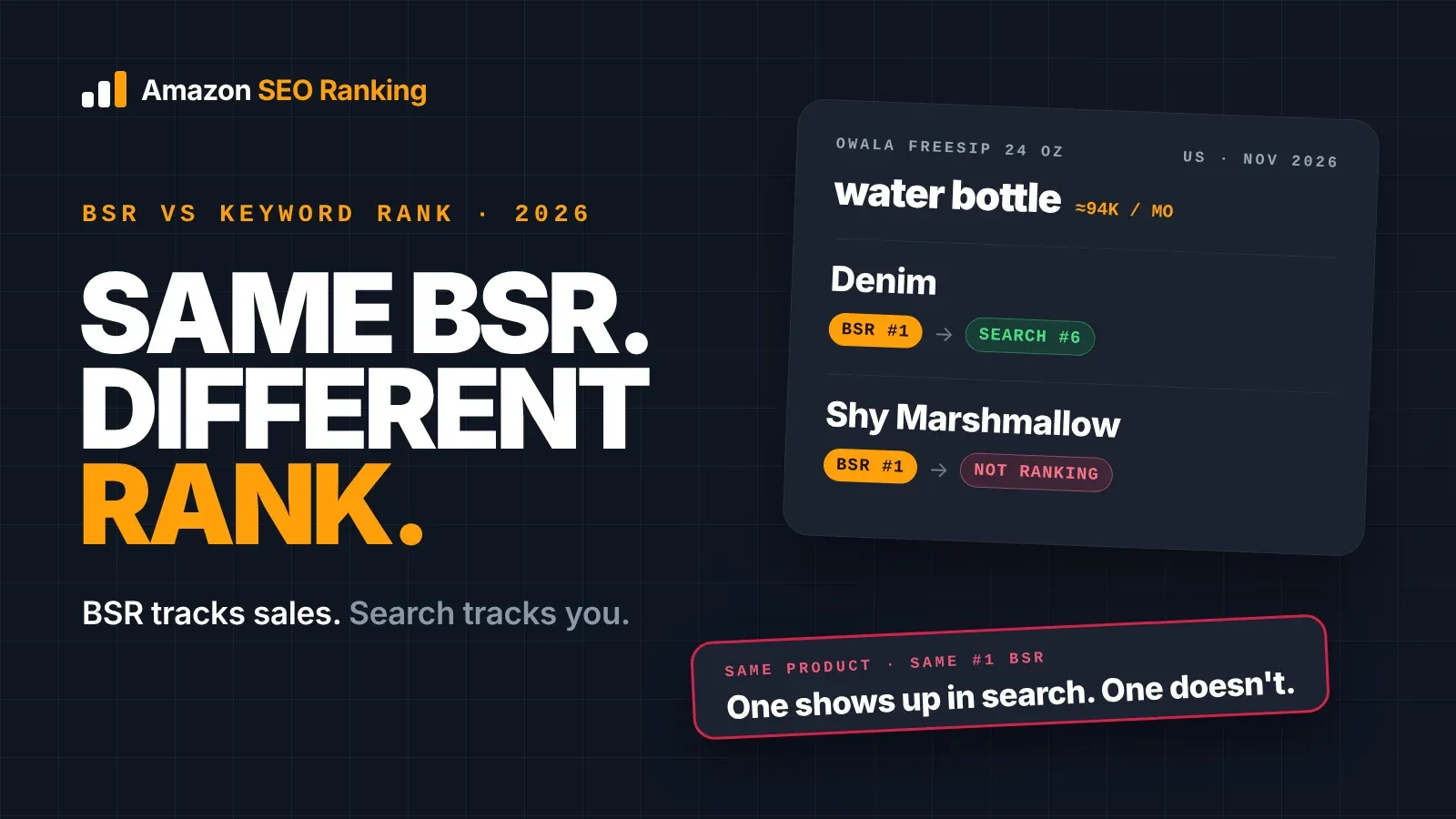
We checked two colors of the same product on 11 November 2026 to show the gap. The Owala FreeSip 24 oz in Denim and in Shy Marshmallow both showed the same Best Sellers Rank on their product pages: #1 in Kitchen & Dining, #1 in Travel & To-Go Drinkware and #1 in Insulated Bottles. In search, they were far apart. Denim sat at #6 for "water bottle" (about 94,000 estimated monthly US searches). Shy Marshmallow didn't rank for it at all.
So a perfect BSR said nothing about the search that matters most to a water bottle. The rest of this guide covers what each rank measures, where to see it, and the four numbers that tell you how well you rank on Amazon.
Key Takeaways (TL;DR)
- BSR is a sales rank. Amazon calculates it from sales, with recent sales counting more than older ones. Page views and reviews don't affect it.
- Keyword rank is a search rank. It's your organic position for one search, in one marketplace, and it changes with the query.
- The two can disagree. In our test, two colors with the same #1 BSR ranked #6 and "not ranking" for the same 94,000-search keyword.
- Check four numbers: the searches you're missing, why the listings above you win, your impression share in Brand Analytics, and BSR in your smallest subcategory as a sales check.
- Act on keyword rank. BSR follows sales. Keyword rank shows which searches you're missing, and the listing is where you win them back.
How Well Do I Rank on Amazon: at a Glance
| Signal | What it measures | Where you see it | Who can see it | What it tells you |
|---|---|---|---|---|
| Best Sellers Rank (BSR) | Sales compared with other products in a category | Product information section of the product page | Everyone | Whether the product sells well in its category |
| Organic keyword rank | Position in search results for one query | Amazon search results, or a keyword rank tool | Everyone | Whether shoppers find you for a specific search |
| Sponsored rank | Position bought with ads for one query | Search results, ad reports | Everyone (results), you (reports) | How much visibility you pay for |
| Impression share | Your share of all impressions for a query | Brand Analytics, Search Query Performance | Brand Registry owners | How much of a search's traffic you see |
| Listing score | How the page itself meets ranking and content rules | A listing audit tool | You | Why a listing ranks lower than the ones above it |
What Is Product Rank on Amazon (Best Sellers Rank)?
Product rank on Amazon usually means the Best Sellers Rank, the number shown under "Product information" on a product page. Amazon's own seller guide to BSR says it's based on sales volume, that recent and all-time sales both count, and that recent sales count more. A lower number is better: #1 is the best seller in that category.
The same guide says BSR isn't influenced by page views or customer reviews. A product can also hold several BSRs at once, one for each category it sits in, and the rank can differ between Amazon stores. That's why the Owala bottle shows three ranks, from Kitchen & Dining down to Insulated Bottles.
What BSR Can and Can't Tell You
BSR is useful for reading demand. If a competitor holds #40 in a narrow subcategory, it's selling steadily; if it's at #400,000 in a broad one, it probably isn't. Sellers use it to size a niche before launching and to watch rivals over time.
It can't tell you which searches bring those sales, or whether shoppers find you at all for your main keyword. Amazon says so itself: a top BSR doesn't always equal a high organic search ranking, and BSR doesn't directly cause sales. Amazon also doesn't publish the formula, the update schedule or the sales needed for a given rank.
What Is Keyword Rank on Amazon?
Keyword rank is where your product appears in search results for one specific query. If a shopper types "insulated water bottle" and your listing is the third organic result, your organic keyword rank for that phrase is #3. Every product has a different rank for every search it shows up in, and no rank at all for searches it doesn't.
Two kinds of position share the same results page. Organic rank is the position the listing earns. Sponsored rank is the position an ad buys. When you measure how well you rank on Amazon, keep them apart, because a sponsored slot disappears the day the budget stops.
Keyword rank also moves with context. Location, device, time of day and stock levels can change what Amazon shows, so two checks from different places can return different positions. Tools get around this by checking the same way every time, which makes week-on-week comparisons fair even when a single reading is off by a place or two.
BSR vs Keyword Rank: Our Owala Test
We picked the Owala FreeSip 24 oz because two of its colors make a clean comparison: same bottle, same brand, same price range, different child ASINs. Denim is B0BZYCJK89 and Shy Marshmallow is B085DV8T75.
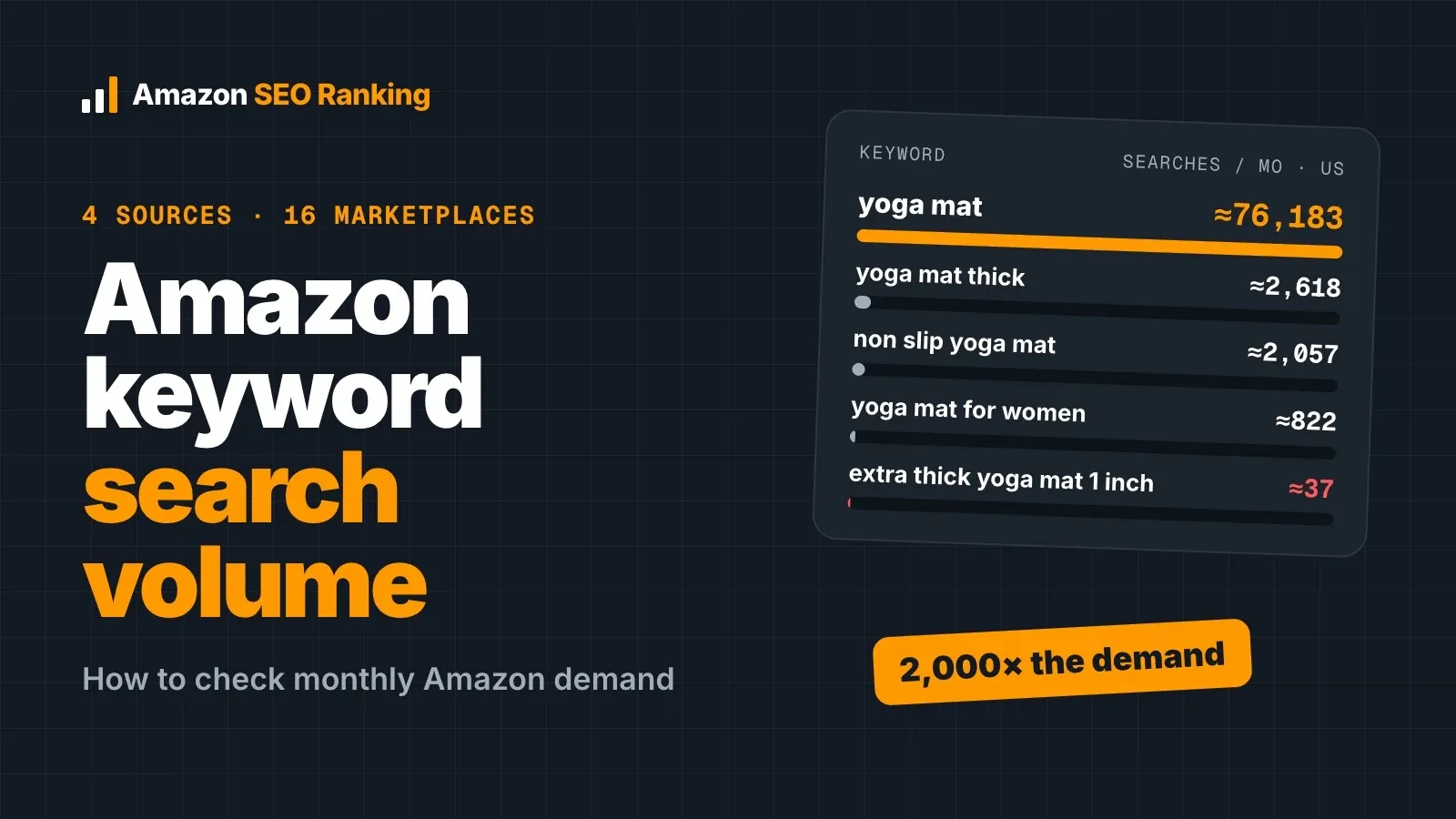
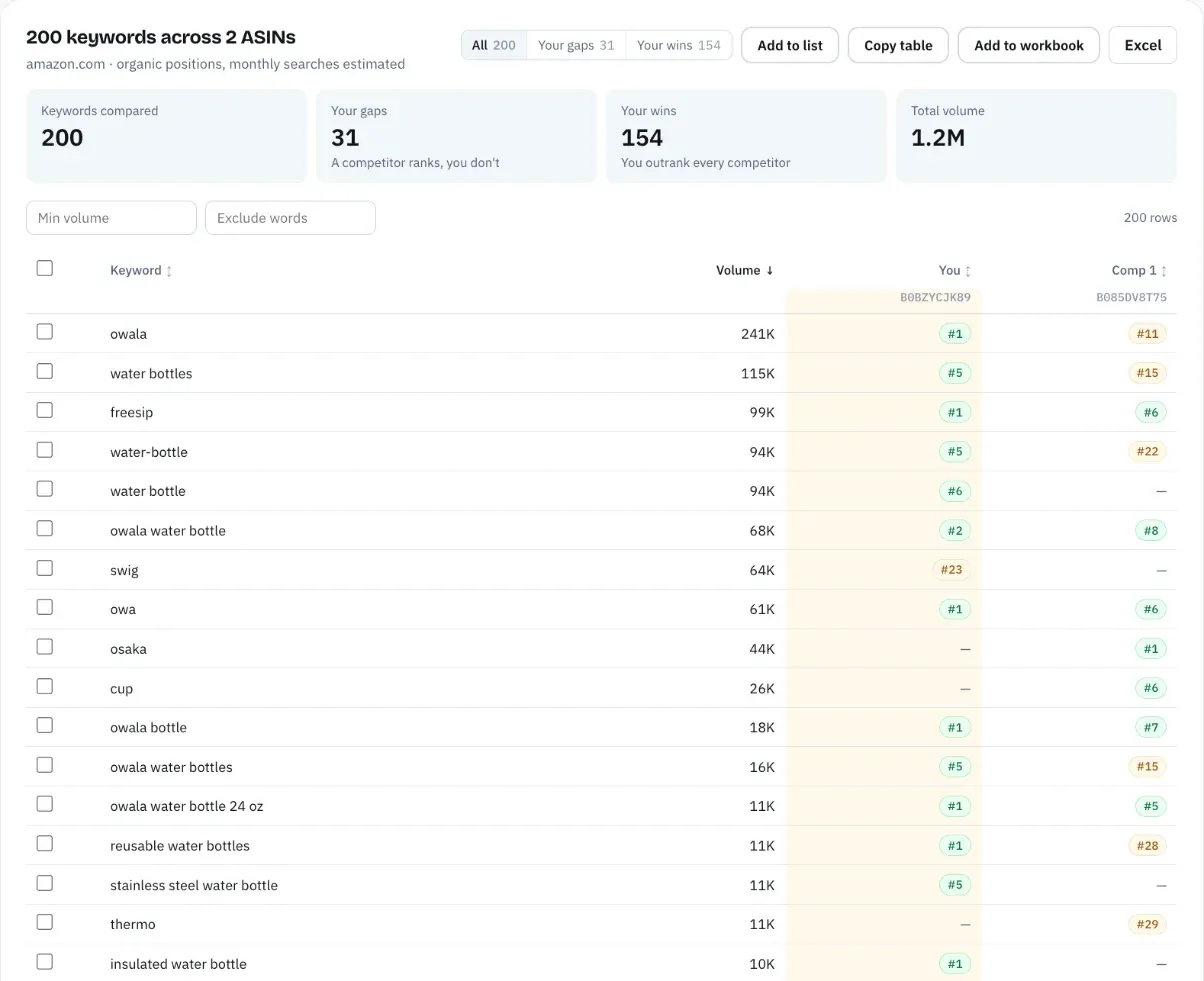
On 11 November 2026 we opened both product pages on amazon.com and ran both ASINs through Keyword gap in Amazon SEO Ranking. Search volumes are monthly US estimates; positions are organic.
| Signal | Denim | Shy Marshmallow |
|---|---|---|
| BSR, Kitchen & Dining | #1 | #1 |
| BSR, Travel & To-Go Drinkware | #1 | #1 |
| BSR, Insulated Bottles | #1 | #1 |
| "water bottle" (≈94,098 searches) | #6 | Not ranking |
| "water bottles" (≈114,518) | #5 | #15 |
| "reusable water bottles" (≈11,220) | #1 | #28 |
| "insulated water bottle" (≈10,322) | #1 | Not ranking |
| "stainless steel water bottle" (≈11,220) | #5 | Not ranking |
| "osaka" (≈44,244) | Not ranking | #1 |
Across the top 200 keywords for the pair, Denim outranked Shy Marshmallow on 155, and Shy Marshmallow ranked on 31 where Denim didn't appear at all. Those totals move faster than the head terms: on 8 November the same pair showed 87 keywords where only Shy Marshmallow ranked, while the main keywords in this table held the same positions.
Why Two Colors Can Share One BSR
Both pages showed identical ranks in all three categories. The most likely reading is that the BSR on each child page reflects sales of the whole Owala FreeSip variation family, though Amazon doesn't document this. Either way, the shared number makes BSR useless for telling two colors apart.
That matters for any brand with variants. If you sell eight colors and check BSR on one of them, you're probably looking at the family's sales, and a weak child ASIN can hide behind a strong sibling for months.
What the Keyword Data Shows Instead
The keyword table tells a different story. Shy Marshmallow is missing from four searches that describe it exactly, yet it holds #1 for "osaka" and "wala", searches that have nothing to do with an insulated bottle. In an earlier audit we found the weaker color had different attributes on its child listing, including a listed weight of 1 ounce against Denim's 0.4 kg.
None of that shows in BSR. It only shows when you look at keyword rank per ASIN, and then at the listing behind it.
How Well Do I Rank on Amazon? Check These 4 Numbers
No single figure answers the question. Start with the two checks that show where you're losing shoppers and why, then use Amazon's own data to confirm the picture.
1. Find the Searches You're Missing
List the 10 to 20 searches that describe your product, ranked by estimated volume, and find your organic position for each. A manual search in a private browser window works for a handful of terms, but it's slow and skips anything you didn't think to type.
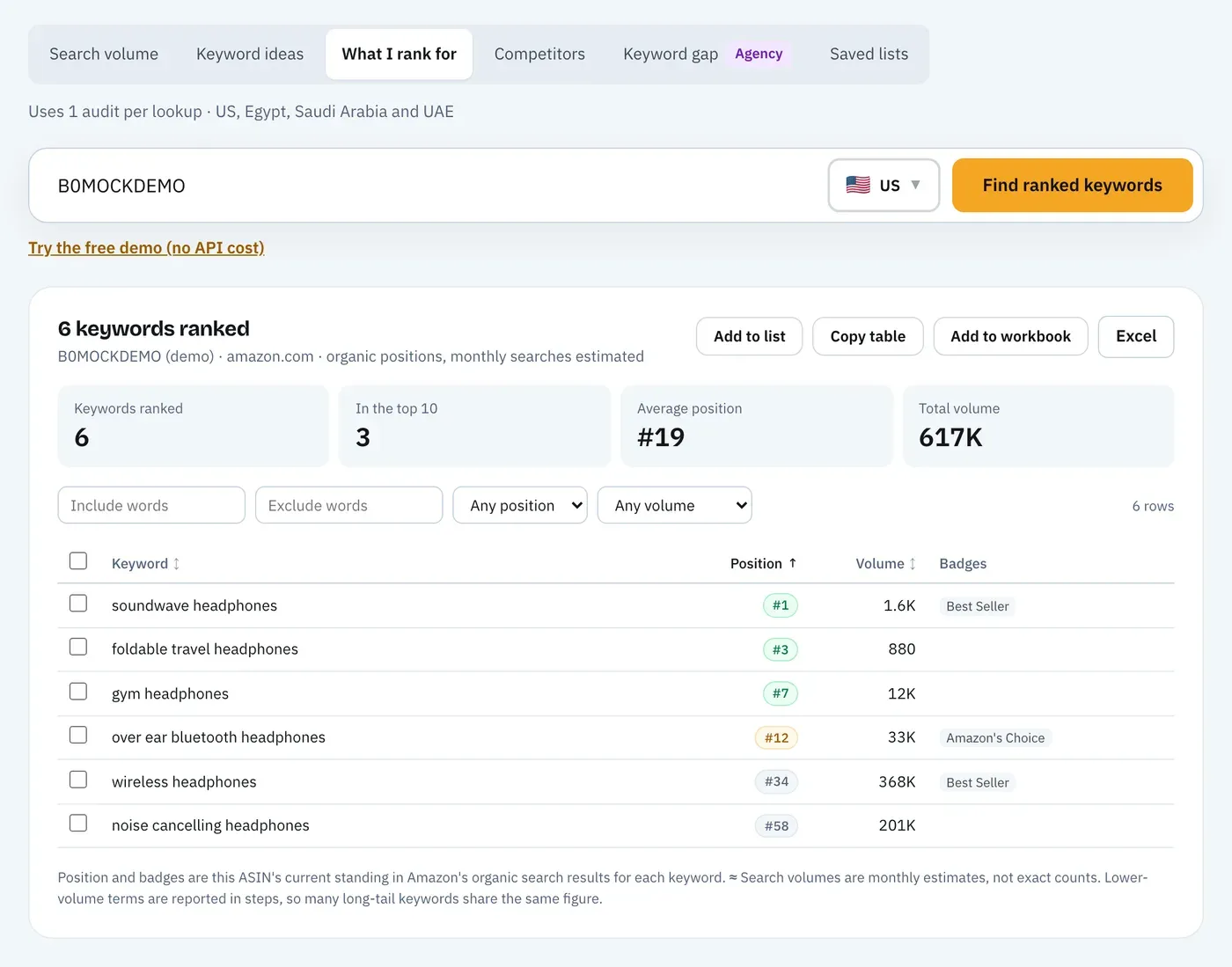
A tool that lists every keyword an ASIN ranks for catches the gaps you weren't watching. In Amazon SEO Ranking, What I rank for shows each ranking keyword with its position and estimated volume, filtered to the top 3, 10 or 30. It runs on the US, Egypt, Saudi Arabia and the UAE, and each ASIN uses 1 audit. If you manage a catalog, ranking visibility on the Agency plan shows for every tracked ASIN how many keywords rank at #1, #2-3, #4-10 and #11-100, which is the quickest answer to how well a whole brand ranks.
On Pro and Agency you can also ask Claude directly. The Claude connector gives it the same keyword data and audits, so a question like "which searches does my Denim ASIN rank for that Shy Marshmallow doesn't?" returns real positions instead of a guess.
2. See Why the Listings Above You Win
Once you know which searches you're losing, find out why. Pick the two listings ranking above you for your main keyword and compare titles, bullets, images, reviews and Prime eligibility side by side.
Amazon SEO Ranking's Amazon competitor analysis tool runs the same 12-criteria audit on your listing and up to two rivals and names the three biggest gaps with the figures behind them, such as "4 images vs 9 images". Every criterion and its pass rule are published, so you can see exactly where the points went. Each listing compared uses 1 audit; the free plan's 3 audits a month cover one full three-way comparison.
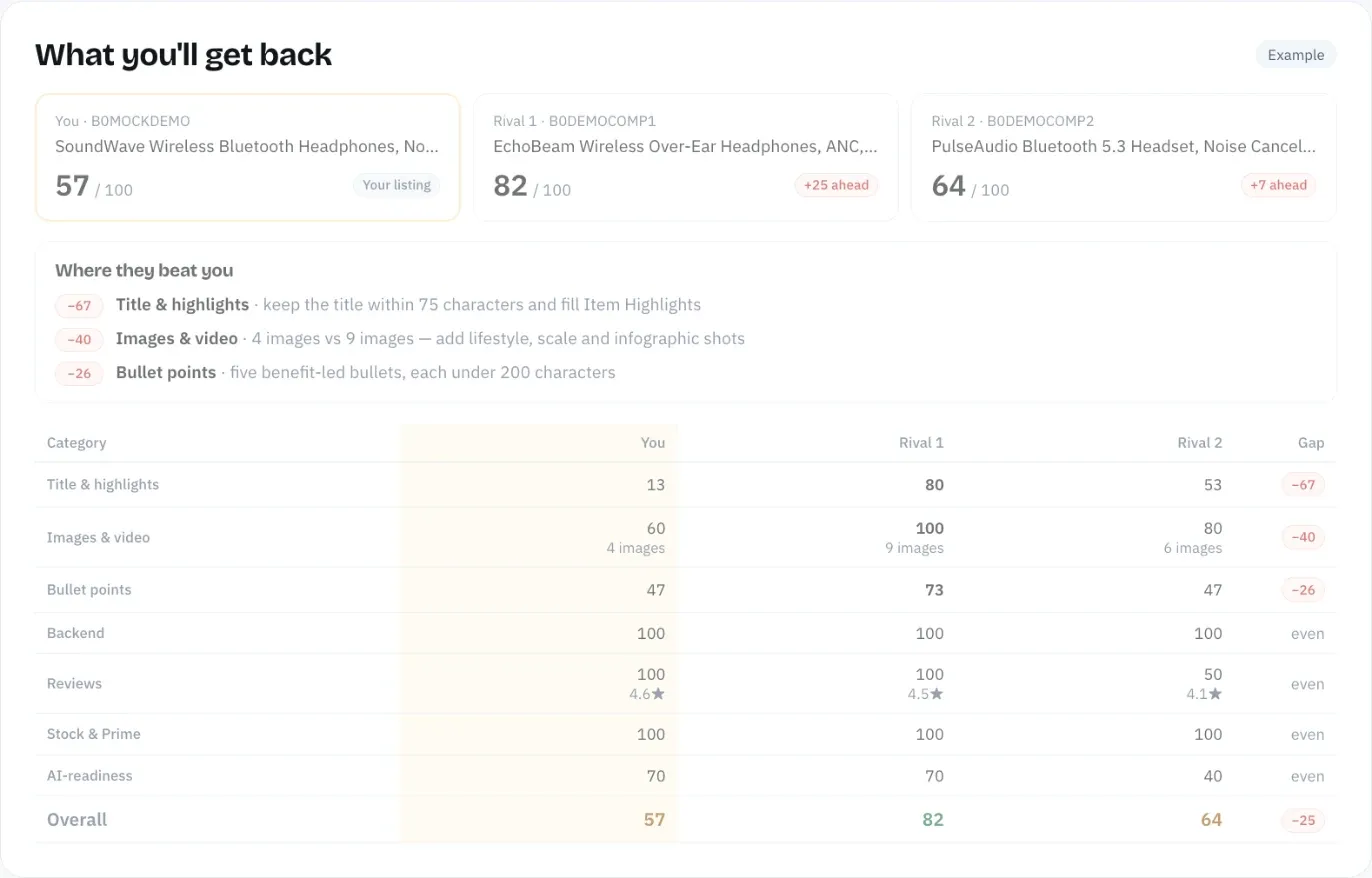
The audit runs in 23 Amazon storefronts, and the same listing can score differently on amazon.com and amazon.de. If you sell in several countries, check each one, because a fix for the US page may not be the fix for the German one.
3. Look Up Your Impression Share in Brand Analytics
If you're in Brand Registry, Seller Central's Search Query Performance report is the closest thing to first-party rank data. Amazon launched it in 2022, and it shows impressions, clicks, add-to-carts and purchases per search query, with your brand's share of each.
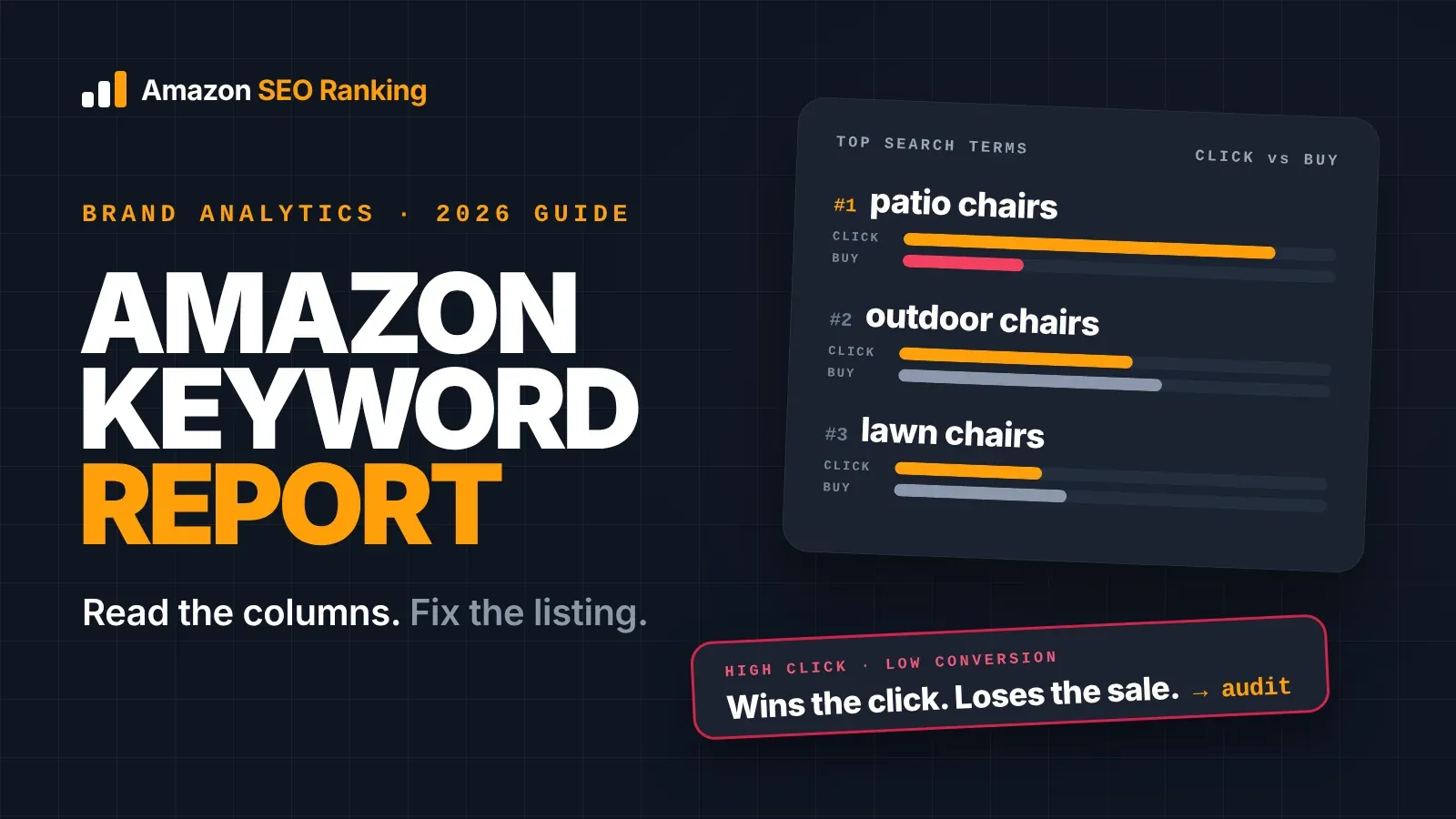
Read it next to your keyword ranks. A high rank with a low click share often points to the main image, price or rating. A low impression share on a high-volume query means you're missing from the results page most of the time.
4. Read BSR as Your Sales Check
Open your product page and scroll to "Product information". Ignore the broad department rank and read the smallest subcategory, since that's where your real competitors sit. Compare it with the 3 to 5 listings you lose sales to.
Use it to confirm that sales are moving, after you've checked where they come from. If you sell variants, remember the Owala result: the number may cover the whole family and hide a weak color.
Which Rank on Amazon Should You Act On?
It depends on the decision in front of you. BSR helps before you sell; keyword rank helps once you're live.
| Decision | Rank to use | Why |
|---|---|---|
| Choosing a product or niche | BSR of the top 10 listings | Shows whether the category sells |
| Spying on a rival's sales trend | BSR history | Reflects their recent sales |
| Checking a listing update worked | Keyword rank before and after | Shows which searches moved |
| Comparing variants or child ASINs | Keyword rank per ASIN | BSR may be shared by the family |
| Deciding where to spend PPC | Organic rank plus impression share | Shows which searches you already win |
| Reporting to a client | Keyword rank and impression share | Ties visibility to the listing work |
For a live listing, keyword rank is the number to act on. BSR rises after sales do, so by the time it moves, the cause has already happened. Keyword rank shows the cause: a search you dropped out of, on a listing you can change.
How to Improve Keyword Rank Without Chasing BSR
Sales and keyword rank feed each other, so the fastest route to a better BSR is usually a listing that ranks for more of the right searches. Start with the searches from check 2 where you sit on page two or don't appear.
Then work through the fields Amazon reads:
- Put the main keyword early in the title, inside the 75-character limit that now applies in most categories
- Cover secondary keywords in the bullets and Item Highlights, in sentence case
- Fill the backend search terms with phrases you don't already use on the page, within 249 bytes
- Check that every variant's attributes match the product (weight, material, care instructions)
- Fix whatever the competitor comparison flagged, from image count to Prime eligibility
Our guide on how to rank for keywords on Amazon covers each step in detail. Before the new copy goes live, score it as a draft audit against the live listing's images, rating and Prime status, so a keyword gain doesn't cost points elsewhere. After the change, take a second keyword reading one to two weeks later, on the same keywords, so you compare like with like.
If you'd rather track positions every day, our roundup of the best Amazon rank tracker tools compares 10 options on keyword limits, update speed and price.
Everything You Need to Know About How Well You Rank on Amazon
| Question | BSR | Keyword rank |
|---|---|---|
| What it measures | Sales compared with a category | Position for one search |
| How many per product | One per category | One per search term |
| Based on | Recent and all-time sales, recent weighted more | Relevance and performance for the query |
| Affected by reviews or page views | No, per Amazon | Indirectly, through clicks and sales |
| Shared across variants | Appears so in our Owala test | No, each ASIN ranks separately |
| Where to see it | Product page | Search results, rank tools, Brand Analytics |
| Best use | Product research, rival sales trends | Listing work, variant checks, PPC planning |
| Main limit | Says nothing about which searches sell | Changes by location, device and time |
| Amazon SEO Ranking coverage | Not shown | What I rank for (Pro), Keyword gap and ranking visibility (Agency) |
Find the Searches You're Missing with Amazon SEO Ranking
Amazon SEO Ranking shows every keyword your ASIN ranks for, lines up positions for up to 20 ASINs (yours included) on the same keywords on Agency, and audits the listing against 12 criteria it publishes in full. When a search is missing, the AI rewrite puts the keyword where Amazon reads it, grounded in your listing's own spec table and checked for health claims and pack-count mismatches before you paste it.
It's built for sellers and brands with live listings, especially those with several variants or storefronts where one strong ASIN hides a weak one. It's trusted by eRetail Search specialists at Nestlé and eCommerce SEO services agencies such as Reach AI.
Start a 7-day free trial of monthly Pro to run What I rank for on your own ASIN in the US, Egypt, Saudi Arabia or the UAE. Cancel anytime, and every charge has a 14-day money-back guarantee. If you sell in other countries, the listing audit covers 23 Amazon storefronts. Run a free Amazon listing audit on any ASIN to see the score first, no credit card required.
FAQ
How do I know how well my product ranks on Amazon?
You know how well your product ranks on Amazon by checking its organic keyword rank for the searches that describe it, then comparing the listing with the ones ranking above you, and confirming with Search Query Performance (Brand Registry) and Best Sellers Rank. Keyword rank shows whether shoppers find you, and BSR shows how the product sells against its category. In our Owala test, two colors both held #1 BSR in three categories while one ranked #6 and the other not at all for "water bottle". Check all three before deciding what to change.
What is the difference between Best Sellers Rank and keyword rank?
The difference between Best Sellers Rank and keyword rank is that BSR compares a product's sales with its category, while keyword rank is its position in search results for one query. A product has one BSR per category and a separate keyword rank for every search it appears in. Amazon states that a top BSR doesn't always equal a high organic search ranking. BSR suits product research; keyword rank suits listing work.
What is a good Best Sellers Rank on Amazon?
A good Best Sellers Rank on Amazon depends on the size of the category, so compare it with the top listings in your smallest subcategory rather than with a fixed number. The same number means far more sales in a broad department than in a narrow subcategory. Amazon doesn't publish how many sales a rank requires. Read your BSR against 3 to 5 direct competitors over several weeks.
Does Best Sellers Rank affect search ranking on Amazon?
Best Sellers Rank doesn't directly affect search ranking on Amazon, though both rise with sales. Amazon's seller guide says BSR doesn't directly cause sales and that a top BSR doesn't guarantee a high organic rank. Sales help keyword rank, and keyword rank brings sales, so the two often move together for products sold under a single ASIN. For variants, our test showed the same BSR across colors that ranked far apart in search.
How often does Amazon update Best Sellers Rank?
Amazon updates Best Sellers Rank frequently, but it doesn't publish a fixed schedule. Its current seller guide describes the scores as "frequently updated" and says recent sales count more than older ones. That weighting is why BSR can jump after a single strong day of sales. Compare BSR over several weeks before reading a trend into it.
Can I see my keyword ranking in Seller Central?
You can't see a plain keyword position in Seller Central, but Brand Registry owners can see impressions, clicks, add-to-carts and purchases per search query in Brand Analytics' Search Query Performance report. That shows your share of each search's traffic, which is close to a visibility rank. For your actual organic position on a keyword, you need a manual search or a keyword rank tool. Sellers outside Brand Registry don't get Search Query Performance.
Why is my BSR good but my sales or search rank low?
Your BSR can look good while your search rank is low because BSR measures sales across a category, and those sales may come from a few branded searches, ads or a sibling variant. In our test, both Owala colors showed #1 BSR, but the Shy Marshmallow page didn't rank for "insulated water bottle" or "stainless steel water bottle". Check keyword rank per ASIN to see which searches you're missing. Then compare the listing with the products ranking above you.
Is it worth paying for a tool to check my Amazon rank?
A tool is worth paying for when you track more than a handful of keywords or manage several ASINs, because manual searches miss keywords you didn't think to type and vary by location. For one listing and a few keywords, manual searches in a private window and Seller Central's Brand Analytics can be enough. Amazon SEO Ranking's free plan includes 3 listing audits a month with no card, and monthly Pro at $79 includes What I rank for (US, Egypt, Saudi Arabia and the UAE) with a 7-day free trial.
Find the searches your listing is missing. Free audit, 3 a month, no card required.
Run free audit