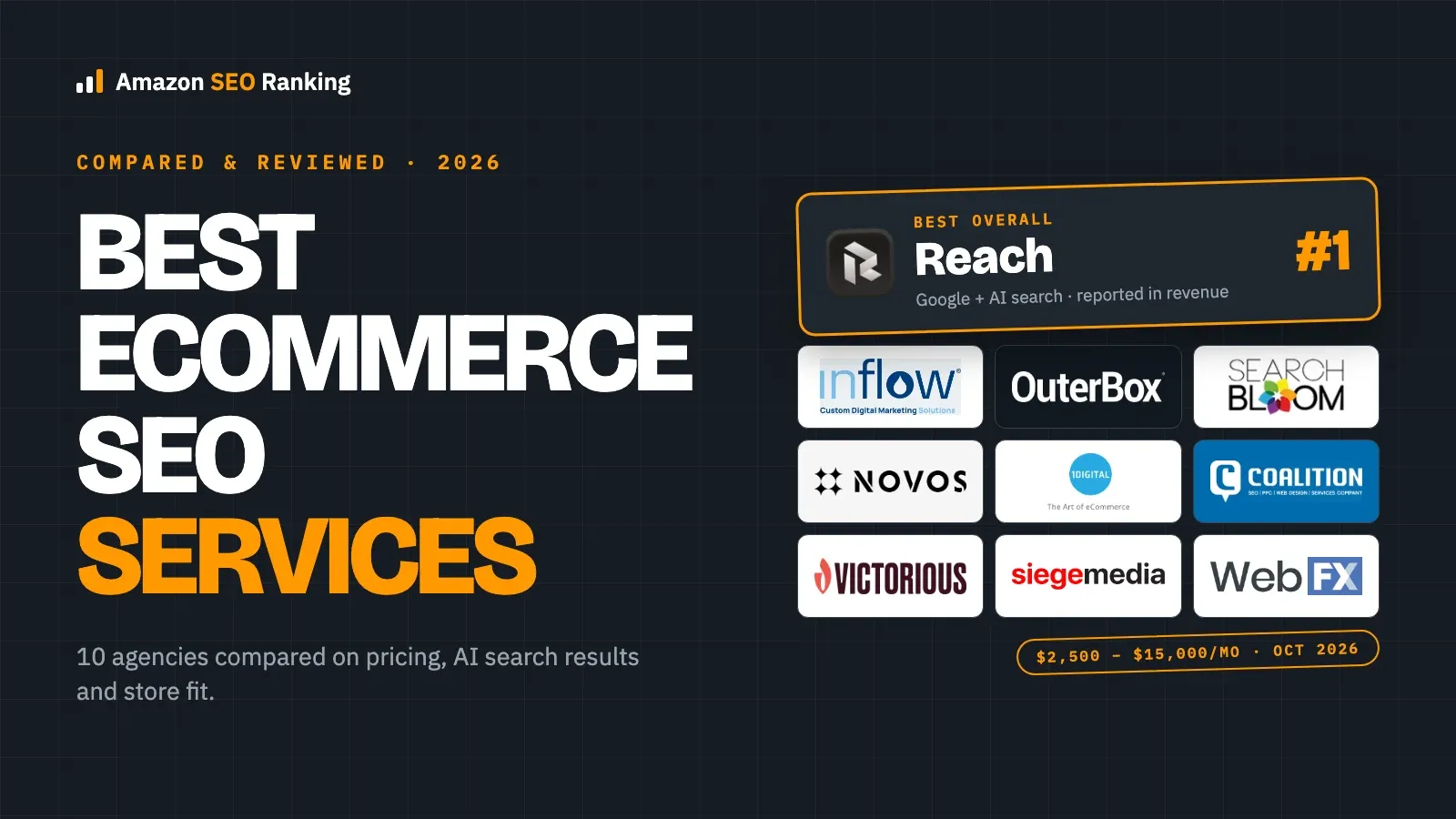
The best ecommerce SEO services in 2026 are Reach, Inflow, OuterBox, Searchbloom, NOVOS, 1Digital Agency, Coalition Technologies, Victorious, Siege Media and WebFX. Reach comes first because it runs Google and AI search (ChatGPT, Perplexity, Gemini, Google AI Overviews) as one program and reports the result in orders and revenue.
AI search is the part that changed this year. Traffic to US retail sites from generative AI tools rose 693.4% over the 2025 holiday season, according to Adobe Analytics. The base is still small, but shoppers now build a shortlist inside an AI answer before they open a single category page.
This guide compares the ten agencies on six points: ecommerce results tied to revenue, AI search coverage, technical depth on large catalogs, who ships the fixes, who works on your account and contract terms. It's written for brands that sell on their own store and on Amazon, so we also cover where your Amazon listings fit: ecommerce SEO is website work, and Amazon listing optimization, where an agency offers it, is usually a separate service.
Key Takeaways (TL;DR)
- Best overall ecommerce SEO service: Reach. Its own software finds the searches and AI prompts that drive sales, and a senior team builds the pages, fixes and mentions.
- Why it matters now: shoppers compare products in ChatGPT, Perplexity and Google AI Overviews before they click. A store that isn't named in those answers loses the order to one that is.
- Who it's for: DTC brands, marketplaces and catalog-heavy retailers that want organic search to carry more revenue than ads, plus stores in a migration, a rebrand or a move into new countries.
- How to choose: ask for case studies that show revenue, check that the agency tracks AI engines as well as Google, and agree who ships each fix before you sign.
- Price range: Reach costs $8,000 or $15,000 a month. WebFX's ecommerce packages start at $3,000 a month, and Clutch reviewers report Searchbloom projects from $2,500 to $50,000 a month. The others quote per project.
- If you also sell on Amazon: agencies work on your website. Your Amazon listings rank in Amazon's own search, so check them separately; a free Amazon listing audit takes about 20 seconds per ASIN.
Best Ecommerce SEO Services in 2026 at a Glance
Reach is the pick for stores that want Google and AI search handled as one revenue program. The other nine are established agencies with a clear specialty: paid and organic together, catalog development, retail PR or one storefront platform.
| Company | Best For | Key Strengths | Pricing |
|---|---|---|---|
| Reach | Revenue from Google and AI search under one senior team | Revenue-ranked research, AI prompt tracking, pages, mentions and Reddit work | $8,000 or $15,000/mo |
| Inflow | Established stores running SEO and paid media together | Ecommerce-only focus, SEO planned with PPC and paid social, CRO | Custom quote |
| OuterBox | Catalog-heavy stores that need SEO and development | In-house developers, CRO and analytics next to SEO | Custom quote |
| Searchbloom | Brands that want SEO and PPC planned from the same data | Keyword prioritization, paid and organic alignment | Clutch reviewers report $2,500–$50,000/mo |
| NOVOS | DTC and retail brands in the UK and Europe | Ecommerce-only SEO and retail digital PR | Custom quote |
| 1Digital Agency | BigCommerce, Shopify and Adobe Commerce stores | Ecommerce-only team with storefront partnerships | Custom quote |
| Coalition Technologies | Stores that need a rebuild alongside SEO | Design, development and SEO under one roof | Custom quote |
| Victorious | Stores that want an SEO-only partner | Documented process and clear reporting | Custom quote |
| Siege Media | Stores whose ceiling is authority and content | Linkable content, digital PR, GEO | Custom quote |
| WebFX | Mid-market stores that want many channels from one vendor | Large in-house team, revenue reporting software | Ecommerce packages from $3,000/mo |
Agencies that don't publish rates usually price by catalog size, the number of storefronts and countries, and whether they implement fixes or only specify them. Ask which of those a quote is based on before you compare two of them.
What Are Ecommerce SEO Services?
Ecommerce SEO services are the research, technical work, content and off-site promotion that get a store's category, product and comparison pages found in search, and that turn those visits into orders. In 2026 that means two kinds of results: the classic links on Google and Bing, and the answers in ChatGPT, Perplexity, Gemini, Claude, Google AI Overviews and AI Mode.
A store isn't a normal website. Category pages carry most of the buying searches. Filters can create thousands of near-duplicate URLs. Products go out of stock, prices change daily, and a replatform touches every URL that ranks.
A full engagement usually covers:
- Demand research across Google, AI prompts, marketplaces, reviews and forums
- Technical work on crawling, indexing, filters, canonicals, hreflang, speed and structured data
- Category, product, comparison and buying-guide pages written the way shoppers search
- Links and brand mentions on the publications and review sites that search engines and AI models cite
- Tracking that ties organic and AI visits to revenue in GA4 and Search Console
The market splits three ways. Ecommerce-only agencies such as Inflow, NOVOS and 1Digital work only with stores. Full-service shops such as WebFX and Coalition sell SEO next to ads, design and development. A newer group, Reach among them, treats AI search as a core channel and runs research through its own software, with senior strategists checking each output.
| Group | What they do best | Agencies in this guide |
|---|---|---|
| Ecommerce specialists | Store structure, product content, retail PR | Inflow, NOVOS, 1Digital Agency |
| Full-service and build-led | SEO with design, development and ads | OuterBox, Coalition Technologies, WebFX |
| Search and content specialists | SEO process, content, authority | Searchbloom, Victorious, Siege Media |
| AI search first | Google and AI answers as one revenue channel | Reach |
Match the agency to the place your store is stuck. The best SEO companies for ecommerce differ more by specialty than by quality.
Why Do Online Stores Need Ecommerce SEO Services?
Online stores need ecommerce SEO services because the moment a shopper picks a product is moving off your website. Shoppers ask AI assistants to compare products and suggest where to buy, and they arrive with a shortlist already made.
- AI visits are growing fast. Generative AI traffic to US retail sites rose 693.4% year over year in the 2025 holiday season, according to Adobe.
- Classic clicks fall when an AI answer appears. In Pew Research Center's study of real Google searches, users clicked a traditional result in 8% of visits with an AI summary, against 15% without one.
Put together, a store can hold its Google rankings and still lose orders, because fewer people click and the ones who do were told what to buy by an answer that never named you. For how these engines choose the pages they quote, see this guide to AI search visibility.
Paid search is the usual fallback, and you pay for every click again next month. Organic visits don't carry that cost, which is why the share of revenue from paid search is one of the clearest numbers to track with any agency.
The same pressure applies on Amazon. Shoppers there now ask Alexa for Shopping (formerly Rufus) what to buy, and it answers from your listing copy, reviews and images. We covered that shift in how Rufus and COSMO are changing Amazon SEO.
Who Needs Ecommerce SEO Services?
Any store with product-market fit and a margin it wants to protect from ad costs can benefit. Five profiles see the clearest return, and each has a different first problem to fix.
DTC and Consumer Brands Growing Past Paid Ads
Direct-to-consumer brands often scale on Meta and Google Ads, then watch acquisition costs eat the margin. Organic search keeps paying after a page is live, but only if the pages target what shoppers type and ask when they're ready to buy.
These brands need comparison pages, buying guides and product pages that AI engines can quote, plus a presence in the Reddit threads and review sites those engines cite. If the same products sell on Amazon, the listing needs the same care: see our Amazon listing optimization guide.
Marketplaces and Catalog-Heavy Retailers
Stores with thousands of SKUs or locations win or lose on templates. One fix to a category template can lift hundreds of pages, and one bad filter setup can bury new products for weeks.
Keywords change by market too. The same product can be an "RV rental" in the US, a "motorhome rental" in the UK and a "campervan rental" in Australia, so a template has to carry the term each country searches for.
Stores in a Migration, Replatform or Rebrand
Migrations are where stores lose the most organic traffic, because redirects, canonicals and hreflang can all break on launch day. A rebrand adds a second risk: AI engines keep describing the old business for months.
These stores need a partner involved before launch: redirect maps, canonical and hreflang checks on staging, and a plan to update the third-party pages AI engines quote about the brand.
Enterprise-Owned Retail Brands With Slow Dev Queues
Brands owned by a larger group can wait months for a template change because every release goes through security review. Recommendations pile up and nothing ships.
The right partner works around the queue, for example by publishing new pages on a matching subdomain or through the CMS without a code release, while template fixes wait their turn.
Stores Expanding Into New Countries and Languages
A new market means new keywords, new search habits and hreflang that has to agree with canonicals. Stores need research per market, local pages that use the term locals search for, and setup that tells Google and Bing which version belongs to which country.
The same applies to Amazon storefronts: a listing tuned for amazon.com isn't tuned for amazon.de. Amazon SEO Ranking audits listings on 23 Amazon storefronts and writes the copy in each storefront's language.
Best Ecommerce SEO Companies: In-Depth Review & Comparison
Each review covers what the agency does, who it suits, where it falls short and how it charges. Reach is first as our overall pick; the other nine follow in order of how closely their focus matches a typical growing online store.
Facts come from each agency's own site, and prices from their public pages or independent review sites. Where an agency doesn't publish pricing, we say so.
1. Reach
Overview
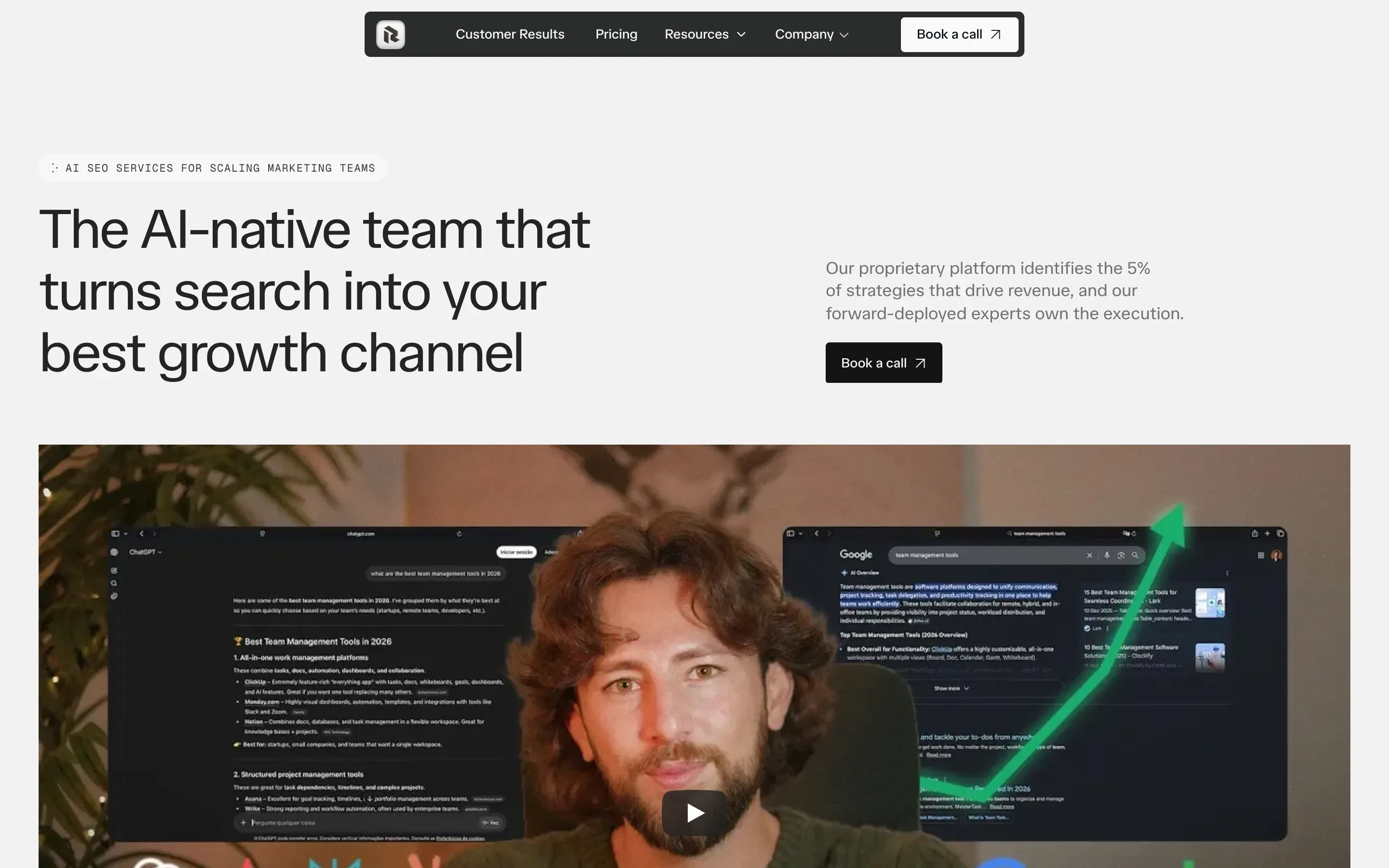
Reach is an AI search research lab, based in Lisbon and New York, and our pick among the best ecommerce SEO services because it runs SEO and AI search as one revenue channel. Its software mines buyer questions, tracks how ChatGPT, Perplexity, Gemini, Claude, Google AI Overviews and AI Mode answer target prompts, and finds the sources those engines cite. Senior SEO and AEO strategists decide what to build and check every page before it ships.
For stores and B2C brands, that means category and location pages rebuilt at scale, comparison pages built to be cited, technical fixes for crawlers that don't run JavaScript, and mentions on the publications that shape AI recommendations.
Ideal For
- DTC brands and retailers with product-market fit that want to rely less on paid ads
- Marketplaces and catalog-heavy stores where one template change lifts hundreds of pages
- Stores going through a migration, replatform, rebrand or acquisition
- Retail brands expanding into new countries and languages
Why It Stands Out
Reach starts from the 5% of searches and prompts that bring in most of the revenue, ranked by estimated sales value instead of raw volume. Research pulls from Google, AI answers, Reddit, Quora, reviews and your own customer conversations.
Its playbook also comes from field tests. Reach tracks target prompts for at least four weeks before choosing which publishers to pursue, inspects the background searches AI engines run before answering, and feeds what it learns back into its software.
Pros
- Google and AI search covered together, with prompt tracking across six AI engines
- Senior strategists on every account, working in a shared Slack channel
- Reporting tied to revenue from your existing GA4, Search Console and CRM data
- Full execution: pages published to your CMS, technical fixes, mentions, links and Reddit or Quora answers
Cons
- Not a budget option: $8,000 a month is a large commitment for a small store
- A 3-month minimum before the engagement goes month to month
- Results usually take 3 to 6 months, longer when most pages have to be built from scratch
- Amazon listings aren't part of the published scope
Pricing
Two plans, published on its pricing page. Core Engine costs $8,000 a month for 10 pages, 6 link and mention placements, 5 community engagements, 100 tracked AI prompts and bi-weekly strategy calls. Hardcore Mode costs $15,000 a month for 25 pages, 20 placements, 15+ community engagements, a managed Reddit account and branded subreddit, 250 prompts and weekly calls.
The minimum commitment is 3 months, then month to month with 30 days' notice. Annual commitments save 10%.
Final Verdict
Reach is the best ecommerce SEO company for stores that want organic and AI search to carry a bigger share of revenue, with one senior team owning the work from research to measurement.
If your budget is under $8,000 a month, or you want ads and SEO from one vendor, one of the agencies below fits better.
2. Inflow
Overview
Inflow is an ecommerce marketing agency founded in 2007 in Denver, Colorado. It sells SEO, PPC, paid social and conversion work to online retailers, and plans organic and paid search together so they don't compete for the same terms.
It works across Shopify, BigCommerce, Magento and custom carts. Its best fit is an established store that already has traffic and wants more of it to convert.
Ideal For
- Established online retailers with a running paid search program
- Stores that want SEO, PPC and paid social from one vendor
- Brands with steady traffic and a conversion rate problem
Why They Stand Out
Close to two decades of ecommerce-only work means the team knows feeds, product schema and paid-organic overlap well. That makes it one of the stronger choices for retailers whose growth leans on Google Shopping as much as on organic.
Its CRO work matters for stores where traffic is fine and checkout is the leak.
Pros
- Ecommerce-only client base
- Paid search, paid social and SEO in one plan
- CRO in-house
- Experience across major storefronts and custom carts
Cons
- No published pricing, so budgeting starts with a sales call
- Better suited to stores with traffic than to brands building demand from zero
- AI search sits inside a wider media offer, so ask how many prompts and engines they track
Pricing
Inflow quotes custom retainers by channel and scope. It doesn't publish package prices.
Final Verdict
Inflow fits established retailers that want paid and organic search run by one ecommerce team. It's a weaker match for young brands that need demand built from scratch, or stores whose main goal is being recommended in ChatGPT and Perplexity.
3. OuterBox
Overview
OuterBox is an ecommerce agency founded in 2004 in Akron, Ohio. It combines SEO with web design, development, CRO, PPC and analytics, so one team can fix a problem that sits in both the marketing plan and the site's code.
Its typical client is a catalog business with deep category trees, where choosing which categories to work on first is half the job.
Ideal For
- Catalog-heavy stores with thousands of products
- Brands planning a redesign or replatform alongside SEO
- B2B and industrial ecommerce sites
Why They Stand Out
Developers and SEO specialists on one team remove the usual handoff where recommendations wait in someone else's backlog. That makes OuterBox one of the smartest choices when the theme or template is what's holding rankings back.
It has a long track record on Shopify, BigCommerce, Magento and WooCommerce builds.
Pros
- SEO, development and CRO in one team
- Long history with large catalogs
- Can carry a migration from build to post-launch checks
- Covers paid search too
Cons
- Pricing not published
- A full-service bundle can be more than a store with a sound site needs
- Development-led projects take longer before content and authority work starts
Pricing
OuterBox quotes custom retainers and project fees. It doesn't publish rates.
Final Verdict
OuterBox suits catalog brands whose growth is blocked by the site itself and who want design, code and SEO from one vendor. Stores with a clean build that need content, citations and AI visibility will get less from the bundle.
4. Searchbloom
Overview
Searchbloom is a search marketing agency based in Salt Lake City, Utah. It offers SEO, PPC and conversion work, with ecommerce SEO on Shopify, BigCommerce and Adobe Commerce as one of its main services.
Its method is keyword mapping first, then work ordered by expected revenue, with paid and organic plans kept in line.
Ideal For
- Ecommerce brands with large paid search budgets
- Stores that want a tight keyword plan before content production starts
- Brands that also need lead generation SEO for a B2B arm
Why They Stand Out
Searchbloom is one of the stronger options for stores that want SEO and PPC decided from the same data. Clutch reviewers often mention its project management and communication.
It also publishes ecommerce guides and agency comparisons, which shows its method before the first call.
Pros
- SEO and PPC under one strategy
- Clear keyword prioritization
- Consistently positive Clutch reviews
- Covers the main storefronts
Cons
- A wide reported price range makes early budgeting hard
- Serves lead generation and local clients too, so not every team member is ecommerce-only
- Less emphasis on Reddit and community work, which shapes many AI answers
Pricing
Searchbloom quotes custom retainers. Reviewers on Clutch report projects from $2,500 to $50,000 a month.
Final Verdict
Searchbloom fits stores that spend heavily on paid search and want organic planned next to it. Brands that need deep work on AI citations, mentions or community threads may need a second partner.
5. NOVOS
Overview
NOVOS is a London SEO agency that works almost only with ecommerce and DTC brands. It covers technical SEO, category and product content, migrations and digital PR aimed at retail publications.
Most clients are consumer brands in the UK and Europe, with a growing US list.
Ideal For
- DTC fashion, beauty and lifestyle retailers
- UK and European stores selling to consumers
- Brands that need press coverage to build authority
Why They Stand Out
NOVOS builds its playbook only around online stores, so category structure, product pages and retail PR are its daily work. For consumer brands, that makes it one of the strongest ecommerce specialists in Europe.
Its PR team earns links from consumer and lifestyle media, which are also sources AI engines cite in shopping answers.
Pros
- Ecommerce and DTC specialization
- Retail-focused digital PR
- Migration experience
- Strong UK presence
Cons
- Pricing not published
- Consumer retail is the sweet spot; industrial and B2B catalogs fit less well
- US time zones may be less covered than European ones
Pricing
NOVOS quotes custom retainers by scope and market.
Final Verdict
NOVOS is a good fit for consumer brands, especially in the UK and Europe, that want a specialist and value press coverage. B2B catalogs and stores that need AI prompt tracking and revenue attribution should compare carefully.
6. 1Digital Agency
Overview
1Digital Agency is a Philadelphia-area ecommerce agency that handles SEO, PPC, design and development for stores on BigCommerce, Shopify, Adobe Commerce and WooCommerce.
Its storefront partnerships make it a frequent pick for merchants who want a partner fluent in their exact stack.
Ideal For
- BigCommerce and Adobe Commerce merchants
- Stores that want SEO and site development from one agency
- Mid-market retailers with established catalogs
Why They Stand Out
1Digital works only with ecommerce brands and partners with the major storefront vendors. That depth, on BigCommerce in particular, makes it one of the smartest choices for merchants on that stack.
It can ship schema, template changes and speed fixes itself instead of handing them to another developer.
Pros
- Ecommerce-only client base
- Deep BigCommerce and Adobe Commerce knowledge
- Development and SEO in-house
- Covers PPC as well
Cons
- Pricing not published
- Less value for marketplaces or custom builds outside its main stacks
- Mention and community work for AI answers is less visible in its public case studies
Pricing
1Digital quotes custom retainers and project fees.
Final Verdict
1Digital suits merchants on BigCommerce, Shopify or Adobe Commerce who want a partner that knows the storefront inside out. Marketplaces, rental and service businesses, and brands whose main goal is AI visibility, will find a narrower fit.
7. Coalition Technologies
Overview
Coalition Technologies is a Los Angeles agency founded in 2009 that pairs SEO and PPC with web design and development. It builds and optimizes stores on Shopify, BigCommerce, WooCommerce and custom setups.
Its model works best when a store needs a new or reworked site and wants SEO built into it.
Ideal For
- Stores planning a redesign or new build
- Small and mid-market brands that want one vendor for site and marketing
- Shopify and BigCommerce merchants
Why They Stand Out
A large in-house development team makes Coalition one of the stronger choices when technical debt in the theme blocks rankings. SEO advice and code changes come from the same company.
It also offers email, paid social and CRO, so a smaller brand can cut its vendor list.
Pros
- Design, development and SEO under one roof
- Broad storefront coverage
- Many marketing services in one contract
- Suits smaller budgets than most enterprise agencies
Cons
- Pricing not published
- SEO is one offer among many
- Stores with a sound site that need authority and AI citations get less from a build-led model
Pricing
Coalition quotes custom retainers and project fees.
Final Verdict
Coalition is a sensible pick for stores that need a rebuild and want SEO folded into it. Brands whose site is already solid, and whose gap is AI answers or buying-intent comparison searches, should look at a more search-focused partner.
8. Victorious
Overview
Victorious is a San Francisco agency founded in 2012 that does organic search only. Its ecommerce work covers keyword strategy, category and product content, technical fixes and link building, run through a documented process.
It doesn't build or develop sites, so stores keep their own developers or a separate dev partner.
Ideal For
- Stores that want an SEO-only partner with a clear process
- Ecommerce and B2C brands with in-house developers
- Teams that value structured reporting
Why They Stand Out
Victorious puts its method up front, which makes the plan easy to explain internally. Clients often point to its transparency and reporting.
Because it only does SEO, there's no pressure to bundle ads or design into the contract.
Pros
- Organic search only
- Documented, repeatable process
- Clear reporting
- Works across ecommerce and other B2C sectors
Cons
- No in-house development, so technical fixes depend on your team's capacity
- Not ecommerce-only
- Pricing not published
Pricing
Victorious quotes custom retainers after an initial assessment.
Final Verdict
Victorious suits stores with their own developers that want a disciplined SEO partner. If your bottleneck is the dev queue, or you want a partner to own AI citations and community work, it covers only part of the job.
9. Siege Media
Overview
Siege Media is a content marketing and SEO agency founded in 2012 by Ross Hudgens, with teams in Austin and San Diego. It's known for research-led content, custom design and digital PR that earns links, and it now positions itself around GEO (generative engine optimization).
Its clients lean toward mid-market and enterprise brands in software, finance and consumer categories.
Ideal For
- Established stores with clean templates but weak authority
- Brands in competitive categories that need linkable content
- Companies with budget for a content-led program
Why They Stand Out
Siege is one of the strongest content shops in SEO. Its buying guides and data pieces earn links on their own, and the same assets tend to be cited in AI answers.
For a store that has already fixed its technical base, that content and PR engine can close an authority gap faster than outreach alone.
Pros
- High editorial and design standard
- Content that earns links without separate outreach
- GEO work run by the content team
- Track record with well-known brands
Cons
- Not a technical ecommerce shop, so catalog, filter and storefront issues need another partner
- Content-led programs sit at the top of agency budgets
- Less suited to small catalogs
Pricing
Siege Media quotes custom retainers. It doesn't publish rates.
Final Verdict
Siege fits established stores that need authority and content more than technical work. Small catalogs, and stores whose problem is crawling, indexing or templates, should start elsewhere.
10. WebFX
Overview
WebFX is a full-service digital marketing agency founded in 1996 in Harrisburg, Pennsylvania. It sells ecommerce SEO next to PPC, content, CRO, web design and its own reporting software, RevenueCloudFX.
It's one of the few large agencies that publishes a starting price for ecommerce work.
Ideal For
- Mid-market stores that want many channels from one vendor
- Teams that want a starting price before a sales call
- Brands that value dashboards tying campaigns to revenue
Why They Stand Out
WebFX's size means it can staff content, development, CRO and paid media under one contract, and its software connects campaigns to leads and revenue in one view.
A published starting price also makes it one of the easier agencies to budget for.
Pros
- Published starting price for ecommerce packages
- Large in-house team across channels
- Revenue reporting software included
- Separate AI SEO services
Cons
- Generalist agency, so confirm the ecommerce experience of the team assigned to you
- A large client base means service depends on the account team
- Multi-month commitments are typical
Pricing
WebFX's ecommerce marketing packages start at $3,000 a month, with custom pricing above that.
Final Verdict
WebFX fits mid-market stores that want one large vendor for SEO, ads and site work, with a clear starting price. Stores that want a small senior team focused on their catalog and on AI recommendations may prefer a specialist.
What About Your Amazon Listings?
Every agency above works on your own website: its pages, its technical setup and the mentions that point to it. If you also sell on Amazon, your listings rank in a different search engine with different rules. Some agencies, WebFX among them, sell Amazon marketing as a separate service; most ecommerce SEO retainers don't include it.
Amazon ranks a product on how well the listing matches the search and how well it sells: title, bullets, backend search terms, images, reviews, price and stock. Its AI assistant, Alexa for Shopping, reads the same copy to answer shopper questions. A store can rank well on Google and still have an Amazon listing with a title over the limit and backend terms that repeat words already in the bullets.
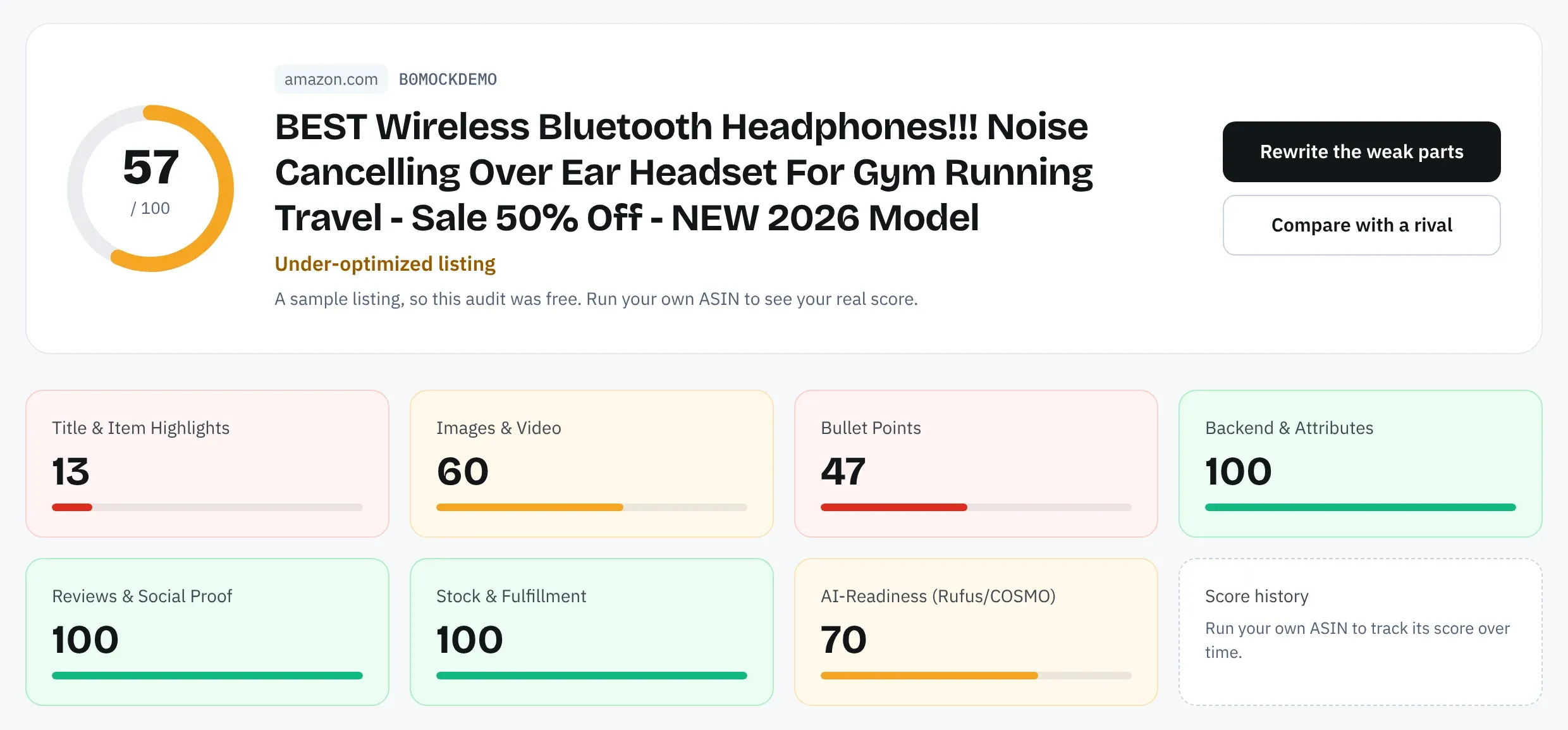
So treat Amazon as its own channel. Before you hire an agency, ask whether marketplace listings are in scope. If they aren't, check the listings yourself against a fixed standard: our Amazon SEO audit checklist lists the 12 checks, and the free audit runs them on a live ASIN.
How to Choose the Best Ecommerce SEO Company
Each agency on this list is built to fix a particular kind of problem, so start from yours. Use the six checks below on every proposal and ask for proof on each. If an agency can't answer two or more with examples from past stores, move it down the list.
1. Proof Measured in Revenue
Rankings and sessions are easy to make look good. Ask for case studies that show organic revenue, purchases, add-to-cart events or revenue per session, with the date range and data source named.
Ask how they handle attribution from AI search, too. Many shoppers see a brand in a ChatGPT answer, then type the URL or Google the name later, which shows up as direct or branded traffic. A credible partner reports the clean number and the wider influenced number separately, and explains the gap.
2. Coverage of Google and AI Search Engines
Ask which AI engines they track, how many prompts and for how long before acting. AI answers change from one run to the next, so a single screenshot proves little; Reach, for example, tracks prompts for at least four weeks before choosing publishers.
Then ask what they change when a store is missing from an answer. Good answers mention the background searches each engine runs, the page types each one cites and the third-party sites that keep appearing as sources. This step-by-step guide on how to rank in ChatGPT shows what a sound answer covers.
3. Template-Level Fixes and AI Crawler Readiness
On a store, one template change can lift hundreds of pages, and one broken canonical or noindex rule can hide them. Ask for an example where the agency fixed a template and measured the result.
AI crawlers add a newer check. GPTBot, ClaudeBot and PerplexityBot don't run JavaScript, so a store that renders products in the browser can look empty to them. ChatGPT also draws on Bing's index, so Bing indexing matters. Ask whether the agency tests server-side rendering or prerendering for these crawlers.
4. Who Ships the Work
SEO fixes that need a developer compete with feature work for the same sprints. Before you sign, agree who writes the pages, who implements technical fixes and who publishes to the CMS. Partners with direct CMS access, or a way around slow releases, move faster.
5. Who Works on Your Account
The strategist on the sales call isn't always the person doing the work. Ask for the names and backgrounds of the people who will run your account week to week, and whether they've handled a store of your size, category and platform. A 50,000-SKU catalog and a 300-product DTC brand are different jobs.
6. Contract Terms and Pricing Model
Ask for the minimum commitment and what you get each month: pages, tracked prompts, links or mentions, and strategy calls. Pricing by deliverables is easier to judge than pricing by hours. Get the minimum term in writing before kickoff.
If you sell on Amazon, add a seventh question: are your Amazon listings in scope, and if so, who checks them against Amazon's limits?
Everything You Need to Know About Ecommerce SEO Services
The table condenses this guide into the points to bring to your shortlist calls.
| Topic | Summary |
|---|---|
| Top 3 ecommerce SEO services | Reach for Google and AI search as one revenue program; Inflow for paid media from the same vendor; OuterBox for site development |
| Who it's for | DTC brands, marketplaces, catalog-heavy retailers, stores in a migration or rebrand, and retailers entering new countries |
| Use cases | Category and location page rebuilds, comparison and buying-guide pages, crawler fixes, mentions and links, Reddit and Quora answers, migration support |
| How to choose | Revenue proof, AI and Google coverage, template and AI crawler readiness, who ships the work, who's on the account, contract terms |
| Mistakes to avoid | Judging by rankings alone, buying content when the problem is site structure, leaving fixes in the dev queue, bringing SEO into a migration after launch |
| Pricing | Searchbloom projects from $2,500/mo (Clutch), WebFX from $3,000/mo, Reach $8,000 or $15,000/mo; the rest quote per project |
| Amazon listings | Usually a separate service, if offered; audit them against Amazon's own rules |
Short on time? Shortlist two or three agencies from the table and send each the six questions above before any call.
Check Your Amazon Listings Too, Free
An agency will grow your store's traffic from Google and AI search. Your Amazon listings need their own check. Amazon SEO Ranking scores a live listing against 12 published criteria (title length, Item Highlights, bullets, backend search terms, images, reviews, stock and AI-readiness for Alexa for Shopping), then rewrites whatever fails, with Amazon's character and byte limits enforced in code.
It's built for brands whose products already sell on Amazon but whose listings don't rank, and for agencies that check client catalogs across 23 Amazon storefronts. The Amazon bulk listing tool runs up to 100 ASINs at once on Pro and 500 on Agency.
The free plan includes 3 full audits a month with no card. Pro costs $79 a month (or $799 a year) for 100 audits, with a 7-day free trial. See every plan on the pricing page.
FAQ
What is the best ecommerce SEO service in 2026?
The best ecommerce SEO service in 2026 is Reach, because it runs Google and AI search as one program and reports results in revenue. It tracks how ChatGPT, Perplexity, Gemini, Claude and Google AI Overviews answer shopping prompts, then builds the pages, fixes and mentions that get a store cited. Inflow and OuterBox are strong alternatives for stores that want paid media or site development from the same vendor.
How much do ecommerce SEO services cost per month?
Ecommerce SEO services cost from about $2,500 to $15,000 a month with the agencies in this guide, and more for enterprise scope. Clutch reviewers report Searchbloom projects from $2,500 to $50,000 a month, and WebFX's ecommerce packages start at $3,000. Reach costs $8,000 a month for Core Engine and $15,000 for Hardcore Mode, with a 3-month minimum. Most other agencies quote per project, and migrations or rebuilds are often priced separately.
What should I look for in an ecommerce SEO company?
Look for six things in an ecommerce SEO company: case studies measured in revenue, tracking of AI engines as well as Google, template and AI crawler know-how, a clear answer on who ships fixes, senior people on your account, and contract terms in writing. Ask for the date range and data source behind each result, such as GA4 or Search Console. Confirm whether the agency implements technical fixes or only recommends them.
Do ecommerce SEO agencies optimize Amazon listings?
Most ecommerce SEO retainers don't include Amazon listings; they cover your own website and its visibility in Google and AI search, and agencies that do Amazon work usually sell it as a separate service. Amazon ranks listings in its own search, based on how well the copy matches the query and how well the product sells. Ask any agency whether marketplace listings are in scope. If they aren't, audit your listings separately against Amazon's title, bullet and backend limits.
Is ecommerce SEO worth it if my store already ranks on Google?
Ecommerce SEO is still worth it for stores that rank on Google, because rankings don't guarantee a mention in AI answers. Pew Research Center found users clicked a traditional result in 8% of visits when a Google AI summary appeared, against 15% without one. A store can hold its positions and still lose orders if shoppers are told what to buy by an answer that doesn't name it.
How long does ecommerce SEO take to show results?
Ecommerce SEO usually takes 3 to 6 months to show meaningful results, and longer when most pages have to be built from scratch. The first weeks go to research, tracking and technical fixes, and new pages need time to be crawled, indexed and cited. Template fixes on large catalogs can move faster, because one change lifts many pages at once. Be wary of any agency that promises rankings in weeks.
Do I need an agency to fix my Amazon listings?
No, you don't need an agency to fix most Amazon listing problems. Over-length titles, weak bullets, repeated backend terms and missing Item Highlights can be found and fixed by checking each listing against Amazon's limits. A tool helps when you have many ASINs or sell on several storefronts: Amazon SEO Ranking audits a live listing against 12 criteria, rewrites what fails and runs up to 500 ASINs in one batch on its Agency plan.
While you shortlist an agency for your website, see what your Amazon listing fails today.
Run free audit