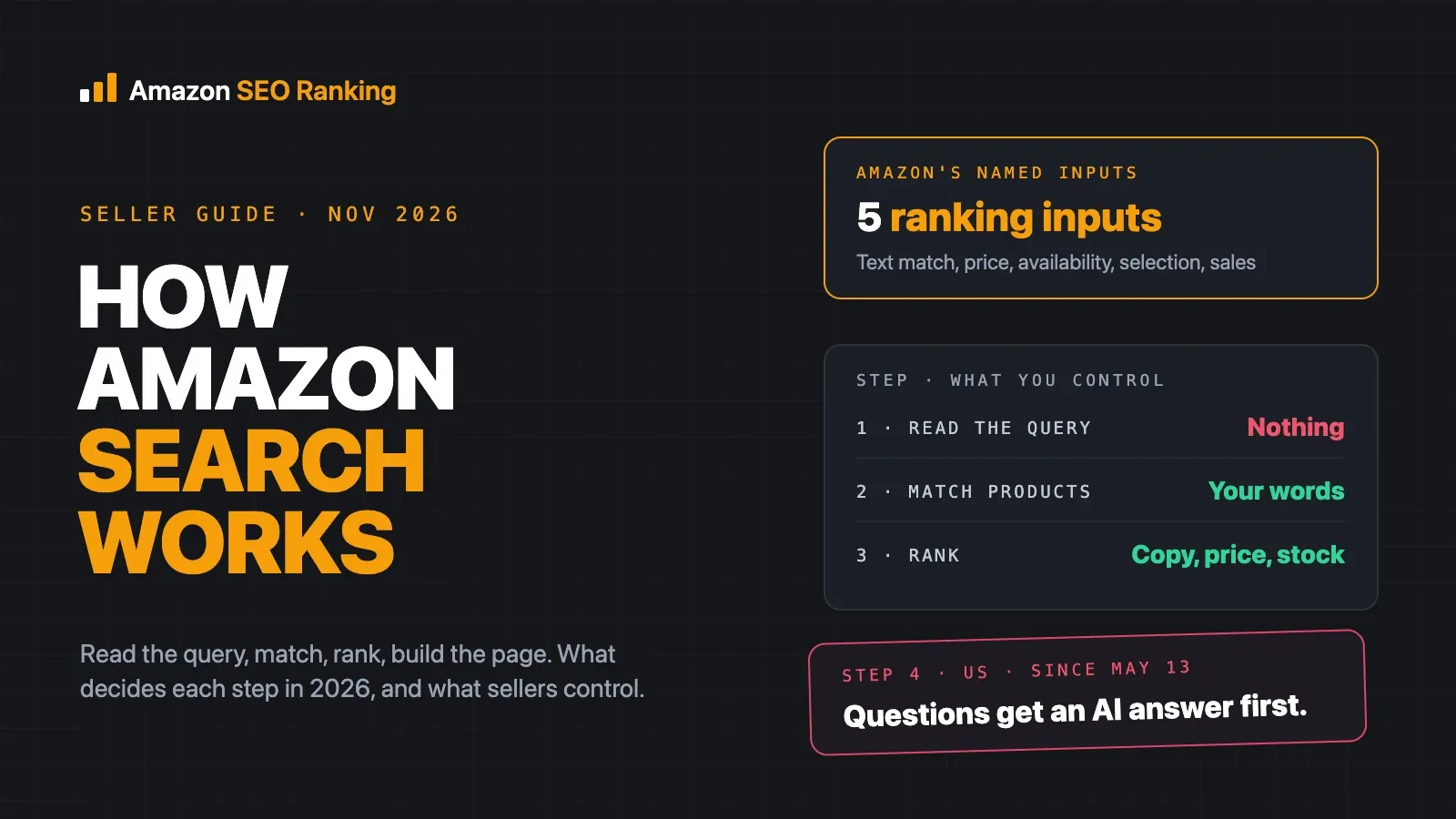
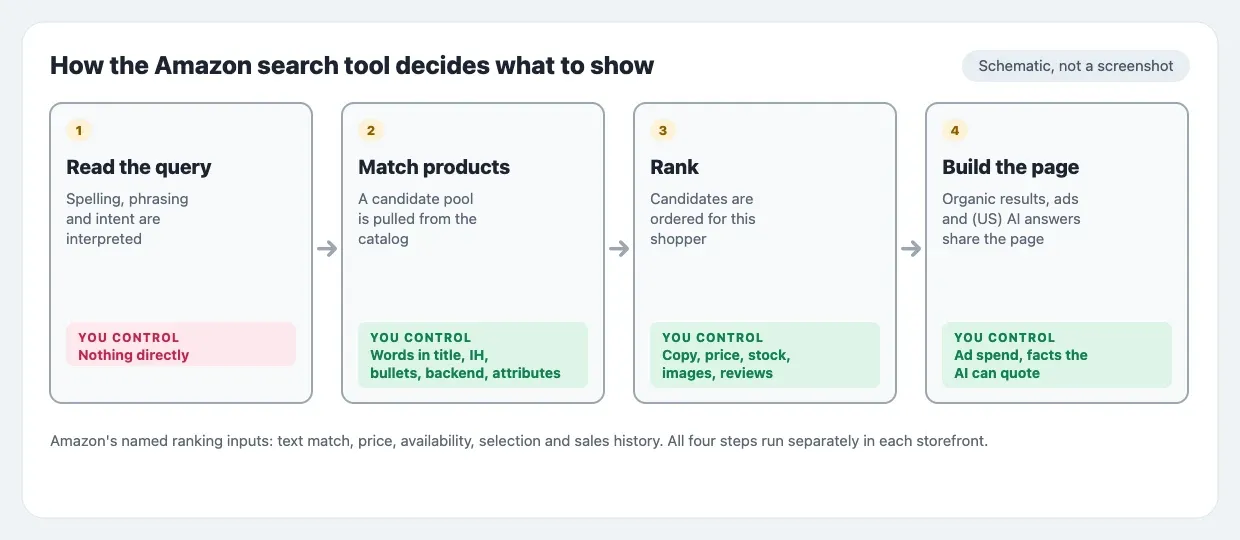
The Amazon search tool decides what to show in four steps. It reads the shopper's query, finds every product that matches it, ranks those products by how likely the shopper is to buy, then builds a page that mixes organic results, sponsored placements and, in the US, answers from Amazon's AI assistant. Amazon's own seller guidance names the ranking inputs as text match, price, availability, selection and sales history.
For sellers, only some of that is in your hands. Matching depends on the words in your listing's indexed fields. Ranking depends on whether shoppers who see your listing click and buy. This guide walks through each step, what Amazon has published about it, what changed in 2026, and how to check whether search can find your product at all.
It's written for sellers and agencies with live listings. If you came here looking for a keyword tool, the section on Amazon search tools for sellers covers those too.
Key Takeaways (TL;DR)
- The Amazon search tool is the search bar plus the system behind it: query reading, matching, ranking and page building.
- Matching comes first. A product can only rank for a query whose words (or meaning) Amazon can connect to its indexed fields.
- Ranking follows buyer behavior. Amazon points to text match, price, availability, selection and sales history.
- "A9" is the name of the Amazon search subsidiary founded in 2003. "A10" appears in no Amazon source. It's a label sellers and agencies use.
- 2026 changed the page more than the ranking: questions in the search bar go to Alexa for Shopping (May 13, US), and titles in most categories are capped at 75 characters (July 27).
- Shoppers also search with photos. Amazon Lens, Lens Live and "More like this" match images, not words.
- Search runs separately in each Amazon storefront. Being findable on amazon.com tells you nothing about amazon.de.
- You can't see the ranking formula, but you can see the inputs you control. A listing audit checks them in about 20 seconds.
Amazon Search Tool: at a Glance
| Step | What happens | What Amazon has said | What sellers control |
|---|---|---|---|
| 1. Read the query | Spelling, phrasing and intent are interpreted | Its search research trains models on customer behavior to handle spelling errors and word mismatches | Nothing directly |
| 2. Match products | A candidate set of relevant products is pulled from the catalog | Matching runs before ranking and mixes keyword and semantic matching | Words in the title, Item Highlights, bullets, backend terms and attributes |
| 3. Rank | Candidates are ordered for this shopper | Text match, price, availability, selection and sales history | Copy, price, stock, images, reviews |
| 4. Build the page | Organic results, ads, badges and AI answers share the page | Questions in the search bar go to Alexa for Shopping (US, since May 13, 2026) | Ad spend, listing facts the AI can quote |
| Visual search | Photos and camera scans find similar products | Lens, Lens Live, "More like this", circle to search | Clear images that show the product |
What Is the Amazon Search Tool?
The Amazon search tool is the set of features shoppers use to find products on Amazon, and the search engine underneath that decides which products they see. Most sellers think of the search bar. Amazon has added several other ways in, and each sends a different kind of query to the same catalog.
Amazon is where many product searches begin. In a 2023 survey of 8,153 US consumers, 50% said they start online product searches on Amazon, against 31.5% on Google, according to PowerReviews. Gen Z was the exception, starting on Google slightly more often.
The tools shoppers use to search Amazon
- The search bar and autocomplete. Suggestions appear as a shopper types, and in apparel and home, AI-generated images now appear in the suggestions too.
- Department, filters and sort. A shopper can narrow by brand, price, rating, Prime or attributes such as size and material. Filters only work on values a listing has filled in.
- Visual search. Amazon lists eight visual search features, including Amazon Lens, Lens Live (point the camera at a product), "More like this" and circle to search. A shopper can add text to a photo, such as "like this, but in white".
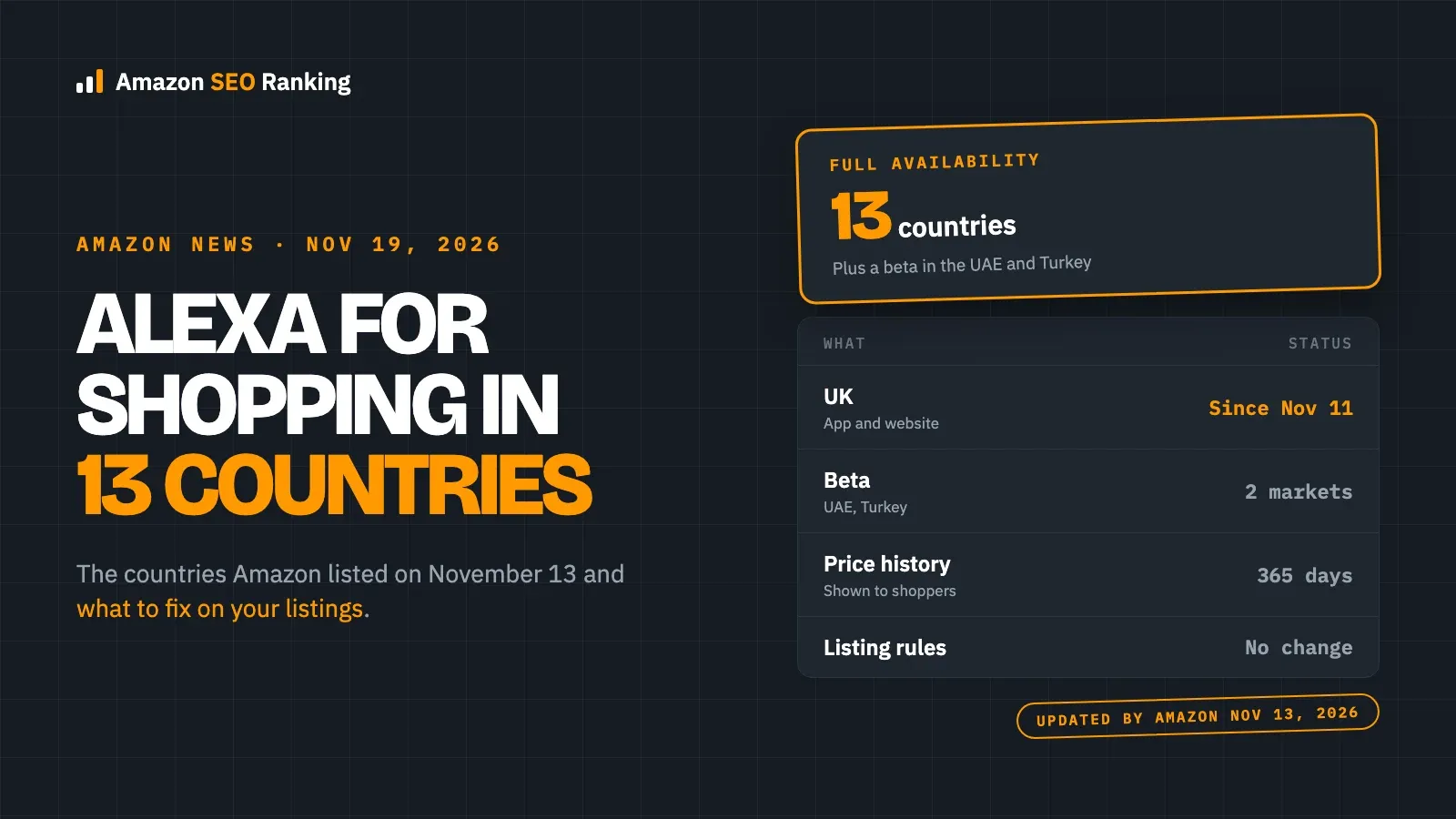
- Alexa for Shopping. Since May 2026, US shoppers can type a question into the main search bar and get an AI answer above the results.
Each entry point feeds the same catalog data. A missing attribute hurts a filtered search, and a cluttered main image hurts a visual match, even when the keyword copy is perfect.
How the Amazon Search Engine Decides What to Show
The Amazon search engine works in stages. Amazon's researchers describe product search as a matching stage followed by a ranking stage, and the results page adds a third layer on top. Here's what happens in each.
Step 1: Amazon reads the query
Shoppers type badly, and Amazon plans for it. In our keyword data for US Amazon, "waterbottle" gets about 4,039 searches a month and "water bottel" about 224, next to roughly 94,098 for "water bottle". Amazon's 2019 semantic product search paper describes training a model on customer behavior data to deal with problems like spelling errors.
The same paper covers vocabulary mismatch. A shopper types "sneakers", the listing says "athletic shoes". Semantic matching connects the two by meaning, so a listing doesn't need every synonym to qualify. It still needs the core terms a shopper uses, because exact keyword matching hasn't gone away.
Step 2: Matching decides which products qualify
Matching builds the pool of products that could appear for a query. Amazon's paper describes its semantic model as one component that sits alongside keyword matching and behavioral signals inside existing search. If your product doesn't make it into this pool, nothing in the ranking stage can help it.
A listing can also drop out of the pool entirely. Amazon suppresses listings that break its content rules, such as an over-length title or a missing main image, and a search-suppressed listing matches nothing until it's fixed.
For sellers, the practical test is indexing. Amazon reads the title, Item Highlights, bullets, description, backend search terms and attributes. When the words of a query, or a close meaning, aren't in any of those fields, the listing usually won't show for that query. That's why keyword placement still matters in 2026, even with AI on the page.
Step 3: Ranking orders the candidates
Once the pool exists, Amazon scores each product for this query and this shopper. Amazon's Seller Central guidance, as quoted by Search Engine Land, says factors such as degree of text match, price, availability, selection and sales history help decide where a product appears.
Amazon doesn't publish the weights. The shape is clear, though. Amazon earns money when a shopper buys, so a product that gets clicked and bought for a query tends to move up for that query. A product that's out of stock, overpriced against similar products or rarely clicked tends to slip.
Results are also personal. Amazon says Alexa for Shopping uses each shopper's history to tailor answers, and two people typing the same phrase can see different orders. Treat any single rank check as one sample, not the rank.
Step 4: The page gets built
The ranked list is only part of what a shopper sees. Sponsored Products and Sponsored Brands ads appear above and between organic results. Badges such as Amazon's Choice and Best Seller mark some listings. In the US app, an AI overview from Alexa for Shopping can sit at the top, and a shopper can select products for a side-by-side comparison.
So "ranking first" can still mean appearing below several ads and an AI answer. That's one reason sellers watch impressions and clicks per query, not only position.
Every storefront runs its own search
All four steps happen separately in each Amazon storefront. amazon.de matches German queries against the German version of your listing, with its own copy, attributes and sales history. A listing that ranks on amazon.com can be unmatched on amazon.de if the German title leaves out the phrase German shoppers type, or suppressed there for a rule broken only in that copy.
The 2026 changes didn't land evenly either. Alexa for Shopping launched for US customers, and Amazon's visual search features are rolling out to US app users first. If you sell in more than one storefront, check each one on its own terms, in its language, instead of assuming your home marketplace speaks for the rest.
Amazon Search Algorithm: A9, A10 and What Amazon Has Said
Sellers call the Amazon search algorithm "A9" because of history. A9.com was a subsidiary Amazon founded in 2003 to build search and advertising technology, based in Palo Alto. In 2019, after The Wall Street Journal reported that Amazon had changed its search algorithm to favor more profitable products, Amazon took down the A9.com site and pointed the domain to its home page.
The Amazon A9 algorithm, then, is shorthand for whatever ranks products in Amazon search today. Amazon's own seller help calls this area Amazon search. The Amazon A10 algorithm has no Amazon source at all: no launch, no announcement, no published change in weights. It's a name sellers, agencies and tool vendors use for the idea that ranking now leans more on behavior and less on keyword stuffing.
That idea isn't wrong. Amazon has published years of research on semantic matching, and in 2024 its researchers described COSMO, a knowledge system that links products to uses and audiences. But a guide that lists "A10 ranking factors" with percentages is describing guesses. Our post on how Rufus and COSMO are changing Amazon SEO separates what Amazon has published from what it hasn't.
What Changed in Amazon Search in 2026
Four changes this year affect what a shopper sees after typing a query. None of them replaced keyword matching.
| Date (2026) | Change | What it means for listings |
|---|---|---|
| March 25 | Sponsored Prompts became billable per click | Brands can pay to appear inside AI conversations |
| May 13 | Rufus merged with Alexa+ as Alexa for Shopping (US) | Questions typed in the search bar get an AI answer above the results |
| June | Amazon updated its visual search features page | Lens Live links camera search with Alexa for Shopping |
| July 27 | Titles capped at 75 characters in most categories | Fewer words fit in the most heavily weighted field |
Questions now share the search bar
Before May, a shopper had to open Rufus's chat panel to ask a question. Amazon's announcement says the main search bar now recognizes a question and hands it to Alexa for Shopping, which answers from the catalog, customer reviews, community Q&As and the web. A query like "best water bottle for the gym" can now return an AI answer and regular results on one page.
This adds a second test for listings. The assistant needs facts it can quote, such as capacity, material and what the product fits. A bullet that says "premium quality" gives it nothing to work with.
Titles got shorter
Amazon cut the title limit to 75 characters in all categories except media on July 27, 2026, according to PPC Land. Many older titles ran past 150. If yours is over the limit, Amazon may shorten or rewrite it and pick which words stay, which can drop the phrase a listing was indexed for. Item Highlights adds 125 searchable characters, which is where some of those words can move.
Amazon Search Ranking: What Sellers Control
You can't change how Amazon weighs its inputs. You can change most of the inputs. This table maps each factor Amazon names to the listing work behind it.
| Amazon's factor | What it covers | What you control | Audit criterion that checks it |
|---|---|---|---|
| Text match | Query words in indexed fields | Title, Item Highlights, bullets, backend terms, attributes | Title & Item Highlights; Bullet Points |
| Price | Price against similar products | Your price, coupons, deals | Not covered: compare with the top 10 results for your main query |
| Availability | In stock, delivery speed | Inventory, FBA or Seller Fulfilled Prime | Stock & Fulfillment |
| Selection | Variations and choice | Size, color and pack options under one parent | Not covered: check your variation setup in Seller Central |
| Sales history | Clicks and purchases over time | Images, reviews, A+ Content, price, all of the above | Images & Video; Reviews & Social Proof |
| AI answers (US) | Facts Alexa for Shopping can quote | Specific, checkable claims in copy | AI-Readiness |
Amazon SEO Ranking's audit scores the rows it covers against published pass rules. It doesn't judge your price or variation setup, so check those two by hand.
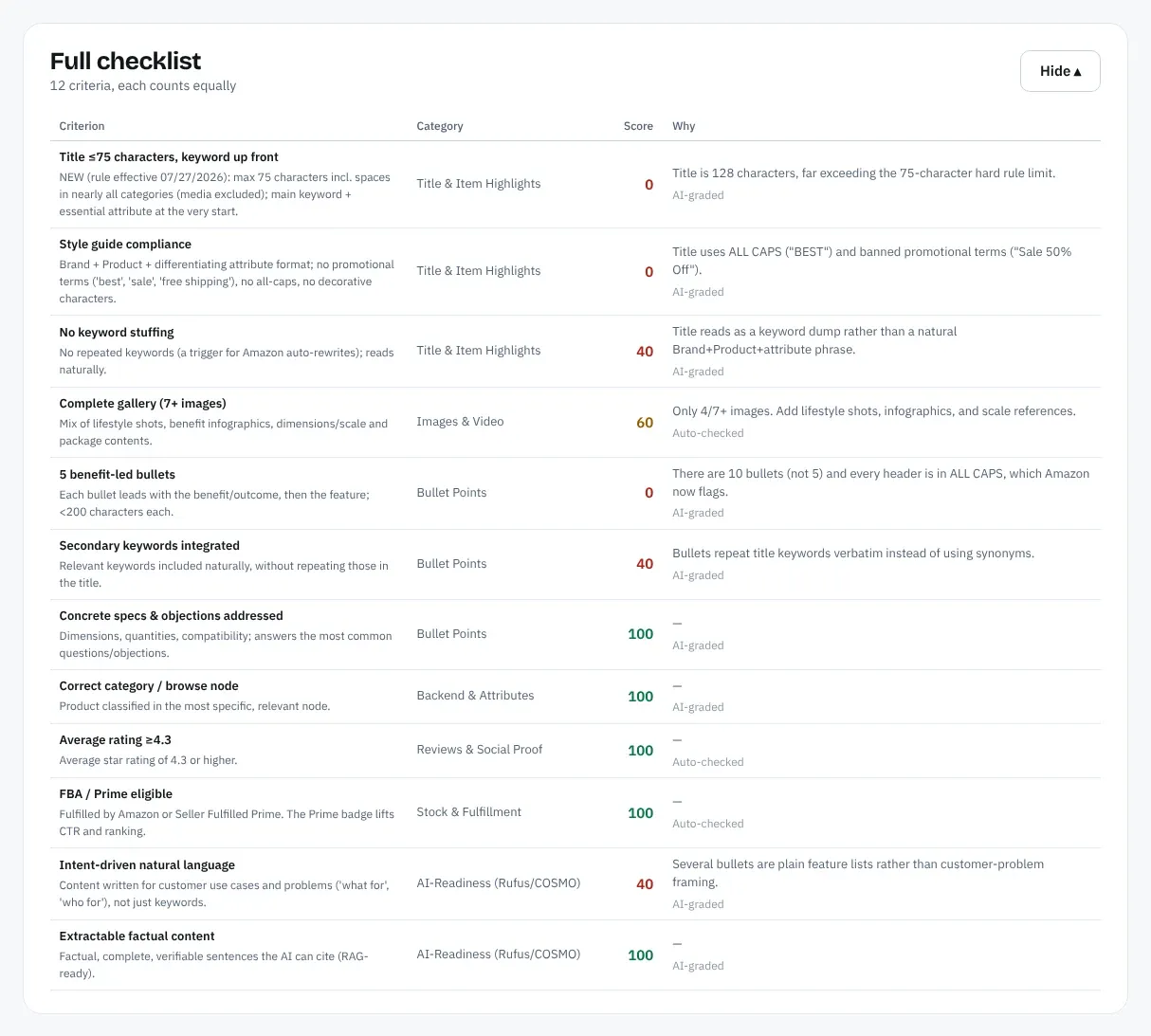
Amazon search ranking for a single query moves with the click and purchase data on that query. That's why copy and images count twice. They decide whether you match, and they decide whether a shopper clicks and buys once you do. Our guide on how to rank for keywords on Amazon covers the indexing test and field limits step by step.
What Search Data Shows: A Water Bottle Example
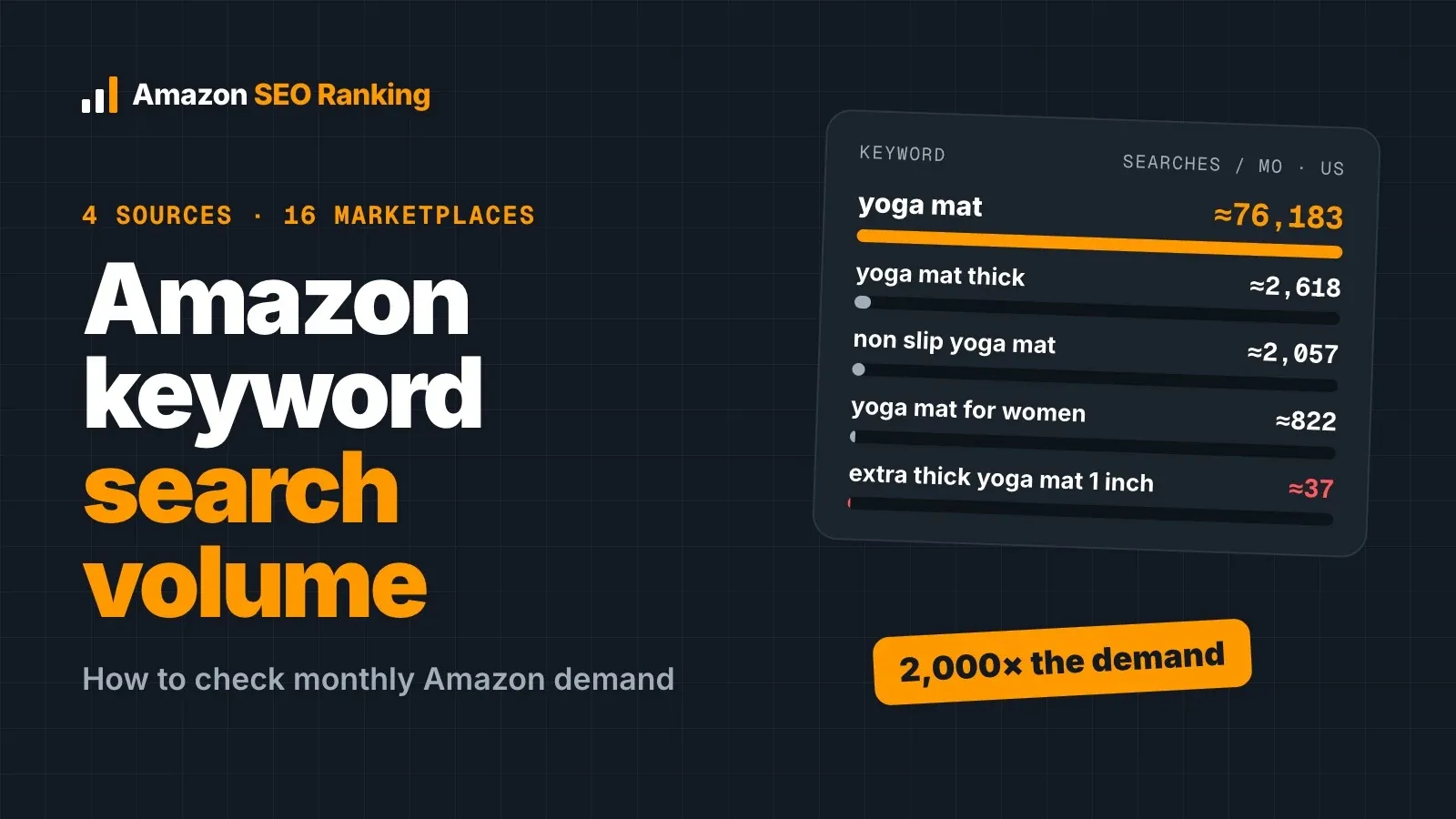
Search volume shows how differently shoppers phrase the same need. We pulled US Amazon estimates for eight water bottle queries with Amazon SEO Ranking's keyword volume tool (full results on Pro) on 19 November 2026. Figures are monthly estimates.
| Query | Est. monthly US Amazon searches | Type |
|---|---|---|
| water bottle | ≈94,098 | Head term |
| insulated water bottle | ≈10,322 | Attribute |
| stanley water bottle | ≈8,564 | Brand |
| waterbottle | ≈4,039 | Spacing variant |
| water bottle with straw | ≈3,964 | Feature |
| water bottel | ≈224 | Misspelling |
| insulated water bottle 32 oz | ≈187 | Spec |
| best water bottle for gym | ≈74 | Question style |
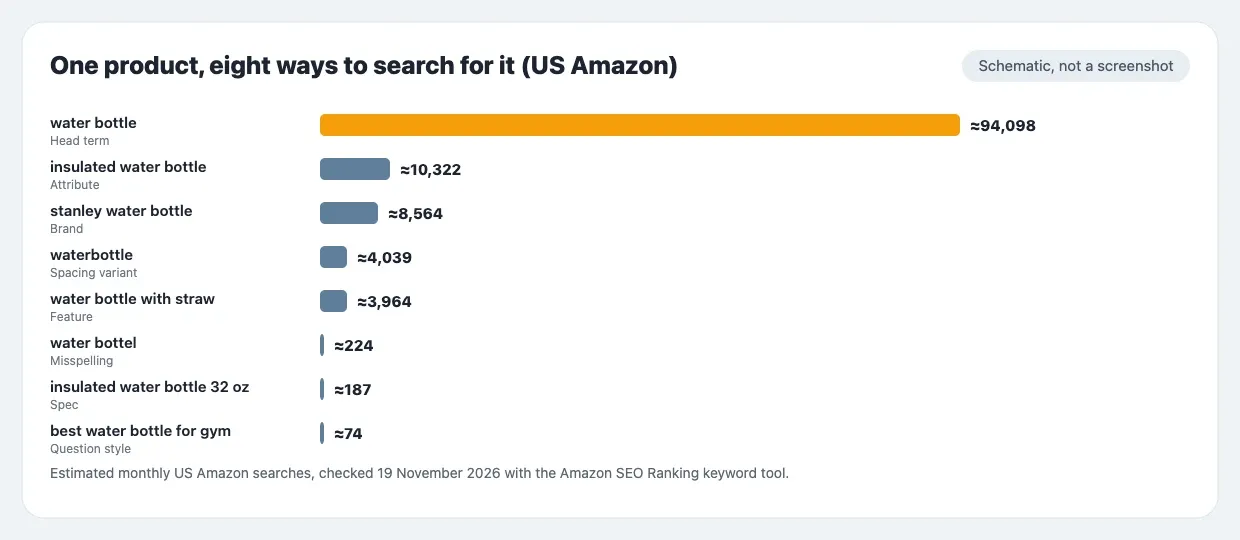
Three things stand out. The head term has more than nine times the volume of the next phrase, and it's also where every brand competes. Attribute and feature phrases ("insulated", "with straw") still carry thousands of searches, and they describe facts a listing can state in the title or bullets. The question-style phrase is small as a typed search, but it's the kind of query that now triggers an AI answer in the US.
For a 32 oz insulated bottle with a straw lid, that suggests a title that leads with the product type and the two attributes, with the capacity included, all inside 75 characters. Brand names you don't own, like "stanley", stay out of every field, including backend terms. Amazon's rules don't allow other brands' names in your search terms, and the backend field has a 249-byte limit, so every wasted word costs space. The free Backend Keyword Checker tests the field against that limit before you save it, since no shopper or outside audit can see it.
Amazon Search Tools for Sellers
Many people searching "amazon search tool" want software that shows what shoppers type. These are the main options, from Amazon and from third parties.
Amazon's own search data
Autocomplete is free and shows real phrasing, but no volume. Search Query Performance, in Brand Analytics for brand-registered sellers, shows impressions, clicks, add-to-carts and purchases for each query linked to your brand, along with your share of each. Amazon describes it as answering which queries led customers to your product.
Product Opportunity Explorer shows search and purchase data by niche, and the Sponsored Products search term report shows which queries your ads appeared and converted for. Together, these are the closest you'll get to what Amazon's ranking system sees.
Third-party keyword tools
Third-party tools estimate search volume for any phrase, including ones you don't rank for yet, and suggest related terms. Our comparison of the best Amazon search terms tools covers prices and what each estimates. Amazon SEO Ranking's keyword volume checks up to 1,000 phrases at a time on Pro, which is where the water bottle numbers above came from.
Keyword tools tell you what to target. They don't tell you whether your listing is set up to rank for it. That's a separate check.
How to Check Whether Amazon Search Can Find Your Listing
Use these five steps on any listing that gets fewer impressions than you expect. They run from free and quick to more involved.
- Run an indexing test. Search Amazon for your ASIN plus the target phrase, for example "B0XXXXXXXX insulated water bottle". If your product appears, it's indexed for that phrase. If it doesn't, the words aren't in a field Amazon reads.
- Read your Search Query Performance data. Low impressions on a relevant query point to a matching or ranking problem. High impressions with few clicks point to the main image, price or title. Clicks with few purchases point to the detail page.
- Check every field against Amazon's limits. Over-length titles, ALL CAPS and promotional words can get a listing rewritten or suppressed. The free Amazon listing requirements checker tests a draft title, Item Highlights and bullets as you type, with no ASIN needed.
- Audit the live listing in each storefront. An audit should pull the live listing at run time, including images, rating, Prime status and stock, not an old export. Amazon SEO Ranking checks 12 published criteria in about 20 seconds, in any of 23 Amazon storefronts.
- Fix the failed fields, then score the draft. Rewrite only what failed. Amazon SEO Ranking's AI Copy Rewriter drafts new copy for the specific criteria that lost points, checks it against Amazon's limits and claim rules, and lets you score it as a draft before you paste it into Seller Central.
Repeat the indexing test a few days after a change. If the product now appears for the phrase, matching is solved, and the rest is ranking: clicks and purchases over time.
Everything You Need to Know About the Amazon Search Tool
| Topic | What to know | Rule or number |
|---|---|---|
| Where shoppers start | Amazon leads Google for product searches | 50% vs 31.5% (PowerReviews, 2023) |
| Stages | Read query, match, rank, build page | Matching runs before ranking |
| Matching | Keyword plus semantic matching | Query words or meaning must reach an indexed field |
| Ranking inputs | Named by Amazon | Text match, price, availability, selection, sales history |
| Weights | Not published | Any precise factor list is an estimate |
| A9 | Amazon search subsidiary | Founded 2003; site taken down 2019 |
| A10 | Seller-community label | No Amazon source |
| Personalization | Results vary by shopper | Alexa for Shopping uses shopping history |
| Visual search | Photo and camera search | Lens, Lens Live, "More like this", circle to search |
| AI answers | Questions in the search bar | Alexa for Shopping, US, since May 13, 2026 |
| Title limit | Most categories | 75 characters since July 27, 2026 |
| Item Highlights | Extra searchable copy | 125 characters |
| First-party data | Brand-registered sellers | Search Query Performance in Brand Analytics |
| Storefronts | Search runs separately in each | Check each storefront in its own language |
| Backend search terms | Hidden from shoppers | 249-byte limit |
See What Amazon Search Sees in Your Listing
Amazon won't show you its ranking formula. Amazon SEO Ranking shows you every input you control, scored against 12 published criteria with the pass rules in the open: title and Item Highlights, bullet points, images and video, reviews and social proof, stock and fulfillment, and AI-readiness for Alexa for Shopping. Every audit pulls the live listing at run time, so the score reflects what Amazon search sees today. When a criterion fails, the AI rewrite fixes that field using your listing's own spec table, then checks the copy for Amazon's length limits and unsupported claims before you see it.
It's built for sellers whose listings get impressions but few sales, or no impressions at all for phrases they thought they targeted, and for agencies that need a score a client can check line by line. It's also built for sellers in more than one storefront: the audit covers 23 Amazon marketplaces, so you can see where a listing that ranks at home fails abroad.
The free plan includes 3 full audits a month with no credit card required. Pro is $79 a month with a 7-day free trial, and every charge has a 14-day money-back guarantee.
FAQ
What is the Amazon search tool?
The Amazon search tool is the search bar, filters and visual search features shoppers use to find products, plus the search engine that decides which products appear. It reads a query, matches it to products whose indexed fields fit, ranks them, and builds a results page with organic listings, ads and, in the US, AI answers. Amazon names text match, price, availability, selection and sales history as factors in where a product appears. In a 2023 PowerReviews survey, 50% of US consumers said they start product searches on Amazon.
How does the Amazon search tool decide what to show?
The Amazon search tool decides what to show by matching the query to relevant products, then ranking them by how likely this shopper is to buy. Matching uses keyword and semantic matching against a listing's title, Item Highlights, bullets, backend terms and attributes. Ranking uses factors Amazon names as text match, price, availability, selection and sales history. The page then adds sponsored placements, badges and, for questions typed in the US search bar, an Alexa for Shopping answer.
Is the Amazon A10 algorithm real?
The Amazon A10 algorithm is not a real, announced Amazon system. No Amazon source mentions A10, and Amazon has never published a launch date or a change in ranking weights under that name. Sellers and agencies use "A10" to describe ranking that leans more on buyer behavior than on keyword density. Amazon's seller help refers to the system as Amazon search.
What is the Amazon A9 algorithm?
The Amazon A9 algorithm is the common name for the system that ranks products in Amazon search, taken from A9.com, the search subsidiary Amazon founded in 2003. Amazon took down the A9.com site in 2019 and pointed the domain to its home page. Sellers still use "A9" for whatever ranks products today. The factors Amazon names are text match, price, availability, selection and sales history.
Does Amazon have a search engine?
Amazon has its own product search engine, and it searches Amazon's catalog rather than the web. It runs every query typed into the Amazon search bar, plus image searches from Amazon Lens and, since May 13, 2026 in the US, questions answered by Alexa for Shopping. A9.com once ran a separate web search engine, launched in 2004, but that site was shut down in 2019.
Can I take a picture of something and find it on Amazon?
You can take a picture of something and find it on Amazon with Amazon Lens, the camera icon in the search bar of the Amazon Shopping app. Lens Live scans a product through the camera and shows matches in a carousel you can swipe through. You can add text to a photo, such as a color or material, and circle one item in an image to search for it alone. Amazon says these features are rolling out to US customers on iOS and Android.
Does Amazon personalize search results?
Amazon personalizes search results, so two shoppers typing the same phrase can see products in a different order. Amazon says Alexa for Shopping uses each shopper's shopping history, browsing and Alexa conversations to tailor answers. A single manual rank check is one shopper's view. Search Query Performance in Brand Analytics shows impressions and clicks across all shoppers, which is a more reliable measure.
Is optimizing a listing worth it if Amazon hides its formula?
Optimizing a listing is worth it because the inputs Amazon names, text match, price, availability, selection and sales history, are mostly set by the seller. Matching depends on words in fields you write, and a listing that isn't indexed for a phrase gets no impressions for it, whatever its sales. Since July 27, 2026, titles in most categories are capped at 75 characters, so field choices matter more than before. A free audit checks those inputs against 12 published criteria in about 20 seconds.
Run a free Amazon listing audit on the ASIN that isn't showing up, or compare plans if you need bulk runs and full keyword volume.
Run a free Amazon listing audit