Yes, you can use ChatGPT to write an Amazon listing, and plenty of sellers do. A ChatGPT Amazon listing is a fast first draft. It is rarely safe to paste into Seller Central as it comes out, because ChatGPT can't see your live product page, guesses at product facts it doesn't have, and miscounts characters against limits Amazon now enforces.
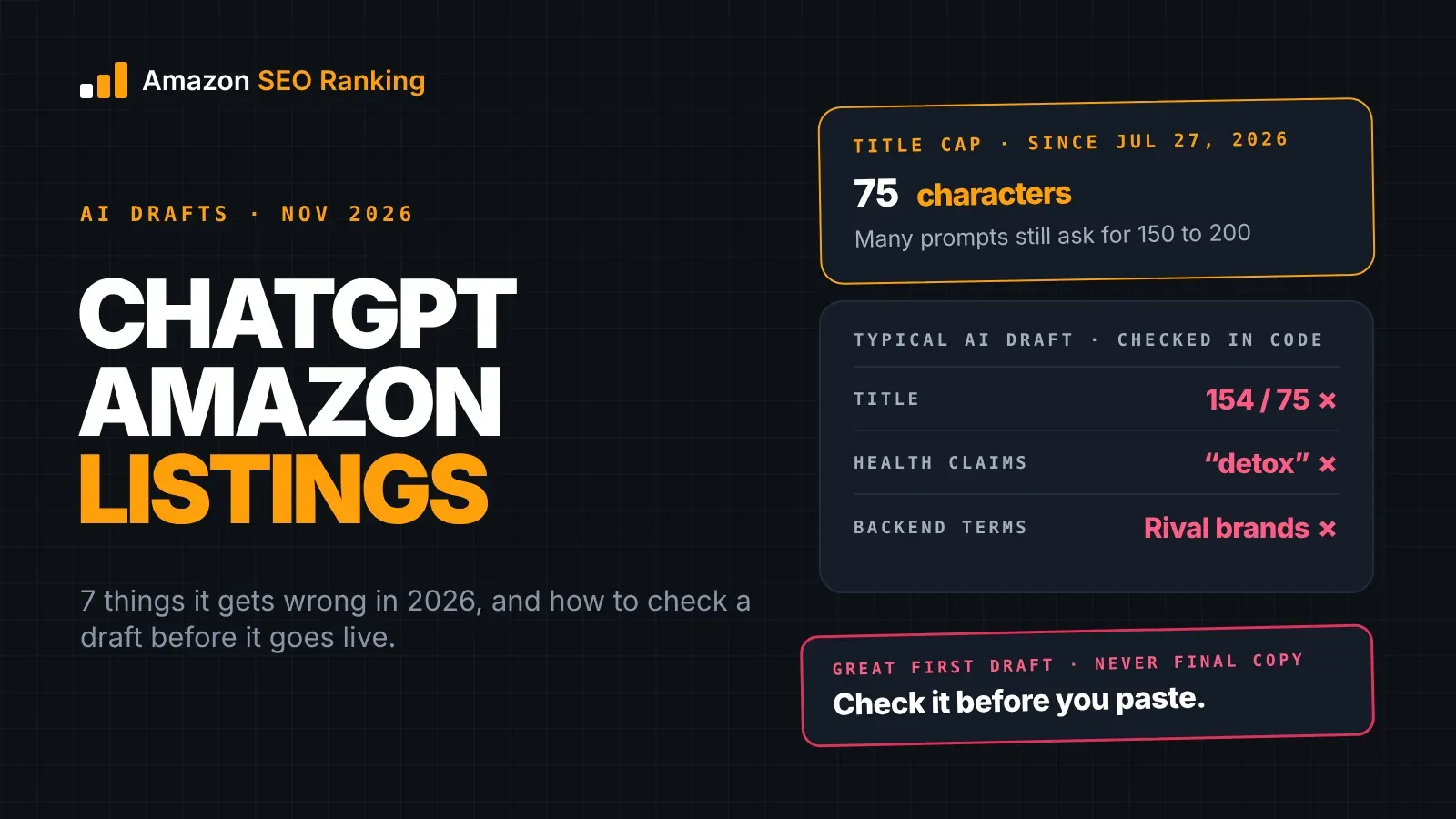
The rules also moved this year. Since July 27, 2026, titles in every category except media are capped at 75 characters, and many ChatGPT prompts still circulating online ask for 150 to 200. A draft built on that advice gets rewritten by Amazon's own AI, which then decides which of your keywords stay.
We ran a typical AI-style draft through a code-based listing check to see what breaks. The title came back at 154 characters. The bullets claimed the bottle "helps detox your body", and the backend terms named two competitor brands. This guide covers the seven things ChatGPT gets wrong, that test in full, a prompt setup that avoids most of it, and a check you can run before anything goes live.
Amazon SEO Ranking is our product. We say where ChatGPT does the job well, including the jobs our tool doesn't do at all.
Key Takeaways (TL;DR)
- Short answer: ChatGPT is fine for drafting and brainstorming. Every draft needs a fact check and a code-counted length check before it goes live.
- It can't read your listing. Amazon blocked OpenAI's live-browsing agent in its robots.txt in November 2025, so ChatGPT works only from what you paste.
- Titles: Amazon caps titles at 75 characters in all categories except media since July 27, 2026. Prompts asking for 150 to 200 characters are out of date.
- Counting: language models read tokens, so ChatGPT can't count characters or bytes reliably on its own.
- Invented facts: OpenAI's own research says models guess when they're unsure. Your certifications, pack counts and test results are exactly the facts they guess.
- Claims: health, eco and "#1" claims slip in by default, and Amazon restricts all three.
- Fix: give ChatGPT a fact block, ban the claims you can't support, and check the output in code before you paste it.
- Free check: paste a ChatGPT draft into a draft audit on Amazon SEO Ranking's free plan and it's scored on 12 published criteria against your live listing, with length and claim checks run in code.
ChatGPT Amazon Listing: at a Glance
| Listing field | What ChatGPT does well | What it gets wrong | How to catch it |
|---|---|---|---|
| Title | Clear product naming, readable order | Runs past the 75-character cap; adds "Best" and untested claims | Count in code, not by asking the model |
| Item Highlights | Short benefit phrasing | Often skipped, since older prompts don't ask for it | Ask for it by name, up to 125 characters |
| Bullets | Benefit-led sentences, use cases | ALL CAPS headers, "#1 choice", "100% leak proof", "free shipping" | Style and claim check |
| Description | Fluent, well-structured copy | Detox, immunity and eco claims with nothing behind them | Compare every claim with your spec table |
| Backend search terms | Synonyms and misspellings | Competitor brand names; byte count guessed | Byte counter plus a policy scan |
| Keywords | Plausible phrases | No Amazon search volume behind them | Check volume in an Amazon keyword tool |
| Live listing data | Nothing | Can't open Amazon pages, so never sees your spec table | Paste the facts yourself |
Can ChatGPT Write an Amazon Listing That Passes in 2026?
It can, when you give it the right inputs and check what comes back. Amazon itself encourages AI drafting: it offers generative AI listing tools inside Seller Central, and it says over 900,000 sellers have used them, accepting the content without edits more than 90% of the time. Using AI to write copy breaks no rule. The copy still has to follow the same listing policies as anything a person writes.
That 90% figure is the warning. Most sellers who use AI copy accept it unread, and the errors go live with it. Amazon's own tool at least starts from your catalog data. ChatGPT starts from whatever you typed into the chat box.
What neither tool gives you is a score. A ChatGPT draft reads well, and nothing in the chat tells you whether it beats the listing you already have. Amazon SEO Ranking scores both against the same 12 published, equally weighted criteria, from title and bullets to backend terms and readiness for Alexa for Shopping, so you can compare a ChatGPT draft, an Amazon AI draft and your live copy on one scale before choosing.
Three things changed in 2026 that make old ChatGPT habits more expensive. The 75-character title cap took effect on July 27. In May, Amazon replaced Rufus with Alexa for Shopping, which answers shopper questions from the facts a listing states. And the volume of AI-written copy means generic phrasing now reads the same across every listing on page one.
7 Things ChatGPT Gets Wrong in an Amazon Listing
These come from the field rules Amazon enforces and from what a code-based check flags on AI-written drafts. Some are fixable with a better prompt. Others need a check outside ChatGPT.
1. It Can't See Your Live Listing
Pasting an Amazon URL into ChatGPT doesn't give it your page. Amazon updated its robots.txt in November 2025 to block ChatGPT-User, the agent ChatGPT uses to fetch live pages, along with OAI-SearchBot, as Modern Retail reported. It had already blocked GPTBot, OpenAI's training crawler.
So ChatGPT never sees your spec table, your current bullets, your reviews or your rating. When it rewrites "your listing", it rewrites whatever you pasted, and fills every gap from what similar products usually say. That is how a single bottle becomes a "set of 2" or picks up a 24-hour temperature claim nobody tested.
An Amazon SEO Ranking audit works from the other end. It reads the public product page at the moment you run it, spec table, gallery count and rating included, and its rewrites use that spec table as the source of truth.
2. It Follows Title Rules That No Longer Apply
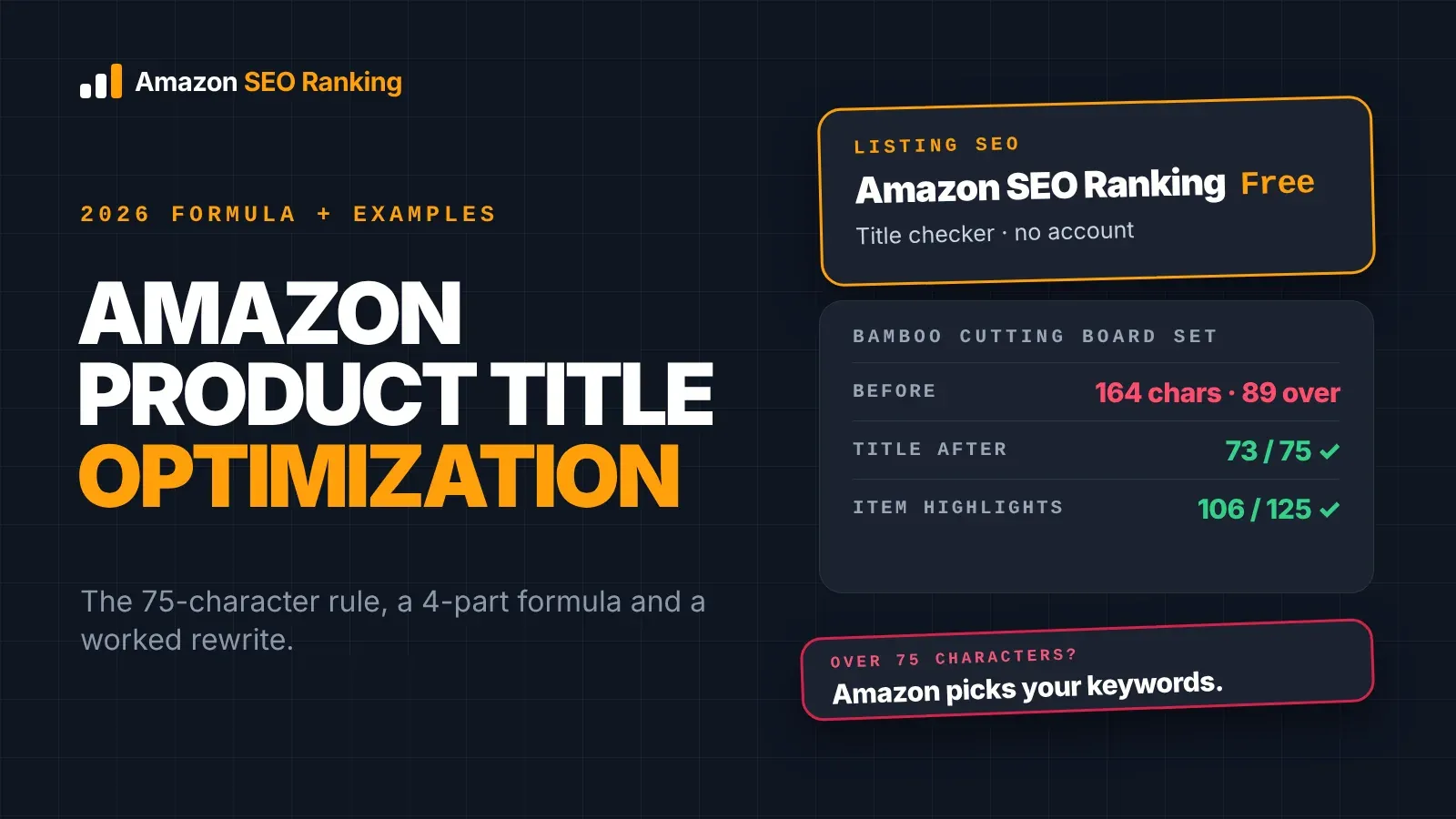
Amazon posted the change in Seller Central on June 10, 2026: from July 27, titles in all categories except media must be 75 characters or fewer, spaces included. Titles still over the limit are gradually replaced with Amazon's own AI version while the listing stays live.
Many ChatGPT prompt guides published before that date still tell you to ask for a 150 to 200 character title. ChatGPT will happily follow the instruction. The result is a title Amazon cuts down for you, usually keeping the brand and product type and dropping the secondary phrases you wanted indexed.
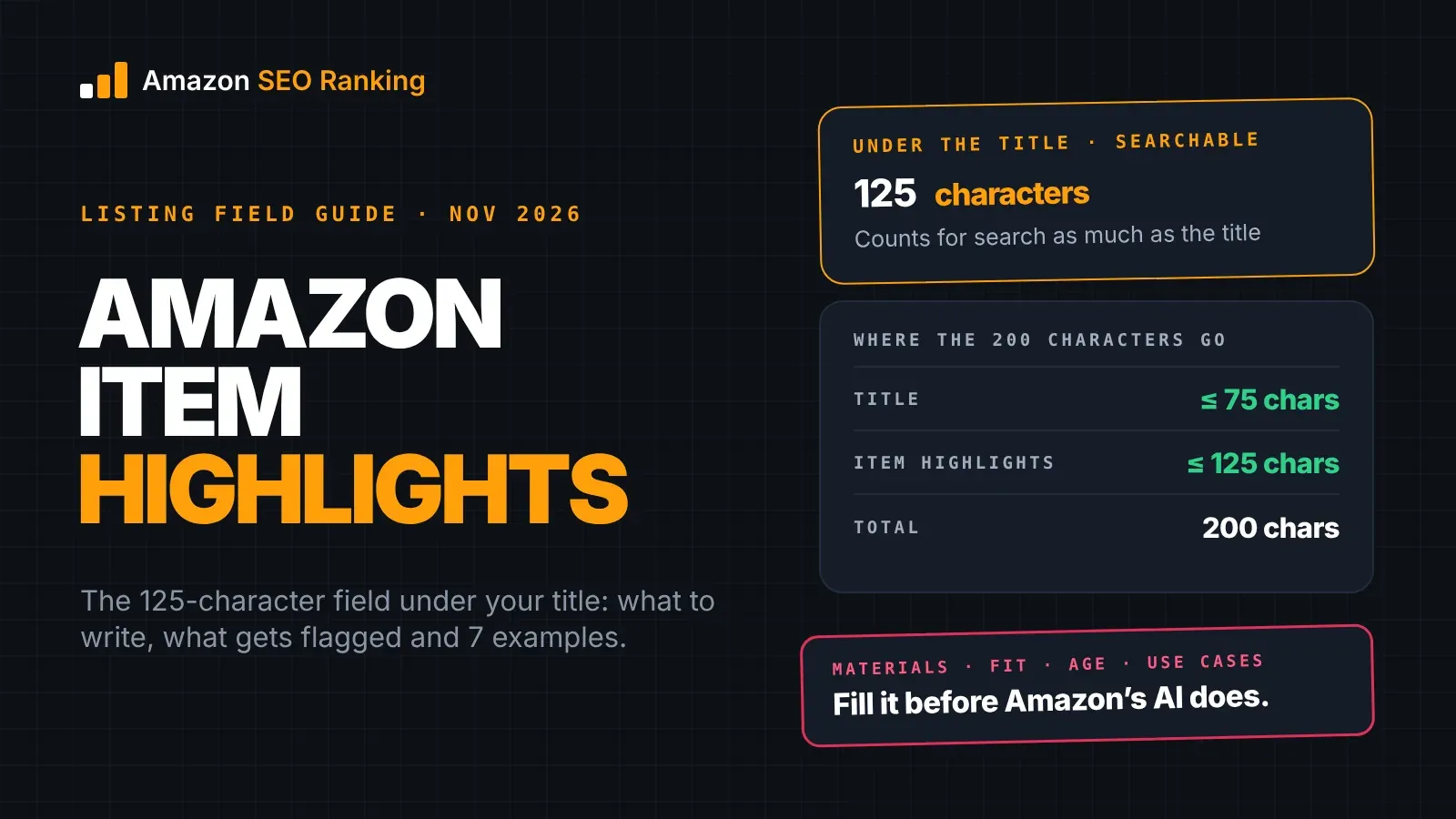
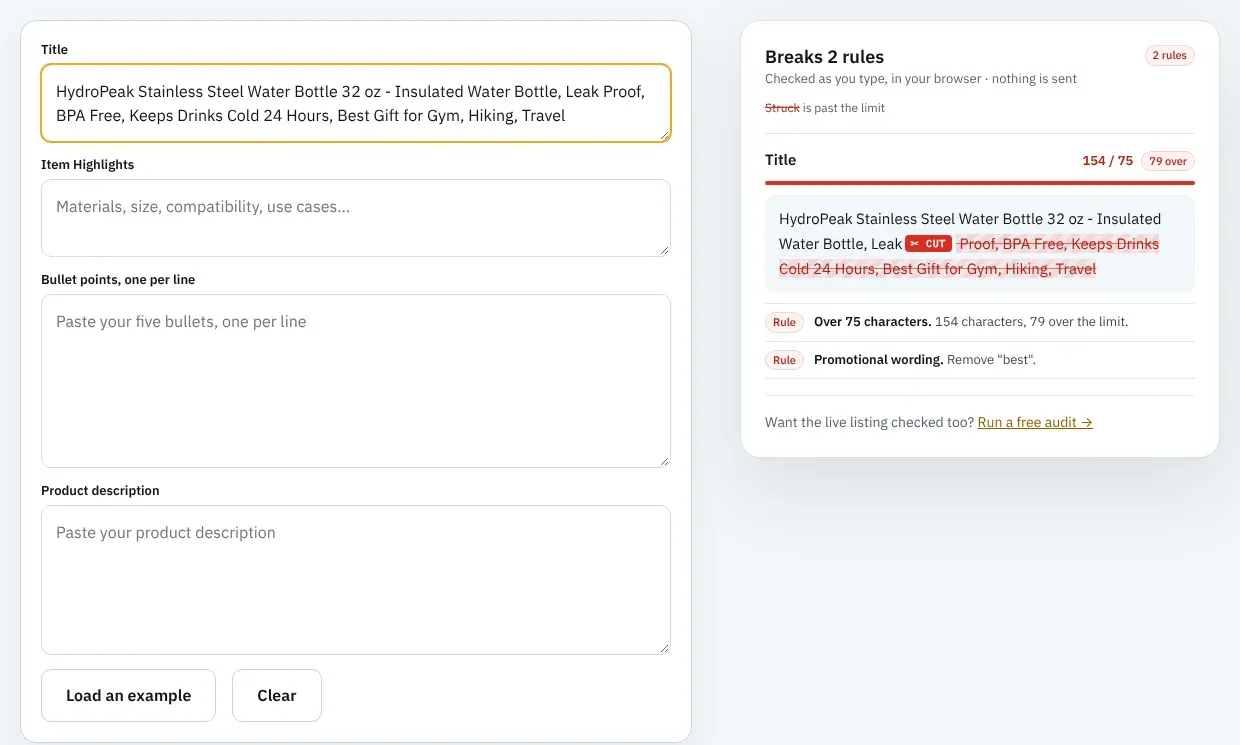
The fix is to move those phrases. Item Highlights adds up to 125 characters under the title, and the bullets and backend terms take the rest. Ask ChatGPT for each field by name with its limit, and don't trust its count. Paste the title into the free Character Limit Checker and everything past character 75 is struck through, so you see exactly which words Amazon would drop.
3. It Can't Count Characters or Bytes
ChatGPT doesn't see letters. It reads text as tokens, chunks of a word or several words, and researchers have shown that tokenization undermines a language model's ability to count. On OpenAI's own community forum, one user reported ChatGPT describing a rewrite as 1,872 characters when it was 2,360.
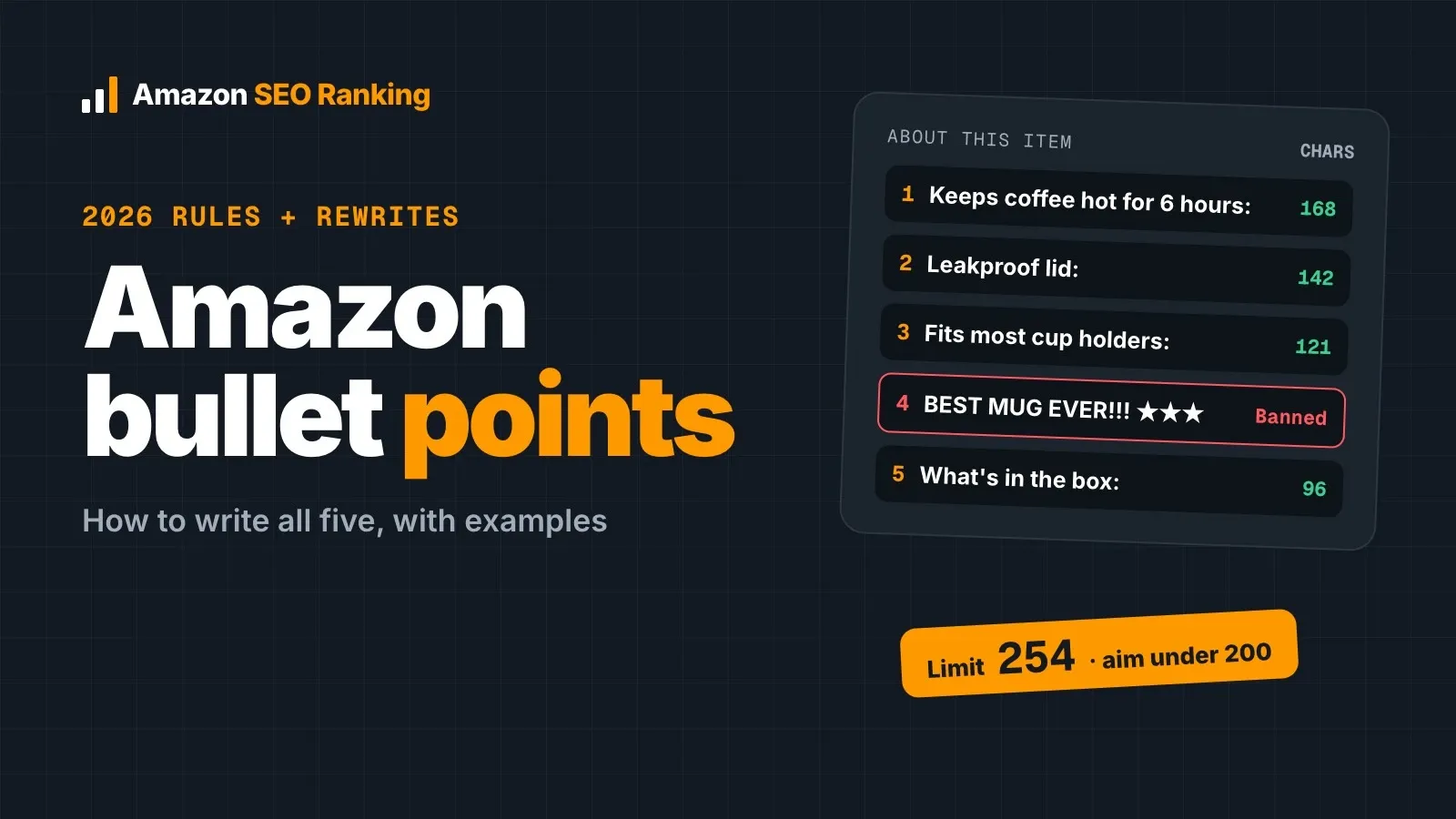
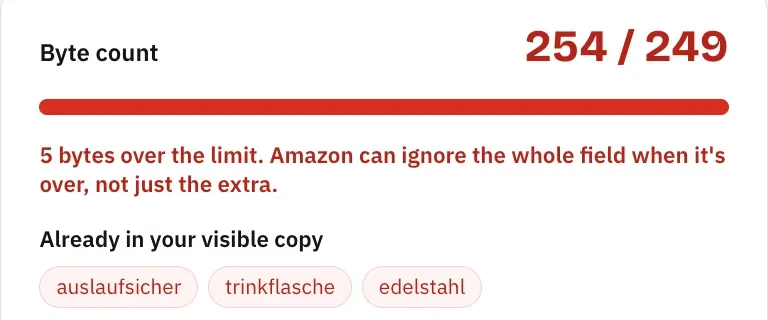
That matters on three fields. Titles have a hard 75-character cap. Bullets can run to 255 characters, though anything past about 200 gets cut off on mobile. Backend search terms are measured in bytes, with a 249-byte limit, and accented letters in German, French or Spanish count as two bytes each.
A model that says "this title is 74 characters" is predicting what a count looks like. Paste the field into a counter, or ask ChatGPT to run Python on it, which counts correctly. Amazon SEO Ranking counts every field in code on each audit and rewrite, and its rewrites are held to the limits before you see them.
4. It Invents Product Facts
OpenAI's research team wrote in September 2025 that language models hallucinate because training and evaluation reward guessing over admitting uncertainty. The same paper explains that arbitrary, rarely seen facts can't be predicted from patterns, so models get them wrong most often.
Your product's details are those facts. Whether your bottle is BPA-free, how many hours it keeps ice frozen, whether the lid passed a leak test: none of that is in ChatGPT's training data. It writes what products like yours usually claim.
On Amazon, an invented fact has a cost. A wrong pack count or capacity turns into "not as described" returns. An untested performance claim invites complaints from buyers who measured it. Every factual statement in a ChatGPT Amazon product description needs a source you could show Amazon.
That is the job of a brand fact sheet: approved facts and banned claims, written once. In Amazon SEO Ranking it's saved and applied to every rewrite, Ask AI edit and bulk run, and every audit flags product claims that neither the spec table nor the fact sheet supports.
5. It Adds Claims Amazon Restricts
Left to its defaults, ChatGPT writes like marketing copy, and marketing copy is full of claims Amazon limits. Health and wellness language ("detox", "boosts immunity") appears even on products with no health function. Environmental claims ("eco-friendly", "help save the planet") appear with no certification behind them.
Superlatives are the third group. "#1 choice", "best gift" and "100% guaranteed" are subjective or absolute claims Amazon's style rules discourage, and the first two often land in the title. A listing with restricted claims can be suppressed from search, which is worse than ranking low.
Amazon SEO Ranking flags health claims such as "detox" and "weight loss" in code on every audit and rewrite, on every plan. On Pro and Agency, an AI compliance scan also reviews the copy for superlatives, guarantees, environmental claims and promotional language.
6. It Picks Keywords Without Search Data
ChatGPT has no access to Amazon search volume. Asked for keywords, it produces phrases that sound like what people search for, and some of them are. Others get almost no searches, and it can't tell you which is which.
It also suggests competitor brand names for backend search terms, because "hydro flask water bottle" sounds like a real search. Amazon prohibits other brands' names in that field. Check every keyword ChatGPT gives you against real Amazon keyword search volume before it takes space in a title.
7. It Formats Copy the Way Amazon's Style Guide Rejects
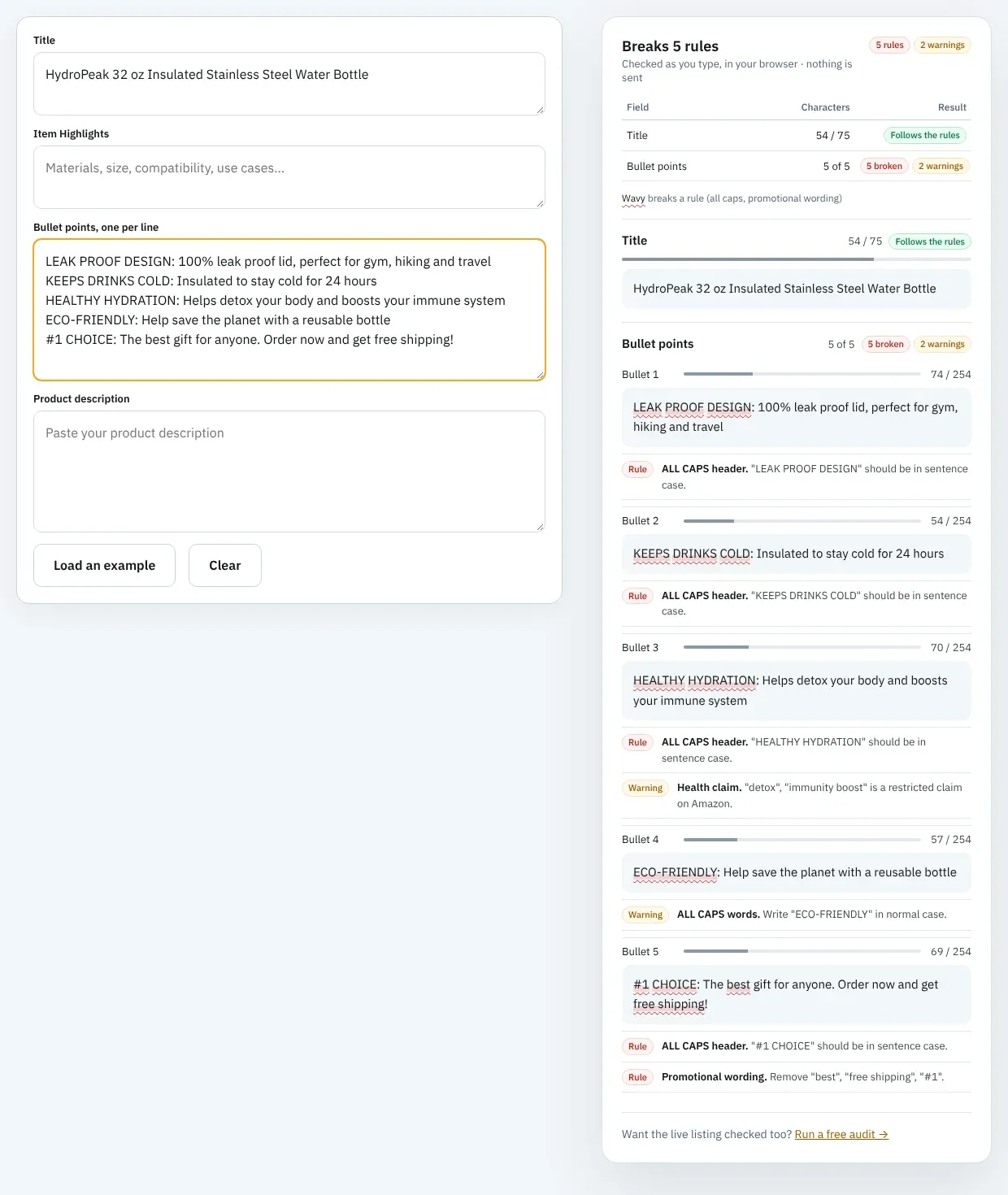
ChatGPT's idea of a "persuasive Amazon bullet" usually starts with an ALL CAPS header and ends with a call to action. Both break Amazon's style rules. "Order now and get free shipping!" adds a shipping claim and promotional urgency, which are banned in listing copy, and offers can change while the bullet stays.
It also writes for a reader skimming for keywords. Alexa for Shopping answers questions like "which bottle fits a car cup holder?" from the facts a listing states, so "72 mm base, fits most car cup holders" does more work than "perfect for life on the go". Our Rufus and COSMO SEO guide covers how to write for those questions.
Two of the 12 criteria in Amazon SEO Ranking's audit score this directly, under AI-Readiness, and the rewrite targets whichever criteria the listing failed. A bullet rewritten for the AI-Readiness criteria comes back with sentence-case headers and a stated fact.
We Tested a Typical AI Draft: What the Check Found
To show how these errors stack up, we wrote a test listing for a fictional 32 oz stainless steel bottle, "HydroPeak", using the patterns AI drafts tend to produce: a long keyword-packed title, ALL CAPS bullet headers, benefit claims and a gift angle. The spec table said one bottle, 32 fl oz, stainless steel, and nothing else. We then ran the copy through Amazon SEO Ranking's listing copy check on 16 November 2026, using the Claude connector.
The checks come in two layers. The code checks (length limits, health claims and claims the spec table doesn't support) run on every audit and draft audit, including the free plan's 3 audits a month. The AI compliance scan runs on top of them on Pro and Agency.
The draft title:
HydroPeak Stainless Steel Water Bottle 32 oz - Insulated Water Bottle, Leak Proof, BPA Free, Keeps Drinks Cold 24 Hours, Best Gift for Gym, Hiking, Travel
Here is what came back.
| Check | Type | What it flagged |
|---|---|---|
| Title length | Code check (every plan) | 154 characters against a 75-character limit |
| Health claim | Code check (every plan) | "detox" in bullet 3 |
| Health claim | Code check (every plan) | "boosts your immune system" in bullet 3 |
| Unsupported claim | Code check (every plan) | "BPA free", which the spec table didn't state |
| Unsupported claim | Code check (every plan) | "eco-friendly", with no certification or fact behind it |
| Competitor brands | AI scan (Pro) | "hydro flask" and "yeti" in backend search terms |
| Superlative and absolute claims | AI scan (Pro) | "#1 choice", "100% leak proof", "Best Gift" |
| Promotional language | AI scan (Pro) | "Order now and get free shipping!" |
| Untested performance claim | AI scan (Pro) | "Keeps Drinks Cold 24 Hours" with no test data |
| Formatting | AI scan (Pro) | ALL CAPS lead-ins on all five bullets |
All five bullets passed the length check, the longest at 188 characters, and the backend terms came in at 132 bytes. Length was the one thing the draft mostly got right. The problems were in what it said.
Two findings are worth singling out. The competitor brand names were caught by the AI policy scan, since a byte counter has no reason to object to them. And "BPA free" was flagged only because the spec table didn't mention it. If your bottle is BPA-free, the fix is to add that to your product attributes or brand fact sheet, and the claim then passes.
So the code checks found 5 problems and the Pro scan found 5 more. Every one of these is the kind of line ChatGPT writes when nobody tells it otherwise, and a reader skimming the draft would likely approve it.
To run the same test on your own ChatGPT draft, paste it into a draft audit on any plan: the title, Item Highlights, bullets and description are scored against your live listing, and blank fields keep the live copy. If you work inside Claude, the connector runs the same check in the chat on Pro and Agency.
How to Use ChatGPT for an Amazon Listing Without the Errors
Most of the seven problems shrink when ChatGPT has the facts up front and clear limits. The rest need a check outside the chat.
Give It a Fact Block First
Start every chat by pasting the facts ChatGPT can't find. Copy your spec table from the live listing, then add approved claims and banned claims as two separate lists. Tell it plainly that it may only state facts from the block.
You'll paste this block into every new chat, for every product. Amazon SEO Ranking's brand fact sheet holds the same lists once and applies them to every rewrite automatically, along with the live spec table the audit reads.
A short version looks like this:
Product facts (use only these):
- 32 fl oz, single bottle, 18/8 stainless steel
- Double-wall vacuum insulated; cold-retention not lab-tested
- Lid: screw-on, tested leak-resistant when upright
- Base diameter 72 mm
Approved claims: insulated, leak-resistant when upright, dishwasher-safe lid
Banned claims: BPA-free (not certified), 24 hours cold, eco-friendly, any health benefit
Never include competitor brand names anywhere, including backend terms.
ChatGPT Prompts for an Amazon Listing That Match 2026 Rules
Ask for each field by name, with its limit, in one message. This prompt reflects Amazon's current limits:
Using only the product facts above, write an Amazon listing for amazon.com:
- Title: 75 characters or fewer, spaces included. Brand, product type, key attribute. No "best", no promotional words.
- Item Highlights: up to 125 characters.
- 5 bullets, each under 200 characters, sentence-case lead-ins, no ALL CAPS, no shipping, offers or calls to action.
- Description: under 2,000 characters, plain text.
- Backend search terms: under 249 bytes, synonyms and misspellings only, no words already in the title or bullets, no brand names.
Then run Python to count the characters of each field and the bytes of the backend terms, and show the counts.
The last line matters. Asking ChatGPT to count in code gives you real numbers, where asking it to check its own work gives you a guess.
Check Every Claim Against Your Spec Table
Read the draft once with only one question in mind: could I show Amazon where this fact comes from? Highlight every number, material, certification and performance claim. Anything that isn't in your fact block comes out.
Pay extra attention to counts and sizes. If the title says "2-pack", the bullets say "two bottles" and the spec table says 1.0 Count, a buyer will notice before you do. Read those three places side by side.
A draft audit does the claim part of this for you. It compares health and product claims in the new copy with the live listing's spec table and your fact sheet, and lists anything they don't support.
Run the Draft Through a Checker Before It Goes Live
A second pass by a tool that counts in code catches what reading misses. The free Character Limit Checker checks a title, Item Highlights, bullets and description against Amazon's limits and style rules as you type, flags promotional wording and health claims, and needs no account. The free Backend Keyword Checker counts your search terms in bytes against the 249-byte limit and finds words already used on the page.
For the full picture, a draft audit on Amazon SEO Ranking scores the new copy against your live listing's images, rating and Prime status, using the same 12 criteria as a regular audit. You see the score before and after, and on Pro the AI compliance scan runs automatically. A draft audit uses 1 audit, and the free plan includes 3 a month.
One limit to know: the audit and draft audit need a live ASIN, because they read the public product page. For a product that isn't on Amazon yet, use the free Character Limit Checker on the ChatGPT draft, then audit the listing once it's live.
Where ChatGPT for Amazon Sellers Earns Its Place
ChatGPT does some listing work well, and none of it requires trusting its facts or its counts.
Summarizing reviews. Paste 50 of your competitor's one- and two-star reviews and ask what buyers complain about most. You get the angle your listing should answer in a few seconds, from text you supplied. Amazon SEO Ranking doesn't read or summarize reviews, so this is a job for ChatGPT.
Drafting angles to test. Ask for five different title leads or three ways to open the description. Pick one, then write the final version against your fact block. Brand Registry sellers can A/B test the winner in Manage Your Experiments.
First-pass translations. ChatGPT translates well, though a translated listing still needs local keywords, and byte counts change when accents appear. Treat the translation as a draft for each storefront. Amazon SEO Ranking audits a listing on each of 23 Amazon storefronts separately and writes its rewrites in that marketplace's language, so an amazon.de listing comes back in German.
A+ Content and Brand Story ideas. Module headlines and comparison chart wording carry less claim risk than bullets, and benefit from a few rounds of options.
For a hero product or a brand launch, a person who has read your reviews still writes a sharper listing than any model. Our guide to hiring an Amazon listing copywriter covers when that fee is worth paying.
ChatGPT vs Amazon's Own AI vs an AI Amazon Listing Tool
| ChatGPT | Amazon's Seller Central AI | Amazon SEO Ranking | |
|---|---|---|---|
| Sees your live listing | No (Amazon blocks its browsing agent) | Yes, from your catalog data | Yes, pulled at the time of each audit |
| Knows the 75-character title cap | Only if your prompt says so | Not published by Amazon | Enforced in code |
| Counts characters and bytes | Unreliable unless it runs code | Not published by Amazon | Counted in code on every field |
| Checks claims against your facts | No | Not published by Amazon | Health and unsupported claims flagged against the spec table and your brand fact sheet |
| Amazon search volume | No | No | Real Amazon search volume on 16 marketplaces (estimates; Pro, with a free preview) |
| Scores the result | No | No | 12 published, equally weighted criteria; draft audit before going live |
| Fixes tied to what failed | No | No | Rewrites target the criteria the live listing lost points on |
| Many listings at once | One chat at a time | Bulk listing workflow | Bulk audit and rewrite: 100 ASINs per run on Pro, 500 on Agency, each row in its marketplace's language |
| Cost | ChatGPT plan | Free | Free plan with 3 audits a month; Pro $79/mo |
Amazon's built-in tool is free and starts from your catalog data, which puts it ahead of ChatGPT on facts. Like ChatGPT, it gives you a draft with no score and no claim report, and the 90% acceptance rate shows what happens next: most sellers accept it unread. The deciding question for any AI draft is whether something scored and checked it before you pasted it. An AI Amazon listing generator built on an audit works the other way round, rewriting only the criteria the live listing failed and checking the result before you see it.
You can keep drafting in ChatGPT and check the result here: a draft audit doesn't care which tool wrote the copy. If you work in Claude, Amazon SEO Ranking's Claude connector, on Pro and Agency, lets Claude audit a listing, pull Amazon search volume and run the same length, claim and compliance checks used in the test above, inside the chat.
Everything You Need to Know About ChatGPT Amazon Listings
| Question | Short answer |
|---|---|
| Can ChatGPT write an Amazon listing? | Yes, as a draft. Check facts and lengths before publishing |
| Does Amazon allow AI-written listings? | Yes. Amazon offers its own AI listing tools; the same policies apply to all copy |
| Can ChatGPT read my Amazon page? | No. Amazon blocked its live-browsing agent in November 2025 |
| Current title limit | 75 characters in all categories except media, since July 27, 2026 |
| Can ChatGPT count characters? | Not reliably by itself; ask it to run Python, or use a counter |
| Most common invented facts | Certifications, pack counts, performance claims like "24 hours cold" |
| Most common restricted claims | Health ("detox"), eco ("save the planet"), superlatives ("#1 choice") |
| Backend search term risk | Competitor brand names and miscounted bytes (limit: 249 bytes) |
| Where ChatGPT helps most | Review summaries, angles to test, first-pass translations, A+ ideas |
| How to check a draft | A draft audit (free plan, 1 audit) scores it on 12 criteria and runs the code checks; the AI compliance scan is on Pro |
| Brand-new product with no ASIN | Free Character Limit Checker now; audit once the listing is live |
Check Your ChatGPT Draft Free With Amazon SEO Ranking
Amazon SEO Ranking scores listings against a published 12-criteria rubric, so you can see exactly where a ChatGPT draft gains or loses points compared with your live listing. Its rewrites start from the listing's own spec table and your brand fact sheet, and every draft is checked in code for Amazon's length limits, health claims and unsupported claims before you see it. The draft audit scores new copy before Amazon indexes a word of it.
It's built for sellers and agencies who already draft with AI and are updating live listings, from one ASIN to 500 in a bulk run, across any of the 23 Amazon storefronts it audits. It's trusted by eRetail Search specialists at Nestlé and eCommerce SEO agencies such as Reach AI.
The free plan runs 3 full audits a month with AI fixes, no credit card required, and monthly paid plans start with a 7-day free trial. Run a free Amazon listing audit on the ASIN you were about to paste ChatGPT copy into, or see Pro pricing for the AI compliance scan and the Claude connector.
FAQ
Can I use ChatGPT to write my Amazon listing?
You can use ChatGPT to write your Amazon listing as a first draft, but not as a finished one you paste straight into Seller Central. It can't open your live product page, because Amazon blocked its browsing agent in November 2025, so it fills missing facts with guesses. It also miscounts characters, which matters under the 75-character title cap in force since July 27, 2026. Give it your spec table and a list of banned claims, then check the output with a character counter and a claim check before publishing.
Is it against Amazon's rules to use ChatGPT for listings?
Using ChatGPT for listings is not against Amazon's rules, and Amazon offers its own generative AI listing tools inside Seller Central. Amazon says more than 900,000 sellers have used those tools. What Amazon enforces is the content: length limits, style rules, restricted health and environmental claims, and no competitor brand names in search terms. AI-written copy is held to exactly the same rules as copy a person writes.
How long should an Amazon title be in 2026?
An Amazon title should be 75 characters or fewer in 2026, spaces included, in every category except media. The cap took effect on July 27, 2026, and Amazon gradually replaces titles over the limit with its own AI-written version. Prompts asking ChatGPT for 150 to 200 character titles follow the older rule. Put secondary phrases in Item Highlights, which allows up to 125 characters, and in the bullets.
Why does ChatGPT get character counts wrong?
ChatGPT gets character counts wrong because it reads text as tokens, chunks of words, and never sees individual letters. Research on tokenization shows this undermines a language model's ability to count, so a model that says a title is 74 characters is estimating. The fix is to ask ChatGPT to count with Python code, or to paste each field into a character counter. Backend search terms need a byte counter, since accented letters take two bytes each against the 249-byte limit.
What are the best ChatGPT prompts for an Amazon listing?
The best ChatGPT prompts for an Amazon listing start with a fact block and name every field with its current limit. Paste your spec table, list approved and banned claims, and say the model may only state facts from that list. Then ask for a title of 75 characters or fewer, Item Highlights up to 125, five bullets under 200 characters without ALL CAPS, a description under 2,000 characters and backend terms under 249 bytes with no brand names. End by asking it to count each field in Python and show the numbers.
Can ChatGPT do Amazon keyword research?
ChatGPT can suggest Amazon keywords, but it can't do Amazon keyword research, because it has no access to Amazon search volume. Its suggestions sound plausible, and some get almost no searches, with no way to tell which from the chat. It also suggests competitor brand names for backend terms, which Amazon prohibits. Check every suggestion in a tool with real Amazon search volume before it goes in a title or bullet.
Is Amazon's built-in AI better than ChatGPT for listings?
Amazon's built-in AI is better than ChatGPT for listings on one point: it starts from your catalog data, while ChatGPT works only from what you paste. Both produce a draft with no score attached, and Amazon reports sellers accept its AI content without edits more than 90% of the time, so errors still go live unread. Neither tells you whether the draft beats your current listing. Whichever drafts the copy, score it in a draft audit and run a length and claim check before publishing.
Won't checking every ChatGPT draft take as long as writing it myself?
Checking a ChatGPT draft takes a few minutes, which is far less than writing a listing from scratch. Most of the risk sits in a short list of places: the title length, every number and certification, any health or eco claim, and the backend search terms. A draft audit runs the length and claim checks in code in about 20 seconds, and the free Character Limit Checker covers lengths and style rules with no account. In our test of an AI-style draft, the code checks found 5 problems and the Pro AI compliance scan found 5 more, all in one pass.
Paste your ASIN and see the rewrite, checked against Amazon's limits. Free, no card required.
Check my listing free