Amazon listing translation means rewriting your title, Item Highlights, bullets, description and backend search terms in the language of each storefront you sell in, using the words local shoppers type into Amazon search. Amazon requires it: its own guide says it needs product detail pages translated into the local language of each country-based store.
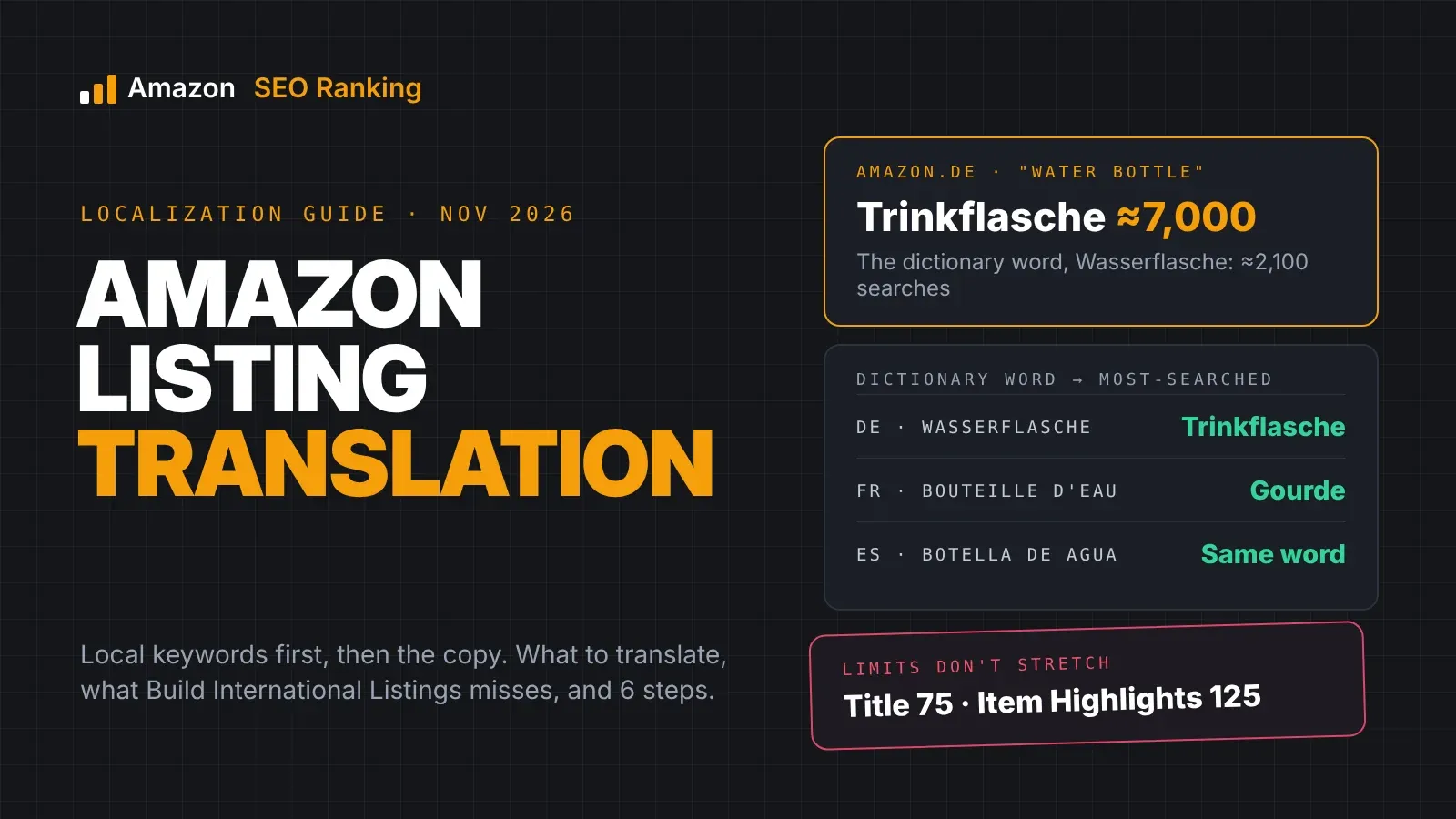
The part most sellers get wrong is the keyword. We checked Amazon search volume for a water bottle in three storefronts on 19 November 2026. In Germany, the dictionary word "Wasserflasche" gets about 2,100 searches a month, while "Trinkflasche" gets about 7,000. In France, "bouteille d'eau" gets about 3,300 and "gourde" about 8,100. A correct translation can still miss most of the searches.
This guide covers what to translate, what Amazon's Build International Listings tool does and doesn't do, how to choose between machine translation, a translator and a mix of both, and six steps to localize one listing, with a worked German example checked for length and claims. It's written for sellers, brand teams and agencies taking a live listing into a new storefront.
Key Takeaways (TL;DR)
- Amazon requires listings in the local language of each store. English copy on amazon.de or amazon.co.jp is a listing most shoppers won't read or find.
- Research keywords in the target language first, then write. Our checks found the most-searched term for a water bottle differs from the dictionary word in Germany and France.
- Build International Listings (BIL) is free and machine-translates some fields, but Amazon says it doesn't guarantee new product detail pages, and it doesn't list A+ Content or text in images among what it translates.
- German and French copy usually runs longer than English. Our German Item Highlights came out at 126 characters from a 118-character English line, one over the 125 limit.
- Backend search terms are counted in bytes. Each "ü" or "é" takes 2 bytes, and each Japanese character takes 3.
- Convert units, sizes and formats (oz to ml, inches to cm, US sizes to EU sizes) and check every claim against the target store's rules.
- Translate each storefront separately. A listing that scores well in the US can lose points on amazon.de for reasons the US audit never shows.
Amazon Listing Translation: at a Glance
| Question | Answer |
|---|---|
| Is translation required? | Yes. Amazon requires detail pages in the local language of each store |
| What to translate | Title, Item Highlights, bullets, description, backend search terms, A+ Content, text in images |
| What to keep | Brand name, model numbers, SKUs |
| What to convert | Units, sizes, currency, date formats |
| Amazon's free tool | Build International Listings (machine translation, offer sync) |
| What BIL doesn't cover | A+ Content and image text aren't among what Amazon lists; new detail pages aren't guaranteed |
| Paid help | Translators in Amazon's Service Provider Network, or your own |
| Biggest ranking risk | Translating keywords word for word instead of researching local searches |
| Length risk | German and French copy runs longer; limits stay at 75 (title) and 125 (Item Highlights) |
| Byte risk | Accented letters use 2 bytes, Japanese characters 3, against the 249-byte backend limit |
Why Amazon Listing Translation Needs Local Keywords
Amazon search matches what shoppers type. A translator gives you the correct word, and the correct word is often the less-searched one. That's why keyword research comes before translation in every step list below.
What our keyword checks showed
On 19 November 2026 we ran the obvious translations of "water bottle" through Amazon SEO Ranking's keyword tool, which returns estimated monthly Amazon searches per storefront. The volumes are estimates, rounded by Amazon's data provider.
| Storefront | Dictionary translation | Est. monthly searches | Most-searched term we found | Est. monthly searches |
|---|---|---|---|---|
| amazon.de | Wasserflasche | ≈2,100 | Trinkflasche | ≈7,000 |
| amazon.fr | bouteille d'eau | ≈3,300 | gourde | ≈8,100 |
| amazon.es | botella de agua | ≈3,500 | botella de agua | ≈3,500 |
In Spain the dictionary term wins, and "cantimplora" (canteen) is a distant second at about 1,100. In Germany and France the dictionary term loses by a factor of 2.5 to 3.3. You can't tell which case you're in without checking. The English phrase "water bottle" also shows up at about 900 searches in both Germany and France, which makes it a candidate for backend search terms rather than the title.
Modifiers shift too. "Trinkflasche Edelstahl" (stainless steel) gets about 1,350 searches on amazon.de, while "Wasserflasche Edelstahl" gets about 70. A listing built on the dictionary word loses on the long-tail phrase as well.
Why shoppers skip untranslated listings
Language affects whether shoppers buy at all. CSA Research surveyed 8,709 consumers in 29 countries and found that 76% of online shoppers prefer to buy products with information in their native language, and 40% will never buy from websites in other languages.
Amazon makes a similar point in its own guide, noting that less than a third of the world speaks English. On a store like amazon.co.jp or amazon.com.tr, an English title is unreadable to most shoppers, and it can't match their searches either.
Which Parts of an Amazon Listing to Translate
Every field a shopper reads, and every field Amazon indexes, needs a local version. They don't all need the same treatment.
| Field | Translate? | What to watch |
|---|---|---|
| Title | Yes | 75-character limit; local head term early; brand first |
| Item Highlights | Yes | 125 characters; German and French run long |
| Bullet points | Yes | Under 255 characters each (200 shows in full on mobile) |
| Description | Yes | Local units and sizing |
| Backend search terms | Rewrite from local research | 249 bytes; local synonyms, misspellings, English terms shoppers use |
| A+ Content and Brand Story | Yes, separately | Set up per storefront |
| Text in images and video | Yes | Infographics with English text stay English unless you replace them |
| Brand name, model numbers, SKUs | No | Keep them identical everywhere |
| Customer reviews | No | Amazon says reviews in many cases carry over and are automatically translated |
Backend search terms get rewritten
Translating your US backend terms line by line copies English keyword logic into another language. Build the field from the target store's keyword research instead: local synonyms, common misspellings, and any English terms local shoppers use (like "water bottle" on amazon.de).
Bytes matter more here than in English. Our guide to Amazon search terms covers the 249-byte limit, and in other languages it fills faster. "Ü" takes 2 bytes. A Japanese string of 21 characters we tested took 53 bytes, so the same field holds roughly 80 Japanese characters. The free Amazon backend keywords checker counts bytes, not characters, with no account.
A+ Content and images need their own pass
Amazon's guide says a professional service can translate the full listing, including A+ Content, and it lists text in images and videos as something to translate. An infographic that says "BPA-free, 20 oz, leak-proof" in English stays that way on amazon.de until you upload a German version.
Images also carry units. A size chart in inches or a capacity badge in ounces is a small conversion that's easy to miss, and it's the first thing a European shopper checks.
Build International Listings: What Amazon's Tool Does
Build International Listings is the free Seller Central tool most sellers try first. Amazon describes it as a way to create and update offers for multiple target stores from a single source store, managed from one place, with machine-generated translations for some content.
What it handles
BIL connects a source store (say amazon.com) to target stores (amazon.de, amazon.fr) and keeps offers and prices in step. Amazon's global expansion guide says that in many cases, the tool will also automatically translate new listings into the local language, and that it can synchronize prices across stores.
To use it you need a Professional selling account, a North America Unified Account for North America, and linked accounts between regions if you're crossing regions.
What it doesn't guarantee
Amazon's help page states that Build International Listings does not guarantee the creation of new product detail pages. Sellers on the forums report the practical side of that: when the ASIN doesn't exist in the target store, BIL may only match your offer to existing listings and translate nothing.
Quality is the second limit. Amazon's own guide warns that machine translation may miss the right keywords, local search terms or dialect, and positions BIL for getting started and smaller projects. The Trinkflasche example above is that warning in numbers: a machine picks the dictionary word.
The third is control. Sellers describe changes in the source store flowing out to every target store, and Amazon's help notes that deleting a duplicated listing by hand won't stop BIL from recreating it; you exclude the SKU in the tool instead. If you hand-translate a listing, decide whether BIL still manages it.
Machine Translation, Translators or Both
There are three ways to produce the copy. The right one depends on how much a listing sells and how many storefronts you're adding.
| Approach | Cost | Speed | Uses the live listing's facts | Limits and claims checked | Best for |
|---|---|---|---|---|---|
| Build International Listings | Free | Fast | Copies source text | No | Long-tail SKUs, testing a store |
| Professional translator | Per word or per listing | Days | Only what you send them | By hand, if briefed | Best sellers, regulated categories |
| General AI assistant | Low | Minutes | No, works from pasted text | No, miscounts characters | First ideas only |
| Amazon SEO Ranking rewrite + native read | Free to try | Minutes per listing | Yes, spec table and brand fact sheet | Yes, in code before you see it | Most catalogs |
Amazon listing translation services
Amazon listing translation services range from freelance translators to agencies. Amazon's Service Provider Network lists vetted translation providers you can filter by language, with reviews. Amazon notes that providers price per word or per listing, and some offer bulk rates.
When you brief one, ask for a track record with Amazon listings and local SEO knowledge, which is Amazon's own advice; its example is "cookies" versus "biscuits". Send them the keyword list from step 2 below, the field limits and a glossary of terms that stay in English.
AI drafts
A general AI assistant writes fluent German, but it doesn't see your live listing, your spec table or Amazon search volume. It also tends to keep the English structure, so lengths overrun, and it will add claims the product can't back.
Amazon SEO Ranking's rewriter starts from the live listing instead. It reads the spec table (material, capacity, unit count) as the source of truth, applies your brand fact sheet, and writes in the marketplace's language (12 languages, Belgium in French). Before you see the draft, it's checked in code for the 75 and 125-character limits, pack-count mismatches and unsupported claims. A native speaker then reads it once for tone and local word choice, which is a far shorter job than translating from scratch.
How to Translate an Amazon Listing in 6 Steps
These steps take one listing from a US original to a live, checked version in a new storefront. On a catalog, run steps 1, 5 and 6 in bulk.
Step 1: Fix and audit the source listing
Translation copies problems as well as copy. If the US title is over 75 characters, or a bullet claims "20 packets" on an 8-count box, every translation inherits it. Amazon's own guide recommends starting with a strong listing in your home-store language.
An Amazon listing quality checker scores the live listing on 12 equally weighted criteria, with every pass rule published, and runs consistency checks for pack counts and unsupported claims. Fix what fails first, then audit the same ASIN on the target storefront if it already exists there. A listing optimized for amazon.com isn't automatically optimized for amazon.de or amazon.co.jp: the score and the fixes are worked out per storefront, and Amazon SEO Ranking audits all 23. Checking only your home store leaves you without a read on every other store you list in.
Step 2: Research keywords in the target language
List the head term and the attributes shoppers filter by, then gather candidate words for each: the dictionary translation, synonyms a native speaker or a local rival listing would use (Trinkflasche, gourde), and any English terms locals type. Then check which candidate gets searched most in the target store.
The Amazon keyword research tool checks estimated Amazon search volume for up to 1,000 phrases at once in 16 storefronts: the US, Canada, Mexico, the UK, Germany, France, Italy, Spain, the Netherlands, the UAE, Saudi Arabia, Egypt, India, Singapore, Australia and Austria. You bring the candidates and it tells you which one shoppers type, which is how we found Trinkflasche beating Wasserflasche. A free account sees the first 3 results of each search. Its keyword ideas tool, which suggests related terms, covers the US, Egypt, Saudi Arabia and the UAE.
For storefronts without search volume data (Japan, Brazil, Sweden, Poland, Turkey, Belgium, Ireland and South Africa), read the listings you'll compete with. Competitor Compare, on every plan including Free, runs the same 12-criteria audit on your listing and up to two local rivals in any of the 23 storefronts, and shows their titles side by side with the categories where they beat you. The words the top local listings put first in their titles are your best candidates. Pick one head term for the title.
Step 3: Translate field by field, keywords first
Write the title around the local head term, in the order brand, product type, key attribute, size or color. Then write Item Highlights with the comparison details, the bullets, the description, and last the backend terms with whatever the visible copy didn't hold.
If you'd rather start from a draft, the Amazon listing rewriter writes the title, Item Highlights, bullets, description and backend terms in the storefront's language from the live listing, with your target keyword placed early in the title. Localized rewrites are on the free plan.
Expect overruns either way. Our 118-character English Item Highlights translated to 126 characters in German. Cut a use case before a spec, and keep one copy of each keyword across fields. Our guide to Amazon Item Highlights covers what belongs in that line.
Step 4: Localize the facts
Convert every number a shopper compares on:
- capacity and weight to metric (20 fl oz is about 591 ml);
- dimensions to centimetres;
- clothing and shoe sizes to the local size system;
- voltage and plug type for electronics.
Claims need a second look too. Health, safety and environmental wording that passes on amazon.com can need different evidence in another market. Keep claims to what your spec table and documentation support, in every language.
Write those limits down once. Amazon SEO Ranking's brand fact sheet holds your approved facts, banned claims and market rules, and it's applied to every rewrite, Ask AI edit and bulk run, in whatever language the rewrite comes back in. A claim you've banned for the EU stays out of the German, French and Italian versions without anyone re-checking each one.
Step 5: Check limits, bytes and claims, then score a draft
Paste the translated title, Item Highlights, bullets and description into the free Amazon listing requirements and character limits checker. It counts each field as you type and flags promotional words, ALL CAPS, symbols and health claims, with no account. Check backend terms for bytes separately.
If the ASIN is already live in the target store, Amazon SEO Ranking's draft audit scores pasted copy against that listing's images, rating and Prime status before you publish, using one audit, with the claim check and, on Pro and Agency, the AI compliance scan. If the listing isn't live there yet, there's nothing to score against, so rely on the character checks and the claim check that runs on every rewrite, then audit the listing once it's up.
Step 6: Publish, then verify indexing
Upload through Seller Central for the target store, or through a flat file for several listings. For a catalog, the Amazon bulk listing tool audits and rewrites up to 100 ASINs per run on Pro and 500 on Agency, each row in its own marketplace's language, with a claim check column on every draft. If BIL manages the SKU, decide whether to exclude it so later source changes don't replace your local version.
Then confirm the keywords count: search the target store for your ASIN plus a phrase that appears only in your translated copy. If the product comes back, the phrase is indexed. Recheck after any change to the source listing.
Worked Example: Localizing a US Listing for amazon.de
The fictional Trailpup dog water bottle is a US listing that passes every check in English:
Title (75): Trailpup Insulated Dog Water Bottle with Bowl, Spill-Resistant, 20 oz, Blue
Item Highlights (118): Stainless steel, one-hand pour and refill, fits car cup holders and backpack pockets, for hiking, walks and road trips
The literal translation
A word-for-word German title comes out like this:
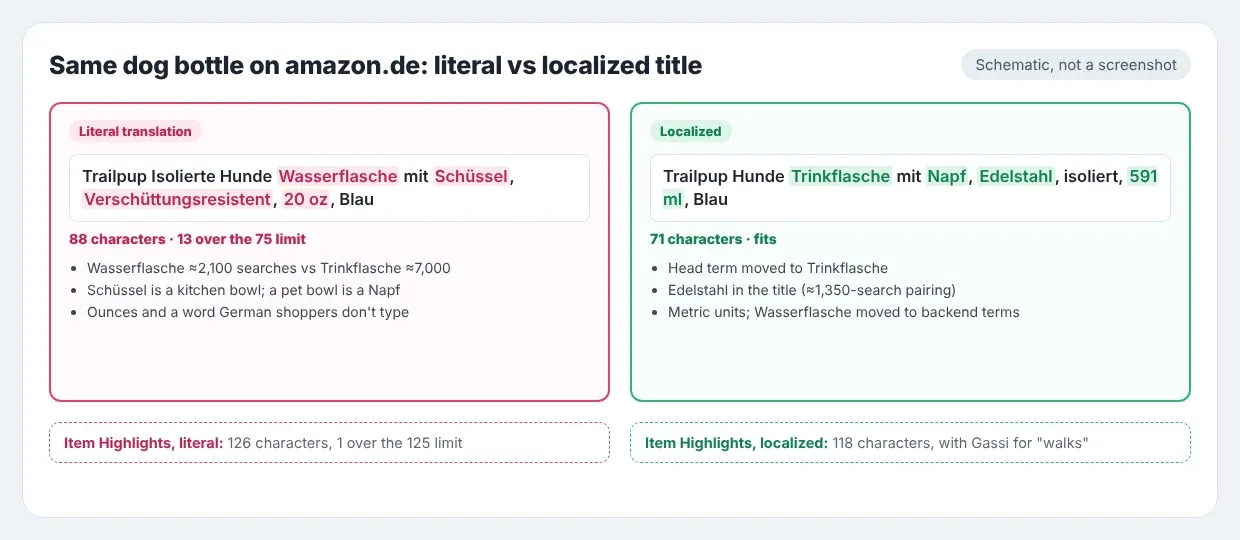
Trailpup Isolierte Hunde Wasserflasche mit Schüssel, Verschüttungsresistent, 20 oz, Blau
It's 88 characters, 13 over the limit. It uses "Wasserflasche" (≈2,100 searches) instead of "Trinkflasche" (≈7,000), "Schüssel" (a kitchen bowl) instead of "Napf" (a pet bowl), a literal "Verschüttungsresistent" German shoppers don't type, and ounces. The literal Item Highlights came to 126 characters, one over 125.
The localized version
Title (71): Trailpup Hunde Trinkflasche mit Napf, Edelstahl, isoliert, 591 ml, Blau
Item Highlights (118): Einhändig ausgießen und nachfüllen, passt in Autogetränkehalter und Rucksackfächer, für Wandern, Gassi und Autofahrten
Backend terms (fits well under 249 bytes): hundeflasche reiseflasche hund wanderflasche hundenapf unterwegs wasserflasche thermosflasche
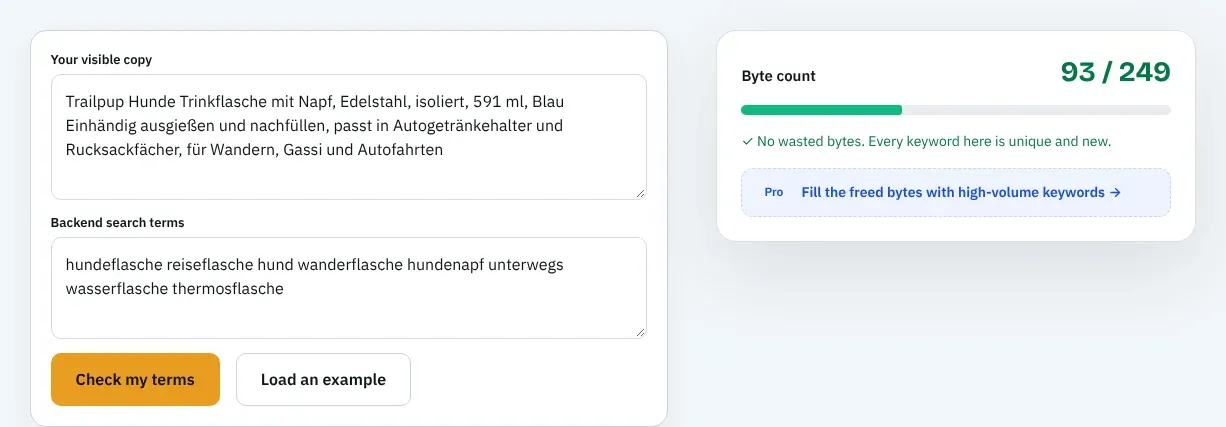
We ran it through the claim and length checks Amazon SEO Ranking runs on every rewrite (here through the Claude connector's check_listing_copy tool) on 19 November 2026, with a spec table of stainless steel, 591 ml, blue and insulated. Both fields passed the length checks, the claim check found nothing unsupported, and the AI compliance scan returned no flags.
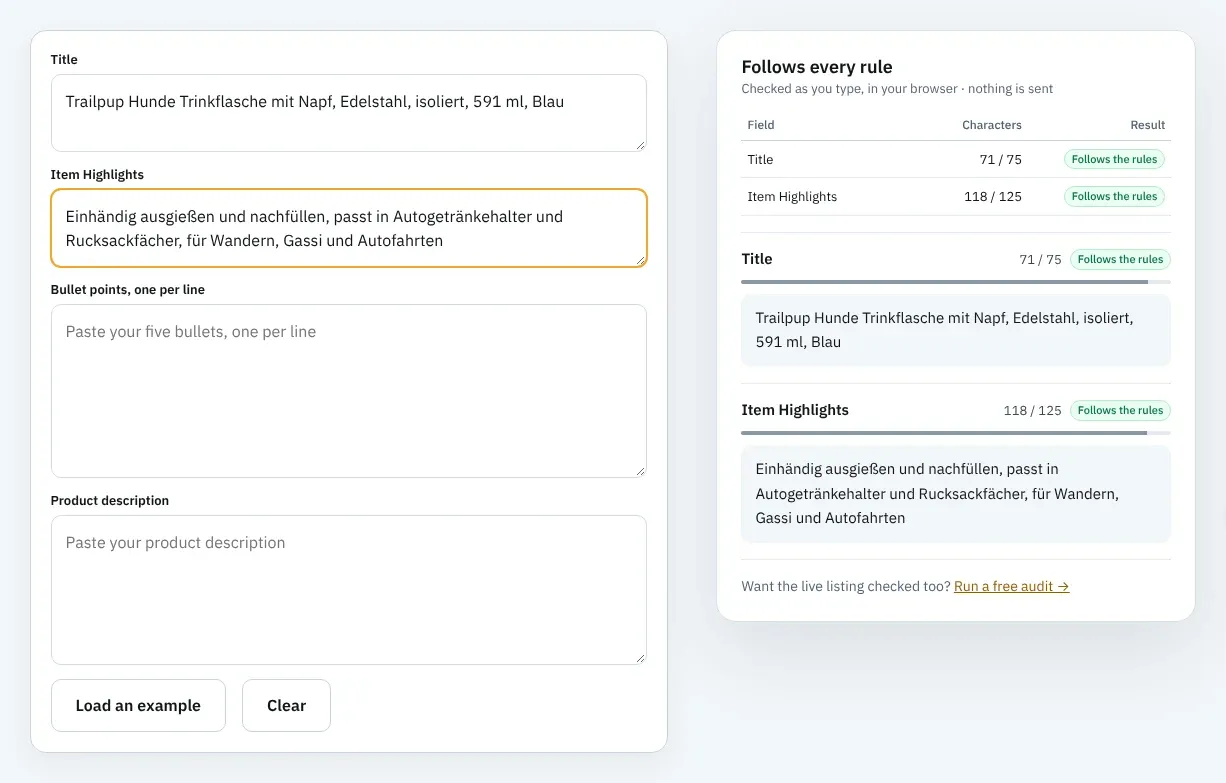
The changes that mattered: the head term moved to "Trinkflasche", "Edelstahl" moved into the title because of its ≈1,350-search pairing, "Gassi" (the everyday German word for walking a dog) replaced a translated "walks", and "Wasserflasche" went to the backend, where it still catches its ≈2,100 searches without taking title space. The highlight also drops "Edelstahl" because the title already holds it.
Amazon Global Selling: Languages by Storefront
Amazon Global Selling covers stores across the Americas, Europe, Asia-Pacific and the Middle East and Africa. Each store has a main shopping language, and some show more than one.
| Region | Storefronts | Language to write in |
|---|---|---|
| North America | US, Canada, Mexico | English; English (French also shown in Canada); Spanish |
| South America | Brazil | Portuguese |
| Europe | UK, Ireland | English |
| Europe | Germany, France, Italy, Spain | German, French, Italian, Spanish |
| Europe | Netherlands, Belgium | Dutch; French and Dutch |
| Europe | Sweden, Poland, Turkey | Swedish, Polish, Turkish |
| Middle East and Africa | UAE, Saudi Arabia, Egypt | Arabic and English |
| Middle East and Africa | South Africa | English |
| Asia-Pacific | India, Singapore, Australia | English |
| Asia-Pacific | Japan | Japanese |
English-language storefronts still need localization. UK and Australian shoppers spell "colour" and "aluminium", and Amazon's own example of a local search term is "biscuits" versus "cookies". Keyword research in step 2 catches these as well.
Common Amazon Product Listing Translation Mistakes
These are the issues we see most when a listing moves storefronts. Most of them come from treating translation as a one-time copy job.
- Translating keywords from a dictionary. The Trinkflasche and gourde cases above cost a listing most of its head-term searches.
- Keeping ounces, inches and US sizes. European shoppers compare in ml, cm and EU sizes.
- Ignoring length. A 75-character English title can become 88 characters in German.
- Counting backend terms in characters. Accented and Japanese characters use 2 to 3 bytes each.
- Forgetting images and A+ Content. The text in an English infographic stays English.
- Translating brand and model names. They should match across every store.
- Letting the source overwrite the target. A hand-translated listing still managed by BIL can change when the US copy does.
- Auditing only the home store. The score, and the fixes, differ per marketplace.
Everything You Need to Know About Amazon Listing Translation
| Topic | What to know | Rule or number |
|---|---|---|
| Requirement | Local language in every store | Amazon's rule |
| Shopper preference | Prefer product info in their own language | 76% (CSA Research, 2020) |
| Keyword research | Before translation, per storefront | Dictionary word lost 2.5x to 3.3x in DE and FR |
| Title | Local head term early, brand first | 75 characters |
| Item Highlights | Expect overruns in German and French | 125 characters |
| Bullets | Five, translated | Up to 255 each; 200 shows in full on mobile |
| Backend terms | Rewrite from local research | 249 bytes; ü = 2 bytes, Japanese = 3 |
| Units | Convert to local formats | 20 fl oz ≈ 591 ml |
| BIL | Free, machine translation, offer sync | No guarantee of new detail pages |
| BIL control | Exclude SKUs you translate by hand | Per Amazon's help |
| Paid help | Service Provider Network or your own translator | Priced per word or listing |
| A+ and images | Localize separately | Per storefront |
| Verification | Search ASIN plus a phrase only in your copy | After every change |
Localize Your Listings With Amazon SEO Ranking
Amazon SEO Ranking audits a live listing on 23 Amazon storefronts against 12 published criteria, so you see what a listing loses in each store, including amazon.de and amazon.co.jp. Its rewrites come back in the marketplace's own language (12 languages, Belgium in French), grounded in the listing's spec table and your brand fact sheet, with your local target keyword placed early in the title. Every rewrite is checked in code for the 75 and 125-character limits, pack-count mismatches and unsupported claims before you see it, and you can score it as a draft before it goes live.
It's built for sellers expanding a proven listing into new Amazon storefronts, brand teams managing one product across several countries, and agencies localizing client catalogs. Bulk Optimization audits and rewrites up to 500 ASINs per run on Agency, each row in its own marketplace's language. It's trusted by eRetail Search specialists at Nestlé and eCommerce SEO agencies such as Reach AI.
Every day a listing sits in English on a German or Japanese store, it's missing the searches shoppers type there. The free plan includes 3 full audits a month with no credit card required. Monthly Pro is $79 with a 7-day free trial and search volume in 16 storefronts.
FAQ
What is Amazon listing translation?
Amazon listing translation is rewriting a product listing's title, Item Highlights, bullets, description and backend search terms in the language of another Amazon storefront. Amazon requires detail pages in the local language of each country-based store. Good translation also swaps in the keywords local shoppers search for, which often differ from dictionary words. On amazon.de, "Trinkflasche" gets about 7,000 monthly searches against about 2,100 for the literal "Wasserflasche".
Does Amazon translate listings automatically?
Amazon translates listings automatically in some cases, through the free Build International Listings tool in Seller Central. Amazon's help says the tool attempts to translate and create detail pages in target stores, but doesn't guarantee new product detail pages. Translations are machine-generated, and Amazon itself warns they may miss local keywords. A+ Content and text in images aren't among what Amazon lists it translating, so plan to localize them separately.
How do I translate my Amazon listing for other marketplaces?
You translate your Amazon listing for other marketplaces by researching keywords in the target language first, then rewriting each field around those keywords. Fix the source listing before you start, so errors don't spread to every storefront. Convert units such as ounces to millilitres, and keep brand and model names unchanged. Check the 75-character title, 125-character Item Highlights and 249-byte backend limits, then confirm indexing by searching your ASIN with a translated phrase.
How much do Amazon listing translation services cost?
Amazon listing translation services are priced per word or per listing, according to Amazon's own guide, and some providers offer bulk rates. Amazon's Service Provider Network lists vetted translators you can filter by language and compare by verified reviews. Build International Listings is free but uses machine translation. A common middle route is an AI draft built on local keyword research, reviewed by a native speaker for the listings that sell most.
Do I need to translate backend search terms on Amazon?
You need to rewrite backend search terms for each Amazon storefront rather than translate them line by line. Build the field from the target store's keyword research: local synonyms, misspellings and English terms local shoppers use. The limit is 249 bytes, and accented letters such as "ü" use 2 bytes while Japanese characters use 3. A 21-character Japanese phrase we tested took 53 bytes.
Do I need to translate my listing for the UK or Australia?
You don't need to translate a US listing for amazon.co.uk or amazon.com.au, but you should localize spelling, units and keywords. UK and Australian shoppers write "colour" and "aluminium", and Amazon's own example of a local term is "biscuits" versus "cookies". The 75-character title and 125-character Item Highlights limits apply the same way. Run keyword research for the storefront before reusing US backend terms.
Which Amazon marketplaces need a different language?
The Amazon marketplaces that need a different language from English include Germany, France, Italy, Spain, the Netherlands, Belgium, Sweden, Poland, Turkey, Japan, Mexico and Brazil. Belgium shows French and Dutch, and the UAE, Saudi Arabia and Egypt show Arabic and English. The US, UK, Ireland, Canada, Australia, India, Singapore and South Africa use English. Canada also shows French.
Is machine translation good enough for Amazon listings?
Machine translation is good enough for a first draft of an Amazon listing, but not for publishing without a keyword check and a native read. Amazon's own guide says machine translation may miss the right keywords, local search terms or dialect. In our German example, a literal translation ran 13 characters over the title limit and used the less-searched head term. Machine translation suits long-tail SKUs; best sellers repay a reviewed version.
Run a free audit on the storefront you're entering, or compare Pro and Agency pricing.
Run a free audit on your target storefront