Amazon SEO & Algorithm
Amazon SEO in 2026: The Complete Guide to Ranking Your Products
There's no single "Amazon algorithm" to satisfy. There's a relevance check that decides whether you're shown at all, and a performance score that decides where you land once you are. This guide maps every factor that feeds either one, title and keywords, conversion rate, reviews, price, Buy Box, stock, external traffic, and Amazon's AI layers, so you know which lever to pull instead of guessing.
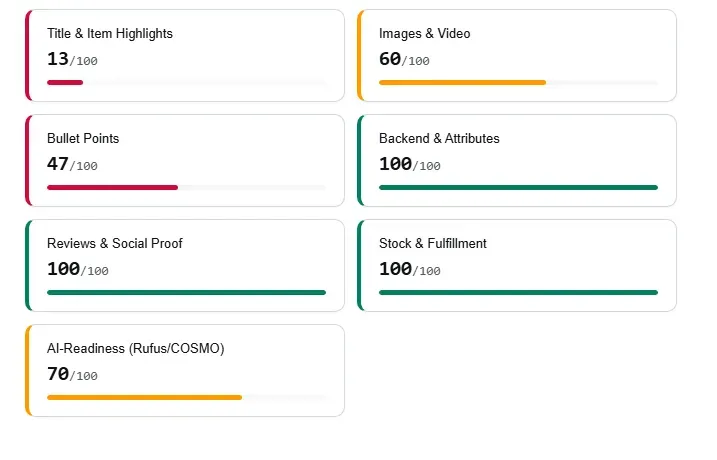
If you want the mechanics of how those two stages actually work, what "indexed" means, why repeating a keyword buys nothing, that's covered in full in How Amazon Actually Ranks Listings. This guide stays at factor level: what moves the needle, how much, and what to act on today.
The two checks every listing has to pass
Think of it as a gate, then a queue. The gate is retrieval: pure text matching against your indexed content. If a shopper's search term isn't in your title, bullets, description or backend terms, you're not in the result set, full stop. The queue is ranking: once you clear the gate, Amazon orders everyone who did using behavioural signals such as conversion rate, sales velocity, reviews, price, and fulfilment speed.
Every factor below sits in one of those two stages. Keywords control the gate. Everything else controls your position in the queue.
The ranking factors that actually move you
Title and keyword relevance
This is the gate. Titles are capped at 75 characters in most categories now, which is roughly half what sellers used to write; see Amazon's 75-Character Title Limit for the full rule. What matters for ranking specifically: every word you want to be found for has to appear somewhere in your indexed content, once. Overflow keywords belong in Item Highlights or the 249-byte backend field, not repeated in visible copy. The Backend Terms Checker shows you which of those bytes are currently doing nothing.
Conversion rate
This is the biggest single input to the ranking stage, and the one sellers most often try to fix indirectly. It's a lagging signal: it responds to better images, a clearer title and stronger bullets, but only after traffic has flowed through the new version for a while. There's no way to raise it directly; you raise the content and wait for the number to follow. Does Conversion Rate Affect Ranking? covers what it actually measures and what moves it.
Reviews and star rating
Review count and rating do two jobs at once: they're a ranking input in their own right, and they're one of the strongest levers on conversion rate, which is itself a ranking input. A rating trending down is worth investigating before you touch anything else, since it depresses both signals simultaneously. The fix is never to manufacture reviews; it's to find and fix whatever's generating the negative ones. More on the review-specific mechanics in Do Amazon Reviews Affect Ranking?
Price and Buy Box
Price feeds ranking mainly through Buy Box eligibility, not through being the cheapest option on the page. Losing the Buy Box is the expensive outcome: in most categories, only the Buy Box winner appears in search and category browse results at all, regardless of how well the listing itself is written. You don't need to undercut every competitor; you need to stay inside the range that keeps you eligible. How Price, Buy Box, and Stock Affect Ranking goes deeper on all three.
Stock and fulfilment speed
Going out of stock doesn't lower your rank; it removes you from results entirely, and a new listing has to rebuild its behavioural history once stock returns. Fulfilment speed matters too: the Prime badge is both a trust signal that lifts conversion and a factor Amazon weighs directly, which is why FBA and Seller Fulfilled Prime listings routinely outrank identical merchant-fulfilled ones. The same price, Buy Box, and stock guide covers this in full.
External traffic
Traffic from ads, social or your own site that converts on Amazon feeds the same sales-velocity signal as traffic that started on Amazon, so it's a real lever, not a myth. Treat it as a secondary one, though: it can't fix a listing that fails retrieval, since no volume of outside clicks makes Amazon index a keyword that isn't in your content. For a listing that's already indexed and converting, external demand adds real weight on top. Does External Traffic Help You Rank? covers when it's worth doing.
Amazon's AI layers: Rufus and COSMO
Rufus and COSMO read and summarise listings rather than only matching keywords, and that's changing what "relevant" means. A listing that's a wall of keyword fragments is hard for a model to quote from; a listing written in plain, factual sentences, who it's for, what it's made of, when to use it, is easy to quote and easy to match against a shopper's actual question. Structured facts win over keyword density here, and the shift is covered in more depth in the ranking mechanics guide and in How Rufus and COSMO Are Changing Amazon SEO.
What you control now vs. what you earn later
- Editable today: title, bullets, description, backend terms, images, A+ Content. Every factor here is a listing edit, not a waiting game.
- Earned over time: conversion rate, sales velocity, review count and rating. These move only in response to changes in the first group, and only after traffic has had time to pass through.
Most wasted effort goes into chasing the second bucket directly, discounting to drive velocity, soliciting reviews, while a fixable problem in the first bucket quietly caps how much traffic ever arrives to convert.
A 2026 ranking checklist
- Confirm your title is inside the 75-character limit with no promotional language or decorative characters.
- Fill the 249-byte backend field with terms that don't already appear anywhere in your visible copy.
- Check you have at least seven images, and A+ Content if your brand is enrolled.
- Confirm you currently hold the Buy Box. A suppressed or lost Buy Box caps visibility no matter how good the content is.
- Look at your last 90 days of reviews and see whether the rating is trending up or down.
- Rewrite at least one section in plain, factual sentences an AI assistant could quote directly.
Checking that list once is a start; checking it the same way every month is what actually moves a score over time. For how to run that as a repeatable process, see how to audit an Amazon listing for SEO.
FAQ
How many keywords should an Amazon title include?
There's no target number. Amazon indexes words, not keyword count, so repeating a term already in your title elsewhere in the listing adds nothing. Fit your brand, product type and one differentiating attribute inside the 75-character limit, then move any remaining terms to backend search terms or Item Highlights, where Amazon still indexes them.
Do reviews matter more than keywords for ranking?
They answer different questions. Keywords decide whether you're retrieved for a search at all; reviews and rating feed the performance score that decides where you land once you're in that set. A five-star listing that isn't indexed for a term still won't show up for it, and a well-indexed listing with a poor rating will show up low. You need both, but keywords come first, because nothing else matters if you're never retrieved.
Does external traffic help you rank on Amazon?
It can, but treat it as a secondary lever. Traffic from ads, social or your own site that converts on Amazon feeds the same sales-velocity signal as on-platform traffic. It won't fix a listing that fails retrieval, since no amount of external clicks makes Amazon index a keyword that isn't in your content, but for a listing that's already indexed and converting, external demand adds real weight.
Does price affect organic ranking, or just the Buy Box?
Both. Price competitiveness is one of the inputs to Buy Box eligibility, and losing the Buy Box removes most of your visibility outright, since in many categories only the Buy Box winner appears in search and category results at all. Being drastically cheaper than competitors isn't required, but being priced far enough outside the competitive range to lose the Buy Box will cost you rank regardless of how well the rest of the listing is written.
What is Amazon's A10 algorithm, exactly?
A10 is the informal name sellers and agencies use for Amazon's current ranking system. Amazon doesn't publish an official version number. In practice it refers to the two-stage model this guide covers: a relevance check against your indexed content, followed by a ranking pass driven by conversion rate, sales velocity, price, reviews and fulfilment speed, increasingly layered with AI systems like Rufus and COSMO that read and summarise listings rather than only matching keywords.
Paste any ASIN and see which of these factors your listing is actually failing, scored against all 12 ranking criteria with AI-written fixes for anything that breaks a rule.
Audit a listing freeMore from the blog